What are AI Call Center Agents and how do they work? 2026 Guide
Date
Sep 25, 26
Reading Time
9 Minutes
Category
AI Voice Agents
Share


TL;DR
- An AI call center agent either takes the call itself or feeds the human rep what they need while the call's happening. People use the same name for both, so ask which one you're actually being sold.
- It lives inside the whole call path. Phone line, speech recognition, the model doing the reasoning, your CRM and other tools, who the call gets routed to, what happens once it hangs up.
- Four jobs. Talk to the caller directly. Help the rep who's on with them. Decide who gets the call in the first place. Review it after it's over.
- Start it on the boring stuff. Order status, booking, balance checks, the after-hours call nobody wants to take at 2am.
- Keep refunds, disputes, and anyone who sounds upset on the human side, at least until those paths get tested on their own.
- Track containment by intent instead of one big number, and watch latency and dead air, not just average handle time.
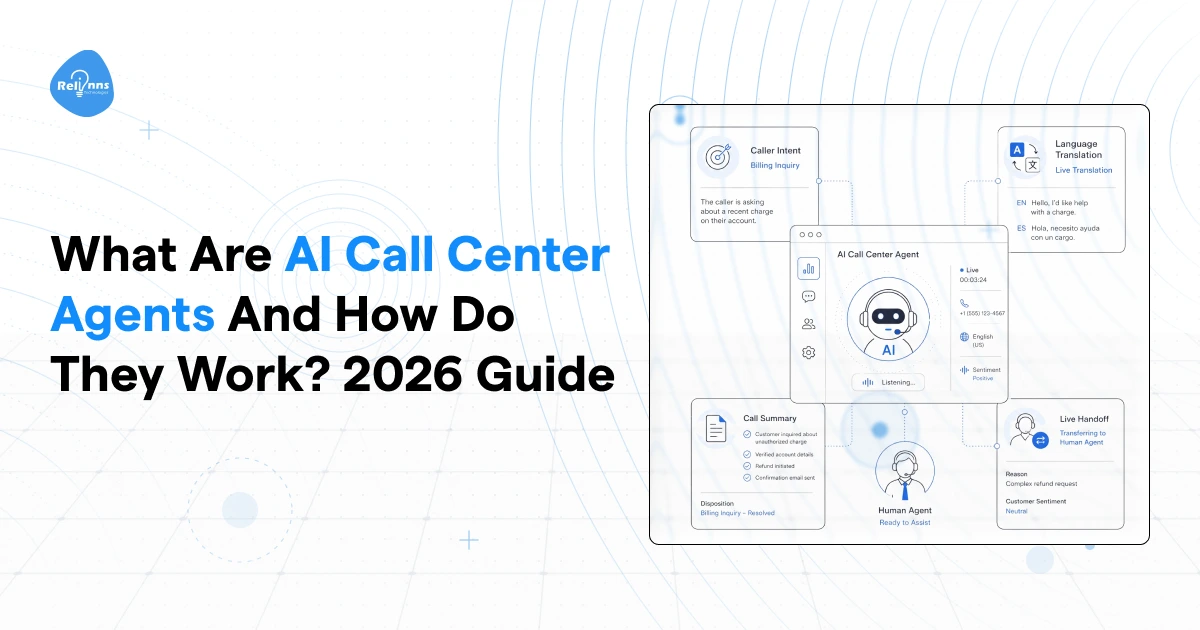
An AI call center agent is software that either takes the call itself or works alongside the human who's taking it. It listens to what the caller wants, checks your CRM or order system for the real answer, and either finishes the job or hands it to a person with everything it learned attached. No repeating yourself. No sitting on hold while someone digs through three different tools.
Most call center leads already know which calls they'd hand off to AI without blinking. Order status. Appointment changes. "Did my payment go through?" Low stakes, the kind of call that's a lookup with extra steps.
The harder question is what happens on the call that goes sideways. A caller with an accent the model keeps mishearing. A CRM that times out mid-call. Or someone who wants a person and ends up explaining the whole thing again because nothing got passed along. That call decides whether the deployment sticks around or gets switched off in month two.
Gartner's number gets quoted constantly: agentic AI resolving 80% of common customer service issues without a human by 2029. Read that twice.
"Common" carries a lot of weight in that sentence. It's easy to hear "80%" and assume the rest sorts itself out. It doesn't.
The other 20%, the messy calls, are what decide whether a deployment earns its keep.
And that's where things get slippery. Ask five vendors what an "AI call center agent" is and you'll get five different answers, sometimes describing completely different products. Worth untangling before you buy anything.
What Is an AI Call Center Agent?
An AI call center agent is AI that takes part in a live customer call, either by handling it directly or by helping the human who is. Vendors use one label for both, and honestly, that's on them, not you. Two demos with the same name can show you two completely different products.
| Form | What it does | Who's on the call | Example |
|---|---|---|---|
| Autonomous agent | Answers or places calls and completes defined tasks | AI, with a human on escalation | Reschedules an appointment and updates the calendar |
| Assistive agent (agent assist, AI copilot) | Listens to live calls, surfaces answers, drafts notes | A human, with AI support | Pulls the refund policy while the rep is still talking |
Traditional IVR systems read from a fixed menu. Basic chatbots answer preset questions off a script. An AI call center agent reads context, catches when someone's tone shifts mid-call, and acts inside your CRM, order database, or scheduler as the conversation happens.
What it can do that the older tools couldn't:
- Understand what someone wants even when they don't say it outright
- Pull live data from your systems for a real answer, not a guess
- Hand off to a human with the whole conversation already loaded, nothing left to repeat
"A rule-based bot tells you the return policy. An AI agent processes the return."
The terms here blur fast, so it's worth pulling them apart.
AI Call Center Agent vs Contact Center AI vs Voice Agent vs Agent Assist
These four terms overlap, but they answer different buying questions, and mixing them up is how teams end up with the wrong product.
| Term | What it covers | Channels | The question it answers |
|---|---|---|---|
| AI call center agent | AI inside phone operations, autonomous or assistive | Phone first | Can AI answer or support our calls? |
| AI contact center agent / contact center AI | The same idea across every service channel | Phone, chat, email, WhatsApp, social | Can one AI layer cover all channels? |
| AI voice agent | Voice AI that holds spoken conversations, inside or outside a call center | Phone, web, apps, devices | Can AI talk to people naturally? |
| Agent assist / AI copilot | AI that supports a human rep and never speaks to the customer | The rep's screen | Can AI make our reps faster? |
| IVR | Menu-based phone routing | Phone | "Press 1 for billing" |
| Rule-based chatbot | Predefined text flows | Web, messaging | Can we deflect FAQs? |
Traditional rule-based chatbots follow predefined flows. Customer says X, bot says Y, every time. LLM-based ones, like what runs BotPenguin's chat side, can call tools and hold context through a whole conversation. The real line between a chatbot and an agent comes down to what it's allowed to do, not which channel it happens to sit on.
For the voice side of this category, our guide on AI voice agents goes deeper.
How an AI Call Center Agent Works Inside a Call Center
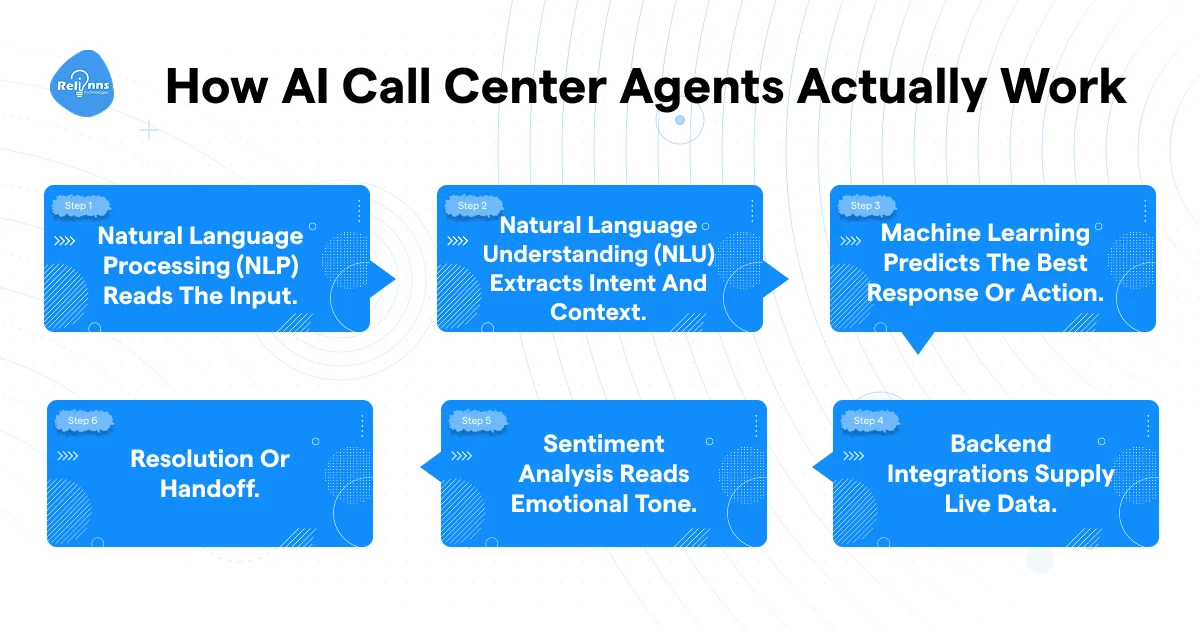
An AI call center agent sits in the same call path your human agents use: the call arrives over your phone system, the agent listens, checks your systems, acts, and either closes the call or transfers it with the context attached.
Natural Language Processing (NLP) reads the input.
Whether a customer calls or types, NLP converts raw language into something the system can work with. For voice, that means speech-to-text over the call channel. If you're picking a stack, understanding WebRTC vs SIP before you commit saves a painful rebuild later.
Natural Language Understanding (NLU) extracts intent and context.
Not just what was said, but what the customer means. "My order is late again" reads very differently from "where's my order."
Machine learning predicts the best response or action.
The model, trained on past interactions and your internal knowledge, picks the most accurate path forward. This is where generative AI does its work, generating responses rather than pulling pre-written ones. And which LLM powers your agent matters more than most vendors will admit upfront.
Backend integrations supply live data.
The agent pulls from your CRM, order system, or policy database in real time. For knowledge-heavy use cases, agentic RAG handles the retrieval layer, so answers come from your actual documents, not a hallucinated summary.
Sentiment analysis reads emotional tone.
If a customer's language shifts toward frustration, the system flags it and adjusts. That might mean a softer response or an immediate escalation.
Resolution or handoff.
The agent either closes the interaction or passes it to a human, with all prior messages already loaded. Response latency at this stage is where many AI call center agents quietly lose customers' trust, even when the answer itself is correct.
Each step takes seconds. The customer experiences it as a fast, knowledgeable response.
Now that you understand the engine, the next question is what form these agents take inside a real contact center.
The Four Types You Will Actually Encounter
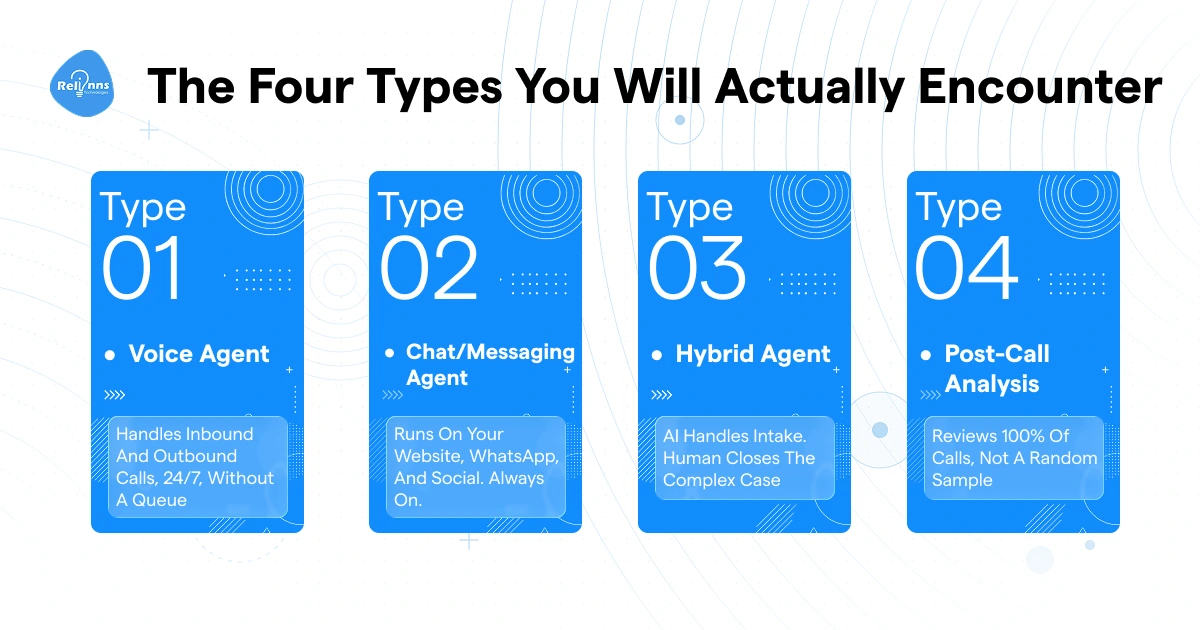
When vendors talk about AI call center agents, they skip telling you which type they mean. There are four, and each serves a different function.
Voice Agents handle inbound and outbound calls: booking, billing, FNOL, and collections. Before committing to a platform, think through your inbound vs outbound strategy and understand the full AI voice agent architecture. The voice stack matters. If you want the agent to sound like a real human, that determines the experience. If you're evaluating the build path, start with how to build one.
Chat and Messaging Agents run across your website, WhatsApp, and social channels. Platforms like BotPenguin let teams deploy across all three from a single dashboard. WhatsApp AI agents deserve a separate look if GCC markets are part of your geography.
Hybrid Agents are the most common setup in contact center AI deployments. These AI call center agents handle intake, resolve what they can, and then pass the rest to a human, with the full conversation history already loaded.
Post-Call Analysis Agents don't interact with customers. They review recorded calls, score performance, and flag compliance risks across 100% of interactions, not the random sample a QA manager gets to.
Each type covers a different slice of the customer journey. Together, they do something a traditional call center structure never could.
What These Agents Can Do That Your Current Setup Cannot
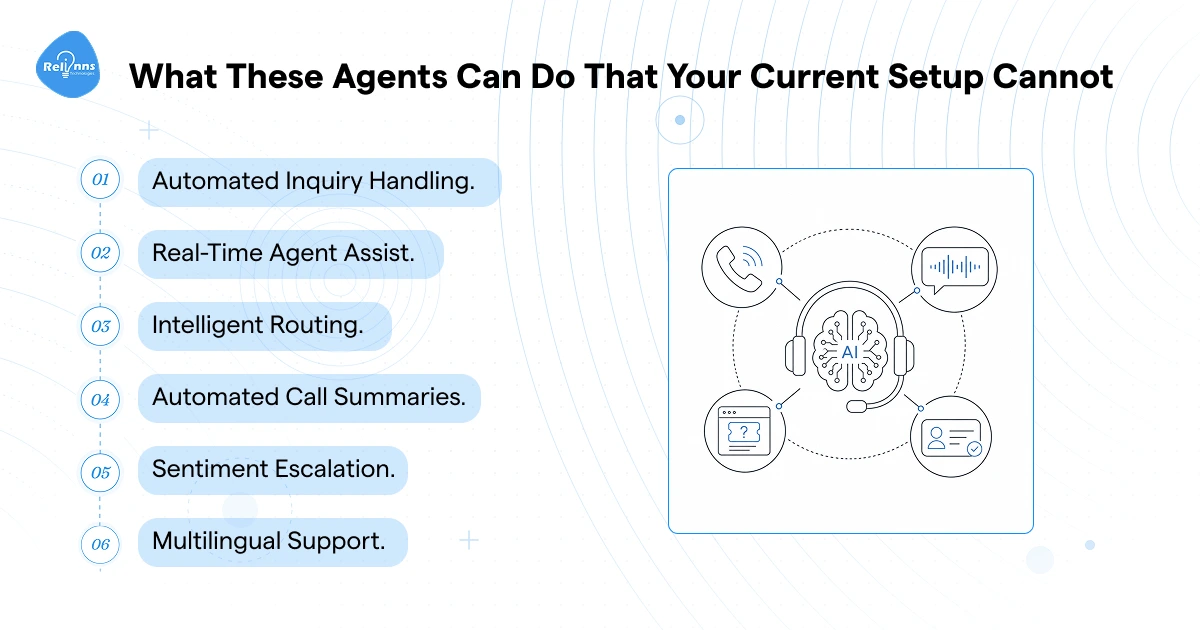
Most contact center AI platforms list the same capabilities in the same order. If you're evaluating AI call center agents for the first time, this is what separates real deployments from vendor demos.
"By 2029, AI-powered agents are expected to resolve up to 80% of common customer service issues." — Gartner
The capabilities that close that gap:
1. Automated inquiry handling.
WISMO, balance checks, appointment booking, and report status. These account for 50-70% of the contact volume and require no human judgment.
2. Real-time agent assist.
Mid-call, the system surfaces knowledge, flags context, and suggests next steps. How well this works depends heavily on your prompting strategy.
3. Intelligent routing.
Not by availability. By intent, customer history, and sentiment score. Right agent, right call, first time.
4. Automated call summaries.
Zoom and Metrigy found AI cuts after-call wrap-up from 16.2 to 10.4 minutes per interaction. That's a 35% reduction, per agent, per shift.
5. Sentiment escalation.
The system detects frustration before the customer asks to speak to a manager. For an outbound AI sales call agent running lead qualification or collections, getting this right is the difference between a recovered relationship and a churned account.
6. Multilingual support.
Multilingual voice AI handles real-time translation, so you can expand markets without adding language-specific headcount.
When AI call center agents operate in healthcare, insurance, or finance, data security and compliance are a hard filter, not a checkbox at contract signing. Worth looking at these AI voice services side by side before you commit to a platform.
Start with automated inquiry handling and call summaries. Those two alone typically cover implementation costs in the first quarter.
Knowing what they can do is one thing. Knowing where operators are putting them to work tells you where the returns are landing.
Where Businesses Are Deploying AI Call Center Agents Right Now
The broadest customer service deployments of AI call center agents cluster in industries with high inbound volume, where most queries don't require a human to resolve.
Healthcare is the highest-stakes environment for AI call center agents. If your sector is healthcare, HIPAA compliance is a hard requirement before deployment, not a feature to check off later. HIPAA-compliant voice agents cover what that looks like in practice. AI voice agents in healthcare go deeper into the clinical workflow.
Insurance and finance are where the outbound case gets commercially interesting. EMI reminders, policy renewal calls, FNOL intake.
An outbound AI sales call agent running collections or renewals isn't replacing anyone. It's handling the volume that no team had the capacity for. Netwealth, one of Australia's leading wealth management firms, now handles 20,000+ monthly inquiries with customers reaching a live agent in under 60 seconds.
That's contact center AI doing the triage work so humans handle the conversations that matter. For the insurance vertical, read voice agents for insurance and life insurance AI side by side.
Use cases are proven. But there is one question almost every buyer stalls on before committing to a deployment.
Will AI Replace Your Call Center Team? The Real Answer
The obvious play, when you first look at the numbers, is headcount reduction. AI call center agents don't call in sick, don't need benefits, and cost a fraction of a full-time seat. The math looks clean.
But every documented deployment tells a different story.
Zoom's 2025 State of AI in CX report found 64% greater employee efficiency when AI copilots work alongside human agents, not instead of them. Agents handle more complex calls, not fewer. For a closer look at how this plays out operationally, AI voice agents vs human agents is worth reading before you decide.
Contact center AI handles the repetitive 70-80%: WISMO, status checks, FAQs, booking. What stays on the human side is the work that needs judgment: disputes, escalations, and conversations where tone changes the outcome.
The most effective AI call center agent setups pair automation with human expertise rather than replacing one with the other. Teams that redeploy toward that 20% see the biggest returns. Teams that cut headcount first usually rebuild it six months later.
Teams seeing the biggest gains aren't the ones that cut headcount. They're the ones that redeployed it toward the 20% of calls that need a human.
Understanding the human-AI split tells you what to automate. Knowing where to start tells you what to do this quarter.
How to Deploy AI Call Center Agents Without Wasting Six Months
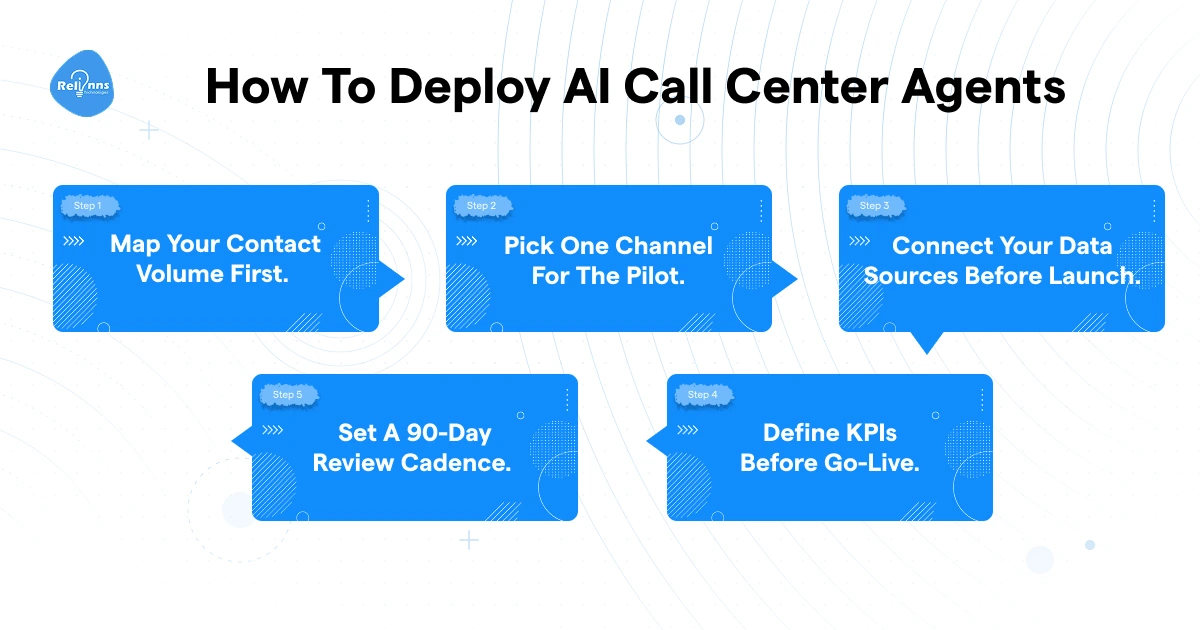
Most failed contact center AI deployments don't fail on the technology. They fail because teams moved before they understood their own contact volume. Before you pick a platform, run this framework.
1. Map your contact volume first.
Pull your top 10 contact reasons, handle time per type, and complexity score. The highest-volume, lowest-complexity category is your pilot target. Get a realistic sense of how much AI voice agents cost before you set budget expectations.
2. Pick one channel for the pilot.
Not omnichannel out of the gate. One. Chat or voice, whichever carries the most routine traffic. If the build path is on the table, read custom vs off-the-shelf AI and how to build an AI voice agent before committing. For custom AI development scoping, an external perspective saves time. Worth reviewing AI consulting firms, machine learning consulting companies, and a shortlist of top AI contact center providers before you decide.
3. Connect your data sources before launch.
AI call center agents produce generic, unreliable answers when disconnected from your CRM, order system, and knowledge base. The quality of your voice AI knowledge base determines answer accuracy more than which platform you pick.
4. Define KPIs before go-live.
Not after. Baseline your numbers before the switch flips. Without a before, you can't prove the after.
The most common failure mode: deploying AI call center agents without defining what success looks like. Set your baseline before go-live.
Track these from day one:
- First Contact Resolution (FCR)
- Average Handle Time (AHT)
- Containment Rate
- CSAT
- Cost Per Contact
5. Set a 90-day review cadence.
Assign an owner. Customer language shifts, new product lines, and model drift change query patterns. Regression testing isn't optional once you're live. And when the pilot proves out, scaling AI voice agents has its own set of decisions worth reading before you get there.
AI call center agents don't remove people from customer service. They remove the parts that grind good agents down: repetitive queries, manual note-taking, and the minutes lost searching for an answer mid-call. The work that's left is the work humans are good at. Judgment. Empathy. The conversation that needs a real voice.
Contact center AI deployments that last are built around that principle.