Custom vs Off-the-Shelf AI: How to Choose
Date
Oct 06, 26
Reading Time
9 Minutes
Category
AI Agents
Share


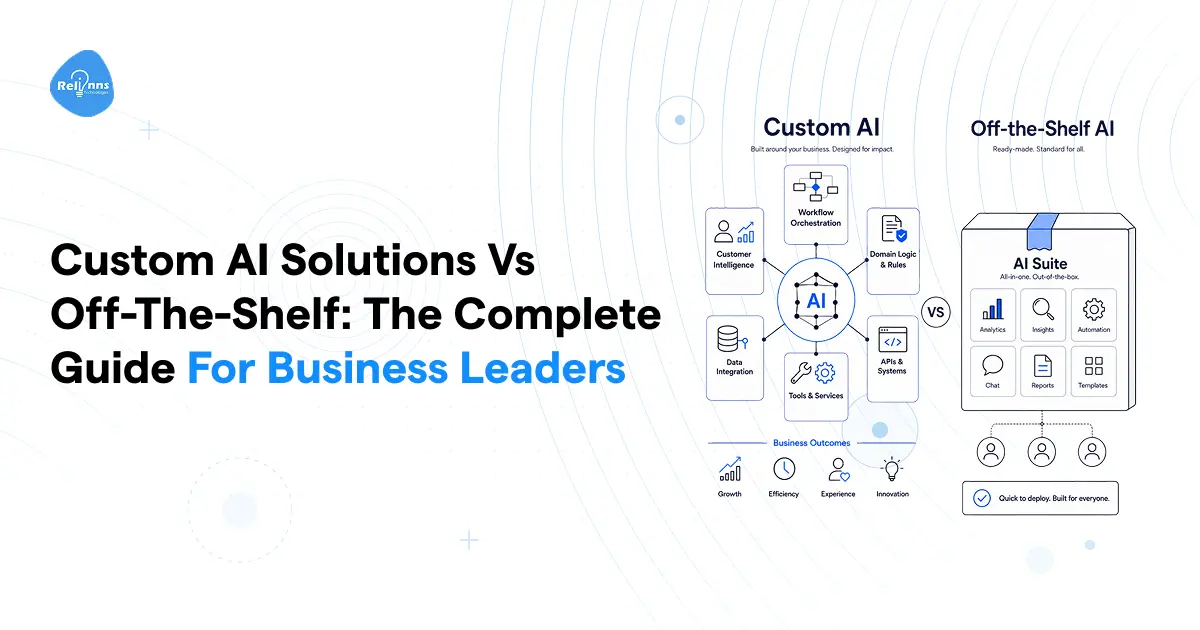
Custom AI vs. off-the-shelf AI becomes a serious decision when AI moves from testing into core business operations.
Off-the-shelf tools work well for standard tasks, but limits appear when workflows depend on proprietary data, multiple systems, internal approvals, or specific rules.
Those limits can create workarounds, integration issues, and less control over how AI fits the business.
The key question is simple: Does your workflow need more control than a standard product can provide?
This guide compares both options across cost, implementation time, data control, integrations, scalability, and long-term fit.
What Are Custom AI Solutions?
Custom AI solutions are systems designed around an organization’s own workflows, data, systems, rules, permissions, and operating requirements.
Custom does not necessarily mean building an AI model from scratch. Existing models can still be used while the surrounding architecture, integrations, data access, and workflow logic are designed specifically for the organization.
What Is Off-the-Shelf AI?
Off-the-shelf AI is a ready-made AI product designed to serve many businesses using predefined features, integrations, workflows, and configuration options.
It can include AI inside existing business software, packaged AI platforms, or services accessed through subscriptions or APIs.
Its main advantages are straightforward:
- Faster implementation
- Lower initial investment in many cases
- Vendor-managed infrastructure
- Existing features and integrations
- Less technical ownership for the buyer
For common requirements, that may be exactly what the business needs.
The tradeoff is control. Your organization works within the functionality, permissions, integrations, deployment options, and pricing structure provided by the vendor.
Custom AI Solutions vs Off-the-Shelf AI
Custom AI vs. off-the-shelf AI is mainly a question of fit. The right choice depends on how much control the business needs over workflows, data, integrations, permissions, cost, and future changes.
| Custom AI | Off-the-Shelf AI | |
|---|---|---|
| Time to Value | Requires design, integration, testing, and deployment | Usually faster when the capability already exists |
| Initial Cost | Higher development investment | Usually lower initial investment |
| Workflow Control | Business defines actions, rules, permissions, and approvals | Limited to available configuration |
| Data and Privacy | Can be designed around specific security and access requirements | Depends on vendor controls and deployment options |
| Integrations | Can connect with internal and legacy systems | Depends on supported connectors and APIs |
| Customization | Built around specific business requirements | Limited by available product features |
| Scalability | Can evolve with workflows and business requirements | Depends on product limits and vendor roadmap |
| Maintenance | Managed internally or by a development partner | Core platform maintenance usually remains with the vendor |
| Dependency | Greater control over architecture and system behavior | Greater dependence on the vendor platform |
The table gives the broad distinction.
Off-the-shelf AI is usually stronger when the process is common, required integrations already exist, and faster implementation matters more than deep customization.
Custom AI becomes a stronger option when proprietary data, several systems, company-specific rules, permissions, or controlled actions are central to the workflow.
The decision should start with the workflow, not the model.
If those requirements already point toward a custom build, Relinns can assess the implementation through its AI agent development services.
Risks of Choosing the Wrong AI Solution
Choosing the wrong approach can create costs long after implementation. The risk comes from selecting an operating model that does not match the importance, data needs, integrations, or control requirements of the workflow.
Choosing Off-the-Shelf AI When You Need More Control
A standard product can become difficult to operate when the business repeatedly works around its limits.
Common warning signs include:
- Manual steps between systems
- Missing integrations
- Limited permission controls
- Repeated workflow workarounds
- Growing vendor dependency
- Requirements moving beyond available features
Vendor dependency is not automatically a problem. It becomes important when a critical process relies on functionality the business cannot control.
Building Custom AI When You Do Not Need It
The opposite decision can also increase cost.
Building a dedicated system for a problem already handled well by an existing product can add unnecessary development, testing, infrastructure, monitoring, and maintenance.
| Lower Strategic Importance | Higher Strategic Importance | |
|---|---|---|
| Common Data and Workflow | Off-the-shelf AI may be enough | Compare both carefully |
| Proprietary Data or Workflow | Review control and integration needs | Custom AI becomes a stronger choice |
The objective is not to choose custom by default. It is to match the AI approach to the workflow.
Why Do Teams Choose Custom AI Agents Over Off-the-Shelf AI?
Businesses usually choose custom AI agents when a standard product cannot provide enough control over the workflow, data, integrations, permissions, or actions involved.
This is especially relevant when businesses need personalized AI agents tailored to specific users, workflows, and business requirements.
The strongest reasons include:
- Several business systems need to work together
- Proprietary or live data drives the workflow
- Internal rules determine what actions are allowed
- Different users require different permissions
- Human approval is required at specific stages
- Existing products need repeated workarounds
- Requirements are expected to evolve
Consider an insurance claim. The agent may need to retrieve policy data, check submitted documents, update a claim record, follow internal routing rules, and transfer exceptions to authorized staff.
The value comes from controlling that complete process rather than adding another AI interface on top of it.
How Relinns Supports Custom AI Requirements
Different AI requirements need different technical approaches. Relinns provides several related development services that can support these use cases.
| Business Requirement | Relinns Service | When It Fits |
|---|---|---|
| AI that performs defined business actions | AI Agent Development Services | When the workflow requires system access, actions, rules, permissions, and escalation |
| AI built around proprietary workflows and data | Custom AI Development | When a standard product cannot support the required architecture or business logic |
| AI grounded in company knowledge | RAG Development | When the system needs approved policies, SOPs, documents, product data, or internal knowledge |
| AI for voice-based workflows | AI Voice Agents | When the process involves inbound or outbound voice interactions |
| Conversational AI connected to business processes | Custom Chatbot Development | When users need a conversational interface connected to systems or workflows |
The right service depends on what the AI must access, understand, and do inside the business.
How to Build a Custom AI Solution
Once custom development becomes the preferred approach, the workflow should be defined before the technology.
1. Define the Problem
Identify the exact process, required actions, systems involved, human approval points, and expected result.
This scope also helps estimate AI agent development cost.
The scope should make clear what the AI owns and where its responsibility ends.
2. Review the Data
Check what information the AI needs, where it is stored, who can access it, and whether its quality is sufficient.
Poor or inaccessible data can limit the system regardless of which model is selected.
3. Design the Architecture
Choose the model, retrieval approach, integrations, memory, permissions, and workflow logic based on the requirements.
Architecture should follow what the system needs to know, access, and do.
4. Build and Test
Testing should cover:
- Expected requests
- Missing information
- Unusual inputs
- Restricted actions
- Failed integrations
- Escalation conditions
The goal is to identify when the system should continue, stop, retry, or involve a person.
5. Integrate and Deploy
Connect the AI with the applications where the business process happens.
That may include CRMs, ERPs, databases, scheduling tools, support platforms, or internal applications.
6. Monitor Performance
Track completion, failed actions, escalations, incorrect outputs, and changes in business rules after launch.
When to Choose Custom AI
Custom AI is worth considering when the workflow is important enough to justify greater control.
Choose custom when:
- AI is central to an important business process
- Proprietary or live data is required
- Several systems must work together
- Internal rules determine what happens next
- Permissions need precise control
- Human approval must be included
- Existing products require repeated workarounds
- Requirements are expected to change significantly
The stronger these conditions become, the stronger the case for custom development.
When to Choose Off-the-Shelf AI
Off-the-shelf AI is often the better option when an existing product already solves the requirement well.
Choose it when:
- The workflow is common and predictable
- Existing features meet the requirement
- Required integrations are available
- Faster implementation is important
- Deep customization is unnecessary
- AI plays a supporting role
- The business does not want to manage the technical layer
A standard product can also help validate an AI use case before the organization invests in custom development.
Off-the-shelf AI does not have to be temporary. If the product continues to meet the workflow, integration, security, and control requirements, there may be no reason to replace it.
The Middle Ground: Fine-Tuning, RAG, and Open Source Models
The decision is not always limited to buying a finished product or building everything from the beginning.
Many custom solutions use existing models while changing the knowledge layer, integrations, workflow logic, hosting, or operating controls around them.
Fine Tuning
Fine tuning adapts an existing model using task-specific training examples.
It can help when the system needs more consistent terminology, behavior, structure, or performance for a defined task.
It does not automatically provide access to current business information.
RAG
RAG retrieves relevant information from approved sources when the AI needs it.
This is useful when the system depends on current policies, documentation, SOPs, product information, or internal knowledge.
Businesses that need a dedicated retrieval layer can explore Relinns RAG development services.
Open Source Models
Open source models can provide more flexibility over hosting, deployment, infrastructure, and customization.
The tradeoff is greater responsibility for security, scaling, monitoring, and maintenance.
The right approach depends on the workload, privacy requirements, infrastructure, and technical ownership available within the organization.
Build vs Buy AI Agent Decision Checklist
A build vs buy AI agent decision becomes easier when both options are measured against the same requirements.
Choose Off-the-Shelf AI If
- The workflow is common
- An existing product already handles it well
- Required integrations are available
- Fast implementation matters
- Custom workflow logic is limited
- Vendor controls meet your requirements
- Your team does not want to manage AI infrastructure
Choose Custom AI If
- The workflow is unique or strategically important
- Proprietary data is required
- Several internal systems are involved
- Permissions and actions need precise control
- Human approval must be part of the process
- Existing tools require repeated workarounds
- Requirements are expected to evolve
Before approving either option, answer five questions:
1. What exact workflow should the AI complete?
2. Which systems and data must it access?
3. Which actions can it perform without approval?
4. Can an existing product already support those requirements?
5. Who will own monitoring and improvement after deployment?
If those answers are unclear, the business needs better scoping before making the build vs buy decision.
How to Choose a Custom AI Development Partner
Once custom development becomes the preferred option, partner selection becomes part of the implementation decision.
Comparing top AI agent development companies can help businesses evaluate relevant experience, technical capabilities, and development expertise.
The development team should understand more than the AI model.
Relevant Industry Experience
The partner should understand the workflows, systems, data requirements, and operating constraints relevant to the project.
Ask about experience connected to the actual use case rather than relying on broad industry claims.
Complete Development Capability
Clarify who owns:
- Discovery
- Architecture
- Development
- Integrations
- Testing
- Deployment
- Monitoring
Responsibility should be clear before development begins.
Engineering Depth
Production AI can require software engineering, data engineering, integrations, security, infrastructure, testing, and monitoring.
The partner should be able to explain how those components work together.
Security Planning
Data access, permissions, logging, retention, hosting, and sensitive information should be considered during architecture planning.
These requirements affect how the system is designed.
Clear Scope
The proposal should make major assumptions visible.
That includes integrations, data readiness, infrastructure, testing, maintenance, and responsibilities on both sides.
Frequently Asked Questions
What is a custom AI solution?
A custom AI solution is designed around specific business workflows, data, integrations, rules, and permissions rather than relying entirely on predefined product functionality.
Is custom AI better than off-the-shelf AI?
Neither option is always better. Off-the-shelf AI works well for common requirements and faster implementation. Custom AI becomes more suitable when proprietary data, deeper integrations, specific workflows, or greater control are required.
When should a business choose custom AI?
Choose custom AI when the workflow depends on several systems, proprietary data, specific business rules, controlled actions, or requirements that existing products cannot support properly.
When should a business choose off-the-shelf AI?
Choose off-the-shelf AI when the requirement is common, an existing product already meets it, required integrations are available, and faster implementation matters more than deep customization.
Can a business start with off-the-shelf AI and move to custom AI later?
Yes. A business can use an existing product to validate the use case and later consider custom development if workflow, integration, data, permission, or control requirements grow.
Does custom AI mean building a model from scratch?
No. Custom AI can use an existing model while adapting the surrounding architecture, data access, retrieval, integrations, workflow logic, permissions, memory, and monitoring around the organization’s requirements.
Final Take
Custom AI vs. off-the-shelf AI is ultimately a question of workflow fit.
Choose off-the-shelf AI when an existing product already supports the required process, integrations, controls, and operating model.
Choose custom AI when proprietary data, deeper system access, company-specific rules, or greater control over actions make standard product limits restrictive.
The strongest decision starts with the workflow rather than the model.