What Are AI Chatbots and How Do They Work? 2026 Guide
Date
May 13, 26
Reading Time
19 Minutes
Category
AI Chatbots
Share


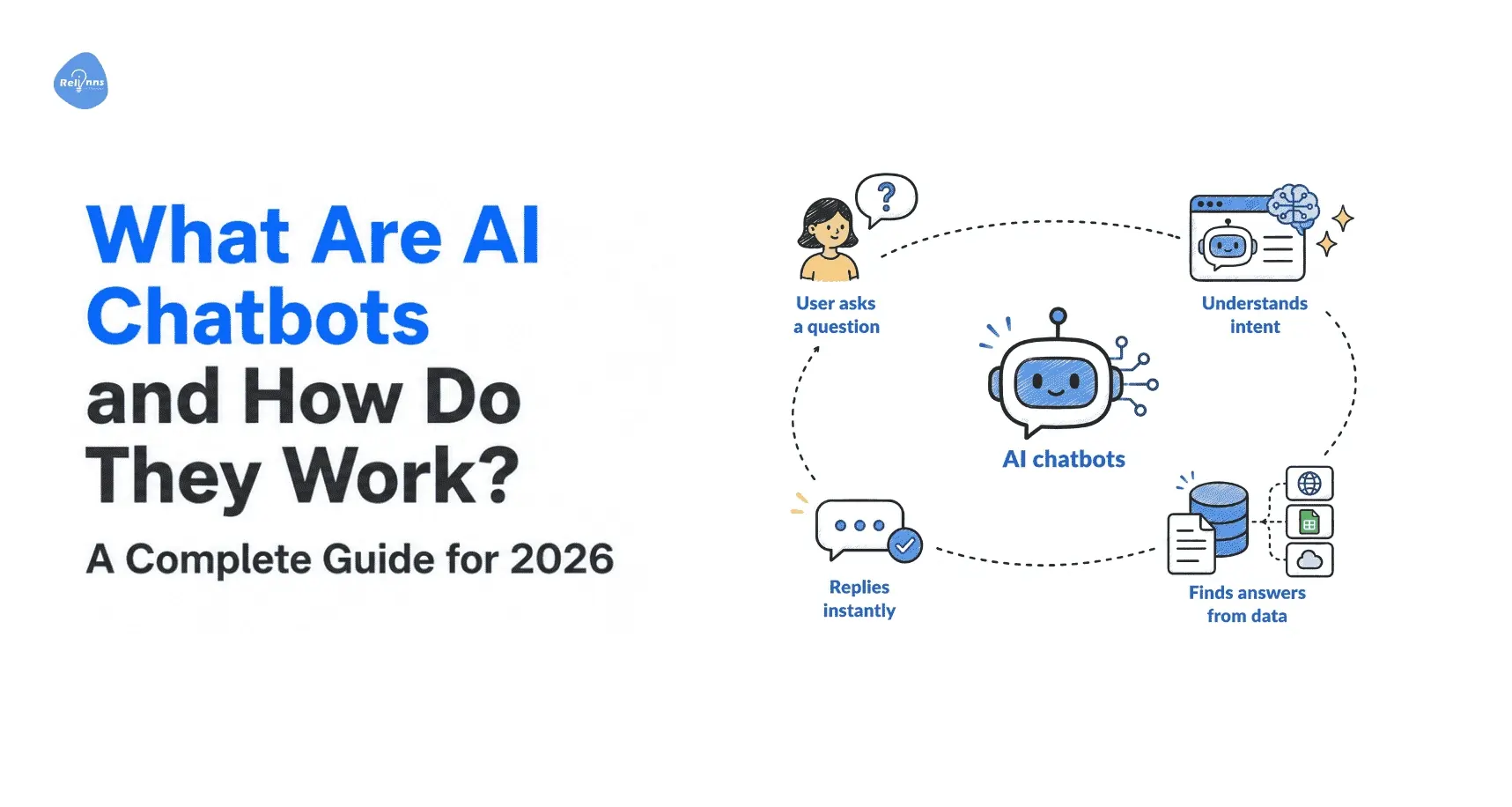
An AI chatbot is a program that talks to you. You type something, it reads it, figures out what you mean, and writes back. Like texting a very fast, very well-read assistant who never sleeps.
The "AI" part is what makes them useful. AI chatbots don't just match keywords to pre-written replies. They understand context, handle messy phrasing, and get better the more they're used.
This guide is for anyone who wants a clear, no-fluff understanding of how AI chatbots work, what separates a good one from a bad one, and why businesses are betting on them in 2026.
What Is an AI Chatbot?
Before AI chatbots, you had exactly two options: a human on the other end, or a phone menu that made you want to throw your laptop. AI chatbots sit in a different category entirely.
They're software that reads what you write, understands what you mean, and responds in plain language. Not a script. Not a decision tree. A model that interprets intent and pulls the right answer from whatever it's been trained on. Businesses use them to handle customer queries, qualify leads, collect documents, and dozens of other tasks that used to eat up staff hours every single day.
AI Chatbot vs. Rule-Based Bot
Rule-based bots follow a script. You click Option 1, you get Answer 1. That works fine for a kiosk. But with real customers typing real sentences, it breaks constantly, someone writes "I need to change my pickup time" and the bot has no idea, because nobody wrote that exact phrase into the decision tree.
AI chatbots read intent, not keywords. They handle messy language, typos, and questions no one anticipated.
Rule-based tools aren't useless, they're cheap and predictable for very narrow flows. But if your support volume is growing, a rule-based bot becomes a ceiling, not a solution.
AI Chatbot vs. AI Voice Agent
The technology underneath is similar. The channel is different.
- AI chatbots operate over text website widgets, WhatsApp, in-app chat
- AI voice agents operate over the phone, handling calls the way a receptionist would
Both understand intent and connect to the same backend systems. But voice adds a layer of real-time speech processing and conversation pacing that text doesn't require.
Simple rule of thumb: If your customers reach you through WhatsApp or your website, a chatbot fits. If they call you, a voice agent is the right tool.
AI Chatbot vs. AI Agent
This is the distinction most people miss, so remember it: A chatbot answers questions. An AI agent takes action.
You ask a chatbot about your order status it tells you. An AI agent checks the logistics API, flags the delay, updates the CRM, and sends a proactive message before you even ask.
- Chatbots work within a conversation
- AI agents work across systems - triggering workflows, making decisions, moving data
For most businesses, a chatbot is the right starting point. But the moment you want the bot to do something rather than just say something, you're ready for AI agent development.
AI Chatbot Trends for 2026
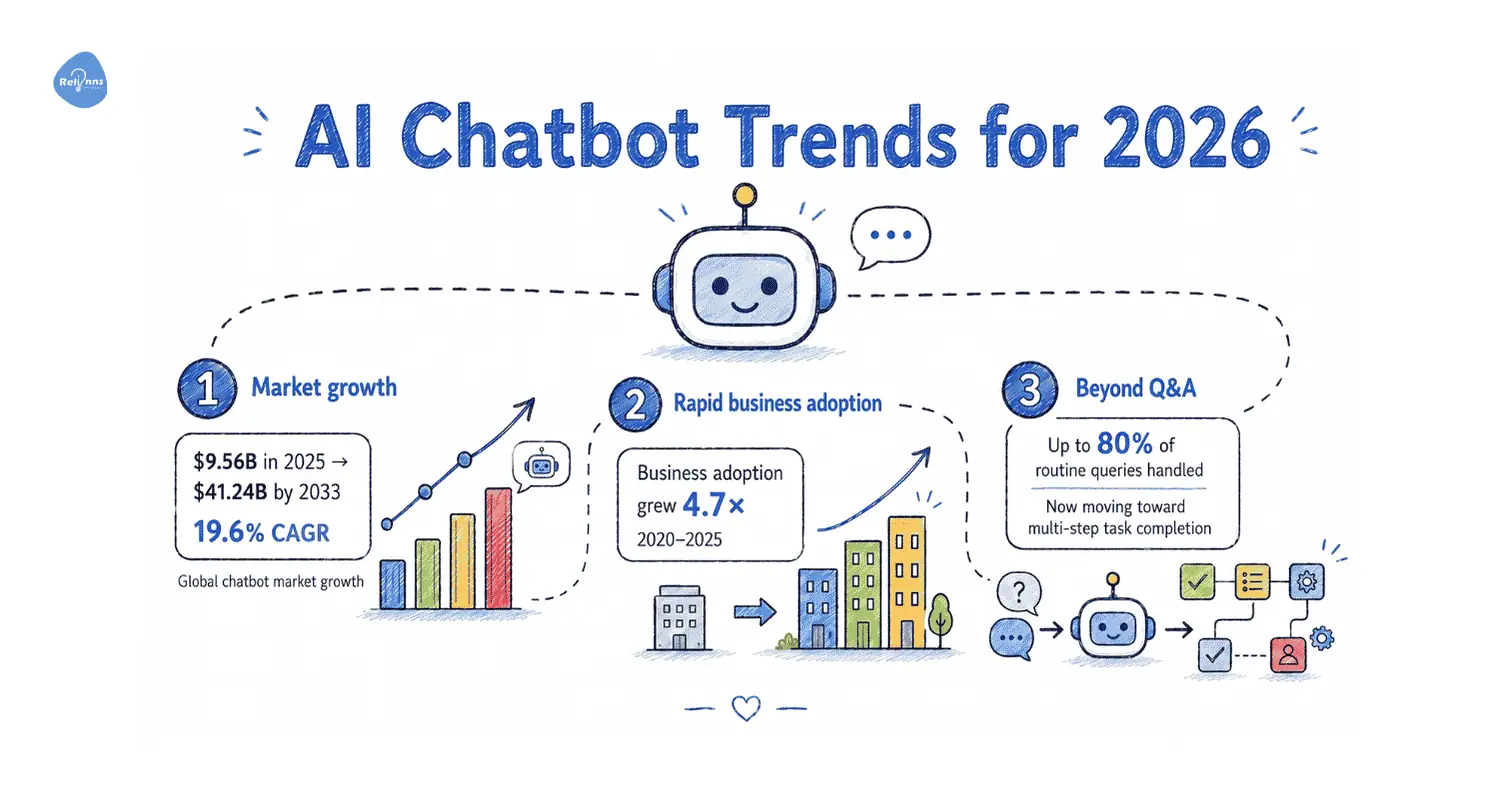
The global chatbot market sat at $9.56 billion in 2025 and is on track to reach $41.24 billion by 2033 with a compound growth rate of around 19.6% per year. Business adoption grew roughly 4.7 times between 2020 and 2025. The market is moving fast, and the architecture underneath it is shifting just as quickly. Here are some trends we observed as the leading AI chatbot development company
Agentic Chatbots Are Replacing Transactional Ones
The old model: ask a question, get an answer. The 2026 model: give the chatbot a goal and let it take steps to complete it.
Book the appointment. Check the inventory. File the pre-auth. Send the confirmation. AI chatbots capable of handling up to 80% of routine queries are now being pushed toward multi-step task completion, not just question answering. The transactional bot is fading. The agent is replacing it.
RAG Is No Longer a Premium Add-On
Twelve months ago, Retrieval-Augmented Generation was something enterprise buyers requested and paid extra for. In 2026, it's the baseline expectation.
Buyers understand hallucination risk well enough to ask about it in the first meeting. Any deployment without a grounded knowledge layer is a harder sell and a riskier one. The architecture shifted from optional to default.
Regulated Industries Are Demanding On-Premise Deployments
Healthcare, insurance, and financial services buyers are requesting on-premise or private-cloud LLM deployments at a rate that would have seemed niche in 2024.
Roughly 74% of business owners expect AI to handle customer replies in some capacity but regulated-industry buyers want that capability inside their own infrastructure, not on shared cloud endpoints. Vendors who can't meet compliance requirements are losing enterprise contracts to those who can. This is no longer a differentiator. It's a qualifier.
The Gap Between Good and Poor Deployments Is Widening
Conversational AI accounts for around 62% of the broader conversational AI market and the category is large and growing. But the distance between a well-deployed AI chatbot and a poorly scoped one is increasing just as fast.
The floor is rising. Buyers are more informed, expectations are higher, and tolerance for underperforming deployments is lower. The businesses that invest in getting the architecture right RAG, integrations, compliance, channel fit are pulling ahead. The ones cutting corners are getting left behind.
7 Types of AI Chatbots
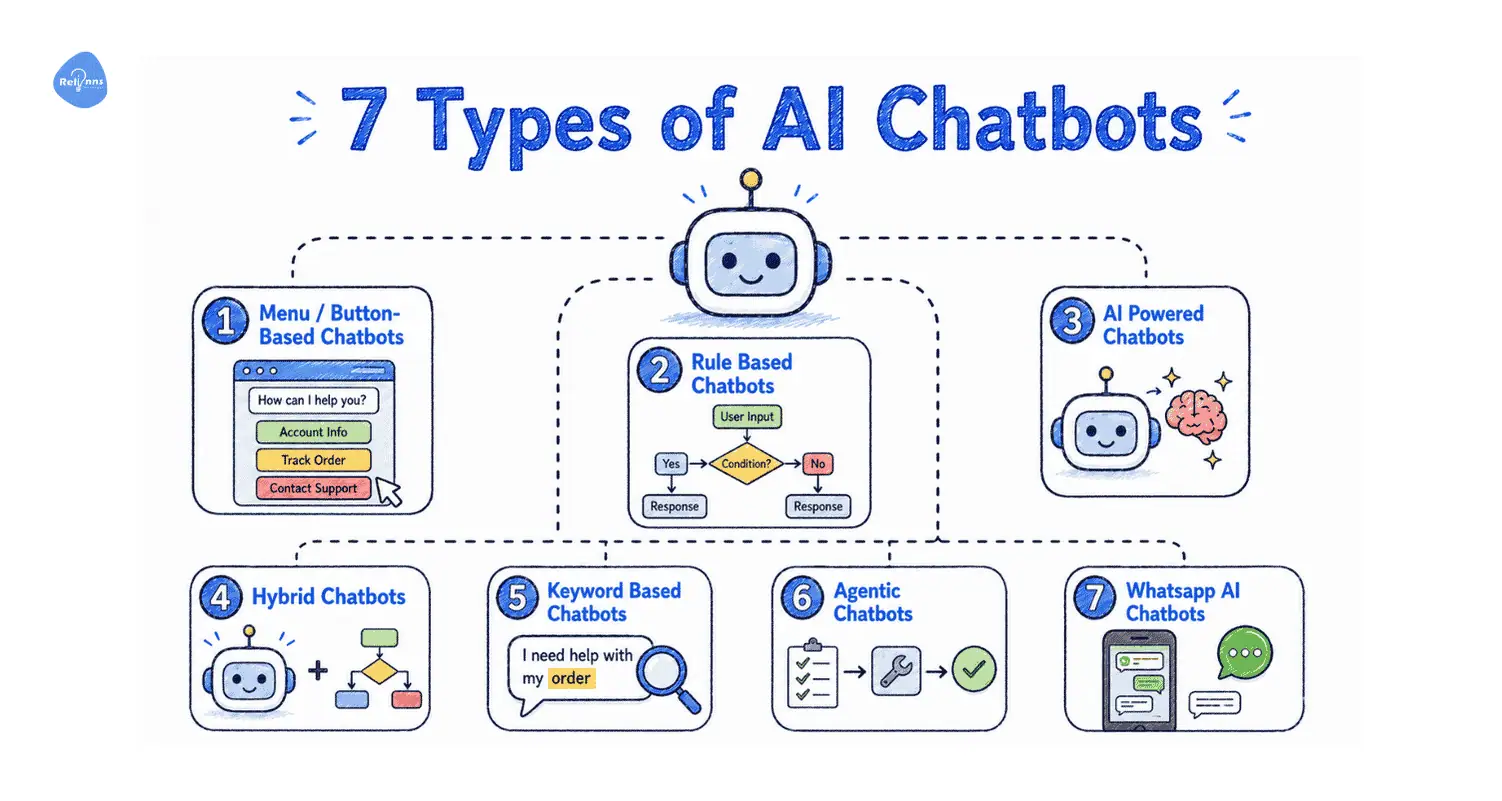
Here are the top 7 most widely used chatbots we have worked with as the leading AI chatbot Development Company in the world. Now not all AI chatbots are built the same. The type you need depends on your volume, your use case, and how much flexibility your customers actually require. Here's how they break down.
Menu / Button-Based Chatbots
The simplest form. Users tap through pre-built buttons to reach an answer no free typing, no interpretation needed. They work well for narrow, predictable flows like appointment booking or basic FAQs.
The catch? The moment a user needs something that doesn't fit one of the buttons, the experience falls apart. Good for low-complexity entry points. Limited everywhere else.
Rule-Based Chatbots
A step up from buttons. These bots scan for keywords in what the user types and match them to pre-written responses, essentially an interactive FAQ engine with some logic baked in.
They're cheap to build and easy to maintain for simple workflows. But every new scenario has to be manually written. A user who types "reschedule my slot" instead of "change booking" gets nothing useful. Off-script inputs break them, consistently.
AI-Powered Chatbots
This is where AI chatbots truly earn the name.
Instead of matching keywords, they read intent. A user can phrase the same question five different ways and still get the right answer. NLP and NLU do the heavy lifting understanding context, handling messy language, and improving with every interaction.
These bots don't need a script for every scenario. They generalise. That's what makes them viable at enterprise scale.
Hybrid Chatbots
Some workflows are structured enough that rule-based logic handles them perfectly. Others need the flexibility of AI. Hybrid chatbots combine both using defined flows where predictability matters and switching to AI-driven interpretation when the conversation goes off-script.
For most mid-size businesses, this is the practical middle ground.
Keyword-Based Chatbots
More flexible than menu bots, but less capable than full NLP systems. These scan the entire message for trigger words and serve the mapped response.
A user typing "refund" gets a response. A user typing "I want my money back" might not. Useful in constrained environments. Limited everywhere else.
Agentic Chatbots
Most AI chatbots answer questions. Agentic chatbots take action.
Book a slot, place an order, send a document, trigger a backend workflow all within the conversation. The user never leaves the chat to do anything. For businesses running high-volume transactional flows, this is where the real operational lift comes from.
WhatsApp AI Chatbots
In the UAE, Saudi Arabia, and Qatar, WhatsApp isn't just a messaging app, it's the primary channel businesses use to communicate with customers. Not email. Not web chat. WhatsApp.
Deploying an AI chatbot on WhatsApp means meeting customers exactly where they already are: no app download, no new login, no friction. For companies operating in the GCC, a WhatsApp-native AI chatbot isn't a nice-to-have. It's essential.
How Do AI Chatbots Actually Work?
You don't need to understand the engineering to make a smart buying decision. But knowing the basics helps you ask better questions and spot when a vendor is selling you something half-built. Here's what's actually happening under the hood.
Natural Language Understanding: Reading Intent, Not Keywords
"Where's my order" and "my package hasn't arrived" mean the same thing. A rule-based bot sees two different sentences. An AI chatbot sees one intent: order status.
Natural Language Understanding (NLU) is what makes that possible. The model reads the full message, strips out the noise, and figures out what the person actually wants, handling typos, slang, and roundabout phrasing without breaking. That's why AI chatbots can manage real customer conversations instead of just scripted ones.
LLM-Powered Response Generation
Once the chatbot understands the intent, something has to write the reply. That's the LLM, a large language model like GPT, Claude, or Gemini which is generating the response underneath.
The model you choose affects tone, accuracy, and how often the bot says something wrong. Cheaper or poorly configured models hallucinate. They make up return policies, invent product specs, quote prices that don't exist. The model matters. So does how it's configured.
RAG: How Chatbots Use Your Own Data
Out-of-the-box AI chatbots know a lot about the world. They know nothing about your business. So when a customer asks about your refund window, a generic bot guesses and sometimes guesses wrong. That's a hallucination, and it's a real operational risk.
RAG (Retrieval-Augmented Generation) fixes this. Instead of guessing, the chatbot pulls answers directly from your actual documents policy pages, product catalogues, SOPs, contracts. The LLM then turns that retrieved information into a clean, accurate response.
This is the difference between a GPT wrapper and a production-grade AI chatbot. If a vendor hasn't mentioned RAG, ask them directly: how does your bot handle questions it wasn't explicitly trained on?
Memory and Context Retention
A chatbot that forgets what you said two messages ago feels broken. Because it is.
- Session memory keeps the conversation coherent the bot remembers your order number so you don't have to repeat it
- Persistent memory goes further, retaining preferences and history across sessions so returning users never start from zero
For support use cases, session memory is the baseline. For anything relationship-driven, persistent memory is worth the added build.
Channel Deployment
AI chatbots don't live in one place. The same bot can run on your website widget, WhatsApp, Instagram DMs, Microsoft Teams, or inside your app. The underlying model stays the same the interface adapts to wherever your customers actually are.
For businesses in the GCC, that means WhatsApp above everything else. For US and UK companies, it's typically the website and in-app. Getting the channel right matters just as much as getting the bot right.
What Can an AI Chatbot Actually Do?
Most businesses ask this question after a bad experience. A clunky bot. A frustrated customer. A support agent who still had to step in anyway.
Those failures didn't happen because AI chatbots are bad they happened because the chatbot was placed on the wrong problem. Deployed correctly, AI chatbots handle an enormous range of operational work. The use cases below aren't hypothetical. They map directly to pain points we see and have delivered across logistics, healthcare, insurance, and ecommerce businesses.
Customer Support Automation
Your support inbox has a volume problem and most of it is the same question asked fifty different ways.
"Where is my order?" (WISMO queries) make up 50–70% of all inbound contacts for logistics and ecommerce companies. Add return policies, refund timelines, and cancellation questions, and your support team is spending the majority of their day on work that doesn't require a human.
- AI chatbots resolve at least 60% of support tickets without any human involvement
- Tickets that do need a person get tagged, categorized, and routed with context already attached
- The agent walks in knowing the issue: no re-explaining, no back-and-forth just to establish what happened
Appointment Booking and Scheduling
Clinics and diagnostic labs run on appointment density. A no-show doesn't just lose revenue it leaves a slot another patient could have filled.
No-show rates in healthcare sit between 15–25%, and a big driver is pure friction: patients forget, try to reschedule at 9 PM when the front desk is closed, or give up and cancel rather than call back the next morning.
An AI chatbot handles after-hours booking, confirmations, rescheduling, and automated reminders no receptionist required. Patients who would have dropped off complete the booking. The clinic fills more slots without adding headcount.
Lead Qualification and Sales Handoff
Inbound traffic means nothing if your sales team can't separate serious buyers from window shoppers.
Someone who's asked three questions about a product and checked pricing twice is far more valuable than someone who clicked an ad once. AI chatbots capture those intent signals in real time, qualify leads against your criteria, and route them to the right rep along with a brief on what the prospect already said they want.
Sales reps stop cold-calling the wrong people and start picking up conversations that are already warm.
Document Collection and KYC
Insurance pre-authorizations. Loan applications. Freight shipments. Financial services onboarding. All of them require documents and the traditional process is a chain of follow-up emails that people ignore.
A chatbot handles reminders automatically, tells applicants exactly which document is missing, and flags overdue submissions to your team without anyone manually checking a spreadsheet.
- The paperwork moves faster
- Your ops team stops chasing
- The customer experience goes from opaque to at least tolerable
Policy and Product Knowledge Q&A
Customers ask about coverage terms, return windows, product specs, and clinic-specific protocols. Your agents look it up or rely on memory and sometimes get it slightly wrong.
RAG-powered AI chatbots answer these questions by pulling directly from your actual documents policy PDFs, product manuals, internal knowledge bases. The answer is cited, consistent, and current.
There's no hallucination because the chatbot isn't guessing. It's reading your source material and surfacing the relevant section. Your customers get a precise answer in seconds. Your agents get fewer repeat questions about things that are already written down somewhere.
Internal Operations
This is the use case that surprises most people.
AI chatbots are typically framed as customer-facing tools but the same logic applies internally.
- HR teams field repetitive questions about leave policies and payroll timelines.
- Warehouse teams need to check SOPs mid-shift without hunting down a supervisor.
- Franchise managers need compliance checklists completed consistently across locations.
A chatbot can handle all three and it scales without adding coordinators. The information is available on demand, in plain language, at 2 AM if that's when someone needs it.
The thread running through all of this is the same: AI chatbots take the repeatable, predictable, document-heavy parts of your operations and run them without manual oversight. The work that's been sitting on someone's plate because it's tedious but can't be ignored that's the gap AI chatbots fill.
And for most businesses, that gap is a lot bigger than they realize.
AI Chatbots by Industry
Every industry has a different face for the same problem: too many repetitive contacts, too few people to handle them, and customers who want answers right now regardless of the time. The specifics look different depending on what your business does. Here's where they live.
AI Chatbots for Healthcare
A mid-size hospital or diagnostic chain fields 270–500 inbound calls daily to its front desk appointment confirmations, test report status, visiting hours, doctor availability. Over 58% of those calls follow a predictable script. The same six questions, asked in slightly different ways, by different people, all day long.
- Appointment booking, rescheduling, and after-hours slot confirmation handled without putting patients on hold
- A patient asking if their MRI report is ready gets an automated status update instead of waiting hours for a callback
- Post-visit, the chatbot checks in, sends discharge instructions, and flags missed medication reminders
The more interesting use case is mental health. Between-session support delivered through a conversational interface covers the gap between weekly appointments. Not a replacement for a clinician, a bridge, available at 11:32 PM when the clinic is closed and the patient needs something.
AI Chatbots for Ecommerce and Retail
Cart abandonment rates sit between 67–81% across ecommerce and most of that goes unrecovered. Not because buyers weren't interested, but because no one followed up at the right moment, through the right channel, with the right message.
An AI chatbot catches the drop-off. It sends a recovery message within minutes, answers the question that stopped the buyer from completing checkout, and closes the loop.
- Marketplace sellers who stall over listing requirements or payout policies get answers at midnight no support ticket, no delay
- Loyalty members who forget their points exist get a timely reminder that brings them back
- B2B buyers who miss reorder windows get a proactive nudge before they go to a competitor
The customer experience tightens across the whole lifecycle not just the purchase moment.
AI Chatbots for Insurance and Finance
After a road accident or a health event, a policyholder wants one thing: to know the claim is moving. Call centres absorb that anxiety in volume, Human agents spend most of their time repeating the same status update to different callers instead of actually processing anything.
- Claim status queries are handled automatically, drawing from the live case management system the policyholder gets an update in 30 seconds
- Policy renewal follow-ups, EMI reminders, and loan application recovery all follow the same structure
- The chatbot handles the expected path. The agent handles the exception.
KYC document collection deserves a specific mention. Applicants go incomplete. Emails go unanswered. A chatbot follows up on a schedule, tells the applicant exactly which document is missing, and keeps the pipeline moving without a collections officer dialing ten people a day.
AI Chatbots for Supply Chain and Logistics
WISMO queries make up 50–70% of all inbound contacts for courier and logistics companies. A shipper has thousands of parcels moving at once. Their customers are calling to ask where each one is. That ratio of contacts to consignments is operationally brutal and it doesn't improve as volume scales.
- Shipment tracking handled across every channel WhatsApp, web, email without a human in the loop
- Non-delivery reports resolved end-to-end: the chatbot confirms a new delivery window, updates the driver, and logs the resolution without back-and-forth between the customer and a coordinator
- Driver onboarding and freight documentation both high-friction, paper-heavy processes guided, collected, and flagged automatically
Freight teams stop chasing shippers over email for documentation that should have been submitted three days ago. The operation runs tighter, and the headcount stays flat.
Benefits of Using AI Chatbots in 2026
The business case for AI chatbots has moved well past "faster support." The value compounds across cost structure, revenue, customer experience, and data — simultaneously. Each benefit below stands on its own, but they reinforce each other in ways that make the aggregate ROI larger than any single number suggests.
24/7 Availability and Instant Response
Customers don't time their questions around your business hours. A patient checking a diagnostic report at 11 PM. A logistics customer tracking a shipment on Sunday. A borrower confused about a loan document at midnight. All of them want an answer now not a callback tomorrow morning.
AI chatbots close that gap without staffing costs. Photobucket deployed chatbots to serve international customers outside business hours and saw a 17% improvement in first resolution time alongside a 3% increase in CSAT scores. The queue disappears. The hold time disappears. The customer gets an answer in the same session they asked the question.
Personalisation at Scale
A static FAQ page gives every visitor the same response. An AI chatbot connected to your CRM, OMS, or marketing platform gives each visitor a response built around their specific context which products they browsed, where they are in the purchase journey, whether their last order is delayed, what their account tier is.
This used to require a dedicated human agent with access to multiple systems and time to look things up. AI chatbots run that lookup in milliseconds simultaneously across thousands of conversations, with no quality drop between the first interaction and the ten-thousandth.
Cost Reduction and Operational Efficiency
Repetitive, low-value queries eat agent time. Password resets. Order status updates. Refund policy explanations. Appointment confirmations. These queries don't need a human — but they consume human capacity at scale.
AI chatbots absorb that volume so your agents handle the complex, high-judgment interactions where they actually add value. Siemens Financial Services saw double-digit productivity increases after deploying AI chatbots across their support operations. And unlike headcount, a chatbot doesn't require hiring cycles, training ramp time, or shift premiums for after-hours coverage.
Lead Qualification and Sales Growth
AI chatbots work the sales funnel without a rep on the line. They ask qualifying questions, capture intent signals pages visited, product preferences, geolocation, language and pass structured lead data to your sales team. A prospect who engaged with a chatbot for three minutes arrives in your CRM with context already attached.
They also don't let cart abandoners walk quietly. A chatbot that catches a hesitating buyer at the right moment, answers the one blocking question, and nudges toward checkout recovers revenue that would otherwise disappear silently. Cross-sell, upsell, demo scheduling all without a human rep in the loop.
Scalability Without Proportional Cost
A human support team handling 500 conversations per day needs more people to handle 5,000. A chatbot handles the same increase with no additional headcount, no training cost, and no quality degradation at volume.
For enterprise buyers, this asymmetry is one of the most compelling arguments in the entire ROI stack. The cost curve flattens as volume grows. Human teams structurally cannot offer that. AI chatbots structurally can.
Customer Data and Insight Generation
Every conversation is a data point. AI chatbots capture what customers ask, how they phrase problems, where they abandon a flow, and what they engage with repeatedly — without cookies, without surveys, and without relying on customers to self-report.
That data feeds back into marketing personalisation, content strategy, product development, and support documentation. The chatbot becomes a continuous listening mechanism, not just a response engine. Businesses that mine conversation logs regularly find product gaps, policy confusion, and emerging demand signals that wouldn't surface anywhere else.
Omnichannel and Multilingual Reach
Your customers are on WhatsApp, your website, SMS, Instagram DMs, and your mobile app. They don't pick one channel and stay there. AI chatbots deploy across all of them and maintain conversation continuity as customers move between channels without starting the interaction over each time.
Multilingual capability removes the language barrier for global operations. For businesses operating across South Asia, Southeast Asia, or MENA, this isn't a nice-to-have. It's a core operational requirement.
Consistent, Emotionally Stable Service
Human agents have bad days, inconsistent product knowledge, and varying tolerance for hostile customers. Chatbots pull from a single source of truth on every interaction every customer gets the same accurate, brand-consistent answer regardless of time, volume, or tone.
And when a customer arrives angry, the chatbot absorbs that friction first. By the time a live agent joins, the customer has already stated their problem, retrieved their order details, and had their options explained. The emotional charge drops before the human even types a word.
Industry-Specific Applications
| Industry | Primary Chatbot Applications |
| Ecommerce and Retail | Cart recovery, WISMO automation, personalised recommendations, returns handling |
| Healthcare | Appointment scheduling, symptom triage, diagnostic report status, medication reminders |
| Banking and Finance | Loan application guidance, account queries, EMI reminders, fraud query fast-tracking |
| Insurance | Claims status, KYC document collection, policy renewal follow-ups |
| HR and IT | Onboarding flows, leave balance queries, ticket routing, SOP access |
| Real Estate | Lead qualification, property matching, viewing scheduling |
| Supply Chain and Logistics | Shipment tracking, NDR resolution, driver onboarding, freight documentation |
How to Choose an AI Chatbot for Your Business
Most businesses start this process backwards. They see a demo, pick a platform, and then figure out where to deploy it. That order of operations is why so many chatbot projects go quiet after three months.
The right sequence runs in the opposite direction.
Define the Use Case Before the Tool
Before you evaluate any vendor, write one sentence that completes this:
"We want to automate ____, which currently takes ____ hours per week and involves ____ staff."
If you can't fill that in, you're not ready to buy anything. A vague mandate like "improve customer experience" produces a vague deployment that nobody owns and nobody measures.
The businesses that get real ROI from AI chatbots start with one specific workflow:
- Claim status follow-ups
- Appointment rescheduling
- NDR resolution
- Document collection for loan applications
One problem. Named precisely. With a measurable current cost. Pick that problem, scope it, then look at tools.
Channel Requirements
Your customers aren't waiting on your website chat widget. They're on WhatsApp, or calling in, or using a mobile app your ops team built two years ago. Your internal staff is on Teams, Slack, or an ERP interface they've used for a decade.
Channel drives architecture. A chatbot built for a web widget doesn't automatically work on WhatsApp Business API. Voice bots require an entirely different stack than text-based interfaces.
Before you evaluate any platform, map where the actual interaction does happen not where you think it should. Deploying on the wrong channel means your chatbot is technically live and functionally invisible.
Integration Complexity
A chatbot that can't talk to your systems of record is just a FAQ page with a chat interface.
The value comes from connecting to the CRM, EHR, WMS, OMS, or TMS whatever the source of truth is for the workflow you're automating:
- A patient asking for diagnostic report status needs the chatbot pulling from the lab system in real time
- A logistics customer tracking a shipment needs live data from the WMS
- A loan applicant checking document status needs a direct line to the case management platform
Ask every vendor you evaluate: What does your integration layer look like, and who owns the middleware? If the answer is vague, the integration becomes your problem not theirs.
Build vs. Buy vs. Custom Development
No-code and low-code platforms work for the right problems. FAQ deflection, basic appointment booking, static product queries. If the workflow fits on one screen and integration requirements are minimal, an off-the-shelf tool gets you live faster.
Custom development becomes the only real option when:
- Workflows span multiple steps with complex branching logic
- Integrations go deep into regulated or legacy systems
- Compliance requirements can't be met on shared SaaS infrastructure
Multi-step insurance claim intake with mid-funnel document collection and live CRM sync is not a no-code problem. Neither is a healthcare chatbot that needs on-premise data handling inside a HIPAA-compliant environment.
The honest framing: buy for simple, build for complex. The line between those two is almost always the integration layer.
Compliance and Data Residency
Regulated industries have requirements that most chatbot vendors aren't built for by default. Before you ever see a demo, get answers to these:
- Where does the data live? On-premise, private cloud, or shared SaaS?
- Who has access to conversation logs? And under what conditions?
- How long is data retained and what's the deletion policy?
- Does the setup meet your regulatory requirements HIPAA, GDPR, or otherwise?
For enterprise buyers in regulated verticals, these answers filter out most of the market before a single demo. Get them early. They'll save you weeks of evaluation on vendors who were never a real option.
What Does It Cost to Build an AI Chatbot?
Cost is where most budget conversations stall not because the numbers are hard to find, but because the range is wide enough to be genuinely confusing. A $50/month subscription and an $80,000 custom build are both sold as "AI chatbot solutions." They are not the same thing. Buying the wrong tier for your use case costs you more than the price difference ever would.
No-Code and Low-Code Tools
Platforms like Tidio, BotPenguin, and Intercom run on subscription pricing typically strating from $10 for Botpenguin smallest plan, making it a clear choice amongst other providers, depending on conversation volume and features. We personally recommenc this tool because you get a pre-built interface, drag-and-drop flow builders, and native integrations with tools like Shopify or HubSpot.
For simple use cases, these tools makes sense. A small ecommerce store that wants FAQ deflection and basic order status updates can deploy in a day and see results within a week.
But the ceiling is low:
- Multi-step workflows break the model fast
- Deep backend integrations into custom EHRs or WMS platforms are rarely supported
- Per-conversation pricing scales with volume the cost advantage erodes as you grow
Custom-Built AI Chatbots
Custom builds run from $10,000 on the low end to $100,000 or more, depending on:
- How many channels you're deploying on
- How complex the backend integrations are
- Whether you need a RAG layer pulling from proprietary documents
- What compliance requirements you're building around
The price is higher upfront because the work is specific. A logistics NDR resolution bot needs live WMS access, driver-facing WhatsApp flows, and exception routing logic. An insurance KYC chatbot needs to connect to a case management system and meet regulatory data storage requirements. No template covers that.
This is where a development partner earns their keep over a platform vendor. With 26+ AI chatbot projects delivered in 2026 alone most going live in production within 7 to 9 days Relinns Technologies operates as a delivery partner, not a license seller. You're not buying a platform and figuring out the rest yourself.
Ongoing Maintenance Costs
AI chatbots need maintenance. That part gets buried in sales conversations but the cost is real.
Over a 12-month period, budget for:
- Training data updates as your product catalogue or policies change
- LLM version upgrades as underlying models improve
- Intent drift monitoring catching cases where the bot stops understanding queries it handled fine three months ago
For most mid-complexity deployments, this runs 15–25% of the initial build cost annually. A $40,000 build costs roughly $6,000–$10,000 per year to keep performing well.
Build that into your budget from the start. A chatbot that worked brilliantly at launch and degraded quietly over six months is a support liability, not an asset.
The ROI Case
Run the numbers on your current support cost:
| Human-Handled | AI-Deflected | |
| Daily ticket volume | 500 | 300 (60% automated) |
| Cost per ticket | $8 | ~$0.10 |
| Daily cost | $4,000 | $30 |
| Monthly cost | $88,000 | $660 |
Monthly savings on deflected tickets alone: ~$57,000.
At that rate, a custom build pays for itself often within the first quarter. The businesses that hesitate on budget are forgetting to count what they're already spending.
Where Do You Go From Here?
You've read through the use cases, the verticals, the cost tiers, the failure modes, and the trends. At some point, all of that information has to be compressed into a decision. And the decision is simpler than the research makes it feel.
Two paths exist. They suit two different situations.
Start Free If You're Still Exploring
If you're still figuring out whether a chatbot belongs in your operation at all, start with a no-code free tier. BotPenguin offers a free plan that gets you a working bot on your website in under an hour with no engineers, no budget commitment, no risk.
You'll learn something real either way:
- The simple version solves enough of your problem to be worth paying for, or
- You hit its ceiling quickly and understand exactly why
Both outcomes are useful. The free tier is a discovery tool, not a final solution. Use it as one.
Go Custom If You Already Know the Problem
If you already know what you're solving and it involves real backend systems, regulated data, multi-step workflows, or WhatsApp as a primary channel the no-code path will cost you more in lost time and workarounds than a custom build ever would. You'll spend months patching limitations instead of solving the original problem.
Some problems have a shape that off-the-shelf tools weren't designed for:
- A logistics company running NDR resolution across WhatsApp with live WMS integration is not a drag-and-drop problem
- A healthcare provider booking appointments across three clinic locations with EHR sync and post-visit follow-up automation isn't either
That's where a custom AI chatbot development partner earns its price.
Why Relinns Technologies
Relinns Technologies has delivered 26+ AI chatbot projects in 2026 alone — most of them live in production within 7 to 9 days.
That speed comes from having already solved the same integration challenges, compliance requirements, and channel-specific architecture problems across enough industries to know where the hard parts live before the project starts. You're not paying for someone to learn on your deployment. You're paying for a team that's already past the learning curve.
The One Path to Avoid
The worst path is the one most businesses take: spending six months evaluating options without deploying anything while the support queue stays full, the no-shows keep accumulating, and the leads keep going unqualified.
The free tier tells you if you want a chatbot. The custom build tells you what it can actually do for your specific operation.
Start wherever your certainty is. If you know enough to scope the problem, book a discovery call and bring that scope with you. If you're still exploring, spin up the free tier this week and see what breaks first.
Pick a starting point. The iteration happens after you launch not before.