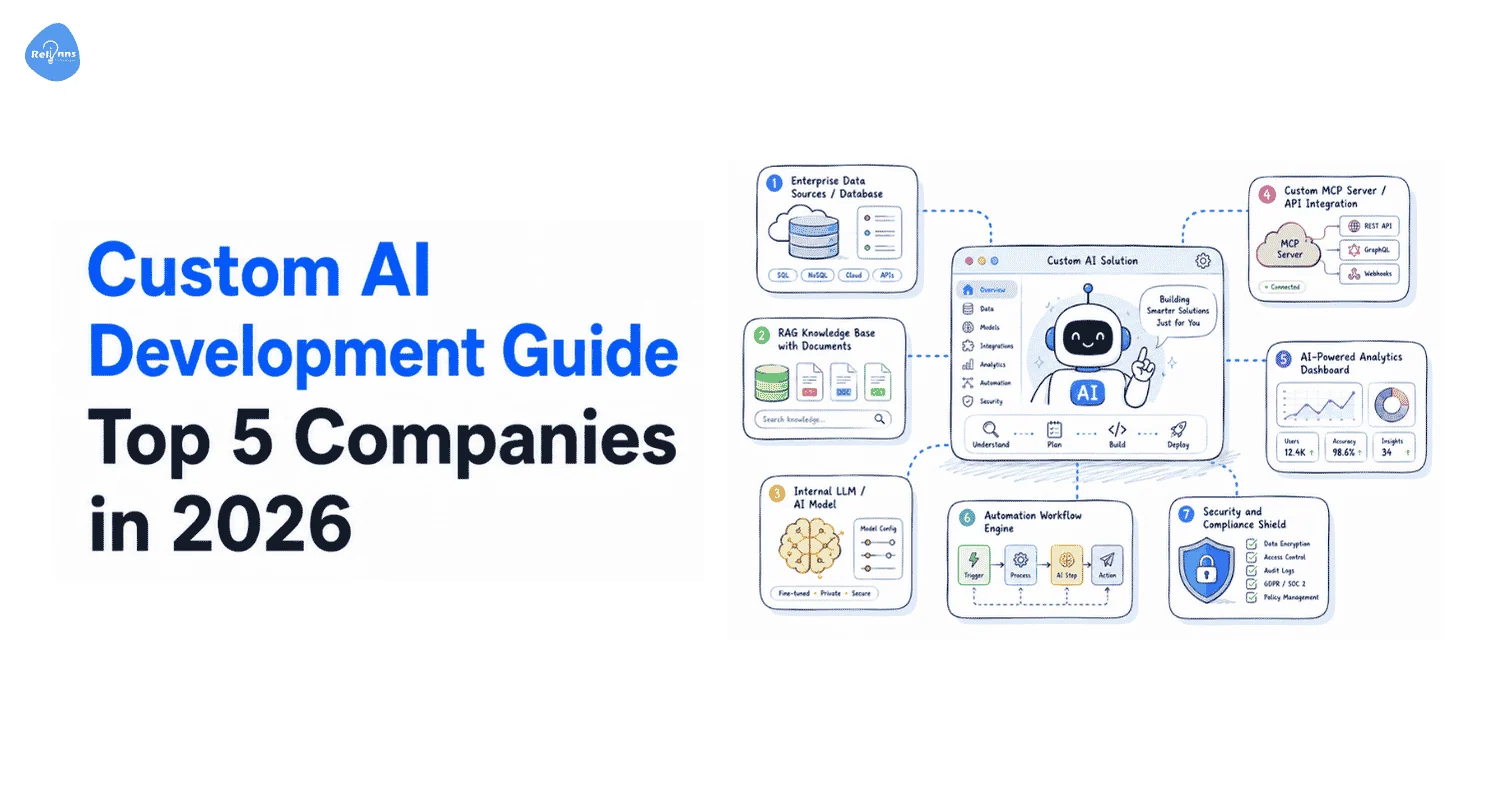
Custom AI Development Guide: Top 5 Companies in 2026
Date
May 15, 26
Reading Time
15 Minutes
Category
Custom AI Development
Share


A clinic in Dubai loses 30 appointments a week because nobody picks up the phone after 6pm. A logistics company in the UK has a team of six agents whose entire job is answering "where's my order." Both of them tried an off-the-shelf AI tool. Both hit its ceiling within 90 days.
That's the pattern right now across healthcare, logistics, insurance, and retail. Generic AI tools get you to 60%. Then they stop.
What changed in 2025-2026 is that "good enough" stopped being acceptable. Companies aren't running AI experiments anymore. They're running operations on AI. And that shift means the bar for what a vendor needs to deliver has moved completely.
This guide covers what custom AI development is, how to know if your business actually needs it, what separates a real vendor from a wrapper shop, and which five companies you should seriously consider in 2026.
One thing upfront: most companies that paid for "custom AI" in 2025 got a GPT-4 wrapper with a branded UI. Buyers in 2026 know the difference. This guide will make sure you do too.
What is Custom AI Development?
Custom AI development means building AI systems around your data, your workflows, and your specific outcomes. Not taking a general tool and hoping it fits. Built from the ground up for how your business actually runs.
That's the short version. But the gap between that definition and what most vendors actually sell is wider than most buyers realize.
What's the difference between custom AI and off-the-shelf AI?
Off-the-shelf AI is built for the average company. Which means it works reasonably well for nobody in particular. You get fast deployment, a familiar UI, and performance that plateaus the moment your use case gets specific.
Custom AI is the opposite trade-off. Slower to build, higher cost upfront, but it trains on your data and gets better as your operation grows. The performance ceiling is yours to define, not the vendor's.
| Off-the-Shelf AI | Custom AI Development | |
| Training data | Generic public datasets | Your proprietary data |
| Integration depth | Surface-level API connections | Native to your CRM, EHR, TMS, or WMS |
| Cost structure | Low upfront, recurring per-seat or per-query fees | Higher upfront, owned asset with no usage caps |
| Performance ceiling | Fixed by the vendor's model | Scales with your data and retraining |
| Data ownership | Vendor's servers, their terms | Yours. Full stop. |
| Compliance control | Limited. You depend on their certifications | Built to your regulatory requirements |
If your use case is answering generic FAQs or summarizing emails, off-the-shelf is fine. But if you're routing insurance claims, managing cold chain exceptions, or handling clinical triage, you need a system that understands your specific logic. Generic tools don't get there.
The Third option: Modified existing platforms
There's a middle path worth knowing about. You take a foundation model like GPT-4o, Llama 3, or Mistral and fine-tune it on your own data. You're not building from scratch, but you're not using it out of the box either.
This works well when your use case is largely covered by a general model but your domain vocabulary, tone, or compliance requirements need specific shaping. A legal firm training a model on 10 years of their contract language. A hospital training one on their discharge summary format.
The catch: a lot of vendors sell this as "custom AI" when it's a fine-tuned wrapper with a branded chat interface. Ask any vendor you're evaluating what they mean by custom. If they can't name the architecture, the training pipeline, and the evaluation methodology in the first call, that's your answer.
What custom AI development is not
Worth being direct about this because the market is noisy.
It's not a chatbot you set up on a no-code platform in an afternoon. Tools like that have their place, but they're configuration, not development.
It's not the "AI" feature your existing SaaS vendor quietly shipped last quarter. That's their model, their data, their decisions about what it optimizes for.
And it's not a one-time build. Any vendor who hands you a finished system and walks away has sold you a depreciating asset. AI systems need retraining as your data changes. A custom AI solution without a retraining plan is a six-month system pretending to be a long-term one.
What is the Need for Custom AI Development?
Generic AI tools work until your operation gets specific. Then they stop.
Off-the-shelf platforms are built for the average company. If your workflows, data, or compliance requirements are in any way particular to your industry, you'll hit that ceiling faster than you expect.
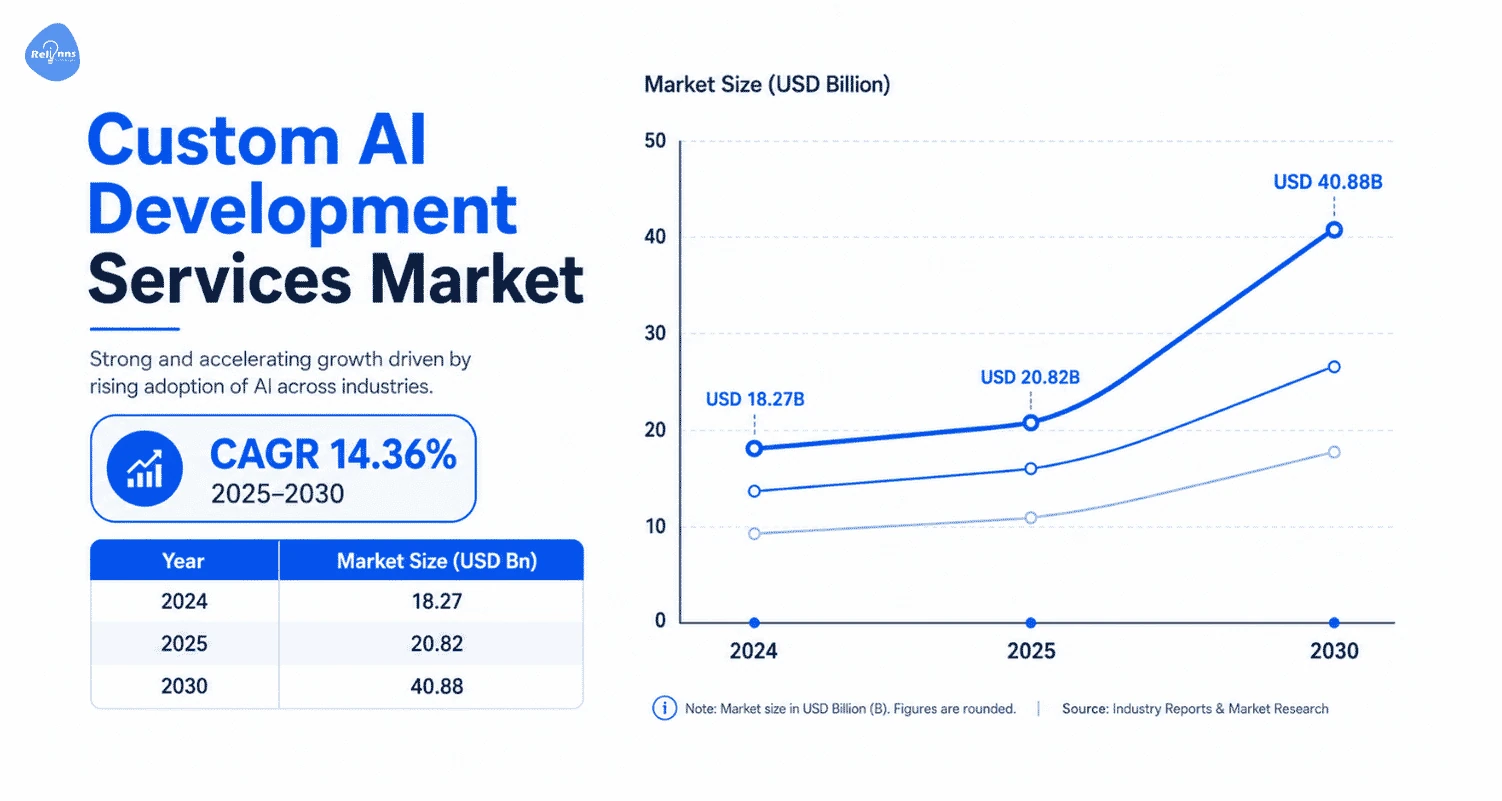
Why Generic AI Tools stop working at scale
Generic AI tools are built for the median company. If your operation has anything specific about it, you're already outside their design parameters.
The gaps show up fast. Accuracy plateaus at 60-70% because the model has never seen your data. Your EHR, TMS, or CRM has no real integration, just a surface-level API that breaks under load. And in regulated industries, you're handing patient data or financial records to a vendor whose compliance posture you don't control.
The Industries where Generic AI breaks first
Some sectors feel this faster than others.
Healthcare runs on proprietary clinical protocols and EHR systems like Epic or Oracle Health. A generic chatbot doesn't know what your discharge workflow looks like or how your TPA handles pre-auth. You require custom RAG enabled Chatbot made specifically for healthcare industry.
Insurance has claims logic that's specific to your products, your underwriting rules, your regulatory jurisdiction. Off-the-shelf models guess at that logic.
Logistics involves multi-carrier coordination, cold chain exceptions, and TMS integrations that vary by operator. Generic tools handle none of that without significant custom work, at which point you're basically building custom anyway.
Finance and NBFCs operate under KYC rules, collections compliance, and regulator-specific requirements that change by market. A model trained on general financial data doesn't understand the difference between a gold loan recovery call in the UAE and a personal loan reminder in the UK.
The Compounding advantage over time
Custom AI systems get better as you feed them more of your data. Generic tools don't learn your business. They stay static while your operation grows around them.
A simple way to think about ROI: take the current cost of a process (say, a team of six handling WISMO calls at $8k/month), apply the resolution rate a custom AI achieves (typically 65-80% for high-volume, repetitive query types), and multiply by 12. That's your annual floor. The number usually justifies the build cost within the first year.
The 2026 shift: From pilots to production
Most executives agree that AI matters. Far fewer have moved past the pilot stage. The gap isn't about belief, it's about build quality and vendor capability.
What changed in the last 18 months: agent frameworks got production-ready, vector databases got fast enough for enterprise query volumes, and deployment tooling stopped being the bottleneck. The infrastructure excuse is gone.
If your vendor is still pitching you a proof of concept in 2026, ask them why they need one. A vendor who has shipped production systems doesn't need to prove the concept. They already have.
What Industries Benefit Most from Custom AI Solutions
Not every industry feels the pain of generic AI at the same speed. But four sectors keep coming up in nearly every conversation about where custom AI actually moves the needle.
Healthcare
A hospital running 400 outpatient visits a day can't afford a front desk that misses calls or a follow-up system that doesn't exist. Custom AI Solutions in healthcare handles appointment booking, pre-auth coordination, post-visit follow-ups, and clinical triage routing all connected to the EHR the hospital already runs on. Generic tools can't touch EHR integrations without significant workarounds. And in a HIPAA-regulated environment, data handling isn't something you leave to a vendor's default settings.
Insurance
Insurance is rules-heavy by design. Claims logic, underwriting criteria, pre-authorisation workflows these aren't generic problems. A custom AI solution built for an insurer understands the difference between an FNOL call and a policy renewal reminder, and handles both without routing everything to an agent. Off-the-shelf tools treat all insurance interactions the same. They're not.
Supply Chain and Logistics
This sector runs on integrations. Your TMS, your carrier APIs, your warehouse management system a generic AI tool sits on top of all of that and calls it "connected." Custom AI gets built into the operation, so when a cold chain exception happens at 2am, the system flags it, escalates it, and logs it without a human in the loop.
Ecommerce and Retail
Fifty to seventy percent of support tickets in ecommerce are some version of "where's my order." That's fully automatable. But beyond WISMO, custom AI handles cart recovery, seller onboarding on marketplaces, reorder nudges for B2B buyers, and loyalty engagement across channels. The retailers seeing real returns aren't using AI as a support cost-cutter. They're using it to drive repeat revenue.
Does Your Business Need Custom AI Solutions?
Not every company should be building custom AI right now. Some should. Let's figure out which side you're on.
How much does custom AI development cost?
Rough ranges by project type:
- AI voice agent (appointment booking, call handling): $5k to $15k
- AI chatbot with CRM integration: $10k to $25k
- RAG system on internal documents: $10k to $30k
- Full LLM fine-tune on proprietary data: $80k to $150k+
- Full agentic workflow build: $20k to $60k
These are educated starting points. The actual number moves based on four things: how clean your data is, how complex your integrations are, whether you're in a regulated industry, and what post-launch support looks like.
The mistake most buyers make is comparing upfront build cost to nothing. The real comparison is upfront build cost versus what you're currently spending on the manual process it replaces. That math almost always favors building.
And if you want a real number for your specific use case, talk to Relinns. We're not the cheapest option on the market, and we're not trying to be. We're the team with one of the lowest client churn rates in the industry because we build things that keep working six months after go-live. Don't take our word for it. Ask our clients.
How long does custom AI development take?
| Project Type | Typical Timeline |
| AI chatbot with CRM integration | 4 to 8 weeks |
| AI voice agent (appointment booking) | 6 to 10 weeks |
| Full agentic workflow build | 10 to 18 weeks |
| RAG system on internal documents | 8 to 14 weeks |
| LLM fine-tuning on proprietary data | 14 to 22 weeks |
Three things stretch every timeline:
1) Poor data readiness at project start
2) No clear internal owner making decisions, and scope changes after sprint 2. All three are avoidable with the right scoping conversation before you sign anything.
Checklist before you approach any AI vendor
Before you get on a call with anyone, answer these honestly:
- Do you have labeled historical data in a usable format?
- Is there one person internally who will own this system after go-live?
- Do your existing tools have documented APIs or integration points?
- Can you define success as a number, not a feeling? ("Reduce inbound call volume by 40%" not "improve customer experience.")
- Is leadership aligned on a 12-month horizon, not a 6-week pilot?
If you answered no to more than two of these, fix those gaps before you start any vendor conversation. A good vendor will tell you the same thing.
When custom AI is the right call
Scenario 1: Your process has no generic equivalent, for example Cold chain temperature exception routing. Pre-auth coordination between hospital, TPA, and insurer. Multi-carrier NDR handling. These don't exist in any off-the-shelf tool.
Scenario 2: Your data is proprietary and using it gives you a real performance edge. Years of claims data, transaction history, patient records. That's an asset sitting unused. Custom AI turns it into a system that gets smarter as your business grows.
Scenario 3: You're in a regulated industry where data can't leave your environment. HIPAA, FCA, RBI. Your compliance team won't sign off on a vendor whose servers you don't control. Custom AI built on your infrastructure solves that.
When you should wait
Two situations where building custom right now is the wrong move.
First when you have no clean historical data. No training data means no model worth building. Invest in data infrastructure first.
And second if you've never tested an off-the-shelf tool for this use case, start there. Not because it'll solve your problem, but because seeing exactly where it breaks gives you the clearest possible brief for a custom build.
What is the Typical AI Development Process?
Every serious custom AI development company runs some version of this sequence. The details vary, but the skeleton doesn't.
1. Discovery and scoping. Before any code gets written, the team maps your workflows, audits your data, and defines what success looks like as a measurable number.
2. Data preparation. Usually the most underestimated phase. Clean, labeled, structured data is what separates a model that works from one that doesn't.
3. Model selection and development. Build from scratch, fine-tune a foundation model, or connect existing models through an agent framework. The right choice depends on your use case and data volume.
4. Integration. The AI connects to your actual systems: your CRM, EHR, TMS, or WMS. This is where most vendor timelines slip.
5. Testing and go-live. Real traffic, not synthetic test cases.
6. Retraining and iteration. Ongoing. A custom AI solution that stops learning after launch starts degrading within months.
What to Look for in a Custom AI Development Company
Picking the wrong vendor for a custom AI build is expensive in two ways. You pay for the build, and then you pay again to fix what didn't work. The market is full of shops who can demo something impressive and deliver something mediocre. Knowing how to tell them apart before you sign is the whole game.
What should I ask before hiring an AI development company?
Five questions worth asking every vendor on your shortlist, in this order:
"Can you show me a production deployment in my industry, not a demo?"
A demo is a controlled environment with clean data and a prepared script. A production deployment is messy, real, and actually proves capability. If they can't point to one, that's your answer.
"Who maintains and retrains the model after go-live?"
A surprising number of vendors have no answer to this. The build team ships the system and moves to the next client. Ask specifically who owns retraining, how often it happens, and whether it's included in the contract or billed separately.
"What does your integration process look like with our specific systems?"
Name your CRM, EHR, TMS, or WMS and watch how they respond. A vendor with real integration experience will ask follow-up questions about your API documentation. A vendor without it will say "we can integrate with anything."
"How do you handle data security and compliance in our environment?"
For healthcare, insurance, and finance buyers especially. You want specifics, not reassurances. Which frameworks do they follow? Where does data sit during training? Who has access?
"What does pricing look like after month 6?"
The build cost is one number. The ongoing support, retraining, and maintenance cost is another. Get both upfront.
The four things that separate real vendors from GPT wrapper shops
First, they name specifics before you sign.
Ask them what models, frameworks, and architecture they'd use for your use case. A credible custom AI development company answers that question in the first call. Vague answers about "using the best available AI" mean they'll decide after you pay.
Second, they have production deployments with measurable outcomes.
Not a PDF with a client logo and a quote. Actual numbers: automation rate achieved, call volume deflected, time-to-resolution improvement. If they can't produce that, their case studies are marketing copy.
Third, post-launch support is in the contract, not an afterthought.
Retraining schedules, performance benchmarks, escalation paths. All of it written down before go-live.
Fourth, and this one matters a lot: they push back.
A vendor who agrees to every requirement in your first call isn't being helpful, they're being dangerous. Good custom AI development services require scoping work, data audits, and honest conversations about what's achievable. If a vendor says yes to everything without asking hard questions, they either don't understand the problem or they're planning to figure it out at your expense.
Industry-specific questions worth asking
Every sector has its own version of "can you actually do this."
Healthcare buyers: Ask specifically about EHR integration experience. Epic and Oracle Health have different API structures. If they've only worked with custom HIS systems, that matters. Ask about HIPAA data handling during the training phase, not just at deployment.
Insurance buyers: Ask how they've handled pre-auth logic and TPA coordination. These workflows have specific business rules that vary by carrier and market. Generic AI agents break on edge cases here.
Logistics buyers: TMS integration and multi-carrier API experience are non-negotiable. Ask how their agentic systems handle exceptions, because exceptions are 30% of logistics operations.
Ecommerce buyers: Ask about OMS and WMS integration depth and what WISMO automation rates they've achieved in production. If you're in the GCC, ask specifically about WhatsApp channel experience. That's where your customers are.
Red flags to walk away from
A demo that runs on synthetic data, not a live client environment. No maintenance clause in the contract. An inability to explain how they measure model performance after go-live. And scope defined as a feature list rather than outcomes.
Any vendor who can't tell you what success looks like as a number isn't ready to be held accountable to one.
Top 5 Custom AI Development Companies in 2026
Every company on this list was selected on the same criteria: production deployments in real client environments, named integrations with industry-specific systems, a tech stack that reflects what's actually being built in 2026, and geographic coverage in Tier 1 markets. No demos. No "we work across all industries" generalism.
1. Relinns Technologies
Relinns is the clearest choice on this list for mid-to-large businesses in healthcare, insurance, Logistics, and Ecommerce & Retail. Not because of the marketing, but because of how the work is scoped.
Most custom AI development companies hand you a finished system and move on. Relinns builds with a retraining plan, defined success metrics, and post-launch support built into the engagement from day one. That's a meaningful difference when you're 6 months into production and your data has drifted.
Geography: Tier 1 presence across the US, UK, UAE, and Canada. Strong GCC coverage, which matters if WhatsApp is your primary customer channel.
Tech stack: Retell AI and ElevenLabs for voice agents, LangChain, LlamaIndex, CrewAI for agentic builds, Pinecone and Weaviate for RAG, GPT-4o, Claude, and Llama 3.x depending on compliance requirements. WhatsApp Business API via Meta for GCC deployments.
Also another upper hand relinns has is thier own Agentic chatbot platform, Botpenguin which reduced dependencies on third party tools and gives you as a custom more control over your tech stack.
Notable use cases: AI voice agents handling 4000+ daily inbound calls at hospital chains, WISMO automation for ecommerce 3PLs, collections reminder systems for NBFCs, pre-auth coordination for insurance TPAs, all round delivery in these verticals.
2. LeewayHertz
LeewayHertz has been building AI systems since 2010 and has over 160 solutions shipped across banking, retail, insurance, and logistics. They're one of the few vendors with documented enterprise logos like Siemens and Shell, which tells you something about their ability to handle complex, regulated environments.
Geography: Strong US presence. Good enterprise reach in Europe.
Tech stack: ChatGPT, PaLM 2, Mistral, BERT, LLaMA. Their ZBrain platform handles enterprise RAG Development and agentic workflows.
Limitation: Their strength is in generative AI and LLM-based builds. If your priority is voice AI or WhatsApp-native workflows in MENA, they're not the natural fit.
3. Mind Studios
Mind Studios takes a consulting-first approach, which works well for companies that need to map their workflows before they can spec a build. They've delivered custom AI solutions across logistics, real estate, healthcare, and fintech.
Geography: Serves mid-sized to enterprise clients across the US and Europe.
Strength: Strong at integrating AI into legacy systems, which is a real problem for companies that have been running the same ERP or CRM for a decade.
Limitation: Less visible in regulated industries like insurance and healthcare at the depth that sector-specific buyers need. Good generalist, not a vertical specialist.
4. Markovate
50 engineers focused on generative AI, with work across retail, healthcare, and fintech. Active on Clutch with solid client reviews. They're a reasonable choice for companies running a focused GenAI build without heavy integration requirements.
Geography: US and India delivery teams.
Limitation: No documented MENA presence and no WhatsApp-native AI experience. If you're building for a GCC market or need EHR/TMS depth, look elsewhere.
5. DICEUS
15 years in custom software with a growing AI practice. Offices across North America and Europe, 250 engineers, and a track record in fintech, insurance, logistics, and healthcare.
Geography: Strong in the US and Eastern Europe. UAE office listed.
Strength: Wide service range including data migration, system integration, and AI development under one roof, which matters if your build requires heavy infrastructure work alongside the AI layer.
Limitation: AI development is one of many services, not the core focus. For companies whose primary requirement is a production-grade AI system with vertical depth, a more AI-native vendor will move faster and go deeper.
No competitor article on custom AI development has a table like this. Most lists give you company names and marketing copy. This gives you what you actually need to compare.
| Relinns Technologies | LeewayHertz | Mind Studios | Markovate | DICEUS | |
| Primary Geography | US, UK, UAE, Canada, GCC | US, Europe | US, Europe | US | US, Europe, UAE |
| Top Verticals | Healthcare, Insurance, Logistics, Ecommerce, Finance | Banking, Retail, Insurance, Logistics | Logistics, Healthcare, Fintech, Real Estate | Retail, Healthcare, Fintech | Fintech, Insurance, Logistics, Healthcare |
| Key Services | AI Voice Agents, AI Chatbots, RAG Systems, LLM Fine-tuning, WhatsApp AI, Agentic Workflows | Generative AI, RAG, LLM builds via ZBrain platform | Custom AI integration, Legacy system AI, Consulting-first builds | Generative AI, LLM fine-tuning, AI consulting | Custom AI, Data engineering, System integration, LLM builds |
| Vertical Depth | Strong, named EHR/TMS/WMS integrations | Strong in banking and manufacturing | Moderate, generalist across sectors | Moderate, focused on GenAI layer | Moderate, broader software scope |
| GCC / WhatsApp AI | Yes, active | No | No | No | Limited |
| Minimum Deal Size | Not Published | Not published | Not published | Not published | Not published |
| Clutch / Review Score | Strong client retention, low churn | Enterprise logos (Siemens, Shell) | Solid portfolio | Strong Clutch reviews | 4.9/5 across 49 Clutch reviews |
| Honest Limitation | Less suited for Startups and SMB's | Less suited for voice AI or GCC-specific builds | Not a vertical specialist for regulated industries | No MENA presence, limited integration depth | AI is one of many services, not core focus |
The pattern is clear. If your operation sits in healthcare, insurance, logistics, or ecommerce and you need a vendor who understands your systems by name, not category, Relinns is the only company on this list with that combination of vertical depth, GCC coverage, and a 2026-relevant stack across voice agents, chat, RAG, and agentic workflows.
All the Companies in this list are amongst the top choices and market leaders so this list is not ranking them but rather giving you a narrowed down options and their details to choose from.
Why Custom AI Projects Fail (and How to Avoid It)
Most write-ups on custom AI development skip this part. They shouldn't. Knowing why these projects fail is more useful than any vendor shortlist.
- No clean data at project start. The vendor inherited the cleanup problem, didn't scope it, and the timeline doubled.
- No internal owner post-launch. The system went live, nobody managed it, and performance degraded quietly by month 3.
- Pilot success, production failure. 500 test queries looked great. Real traffic exposed edge cases the model had never seen.
- Integration underscoped. The EHR or CRM integration took three times longer because nobody audited the API documentation before signing the contract.
- Success metric defined too late. "Improve customer experience" is not a metric. No metric means no accountability.
What a responsible vendor does differently
A good custom AI development company runs a data audit before scoping anything. They put defined KPIs in the contract, not the deck. They agree on a retraining schedule before go-live, not after the model starts underperforming. And they map integrations to real API documentation, not assumed capability.
If your vendor skips any of these steps, you're funding their learning curve.
Custom AI in 2026 isn't something you plan for next year. It's an operational decision you're already behind on.
Before you talk to any vendor: clean data, an internal owner, a measurable success metric, and a partner who knows your vertical. That's the whole checklist.
Frequently Asked Questions (FAQ’s)
How much does custom AI development usually cost?
Ranges from $5,000 for a basic voice agent to $150,000+ for a full Agentic AI System with LLM + RAG fine-tune etc, depending on integration complexity and compliance requirements.
How do you choose between custom AI and off-the-shelf tools?
If your use case is generic, start off-the-shelf. If your data is proprietary or your industry is regulated, build custom.
How long does it take to build a custom AI solution?
Simple chatbots take 4 to 8 weeks. Agentic workflows and RAG systems run 10 to 18 weeks. LLM fine-tunes take longer.