What Are AI Voice Agents and How Do They Work?
Date
Sep 23, 26
Reading Time
18 Minutes
Category
AI Voice Agents
Share


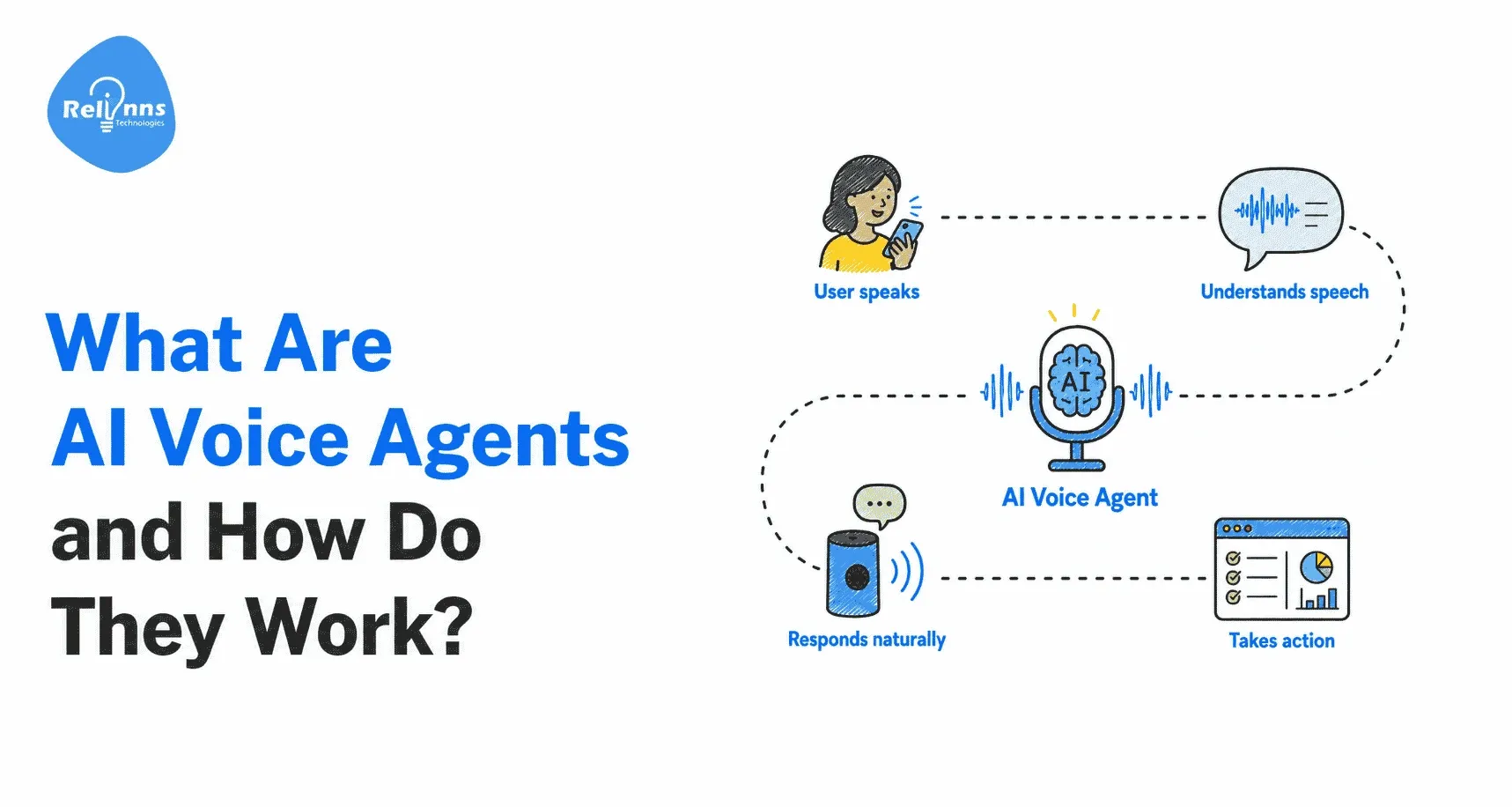
→ What an AI voice agent is: Autonomous software that handles full phone conversations, understands caller intent, and completes tasks without a human in the loop
→ How it works: Speech recognition converts voice to text, an LLM processes intent and context, an action engine calls your live systems, and text-to-speech delivers the reply in under a second
→ What it can do: Book appointments, track orders, initiate claims, send payment reminders, answer FAQs, and hand off to a human with full context intact
→ Where it fits: Clinics, logistics operators, insurers, lenders, and ecommerce teams handling 200+ calls per month on repeatable workflows
67% of customers hang up when they hit an automated phone menu. They don't call back.
Missed calls cost businesses thousands in lost appointments, abandoned orders, and customers who moved to a competitor. Most phone systems date from a world where staff answered every call. That world is gone.
AI voice agents answer every call, around the clock, without a queue. This guide covers what they are, how they work, and where they deliver real value.
An AI voice agent is software that handles phone conversations without a human. It listens, understands what the caller wants, and acts on it through connected systems by booking appointments, checking order status, and initiating claims. Unlike IVR menus, it reasons across a full conversation and completes the task.
If you manage operations, customer support, or a front desk, then this article is for you.
What Is an AI Voice Agent?
An AI voice agent is an autonomous software system that handles spoken conversations end to end.
It has 3 simple components at its core: interface, intelligence, and agency.
Interface: voice
The caller speaks. The agent listens and responds in natural speech, without a menu of options.
Intelligence: AI and LLM reasoning
The agent understands the intent behind what a caller says, holds that context across the call, and decides what to do next. It handles interruptions, follow-up questions, and context shifts without a script.
Agency: the ability to act
A voice assistant responds. An AI voice agent books an appointment, answers a policy question, or routes the call to the right person after it reasons through what the caller needs.
How Do AI Voice Agents Work?
Every call moves through five stages in under a second, each handing off seamlessly to the next.
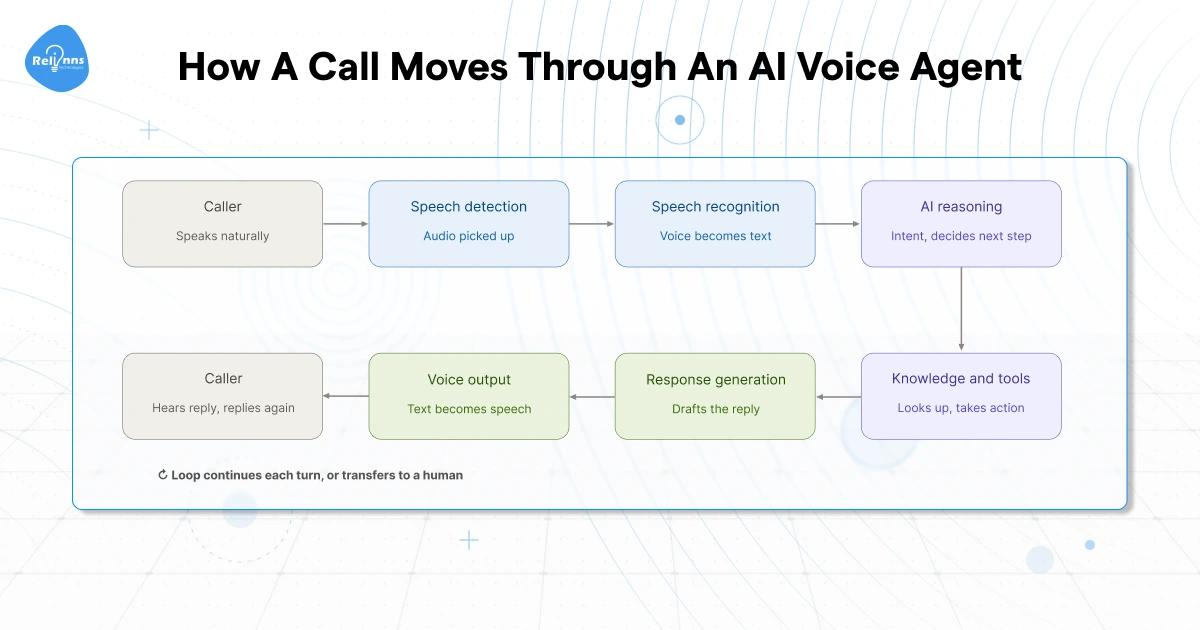
- ASR (Automatic Speech Recognition): Converts the caller's voice to text in real time, handling accents, noise, and varied pacing without dropping words.
- NLU (Natural Language Understanding): Reads meaning, not just words. A caller saying "move my appointment from Tuesday to Thursday" is parsed into intent (reschedule), entities (appointment, dates), and required action, rather than a keyword match.
- LLM Reasoning: The large language model takes that intent, checks conversation history, applies its instructions, and decides what to do next. It holds context across turns and knows when to escalate to a human.
- Action Engine: Executes the decision by calling the systems the business already runs: calendars, CRMs, order management, payment platforms. It doesn't simulate completing tasks. It completes them.
- TTS (Text-to-Speech): Converts the response back to voice with natural cadence and pacing. On a well-built agent, callers rarely notice the difference in the first few exchanges.
Most developers who build AI voice agents for the first time walk in with the same assumption: pick a good model, write a solid prompt, ship. Six weeks later they're debugging dropped calls, chasing latency spikes, and wondering why the agent confidently answers questions with information it fabricated.
What Technologies Power an AI Voice Agent?
A voice agent runs on nine components working together. Each one does a specific job, and none of them work alone.
Telephony and voice channels
The call has to reach the agent first. Telephony connects the caller's phone system to the agent, whether that's an inbound number, an outbound dialer, or a web-based voice channel.
Voice activity and turn detection
The agent needs to know when the caller is talking and when they've stopped. This layer catches pauses, filters background noise, and decides when to respond instead of interrupting.
Speech-to-text
The caller's audio becomes text in real time. This is the same job ASR does in the call flow above, converting speech to a format the AI can reason over.
Large language models
The LLM reads the transcribed text, holds context across the conversation, and decides what to do next. This is the reasoning layer.
Knowledge retrieval and RAG
An LLM's training data goes stale the moment it's trained. Retrieval-augmented generation grounds the agent's answers in current, business-specific information instead of what the model already knows, checking a knowledge base or database before responding rather than guessing from memory.
Tools and API integrations
Answering a question is one thing. Booking an appointment, pulling an order status, or updating a CRM record is another. Tools and API integrations let the agent act on the systems a business already runs, not just talk about them.
Memory and conversation state
A caller shouldn't have to repeat their name three times during a single call. Memory holds what's been said earlier in the conversation, and in some deployments, across multiple calls.
Text to speech
The agent's response becomes voice. Pacing, tone, and how fast the first sound reaches the caller all shape whether the reply feels natural or robotic.
Orchestration and guardrails
Something has to coordinate all eight of the above, decide when to call a tool, when to escalate, and when to stop the agent from saying something it shouldn't. Orchestration and guardrails are the layer that holds the rest together.
Getting each piece right matters more than picking a specific vendor or model. The stack decisions, which provider to choose for each layer, how to wire them together, and how to test the result, are covered in how to build an AI voice agent .
What Can AI Voice Agents Actually Do?
Break it into four buckets: understand, answer, act, escalate.
Understand
The agent parses free-form speech, not fixed commands. It catches intent, holds context across multiple turns, and follows references back to something said three sentences ago.
Answer
FAQs, policy questions, product details, account information. The agent pulls from what it already knows and responds without looking anything up.
Act
Booking, canceling, rescheduling, creating a ticket, retrieving an order, updating a record, collecting information. This is where the agent stops talking and starts performing an action within a connected system.
Escalate
The agent recognizes when a request sits outside what it can handle and transfers the call, along with the context already gathered, to a person.
That four-way split is also what separates a voice agent from a basic voice assistant. A voice assistant answers. A voice agent understands, answers, acts, and escalates when it should.
How Do AI Voice Agents Connect With Business Systems?
A voice agent that only talks is a voice assistant. What makes it an agent is the layer underneath: the connection to the systems a business already runs.
The model is simple. A caller speaks. The agent decides what the caller needs. Then it reaches into a business tool to get the answer or complete the task, and responds with the result.
That connection happens through:
- CRM systems, to pull caller history and write back outcomes
- Helpdesk platforms, to create or update tickets
- Calendars, to check availability and book appointments
- EHR systems, to look up patient records in healthcare deployments
- Order management systems, to check status and process returns
- Payment platforms, to process transactions or send reminders
- Knowledge bases, to ground answers in current, business-specific information
- ERP systems, to check inventory or trigger downstream workflows
- Custom APIs, for anything the business runs that doesn't fit a standard category
Each connection turns a spoken request into a real action. Without it, the agent can only describe what it would do.
How Do AI Voice Agents Know When to Transfer to a Human?
An agent transfers when it hits one of a few triggers:
- It can't determine intent
- Confidence drops below the threshold. According to a research in 2023 by Elias Stengel-Eskin and Benjamin Van Durme found 0.40 to be the optimal confidence threshold for rejecting low-confidence outputs in their task-oriented dialogue experiment.
- The caller asks for a person directly
- The request falls outside its scope
- or a connected system fails mid-call.
A good handoff carries context with it. The human agent should receive the call along with the transcript, the caller's intent, anything already collected, and relevant account details, not a blank screen and a caller repeating themselves from scratch.
What's the Difference Between an AI Voice Agent, a Chatbot, an IVR, and a Voice Assistant?
These four systems are constantly lumped together. They are not the same thing. The differences matter more than most buyers realise when shortlisting vendors.
| IVR | Voice Assistant | AI Chatbot | AI Voice Agent | |
| Modality | Voice only | Voice, consumer device | Text only | Voice, inbound and outbound |
| Conversation style | Rigid menu trees. Press 1 for billing. | Single-turn commands | Multi-turn text dialogue | Multi-turn voice. Handles interruptions, follow-ups, and context shifts. |
| Intelligence layer | Rule-based scripts. No language understanding. | Basic intent recognition, limited context | LLM-powered with persistent context | LLM plus full voice stack. Real-time reasoning with memory. |
| Action capability | Route calls. Play recordings. | Timers, search, smart home controls | API integrations, CRM updates, bookings | Full API integrations across any business system |
| Best-fit use case | Basic inbound routing | Consumer quick queries | Website and app text support | Autonomous phone handling at scale |
AI voice agents vs IVR systems differ fundamentally. IVR routes callers through fixed menus, while voice agents understand intent and complete tasks. Voice assistants answer consumer commands.
The core difference between AI voice agents and chatbots is the interaction layer: chatbots handle text-based conversations, while voice agents operate over live speech. An AI voice agent does what none of the others can: it holds a full voice conversation, reasons through what the caller needs, and completes the task without a human in the loop.
Is a Voice Bot the Same as an AI Voice Agent?
The terms get used interchangeably, and that's the problem. Voice bot has no fixed definition. The distinction between a voice bot and a voice agent depends on what lies beneath the label. Others use it for the same thing an AI voice agent is.
When you see "voice bot" on a vendor's site, check what's underneath the label: rule-based scripts or an LLM that reasons and acts. The name tells you nothing on its own.
Is an AI Receptionist the Same as an AI Voice Agent?
An AI receptionist is a job, not a technology. It's an AI voice agent configured for one specific role:
- Answering the front desk line
- Routing calls
- Taking messages
- Booking appointments, etc
For businesses deciding between automation and front-desk staffing, the human receptionist vs voice agents comparison covers the operational tradeoffs directly. A voice agent handling outbound collections calls or claims intake isn't a receptionist at all, even though it's built on the same underlying stack.
What Are the Different Types of AI Voice Agents?
Two ways to classify them: by call direction, and by how much they're allowed to do on their own.
By call direction
- Inbound agents answer the calls that come in: receptionist duties, support, booking, routing, status checks.
- Outbound agents initiate the calls: reminders, confirmations, follow-ups, collections, qualification.
Most deployments start with one direction and add the other once the first workflow is stable. The choice between inbound vs outbound voice AI depends on who initiates the conversation and what workflow the agent owns.
By level of autonomy
- Informational voice AI answers questions. It doesn't take action, it responds.
- Transactional voice agents execute defined actions: booking an appointment, updating a record, initiating a claim.
- Agentic voice AI coordinates multiple steps, tools, and decisions toward an objective, checking a system, deciding what to do with the result, then acting on it without a human directing each step.
Most businesses evaluating a voice agent today are looking at transactional deployments. Agentic voice AI is the direction the category is moving, not where most production systems sit yet.
When Should a Business Use an AI Voice Agent?
A voice agent works best when several things line up: high call volume, repeatable intents, structured outcomes, data and APIs the agent can reach, clear escalation conditions, and a way to measure whether it's working.
Strong fit:
- "Where is my order?"
- "Can I reschedule my appointment?"
- "What documents do I need?"
Poor fit:
Complex negotiations, ambiguous high-stakes decisions, edge cases that need judgment rather than a lookup.
If a call type appears frequently, follows a pattern, and ends with a clear outcome, it's a candidate. If it doesn't, it stays with a person.
What Are the Benefits of AI Voice Agents?
The business case isn't about replacing staff. It's about removing the ceiling on what your phone channel can handle and cutting the cost of every interaction that flows through it.
- Every call gets answered, around the clock:
A missed 9pm call is a lost appointment, a loan application that went to a competitor, a customer who won't call back. AI voice agents answer at any hour with full capability revenue stops leaking at close of business.
- Volume spikes stop being a staffing problem:
Human teams hit capacity. AI voice agents scale to thousands of concurrent calls during launches, billing cycles, or demand surges no overtime, no quality drop, no scrambling.
- Cost per interaction drops sharply:
Human agents cost $0.70–$12 per call factoring in salary and overhead. AI voice agents handle the same interaction for $0.03–$0.40. At thousands of calls per month, that gap compounds fast.
- One agent, 70+ languages:
Multilingual support without multilingual hiring. Businesses expanding into new markets don't need to rebuild their support model from scratch.
- Consistent by design:
Human agents have off days, go off-script, give conflicting answers. An AI voice agent applies the same logic on every call compliance and consistency become structural, not something you manage.
- Data writes itself:
Every call logs to your CRM, updates records, and captures outcomes automatically. No manual note-taking, fewer errors, faster data for your downstream teams.
- Hold times drop to zero:
Hold time exists because demand exceeds supply. When AI handles routine volume, the callers who reach a human are there because they need one not because the queue was too long.
- Fewer live reps needed for routine volume:
Most operations cut their live-rep requirement for inbound routine calls by 30–50% once an AI voice agent handles appointment confirmations, order status checks, and payment reminders.
Not all voice AI platforms do the same thing. Some are developer infrastructure, others are full contact center suites, and the right fit depends on whether you need turnkey speed or component-level control. See our detailed breakdown of the top AI voice agent providers for a full comparison of pricing, latency, and integrations.
AI Voice Agents vs. Humans: Where Should Each Handle the Call?
The right split in AI voice agents vs human agents depends on whether the call needs repeatable execution or human judgment.
- Repetitive, high-volume, structured, predictable, transactional calls.
- Appointment confirmations
- Order status
- Payment reminders
Humans handle these disciplines:
- Complex, emotionally sensitive, exceptional, high-value, judgment-heavy calls.
- A frustrated customer
- An unusual claim
- A negotiation.
Most deployments run hybrid. The agent takes the volume that fits its pattern. The calls that need discretion, empathy, or authority stay with a person, and that person now spends their time on those calls instead of the routine ones.
This isn't AI replacing a team. It's AI absorbing the part of the workload that doesn't need a person, so the team handles less volume at higher complexity.
What Are AI Voice Agents Used For in Each Industry?
AI voice agents for customer service handle high-volume, repeatable calls across industries where a human doesn't need to own every interaction. For larger support operations, AI call center agents coordinate automated resolution, intelligent routing, and human handoffs across the wider contact center.
AI Voice Agent Use Cases in Healthcare
Front desks at multi-specialty clinics receive 200–500 calls a day, with 60% being appointment requests, reschedules, and report queries.
- Handles booking, rescheduling, and post-discharge follow-up calls autonomously
- Escalates to staff only when clinical judgment is genuinely needed
- Recovers no-show slots in real time instead of leaving them empty until morning
AI Voice Agent Use Cases in Ecommerce and Retail
WISMO (where is my order) accounts for 50–70% of all inbound support contacts in ecommerce operations.
- Pulls live order data and delivers status updates without transferring the call
- Handles return initiation and exchange requests end-to-end
- Runs outbound cart abandonment calls, recovering revenue that text messages alone miss
AI Voice Agent Use Cases in Insurance
The first-notice-of-loss call determines how a claim starts and most insurers handle it with an overloaded team.
- Captures FNOL details, verifies coverage, and logs the claim while the policyholder is still on the call
- Runs renewal outreach at scale, reaching thousands of expiring policies in a week
- Does all of this without adding a single agent seat
AI Voice Agent Use Cases in Supply Chain and Logistics
Delivery exceptions, failed attempts, and ETA queries are low-complexity and high-volume exactly the workload voice agents are built for.
- Proactively calls customers before delivery windows to confirm address and availability
- Handles inbound tracking queries without a coordinator in the middle
- Notifies dispatch teams of route exceptions in real time, cutting re-attempt costs
AI Voice Agent Use Cases in Finance and Banking
Every interaction needs to be logged, every disclosure delivered correctly, and no sensitive data mishandled.
- Follows controlled scripts for regulated disclosures on every call, without deviation
- Records all interactions and flags calls requiring human review before closing
- Recovers more delinquent EMI accounts than SMS campaigns at a fraction of the human agent cost
Building a production-ready voice agent means getting latency, interruption handling, and system prompt design right before anything else. The details on architecture and stack choices live in a dedicated build guide.
Choosing the right AI voice agent comes down to testing integration depth, latency, and escalation handling under real conditions, not demo conditions. Buyers should treat every vendor claim as something to verify before procurement, not after.
What Separates a Good Voice Agent from a Frustrating One?
Voice quality and pricing are visible before you sign. These six things aren't; run each test before any vendor conversation moves to procurement.
1. Multi-turn context retention
The most common reason callers abandon an automated call is being forced to repeat themselves. A good agent remembers the name given in turn one, the appointment type mentioned in the middle, and the preference stated just before the last question.
Demo test: Give your name in turn one. Ask an unrelated question in turn two. Reference your name in turn three without repeating it. If the agent doesn't use it correctly, context retention is broken.
Clean interruption handling
Callers interrupt, self-correct, and change their minds mid-sentence. An agent that ignores this, finishes its line anyway, and then re-asks is just a voice menu with better pronunciation.
Demo test: Let the agent start a response, then interrupt four words in with a correction. It should stop immediately, process the new input, and move forward no replay, no stutter, no ignored input.
Sub-500ms perceived latency
Published latency measures infrastructure. Perceived latency is the pause a caller experiences after asking something that requires a live API lookup. Anything above 800ms in a real call registers as hesitation and hesitation breaks trust.
Demo test: Ask something that requires a real lookup, an appointment slot, an order status, a policy number. Measure from the end of your question to the first word of the agent's reply. Do it three times. High variance or a median above 700ms means production will feel worse, not better.
Graceful fallback when confidence is low
Every agent will hit inputs it can't handle cleanly. A poorly designed one either guesses wrong or loops with "I didn't understand that." A well-designed one acknowledges the gap and routes the caller forward without making them feel like they broke something.
Demo test: Ask something genuinely ambiguous a question with two valid interpretations, or a request at the edge of its scope. A good agent clarifies or offers a clear path forward. A failing one confabulates or loops.
Human handoff without context loss
This is where most deployments lose the trust built in the first two minutes. If the human agent opens with "can you tell me your name and reason for calling," the AI has failed regardless of how well the call started.
Demo test: Ask what the human agent sees when a call escalates. The screen should show the caller's name, conversation summary, escalation reason, and collected data. A blank screen or generic notification means the handoff architecture is incomplete.
Tone calibration to match brand voice
A luxury clinic and a quick-service restaurant need different things from the same technology. An agent that sounds clinical in a casual context or breezy in a formal one will feel off to callers even if they can't articulate why. Tone isn't decoration. It's what determines whether a caller trusts the agent or asks for a human within thirty seconds.
Demo test: Ask for a call recording from a client in your industry not a generic demo. Listen for whether phrasing and pacing fit the context. Then ask how tone customisation is implemented. A vendor who can't clearly answer that question hasn't actually solved it.
Common Misconceptions About AI Voice Agents
These are the most common misconceptions our sales team encounters from business owners who are yet to implement agentic workflows the right way, which is to enable their employees.
"It will replace my customer service team"
AI voice agents handle volume; your team handles judgment.
The calls agents take off the queue are the repeatable ones: appointment confirmations, order status checks, payment reminders.
Calls requiring empathy, discretion, or authority stay with humans. Most deployments result in the same team handling higher-complexity work, not a smaller team doing the same work.
"It sounds robotic and customers hate it"
This was true in 2021. Modern TTS from providers like ElevenLabs and OpenAI produces voice output most callers can't distinguish from a human in the first thirty seconds.
The tell today isn't the voice it's poor conversation design. A well-built agent sounds natural. A poorly built one sounds robotic regardless of the underlying model.
"It only works for large enterprises"
SMB deployments are now the fastest-growing segment in the category. A dental practice, a property management firm, a logistics company handling dispatch queries all have the call volume and use case clarity to deploy profitably.
The minimum viable deployment is a single workflow with 200+ calls per month, not a 50-seat contact centre.
"It can only handle simple FAQs"
A modern voice agent can book appointments, pull live order ETAs, verify policy numbers, initiate claims intake, and route calls after gathering structured context all within a single call.
These are multi-step workflows crossing two or three integrated systems. Integration depth and agent design set the ceiling, not the technology itself.
"It will confuse and frustrate my customers"
Well-designed agents now autonomously resolve ~70% of routine calls, with CSAT scores that have risen consistently year over year.
The frustration callers report isn't with AI agents - it's with agents that loop, lose context, and can't escalate cleanly. Those are implementation problems. An understaffed human queue with four-minute hold times scores lower on CSAT than a well-built agent that answers in two seconds.
Limitations of Current AI Voice Agents
Any vendor who skips this section in their sales process is telling you something important. These are real constraints that affect production deployments know them before you build, not after you launch.
Accent and dialect accuracy gaps
- ASR models are trained on uneven datasets; mainstream American English and standard Mandarin are well-represented; regional dialects and code-switched speech are not
- A healthcare deployment in South Africa or a logistics operation in rural India will see materially higher error rates than any vendor benchmark suggests
- Before committing to a multilingual deployment, run your actual callers through the ASR layer and measure word error rate; published language support counts don't measure dialect coverage
Emotion and sarcasm recognition failures
- LLMs read text well; they read tone inconsistently
- A caller saying "great, another hold" or "whatever you say" is expressing frustration or disengagement; current models frequently miss this and don't trigger escalation
- In contexts where detecting distress early is a design requirement, this gap needs human oversight at the supervision layer, not just a model update
Hallucination risk in the reasoning layer
- LLMs produce confident-sounding outputs even when their reasoning is wrong an agent can confirm a non-existent appointment slot or cite an outdated policy detail without hesitation
- The mitigation is retrieval-augmented generation (RAG): grounding responses in live data from verified systems rather than model memory
- Deployments that skip RAG carry meaningful hallucination risk, especially around dates, prices, and policy specifics
Compliance constraints in regulated industries
- Healthcare, financial services, and insurance deployments face requirements a standard platform configuration won't satisfy out of the box
- HIPAA requires a signed BAA and documented data handling for every component in the stack telephony layer, ASR provider, and LLM included
- Platforms that offer HIPAA compliance as an enterprise add-on rather than a standard feature create liability exposure for buyers who don't read the fine print
Performance degradation in high-emotion scenarios
- AI voice agents perform well on structured, cooperative call flows and measurably worse on emotionally elevated ones fragmented sentences, mid-turn context shifts, and unstructured speech all degrade accuracy
- This isn't a reason to exclude voice agents from sensitive verticals; it's a reason to set escalation thresholds low for those call types
- Design the handoff to a human as the expected path for high-emotion calls, not the exception
Dependency on integration reliability
- An agent that books appointments via a scheduling API is only as reliable as that API when the integration goes down, the agent doesn't degrade gracefully, it fails the task entirely, often mid-call
- Integration monitoring isn't optional infrastructure; it's a core operational requirement of running a voice agent in production
- Deployments that monitor only the AI layer and leave integration uptime untracked will face unexplained call failure spikes that are hard to diagnose after the fact
How Do You Measure Whether an AI Voice Agent Is Working?
Six metrics determine whether a deployment is working. Track all six from day one of the pilot. Any deployment reporting only CSAT is hiding the numbers that matter.
| KPI | What it measures | Target benchmark |
| Call deflection rate | Percentage of calls the agent resolves without human transfer | 60-70% for standard deployments |
| First-call resolution (FCR) | Calls resolved in a single interaction, no callback required | Above 75% for structured workflows |
| CSAT score | Caller satisfaction rated post-interaction | Above 4.0/5.0 for well-tuned agents |
| No-show reduction rate | Drop in missed appointments after reminder outreach | 15-25% reduction is achievable within 30 days |
| Average handle time (AHT) | Duration per resolved interaction | 25-40% lower than human agent baseline |
| Lead conversion from voice | Inbound enquiries that result in a booked appointment or qualified lead | Varies by sector; establish your own baseline in week one |
What Compliance Requirements Apply to AI Voice Agents
These requirements are mostly legally enforceable in most Tier 1 markets, not theoretical. But it's better to be aware of these points before starting out.
- Disclose AI identity: The EU AI Act, FTC guidelines, and several US state laws require disclosure when a caller sincerely asks. Design a truthful response that keeps the call on track.
- Maintain audit trails: Log every turn, every agent statement, and every system action triggered, especially in financial services and healthcare.
- Redact PII at storage: Names, policy numbers, and payment details should be masked in transcripts automatically not left to your team to configure.
- Sign data processing agreements: GDPR and HIPAA apply to every vendor in your stack, telephony, ASR, LLM, and TTS. Request signed documentation, not verbal confirmation.
- Test for demographic bias: Measure word error rate and task completion across your actual caller demographics before go-live. No vendor will flag this problem unprompted.
- Define human-in-the-loop logic: Document which call types always route to a human, which route on confidence thresholds, and which escalate immediately before deployment, not after a compliance finding.
Frequently Asked Questions About AI Voice Agents
What is an AI voice agent?
An AI voice agent is software that handles spoken phone conversations end-to-end, listening, understanding intent, taking action through connected systems, and responding in natural voice, without a human in the loop. Unlike IVR, it reasons across multi-turn conversations and completes tasks rather than routing calls.
How are AI voice agents different from IVR and chatbots?
IVR follows rigid menu trees. Chatbots handle text. AI voice agents combine language understanding, reasoning, and action execution booking appointments, initiating claims, updating records all within a single spoken conversation.
Can AI voice agents reduce the number of live reps needed?
Yes. Most operations cut their live rep requirement for routine inbound calls by 30–50% once an AI voice agent handles appointment confirmations, order status checks, payment reminders, and FAQs. The reps who remain focus on complex, high-judgement calls rather than repeatable volume.
How do AI voice agents integrate with CRMs?
Through real-time API calls during the conversation. The agent queries your CRM on caller identification, personalises the interaction, then writes back outcomes and triggers automations at call end. Salesforce, HubSpot, and Zoho are widely supported, but integration depth depends on configuration, not compatibility lists.
Which platforms support multilingual conversations?
Retell AI and Vapi support 100+ languages. Synthflow supports 30+. Google CCAI covers enterprise multilingual deployments. Published language counts don't guarantee dialect accuracy test on representative samples before go-live.
Are AI voice agents GDPR- and HIPAA-compliant?
They can be, but compliance isn't automatic. GDPR requires a DPA with every vendor in your stack. HIPAA requires a signed BAA, documented data handling, and data residency controls. Configuration and vendor documentation determine compliance, not marketing claims.
What's the difference between a voice assistant and an AI voice agent?
A voice assistant (Siri, Alexa) handles single-turn personal commands. An AI voice agent handles inbound and outbound business calls, executes multi-step workflows, and operates autonomously at scale. One is a calculator. The other is an accountant.
AI Voice Agents Are Business Infrastructure, Not a Chatbot Upgrade
A business running an AI voice agent isn't running a smarter phone menu; it's running revenue and service infrastructure that operates at full capacity every hour of every day. The clinic recovering after-hours appointment slots, the lender running EMI reminders at scale, the logistics operator cutting failed deliveries these aren't efficiency gains. They're structural improvements to how a business operates.
The gap between businesses that have deployed this infrastructure and those that haven't is already wide, and it's widening.
If you're ready to build, talk to the Relinns team and get a deployment scoped around your actual call flows and not a demo.