What are WhatsApp AI Agents and How do they work? Complete Guide for 2026
Date
Sep 02, 26
Reading Time
13 Minutes
Category
Whatsapp AI Solutions
Share


TL;DR
- WhatsApp AI agents don't just reply, they take action: booking appointments, updating CRM records, sending payment links, and escalating to a human when needed
- 91% of conversational AI interactions in 2025 happened on WhatsApp, with a 95-98% open rate versus 20% for email
- Under the hood: intent detection, live data retrieval from your CRM/OMS/EHR, then action or response, all in under two seconds
- The best ROI comes from proactive use, not just answering questions: EMI reminders, policy renewal nudges, appointment reminders, and cart recovery
- Deflection rates run 55-75% depending on industry, but WhatsApp's own rules (24-hour messaging window, template approvals, opt-in requirements) shape what you can actually build
- Start with one high-volume, low-complexity workflow (WISMO, appointment booking, claim status) rather than automating everything at once
Most businesses treat WhatsApp like a fancier SMS. Broadcast a promo. Send an order update. Done.
That's leaving serious money on the table.
91% of all conversational AI interactions in 2025 happened on WhatsApp. Not email. Not webchat. WhatsApp. And companies already using AI agents on it are seeing 60-80% of customer queries resolved without a single human involved, with handling times cut nearly in half.
WhatsApp isn't a support channel. It's an autonomous sales and service layer that runs 24/7, speaks your customer's language, and closes the loop on everything from bookings to collections.
This is what that actually looks like.
What Are WhatsApp AI Agents?
A WhatsApp AI agent is an AI-powered assistant that connects to WhatsApp through the Business API, understands what your customer actually wants, and does something about it.
That last part matters. The difference between an AI agent and a chatbot isn't the AI. It's the action.
A chatbot replies. An agent books the appointment, updates the CRM record, sends the payment link, and escalates to a human when it's out of its depth. Outcomes, not messages.
Under the hood, there are three layers working together: the LLM that handles reasoning and language, the integration layer that pulls and pushes data from your systems (CRM, OMS, EHR, policy database), and the WhatsApp API that handles delivery.
Most vendors talk a lot about the first layer. The one that breaks in production is the second. An agent that can't reach your actual data in real time is just a very expensive FAQ page.
Why WhatsApp Is the Right Channel for AI Agents
Email gets a 20% open rate on a good day. WhatsApp sits at 95-98%. That's not a marginal difference. That's a different category of channel.
And unlike email, WhatsApp messages get read within minutes. Often within one. Your customer doesn't need to download an app, create an account, or remember a password. They're already on WhatsApp. They're already authenticated. The friction is basically zero.
The channel also gives you real tools to work with: buttons, quick replies, carousels, documents, voice notes. An AI agent on WhatsApp isn't limited to plain text. It can show a product carousel, send a policy document, and collect a signed form in the same conversation thread.
But here's where most guides miss the point. They write about WhatsApp like it's a nice-to-have in Western markets. In the UAE, Saudi Arabia, and across South Asia and LATAM, WhatsApp is the primary business communication channel, full stop. UAE and KSA sit at 89-91% WhatsApp penetration. UAE customers expect a reply in under 10 minutes.
North America leads in WhatsApp Business API market share globally at 34%, but that's driven by enterprise IT adoption, not consumer habit. In MENA and India, the habit is already there. The API is just catching up.
WhatsApp a good channel for B2B customer communication?
Depends on your market. In North America and Western Europe, B2B communication still runs on email and LinkedIn. WhatsApp is personal space there, and most buyers keep it that way.
But in the UAE, Saudi Arabia, India, and across LATAM? WhatsApp is where business actually happens. Procurement decisions, vendor conversations, approval chains. All of it. Treating it as a consumer-only channel in these markets means you're showing up in the wrong place.
Even in Western markets, the B2B case is stronger than people assume. If you're in logistics, field services, or healthcare, your "B2B customer" is often a human being with an urgent operational problem who doesn't want to file a ticket and wait. They want a fast answer on a channel they already have open.
The honest limitation: WhatsApp B2B works best for operational communication, status updates, and support. It's not a substitute for a proper account management relationship. Use it where speed and accessibility matter. Don't use it as a replacement for everything else.
Is a WhatsApp AI Agent the Same as a WhatsApp Chatbot?
Short answer: no, And the difference matters more than most vendors will tell you.
A rule-based chatbot runs on a script. It's looking for keywords, following a decision tree, and routing you through a menu. "Press 1 for support." You've seen it. You've probably abandoned it halfway through.
An AI agent understands what you actually typed, even if it's messy, misspelled, or nothing like the expected input. It holds context across the whole conversation. It remembers what you said two messages ago. And when it has enough information, it acts. Books the slot. Updates the record. Sends the link.
That's the hard line. Chatbots return responses. Agents produce outcomes.
When should a business use a chatbot vs an AI agent on WhatsApp?
If your use case is simple and static, a chatbot works fine. Store hours, basic FAQs, a single-step form. But the moment your customer needs something that requires pulling live data, making a decision, or completing a multi-step task, a chatbot hits a wall fast.
Here's how they compare across the dimensions that actually matter at the procurement stage:
| Rule-based chatbot | WhatsApp AI agent | |
| Context memory | None. Every message is isolated. | Holds full conversation context across turns. |
| Action capability | Returns text responses only. | Books, updates, escalates, triggers payments. |
| Fallback handling | Breaks or loops on unexpected input. | Recognises gaps and routes to a human gracefully. |
| Setup time | Fast. Days to weeks. | Longer. Requires integration work. |
| Cost | Lower upfront. | Higher upfront, lower cost per resolution at scale. |
| Maintenance | High. Every new query needs a new rule. | Lower. The model handles language variation. |
| Language flexibility | Limited to scripted languages. | Handles free-form input across languages naturally. |
| Compliance risk | Lower complexity, easier to audit. | Requires guardrails, data handling policies, and testing. |
How Does a WhatsApp AI Agent Work?
Most people picture a chatbot sitting in a server somewhere, pattern-matching keywords and spitting out templated replies. That's not what's happening here. A properly built WhatsApp AI agent is a multi-layer system where language, data, and action happen in sequence, fast enough that the customer just sees a reply in under a second.
Here's what's actually going on under the hood.
The Technical flow (non-technical explanation)
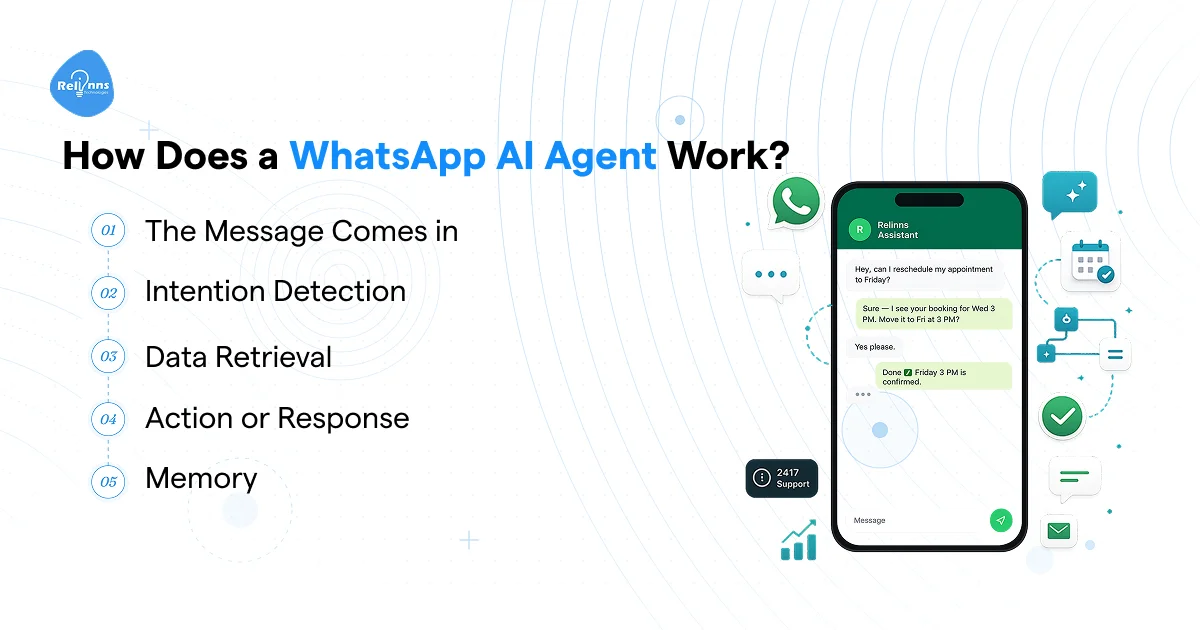
Step 1: The message comes in. Your customer sends a WhatsApp message. Could be "what's the status of my order" or "I need to reschedule my appointment for Thursday" or just "help." The WhatsApp Business API receives it and passes it to the agent.
Step 2: Intent detection. The LLM reads the message and figures out what the customer actually wants. Not keyword matching. Genuine language understanding. "I haven't received my parcel" and "where's my stuff" mean the same thing, and the agent treats them the same way.
Step 3: Data retrieval. This is where most demos fall apart. The agent now needs to go get real information. It queries your CRM, your order management system, your EHR, your policy database, whatever system holds the answer. If this integration isn't built properly, the agent is flying blind. It'll either hallucinate an answer or tell the customer it can't help, which is worse than no agent at all.
Step 4: Action or response. With the data in hand, the agent either responds with information or takes an action. Books the appointment. Sends the payment link. Updates the delivery address. Flags the account for a human to review. The action depends on what permissions and integrations you've set up.
Step 5: Memory. The context from this conversation gets stored. So when the same customer messages again tomorrow, the agent knows what was discussed. No "please describe your issue again." This continuity is what makes the experience feel like a real conversation instead of a reset every time.
The whole loop, from message received to reply sent, typically runs in under two seconds.
The WhatsApp constraints most vendors don't mention
Here's the part that doesn't show up in any product demo.
WhatsApp has its own rules, and they will affect your deployment. The biggest deployment failures we see aren't AI failures. They're WhatsApp policy failures. And they're entirely avoidable if you know what you're walking into.
The 24-hour messaging window. Once a customer messages you, you have a 24-hour window to reply freely. After that window closes, you can only contact them using pre-approved message templates. This matters a lot for follow-up flows. If your agent needs to send a reminder or close a loop the next day, it needs a template ready, not a free-form message.
Template pre-approvals. Any message your agent sends outside the 24-hour window needs Meta's prior approval. Approvals typically take 24 to 48 hours, and Meta rejects templates that look too promotional or don't meet their formatting guidelines. Build your template library before you go live, not after.
Opt-in is non-negotiable. You cannot initiate a conversation with a customer who hasn't explicitly opted in to receive WhatsApp messages from you. This catches a lot of companies off guard, especially when they want to run outbound campaigns through the agent.
Spam score and account suspension. If customers are blocking your messages or reporting them, your account's quality rating drops. A low quality rating restricts your messaging limits. A very low one gets your number flagged. The fix is simple: send relevant messages to people who want them. But you need to monitor this actively, not reactively.
None of this is a reason to avoid the channel. It's just the reality of building on a platform that Meta controls. Know the rules before your vendor starts the build.
Key Benefits of WhatsApp AI Agents
1. Scale beyond headcount
A human agent handles one conversation at a time, two if they're fast. A Whatsapp AI Agent handles 10,000 simultaneously, at the same quality. Volume spikes during a product launch, a recall, or a hospital admission surge don't require emergency hiring. The agent absorbs it.
2. Outbound is where the revenue is
Waiting for customers to message you is half the picture. The real commercial value is outbound. EMI reminders that get paid. Policy renewals that don't lapse. Appointment reminders that cut no-show rates. Back-in-stock alerts that convert. Your agent can initiate all of these automatically, at scale, on a channel with a 95% open rate. That's not support. That's revenue.
3. Personalization that moves the needle
When the agent greets a customer by name, references their last order, and adjusts its offer based on their loyalty tier, completion rates go up. Customers respond because it feels like the business knows them.
4. Multilingual as standard
In markets like UAE, India, and Saudi Arabia, multilingual support isn't optional. Arabic, Hindi, Bahasa the agent handles all of it without a separate workflow.
5. 24/7 availability
The agent works while your team sleeps, covers Sundays and public holidays without overtime. Table stakes, not a selling point but worth having on the list.
How do I measure the ROI of a WhatsApp AI agent?
Start with three numbers: your current cost per support ticket, your monthly ticket volume, and your average handling time. Those are your inputs.
Then measure what the agent actually changes: deflection rate (queries resolved without human involvement), cost per resolution after deflection, and conversion rate on any outbound flows you run.
Deflection rate benchmarks by industry, based on production deployments:
- Healthcare: 60-70%
- Ecommerce: 65-75%
- Insurance: 55-65%
If you're handling 50,000 tickets a month at $4 per ticket and the agent deflects 65% of them, that's $130,000 in monthly savings before you count the outbound conversion lift.
The mistake most teams make is measuring only cost reduction. The stronger ROI case includes what the agent generates: appointments booked outside business hours, renewals captured before lapse, abandoned carts recovered. Add those to your model and the numbers look very different.
Common Use Cases for WhatsApp AI Agents
There are two ways to run AI agents on WhatsApp. Most businesses only think about the first one.
Reactive use cases (customer-initiated)
These are the conversations your customers are already starting. The agent's job is to handle them faster, at scale, without burning through your support team.
WISMO is the single highest-volume use case in ecommerce. "Where is my order?" accounts for 50-70% of all inbound support contacts for most online retailers. It's fully automatable. The agent queries the OMS, pulls the live tracking status, and replies in seconds. No human needed.
Appointment booking and rescheduling is the equivalent in healthcare. Patients call to book, cancel, move slots, ask about preparation instructions. A WhatsApp AI agent handles all of it, 24/7, connected directly to your scheduling system.
For insurance, the high-volume queries are claim status and policy questions. "Has my claim been processed?" "What does my policy cover for hospitalisation?" The agent pulls the answer from your policy database or CRM and responds instantly, without putting the customer on hold for 12 minutes.
And then there's the less glamorous but genuinely valuable stuff: KYC document collection for loan applications, onboarding flows for new insurance customers, returns and refund status for retail. Repetitive, structured, high-volume. Exactly what agents are built for.
Proactive use cases (agent-initiated)
This is where the real revenue case lives, and almost nobody talks about it.
A WhatsApp AI agent doesn't have to sit and wait. It can reach out. And on a channel with a 95% open rate, that matters.
EMI and payment reminders for NBFCs and lending companies are the clearest example. Instead of a call centre team dialling through a list of overdue accounts, the agent sends a personalised WhatsApp message, offers a payment link, and follows up automatically if there's no response. Collections rates improve. Agent costs drop.
Policy renewal nudges work the same way for insurance. The agent identifies policies approaching expiry, sends a timely reminder, answers questions about renewal terms, and routes to a human only when the customer is ready to close. No lapsed policies because nobody followed up in time.
In healthcare, appointment reminders alone can cut no-show rates by 20-30%. The agent sends a reminder 24 hours before, offers a one-tap reschedule if the patient can't make it, and fills the slot automatically from a waitlist. That's recovered revenue, not just a reminder.
For ecommerce, abandoned cart recovery on WhatsApp outperforms email by a significant margin. The open rates are just higher. A D2C brand sending a cart recovery message on WhatsApp with a limited-time offer converts far better than the same message sitting in a spam folder.
Industry-specific whatsapp agents deployments
Generic use case lists are fine for orientation. But if you're a COO at a hospital group or a CTO at an insurance company, you need to know what this looks like in your specific operation.
Healthcare. The agent handles inbound appointment booking, sends pre-op preparation instructions to surgical patients, responds to "is my lab report ready" queries (which make up 40-60% of inbound calls at most diagnostic labs), and runs post-discharge follow-up flows to check recovery and flag complications early. Every one of those flows connects to your HIS or LIS. Without these integrations, it's just a messaging tool.
Insurance and lending. First Notice of Loss intake over WhatsApp means the customer reports a claim conversationally, the agent collects the required information, and the case gets created in your system without a call centre agent involved. Claim status queries, EMI reminders, policy FAQ, gold loan branch queries. The highest-volume, lowest-complexity interactions in financial services are almost entirely automatable on this channel.
Ecommerce and QSR. For online retail, the priority is WISMO deflection, cart recovery, and returns. For QSR chains, the interesting use case is phone order-taking. A WhatsApp AI agent can take a customer's food order over WhatsApp, confirm it, and push it directly to the kitchen system. Ghost kitchens especially benefit here because they have no direct customer relationship to speak of. The agent builds one.
Logistics and courier. Shipment tracking is the obvious one. But the more operationally valuable use case is NDR (non-delivery report) resolution. When a delivery fails, the agent proactively contacts the customer, collects a corrected address or preferred time slot, and updates the driver's route. That cuts re-attempt costs which run $3-10 per failed delivery. And for fleet operators, driver onboarding over WhatsApp, where the agent collects documents, verifies compliance, and walks new drivers through the process, removes weeks of manual back-and-forth.
The pattern across all four verticals is the same. High volume, structured workflows, real integrations. That's where the agent earns its cost.
Challenges and Failure Modes for WhatsApp AI Agents
No honest guide skips this part. AI agents on WhatsApp can go wrong in ways that are expensive and visible to your customers. Here's what actually breaks.
Hallucination is the first thing any technical buyer should ask about.
LLMs generate confident-sounding answers even when they're wrong. Without guardrails, your agent can tell a patient the wrong medication dosage, quote an insurance customer an incorrect claim amount, or confirm a delivery date that doesn't exist. The fix is a combination of RAG (grounding the agent in your actual data), output validation, and hard stops on high-risk topics. But it requires deliberate engineering. It doesn't come out of the box.
Poor Human Handoff flow
Bad handoff design is the second failure mode. When the agent can't resolve something and no human is available, what happens? If the answer is "the customer gets a dead end," you've built something worse than not having an agent at all.
Integration depth determines whether you have an agent or an expensive FAQ bot.
An agent that can't query your live systems in real time is just generating responses from static training data. That's not useful.
Compliance is where the gaps get serious. GDPR gets mentioned everywhere. HIPAA for healthcare data, PCI for payment flows, and data residency requirements in GCC markets almost never come up. If your patient data is being processed through a US-based LLM and you're operating in the UAE, you have a problem.
And then there's language quality. "Supports 100+ languages" is a marketing claim. Gulf Arabic dialects, Hindi, Bahasa Indonesia in actual production conversations are a different test entirely. Ask your vendor for a live demo in the language your customers actually use.
An AI agent with no guardrails is a liability, not a product. The cheapest deployment is almost always the most expensive in the long run.
Final word on Whatsapp Agents
If you've read this far, you're not wondering whether WhatsApp AI agents work. You're wondering whether they'll work for your specific business, at your current scale, with your existing systems.
That's the right question. And the answer depends on a few things worth checking before you talk to any vendor.
Are you ready to deploy? Run through this quickly.
- Do you have a clearly defined high-volume, repetitive use case? (WISMO, appointment booking, claim status, payment reminders)
- Do your core systems (CRM, OMS, EHR, policy database) have accessible APIs?
- Do you have customer opt-in data, or a clear path to collecting it?
- Is there a human escalation path when the agent can't resolve something?
- Does your business operate in a regulated industry that requires HIPAA, PCI, or GCC data residency compliance?
If you answered yes to the first four and you know the answer to the fifth, you're ready to scope a build. If you're still fuzzy on any of them, that's where the conversation with a vendor should start, not with a demo.
Now if you are wondering where to start from, the answer is not with a full transformation. One use case. One integration. One channel.
Pick the highest-volume, lowest-complexity workflow in your operation. For most ecommerce businesses that's WISMO. For hospitals it's appointment booking. For insurers it's claim status. Build that well, instrument it properly, and let the results make the case for the next use case internally.
The companies that get this wrong try to automate everything at once. They end up with a bloated scope, a delayed build, and an agent that does ten things poorly instead of one thing well.
If you're evaluating vendors for a WhatsApp AI agent deployment and want to talk through what the build actually looks like for your industry, your systems, and your scale, that's exactly what we do at Relinns.
No generic demos. No GPT wrappers dressed up as enterprise AI.
Frequently Asked Questions
What is a WhatsApp AI agent?
A WhatsApp AI agent connects to the WhatsApp Business API, understands what a customer wants, and takes action on it. That means booking an appointment, updating a CRM record, or sending a payment link, not just replying with text.
How do AI agents work on WhatsApp?
The agent receives the message, detects intent, pulls live data from your CRM, OMS, or policy database, then responds or takes action. It stores the conversation so the next message picks up where the last one left off. The whole loop runs in under two seconds.
What's the difference between a WhatsApp AI agent and a WhatsApp chatbot?
A chatbot follows a script and returns text. An AI agent understands free-form input, holds context across the conversation, and completes the task itself, whether that's rescheduling an appointment or sending a refund.
What are common use cases for WhatsApp AI agents?
Order status updates, appointment booking, claim status checks, and payment reminders are the highest-volume use cases. Ecommerce brands use it for WISMO deflection and cart recovery, healthcare providers for booking and lab-result queries, and lenders for EMI reminders.
How do I deploy a WhatsApp AI agent for my business?
Start with your highest-volume, lowest-complexity workflow, one that already has an accessible API to pull from. Confirm you have customer opt-in and a human escalation path, then build and instrument that single use case before expanding.