Every Layer of the AI Voice Stack Explained: Beginners Guide 2026
Date
Aug 24, 26
Reading Time
9 Minutes
Category
AI Voice Agents
Share


Most voice AI demos look good. The call flows, responses land fast, and everyone nods in the meeting. Then you go live, and something breaks. Latency spikes, the agent mishears critical words or phrases, and compliance flags the rollout compliance issues surface after rollout.. And nobody can tell you which piece failed.
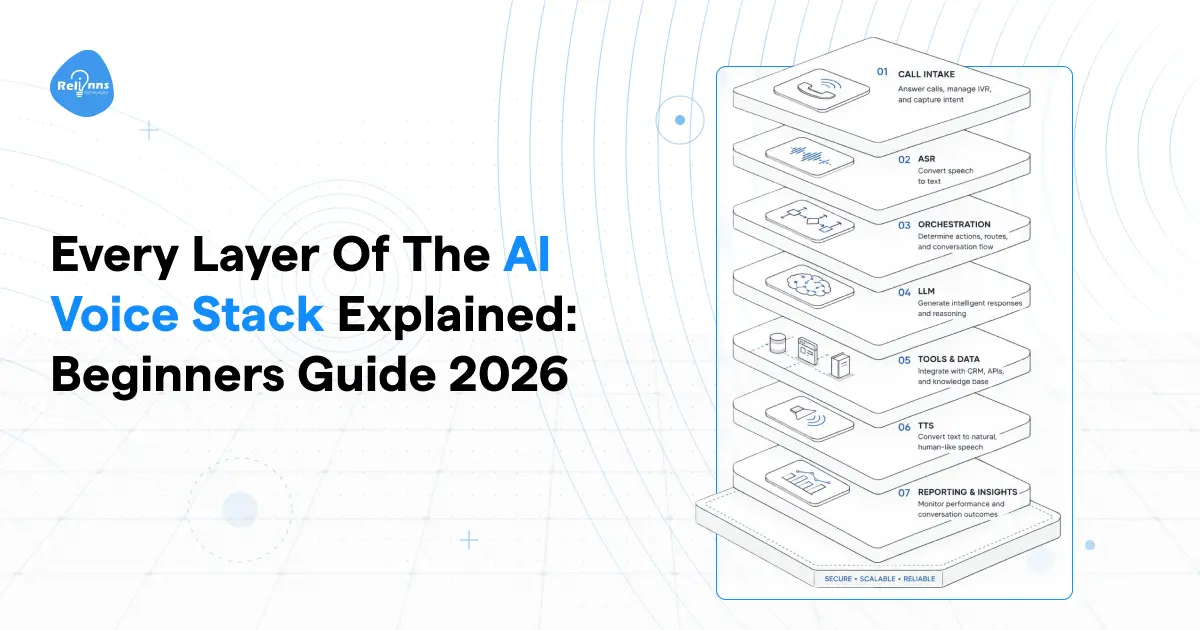
This is what happens when you treat AI voice agents like a product rather than a pipeline you assemble. The AI voice stack has four distinct layers, each with its own vendors, failure modes, and performance tradeoffs. Miss one, and the whole conversation falls apart.
The shift from human to AI agents is settled in most high-volume operations. AI wins on cost and availability. But the AI voice agent tech stack underneath any deployment is what determines whether it actually works. This guide breaks down each layer so you can evaluate vendors, brief your team, and understand what the AI voice stack decisions you make today will cost you later.
But there's a misconception about how this pipeline works that shapes every decision you make after this, and most guides skip right past it.
What Is the AI Voice Stack?
The AI voice stack is the set of technologies that let a machine have a real conversation with a human. Not a phone tree. An actual back-and-forth where it listens, thinks, and responds in real time.
It has four layers. And here's what most people miss: each layer is independently swappable. Upgrade your speech recognition without touching your language model. Switch your voice provider without rebuilding anything else. That modularity is what separates modern voice AI from the rigid IVR systems that came before it.
The AI voice agent tech stack flows like this:
| Layer | Shorthand | Input | Output |
| Speech-to-Text (STT) | The Ears | Raw audio | Text transcript |
| Large Language Model (LLM) | The Brain | Text | Decision + response |
| Text-to-Speech (TTS) | The Voice | Text | Spoken audio |
| Orchestration | The Conductor | All layers | Real-time flow |
Think of it as AI agents with a voice interface. And if you want to build an AI voice agent that holds up in production, you need to understand this AI voice stack before you talk to a single vendor.
Voice AI is a pipeline, not a product. The moment you treat it as a product, you lose the ability to diagnose where it breaks.
Each layer sounds straightforward in isolation. And while reviewing this blog, the SME for voice agent, Ajay, said that one of them is responsible for roughly 40% of all production failures, and it's the first one.
Layer 1: STT - How Your Voice Agent Listens
STT is where the AI voice stack begins, and where most deployments quietly fall apart.
Speech-to-Text does one thing: converts raw audio into a text transcript in real time. That transcript is what every other layer works from. If it's wrong, everything downstream is wrong the LLM reasons on bad input. The response is off. And you spend weeks blaming the language model when the problem started in the ears.
Teams evaluate STT almost entirely on Word Error Rate (WER). That's a mistake. A model with 93% accuracy still fails on phone numbers, medical terminology, or an accent your benchmark dataset didn't include. WER tells you how often words are correct in a lab. It doesn't tell you what happens when a customer reads out a 16-digit policy number with call center background noise.
The metrics that actually matter in production:
- Latency under 300ms: anything slower and the conversation starts feeling like a satellite call
- Intelligent endpointing: knowing when a user has finished speaking, not just paused to think
- Formatting accuracy on dates, phone numbers, and addresses
- Real-world noise handling, not quiet studio audio
I've seen a real case where a team spent $40,000 on prompt engineering trying to fix their agent's responses. The actual problem was their STT clipping the first 200ms of every utterance. The LLM never received a complete sentence. No amount of prompting was going to fix that.
Reducing voice agent latency starts at the STT layer, not the LLM. And if you're thinking about how voice agents handle raw audio data, that's a separate but equally important question to ask your vendor.
"40% of voice agent failures trace back to the STT layer. Teams debug the LLM for weeks when the transcript was broken from the start."
When comparing STT providers for your AI voice stack, here's what the numbers look like across options that actually ship in production:
| Provider | Latency | WER | Best For |
| Deepgram Nova-3 | Under 300ms | 6.84% | Multilingual, noisy environments |
| AssemblyAI Universal | ~300ms | 6.6% | Stable transcripts, live captioning |
| Whisper Large-v3 | ~300ms | 8.0% | Zero-shot multilingual |
The right pick depends on your user base. If you're building an AI voice agent tech stack for healthcare or insurance where domain terms matter, test with your actual vocabulary, not benchmark datasets.
Fix your transcription, and the LLM still has its own failure modes, ones that only surface when the conversation gets complex or the user interrupts.
Layer 2: LLM - The Brain of the Operation
The LLM is the layer everyone talks about. It's also the layer that breaks the least in a well-built AI voice stack, which makes all the attention a little ironic.
What it actually does: takes the text transcript from STT, figures out what the user wants, decides what to say, and calls external tools if needed. Booking a calendar slot, pulling a customer record from your CRM, and checking an order status. That last part is where voice agents stop being fancy FAQ bots and start doing real work.
But here's what most people miss when selecting an LLM for voice: Time to First Token (TTFT) matters far more than raw model intelligence. A 2-second response gap in a voice call feels like the agent crashed. Throughput benchmarks don't tell you that. TTFT does.
The practical takeaway? You don't need a frontier model for most voice flows. Smaller, faster models like Gemini Flash or Claude Haiku handle most conversations well. Save the heavier models for complex reasoning that actually justifies the latency cost. This breakdown of the best LLM for voice agents is worth reading before you commit to anything.
What if most of your voice calls use under 5k tokens. Paying for a 128K context window on every call is just a waste.
Before selecting an LLM, calculate your total latency budget. If you need a response in under 1.5 seconds end-to-end, the LLM gets roughly 300-600ms. That rules out most frontier models at default API settings. Test TTFT, not benchmark leaderboards.
Voice AI prompting is also a real lever here. Concise prompts cut inference time. And if your LLM needs to pull from internal documents or SOPs to answer calls correctly, building a voice AI knowledge base is the right move before you start patch-fixing with prompts.
When you're sizing this layer of your AI voice stack, the decision that pays off is picking the right model for the job, not the most impressive one. The AI voice agent tech stack rewards correct configuration, not brand names.
The LLM gets the most press. The TTS layer gets the least. It's also the one on which your users form an opinion in the first three seconds of a call.
Layer 3: TTS - The Voice Your Brand Speaks In
TTS is the layer most teams spend the least time on. That's a mistake.
Text-to-Speech converts the LLM's response text into spoken audio. Technically, it's the last step before the user hears anything. Practically, it's the first thing they judge. A robotic voice doesn't just sound slightly off. It confirms the fear that 47% of users already carry into the call: that this AI won't actually understand them.
Voice selection isn't a technical decision. It's a brand decision wearing a technical label. A casual, warm voice might work perfectly for a consumer app. The same voice on a health insurance claims call reads as flippant. I've seen teams pick a voice because it scored well on internal tests, only to watch NPS drop as their enterprise users found it "too chatty." Your TTS voice is your product's personality. Treat it that way.
On the performance side, Time to First Byte (TTFB) is what determines whether your agent feels responsive. Under 200ms, and the conversation flows naturally. Above 400ms, and the silence feels like a dropped connection. The reason modern AI voice stacks hit those numbers is streaming TTS: generation starts before the LLM has finished its full response, so the user hears the first words almost immediately.
Most commercial providers now score above 4.0 on the Mean Opinion Score (MOS), placing them in the human-level quality range. The differentiation is latency and cost at scale.
| Provider | TTFB | Key Strength |
| ElevenLabs Flash v2.5 | ~75ms | Lowest latency, 32 language support |
| Cartesia Sonic | ~90ms | Realistic voices, competitive pricing |
| GPT-4o TTS | 220-320ms | Emotional modulation, promptable tone |
| Rime AI | Under 200ms | Best cost-to-quality ratio at scale |
If you're serious about making an AI voice sound human, this table is a starting point, not a final answer. Test with your actual users. And if detecting customer frustration through voice matters to your use case, the TTS tone you pick shapes whether that detection is useful or just disruptive.
This is the layer in the AI voice agent tech stack where your brand either lands or falls flat. Getting all the technical choices right means nothing if the voice makes people want to hang up.
Three layers working perfectly in isolation still produce a broken conversation if the layer connecting them was never designed. That's orchestration, and it's the one most teams forget.
Layer 4: Orchestration - The Layer Most Teams Forget to Design
If you've ever watched a voice demo go perfectly and then seen the production deployment feel weirdly broken, orchestration is usually why.
This layer doesn't do anything visible on its own. It manages the real-time flow between the other three: audio streaming, turn-taking, interruption detection, conversation state, and API error handling. Everything that makes a voice conversation feel like an actual conversation, not a phone tree.
The turn-taking problem is harder than it sounds. The agent has to know when you've stopped speaking versus when you've paused mid-thought. Get it wrong in one direction, and it cuts you off mid-sentence. In the other, it sits in silence long enough that you assume the call dropped.
False positive interruptions are the failure mode most teams ignore. Background noise, a cough, someone talking nearby, the agent registers it as speech, stops responding, and the user thinks they've been cut off. That's not an STT problem or a TTS problem. It's an orchestration problem, full stop.
Teams that track false-positive interruption rates consistently outscore teams that only monitor accuracy or latency on call quality audits. It's the single metric most strongly correlated with users' descriptions of an agent as "natural."
The infrastructure underneath also matters. Whether you're routing calls over WebRTC vs SIP directly shapes how audio arrives at this layer. And inbound vs outbound voice AI creates genuinely different orchestration requirements outbound needs proactive turn initiation, and inbound needs reactive listening with patience.
On the platform side, frameworks like LiveKit and Pipecat give you full control over the AI voice stack but require substantial engineering effort to configure effectively. Retell and Vapi get you to production faster, but with less flexibility. Which fits depends on how custom your requirements are.
The AI voice agent tech stack lives or dies on this layer more than most people expect. Every good decision you made on STT, LLM, and TTS means nothing if the conductor isn't working.
Now that each layer is clear, the bigger decision is how you wire them together architecturally, and that choice alone can swing your end-to-end latency by 3 seconds.
Cascading vs. Speech-to-Speech: The Architecture Decision That Shapes Everything
How you wire the four layers together matters as much as the layers themselves. This is the choice that sets the performance ceiling of your AI voice stack.
The standard approach is a cascading pipeline. STT converts audio to text; that text feeds the LLM; the LLM's response goes to TTS, and the user hears the output. Sequential, inspectable, debuggable. When something breaks, you pull the transcript, check the LLM input, and trace the fault in minutes. The full audit trail is why cascading became the default for enterprise deployments. The tradeoff is latency: 2-4 seconds end-to-end under normal conditions. For most high-volume business operations, that's acceptable.
Then speech-to-speech models entered the picture and made that tradeoff feel like a compromise.
S2S skips the text layer entirely audio in, audio out. OpenAI's Realtime API gets this down to roughly 500ms. At that speed, the conversation stops feeling like interacting with software and starts feeling like talking to a person. Interruption handling is native. The gap that makes cascading feel slightly mechanical disappears. For consumer-facing applications, the case for S2S is real.
But here's where it breaks down.
S2S gives you no audit trail. When the agent says something wrong, there's nothing to inspect. No transcript, no reasoning trace, no log of what the model received and why it responded the way it did. I've spoken with compliance teams at insurance carriers and hospital groups who were genuinely interested in S2S until someone asked, "What was the agent's reasoning when they gave that wrong answer?" The answer was nothing they could produce. The project ended there.
Healthcare voice agent deployments in regulated environments, anything that touches a HIPAA-compliant voice agent requirement, finance, insurance claims, these use cases need an audit trail. S2S isn't a viable option without it.
The answer most mature teams land on is a hybrid architecture. S2S for low-stakes conversational turns where speed matters. Cascading for any decision point that requires an audit trail. LiveKit makes switching between modes mid-conversation possible, which is what makes this practical rather than theoretical. When you're thinking about scaling a voice agent in production, this hybrid approach is where most serious deployments end up.
| Architecture | Latency | Audit Trail | Best For |
| Cascading Pipeline | 2-4s | Full visibility | Regulated industries, complex workflows |
| Speech-to-Speech | ~500ms | None | Consumer apps, speed-first use cases |
| Hybrid | Variable | Partial | Most enterprise deployments |
The AI voice agent tech stack you choose at the architectural level shapes every downstream constraint. Pick cascading, and you get control at the cost of speed. Pick S2S, and you get speed at the cost of visibility. Pick a hybrid, and you get complexity, but you also get both.
Architecture sets your ceiling. What sets your floor is how you pick the components inside it, and that starts with knowing your actual constraints.
How to Choose Your AI Voice Agent Stack
There's no universally correct AI voice stack. Anyone who tells you otherwise is selling something.
The right choice comes down to three things: how fast you need responses, how exposed you are to compliance requirements, and how quickly you need to be live. Most teams that get this wrong were optimizing for WER accuracy or model prestige while orchestration latency quietly added 800ms that nobody measured.
| Priority | Direction |
| Production in under 1 month | Managed platform (Retell or Vapi) |
| HIPAA or compliance audit trail | Cascading architecture + custom build |
| Sub-500ms latency | Speech-to-speech model |
| High volume with infrastructure control | Custom build on LiveKit |
| 10+ language support | Deepgram + ElevenLabs cascading |
If you need to ship fast and you're under 10K minutes a month, a managed platform is the right call. You'll trade customization for speed. That's a reasonable trade early on. Once you hit scale or reach the ceiling of what a managed platform can handle, that's when a custom build on LiveKit makes sense.
The voice agent costs conversation is worth having before you commit to a direction. If you're still framing where voice sits in your broader technology bets, the custom AI vs off-the-shelf question applies here, too. And if you want a side-by-side look at platforms, the top voice AI services breakdown is a good starting point.
The AI voice agent tech stack decision you make today isn't permanent. Start with what ships. Learn from real traffic. The AI voice stack you run at 50K calls a month will look different from the one you launched with, and that's fine.
Relinns builds production voice agents for healthcare, insurance, logistics, and ecommerce operators. Book a live demo to see a working deployment in your vertical.
Four layers. Each one has a specific failure mode. STT corrupts the transcript before the LLM sees it. The LLM adds 2 seconds of latency because no one measured TTFT before launch. The TTS voice tanks user trust in the first three seconds of a call. Orchestration lets the agent cut users off mid-sentence for weeks before anyone tracks it.
The teams that ship reliable AI voice agents for customer service and lead qualification voice agents that actually perform aren't the ones with the most impressive vendor stack. They're the ones who understood what breaks in the AI voice stack before it broke in production.
That's the whole point. Build with that in mind.