WebRTC vs SIP for AI Voice Agents: The 2026 Stack That Scales
Date
Aug 24, 26
Reading Time
10 Minutes
Category
AI Voice Agents
Share


TL;DR
- WebRTC wins for any session that starts on a screen (web widget, in-app, kiosk, embedded SaaS). Sub-100ms first-packet latency, native Opus audio, no per-minute carrier cost.
- SIP wins the moment a real phone number is involved. It's the only way to reach a landline or mobile, and it plugs into carrier relationships and compliance frameworks you already run.
- SIP's weak spot is latency and audio quality. Carrier hops add 150-300ms, and 8kHz G.711 audio fed into a 16kHz STT model degrades transcription. Most "our agent mishears everything" complaints trace here, not to the LLM.
- The codec transcoding step is non-negotiable on SIP. Convert to the model's native sample rate before audio hits STT, or you lose words and misread intent.
- Production teams don't pick one. They run a hybrid: two ingress paths (WebRTC and SIP), one agent runtime, with a media gateway transcoding SIP audio on entry. Prompts and workflows get written once.
- Build in sequence, not all at once. Start with WebRTC for fast usage data, add a SIP number, port the main line only after metrics are healthy, then layer outbound.
- Cost gap is small at low volume, real at scale. At 100,000 minutes/month, carrier fees separate a SIP path from a WebRTC one by $2,000-$12,000. Route screen-based conversations to WebRTC and reserve SIP spend for calls that need a phone number.
- Running two separate platforms for the two transports doubles your compliance, contracts, and integration overhead. A single runtime handling both is the architecture that scales.
Most teams building voice agents in 2026 spend months arguing about the LLM. Which model, which fine-tune, which system prompt. The TTS voice gets hours of debate. The audio transport layer barely comes up. That's the wrong priority order.
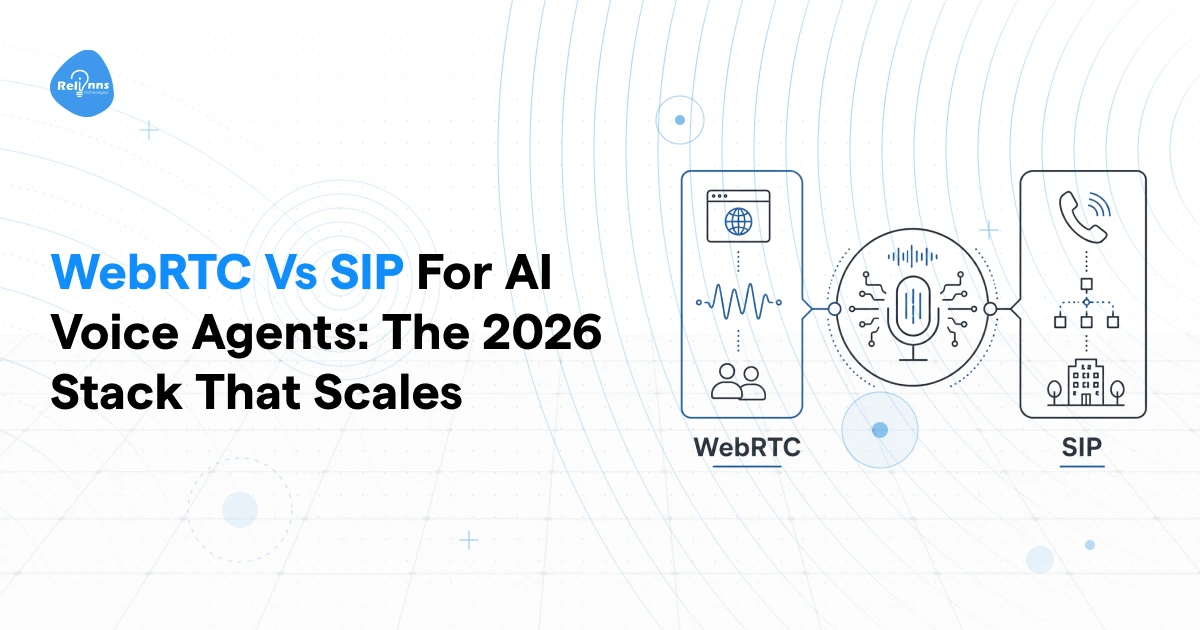
If you're thinking through WebRTC vs SIP for AI voice agents, two things are true at the same time: WebRTC is now the de-facto transport for agents targeting sub-500ms conversational response, and SIP is the only way to reach a real phone number.
Short answer: WebRTC for browser and in-app sessions, SIP for phone calls. Most production deployments end up needing both, which also happens to be the smarter architecture anyway.
This piece covers how each protocol works, when each one wins, what a hybrid stack looks like in the real world, and what WebRTC vs SIP for AI voice agents costs to run at scale.
What is WebRTC (Web Real-Time Communication)?
WebRTC (Web Real-Time Communication) is an open-source protocol stack for real-time audio and video. It runs natively in Chrome, Safari, Firefox, Edge, iOS, and Android. No plugin, no carrier in the middle, no client software to install.
Audio travels as an Opus stream over SRTP. The protocol handles jitter buffers, packet loss concealment, and forward error correction on its own. And because there's no codec transcoding on the audio path, the signal your AI server receives is the same quality signal the microphone captured.
On a clean network, the end-to-end path from microphone to AI server lands under 100ms.
In any WebRTC vs SIP comparison for AI voice agents, that under-100ms ceiling is the first number to understand.
Why Do AI Voice Agents Use WebRTC?
Speed and cost. Every millisecond saved before the first audio packet reaches your STT model is a millisecond available for inference and response. WebRTC delivers audio at 16-48kHz Opus with no transcoding step. The user is already on a screen, so no carrier setup or hardware is required.
And there's no per-minute carrier cost. You pay for inference, not for the pipe. When the WebRTC vs SIP for voice agents decision comes up in a real deployment, that zero-carrier-cost advantage is what makes WebRTC the obvious default for any session starting in a browser or app.
What is SIP (Session Initiation Protocol)?
SIP (Session Initiation Protocol) is the signaling backbone of the telephone network. Every major carrier runs on it: Twilio, Telnyx, Plivo, Vonage. It's been the standard for decades, and the ecosystem around it is deep.
One thing to get straight from the start: SIP only handles signaling. Setting up the call, managing it, tearing it down. The actual audio moves over RTP or SRTP as a separate layer. When a customer dials a real phone number, that call enters your stack through a SIP trunk. There's no workaround for that.
In a WebRTC vs SIP decision for AI voice agents, SIP earns its place through sheer reach. Any phone number in the world. That's the one thing WebRTC can't replicate.
Why Do AI Voice Agents Use SIP?
Because your customers still call phone numbers. Any landline, any mobile, any country. Your existing carrier relationships stay intact, your published numbers don't change, and the compliance frameworks you're already working within (TCPA, call recording laws, carrier-level redundancy) apply without modification.
For an inbound AI receptionist answering a business line that patients or customers have called for years, SIP isn't a choice. It's the only path.
The Main Problem with Using SIP for AI
SIP was built for human-to-human calls. Two people, some tolerance for delay, nobody counting milliseconds. AI voice agents don't work that way. Every extra hop in the call path is a compounding problem.
The audio path on a SIP-routed call looks like this:
User speaks > Cell tower > Carrier > SIP trunk > WebSocket > STT > LLM > TTS > WebSocket > SIP trunk > Carrier > User
Each carrier hop adds 20-50ms before your AI stack hears anything. Three to five hops means 150-300ms burned before the STT model processes one phoneme. That's before inference, before the LLM thinks, before TTS renders a response.
And then there's the codec problem. SIP audio arrives as G.711 at 8kHz. Modern STT models expect 16kHz Opus or PCM 16kHz. Feeding 8kHz telephony audio into a model built for higher sample rates degrades transcription accuracy.
The transcoding step is unavoidable, and when it's handled poorly, it adds more latency to an already stretched path.
This is the core technical problem in deploying AI voice agents on phone infrastructure, whether using WebRTC or SIP. Teams report two symptoms: calls feel slower than the LLM benchmarks suggest, and the agent mishears words more than expected. Both trace back here, not to the model.
Direct Comparison Between WebRTC and SIP for Voice Agents
Side by side, the WebRTC vs SIP comparison for AI voice agents is wider than most teams expect before they start building.
| Dimension | WebRTC | SIP / PSTN |
| Typical first-packet latency | 60-120ms | 250-400ms |
| Audio codec | Opus (16-48kHz) | G.711 / G.722 (8-16kHz) |
| Audio quality delivered to STT | Native, no transcoding | Requires transcoding; quality loss risk |
| Reach | Browser, mobile app, kiosk, embedded device | Every landline and mobile number worldwide |
| Phone number support | No | Yes |
| Session setup time | 200-500ms (ICE + DTLS) | 700-1,500ms (SIP INVITE + ringing) |
| Per-minute carrier cost | None (bandwidth only) | 0.5-3 cents (carrier termination) |
| Encryption | SRTP mandatory | SRTP optional; many deployments still run plain RTP |
| NAT/firewall handling | Native (STUN/TURN/ICE) | Requires SBC |
| Best for | Web widget, in-app, kiosk, customer portal | Inbound and outbound phone calls |
The latency numbers look dramatic on paper. And the first-turn advantage for WebRTC is real. But once a conversation is in flow, steady-state turn-taking narrows that gap to something less decisive than the table suggests.
The codec row is the one to focus on. In a WebRTC vs SIP for AI voice agents deployment, it's not the extra milliseconds that cause the most problems. It's feeding 8kHz G.711 telephony audio into an STT model tuned for 16kHz that degrades transcription accuracy. That's where you lose words, misread intent, and broken conversation flows.
This matters even more for multilingual voice AI agents, where narrowband telephony audio can compound language and accent errors.
The reach row is the other hard constraint. If your users call a phone number, SIP is non-negotiable. That column doesn't shift regardless of what the rest of the comparison says.
So, When to Choose WebRTC for Your Voice Agent?
The use cases where WebRTC wins in any WebRTC vs SIP for AI voice agents decision share one thing: the user is already on a screen.
Website voice widget.
A "Talk to our AI" button on a support or marketing page. The user's already in Chrome. WebRTC connects in under 500ms, no app install, no phone number required.
In-app voice support.
iOS or Android apps where customers speak to the agent directly. Microphone access is already granted, and the Opus stream goes straight to your STT cluster.
Kiosks.
Retail check-ins, hospital lobbies, airport self-service terminals. The hardware runs a browser, the session is WebRTC, and there's no per-minute carrier bill on any of those conversations.
Embedded voice in SaaS products.
Onboarding flows, account self-service, in-product help. Users are already logged in. No carrier setup required on your end.
Internal tools.
AI sales coaching, rep roleplay training. Your team is on laptops. No SIP trunk needed anywhere in that workflow.
The cost angle matters too. If the user is on a screen, every conversation minute costs you inference only, not inference plus carrier.
At 100,000 minutes per month, that difference is the real budget. In a WebRTC for voice agent deployment, that math tips a lot of infrastructure decisions.
If you control the client and the user is on a screen, WebRTC is the right call.
And When to Choose SIP for Your Voice Agent?
SIP wins the moment a phone number enters the picture. In the WebRTC vs SIP for AI voice agents decision, there's no routing around this.
AI receptionists on existing business lines. A dental clinic's main number, a logistics company's dispatch line, a bank's inbound queue. Customers have called these numbers for years. You're not asking them to open a browser tab.
Outbound campaigns. Appointment reminders, EMI collection calls, lead qualification to PSTN numbers. The people you're calling are on mobile phones and landlines. SIP is the only way to reach them.
Legacy contact center integration. If your infrastructure runs on Avaya, Genesys, or an on-premise PBX, SIP is already the language it speaks. Any AI voice agent layer connects through the same trunk setup.
After-hours overflow. Your call center closes at 6pm. The AI takes the SIP route. No change from the caller's perspective.
One thing teams get wrong here: you don't need to switch carriers. Bring Your Own Carrier (BYOC) setups let you point an existing SIP trunk at the AI agent runtime. Your numbers stay yours, your carrier rates don't change. I've seen teams delay SIP deployments for months assuming they'd need to migrate everything. They didn't.
Once a real phone number is in the SIP vs WebRTC voice agent decision, the protocol is chosen for you. The only real question left is how well your SIP path handles AI traffic.
The Hybrid Architecture Successful Teams Actually Run
Most serious voice agent production deployments in 2026 don't pick one protocol. They run both. The WebRTC vs SIP decision for AI voice agents isn't a company-level choice. It's a use-case-level choice.
Two ingress paths, one agent runtime. That's the architecture.
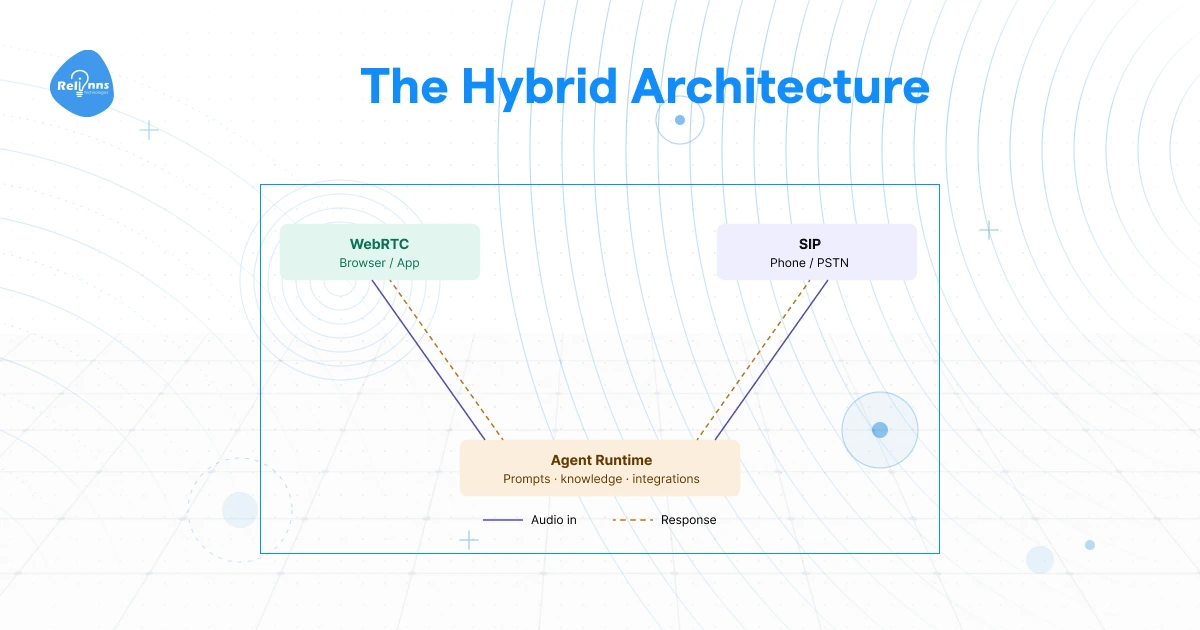
WebRTC ingress handles sessions that start on a screen: your website widget, iOS app, Android app. Sub-second response, no per-minute carrier cost, audio arrives at the agent in the right format.
SIP ingress handles everything that starts on a phone: your published business number, inbound diversions from an existing PBX, outbound campaigns to PSTN numbers.
The piece teams underestimate is the media gateway sitting between SIP and the agent runtime. SIP audio arrives as G.711 at 8kHz. The gateway transcodes it once on entry to Opus or PCM 16kHz. From that point, the agent runtime sees the same audio format regardless of which path the call took to get there. Your prompts, your knowledge base, your CRM integrations, your escalation logic: written once. One set of workflows, one analytics view, one place to debug.
I'd argue this is the clearest dividing line between a voice agent pilot and a production-grade build in the SIP vs WebRTC for voice agents conversation. Pilots pick one transport because it's faster to stand up. Production teams pick both because their customers use phones and screens at the same time, and the agent needs to answer both.
Step-by-Step Implementation Path for This Hybrid Voice Agent Architecture
The mistake most teams make is trying to build both transports at once. You end up with two half-working systems and no clean signal on what's failing. The right way to build a hybrid WebRTC vs SIP voice agent stack is sequenced, not simultaneous.
Step 1: Start with WebRTC.
Deploy a browser widget. No carrier setup, no number provisioning, no SIP trunk negotiation. You get real usage data, prompt feedback, and a revenue signal within days. This is where you fix your prompts, escalation logic, and knowledge base.
Step 2: Add a phone number.
Once the agent handles browser sessions reliably, attach a SIP-routed number. Either provision one through your voice platform or point an existing carrier trunk at the agent runtime. Don't port anything yet.
Step 3: Port the main business line.
When call completion rates and resolution metrics are positive on the test number, forward or port the existing published number. Not before. I've seen teams rush this step and then spend three weeks explaining to customers why the AI sounds confused.
Step 4: Layer outbound.
The same agent, the same prompts, now running proactive SIP campaigns: appointment reminders, collections, win-back calls. No new build. The existing agent handles it.
Step 5: Measure both paths separately.
WebRTC and SIP have different jitter profiles and different user expectations. Track first-response latency, interruption handling, and resolution rate on each transport independently. A drop in SIP resolution rate usually points to codec or jitter issues, not prompt issues.
Best Practices to Keep in Mind
Always transcode SIP audio to the model's native sample rate before it hits STT. G.711 into a 16kHz STT model degrades accuracy. It shows up as missed words and confused intent, not as a codec error any monitoring tool will flag immediately.
Set up a proper jitter buffer on the SIP path. WebRTC handles this natively. SIP over the public internet without one produces chopped audio that no amount of prompt tuning will fix.
Test in real network conditions, not just LAN. WebRTC on 4G and 5G performs well. On poor 3G, SIP may be the more reliable fallback. And insist on TLS signaling and SRTP media with your carrier. Plenty of deployments still run unencrypted RTP and don't find out until an audit.
Most Common Mistakes Teams Make
Optimizing the wrong transport. Teams spend weeks tuning SIP latency for a use case that lives in the browser, or build a WebRTC widget for customers who call from mobile phones. Match the transport to where your users are, not where you assumed they'd be.
Skipping codec transcoding. Feeding 8kHz telephony audio to a modern STT model without conversion is the most common root cause behind "our voice agent mishears everything" complaints. It's almost never the LLM.
Two vendors for two transports. Running separate platforms for WebRTC and SIP in an AI voice agent deployment means two data agreements, two audit trails, two prompt sets, two dashboards. One runtime handling both is the architecture that scales. The teams I've seen try to manage two vendors rebuild on a single platform within six months anyway.
The Hidden Anatomy of Your Voice Agent Architecture Bill
Most pricing conversations stop at per-minute rates. Finance teams see a quoted number, build a model around it, and miss half the actual cost. The real bill for a WebRTC vs SIP for AI voice agents deployment sits across four or five line items.
WebRTC cost stack for a typical 4-minute conversation:
- STUN/TURN infrastructure: minimal, often hosted, close to zero per call
- STT inference: $0.01-0.04
- LLM inference: $0.02-0.08
- TTS inference: $0.01-0.03
- Bandwidth: negligible
- Carrier fee: none
Total: roughly $0.04-0.15 per conversation depending on your model choices.
SIP cost stack for the same conversation:
- All the inference costs above
- Carrier termination: 0.5-3 cents per minute inbound, more for outbound to mobile. That's $0.02-0.12 added per 4-minute call
- SBC or media proxy if you're running self-hosted infrastructure
At low volumes, that gap is forgettable. At 100,000 minutes per month, the carrier cost difference between SIP and a WebRTC voice agent path is $2,000-$12,000. That money either goes to the carrier or back into your product.
The practical rule: if a use case can run on WebRTC because the user is on a screen, run it on WebRTC. Keep SIP spend for conversations that genuinely need a phone number. That one routing decision changes your unit economics.
But there's a cost that almost never appears in any vendor pricing sheet. Teams running two separate platforms for their SIP vs WebRTC AI voice agent setup carry double the compliance overhead, double the vendor contracts, and double the integration surface to maintain.
That engineering cost doesn't show up in per-minute pricing. It shows up six months later in a resourcing conversation nobody wants to have.
So, What Should You Do?
Build a hybrid stack. For any voice agent deployment that needs to serve users across channels in 2026, that's the answer.
Start with WebRTC. It gets you to a production-testable agent with real usage data faster than any other path. Add SIP when a phone number enters the picture. The sequencing matters because it keeps your team focused on making the agent good before expanding where it can be reached.
The harder question most operations leaders face in a WebRTC vs SIP for AI voice agents build isn't which protocol to pick. It's how to run both without ending up with two separate systems, two prompt sets, two compliance frameworks, and two vendor relationships.
The right architecture is a single agent runtime where both transports are handled at the infrastructure layer. Your team writes the conversation once. It works on a browser, in an app, and on a phone call.
For most mid-to-large enterprises, building and maintaining a SIP and WebRTC voice agent infrastructure internally is the wrong use of the engineering budget.
The transport layer, agent runtime, STT/LLM/TTS stack, carrier integrations, and compliance requirements are a full-time problem before your team writes a single prompt.
Relinns Technologies builds custom AI solutions for voice agents across both stacks for enterprises in Healthcare, Insurance, Ecommerce, and Logistics, end to end.