How to Handle Interruptions in Voice Agents Effectively?
Date
Aug 31, 26
Reading Time
9 Minutes
Category
AI Voice Agents
Share


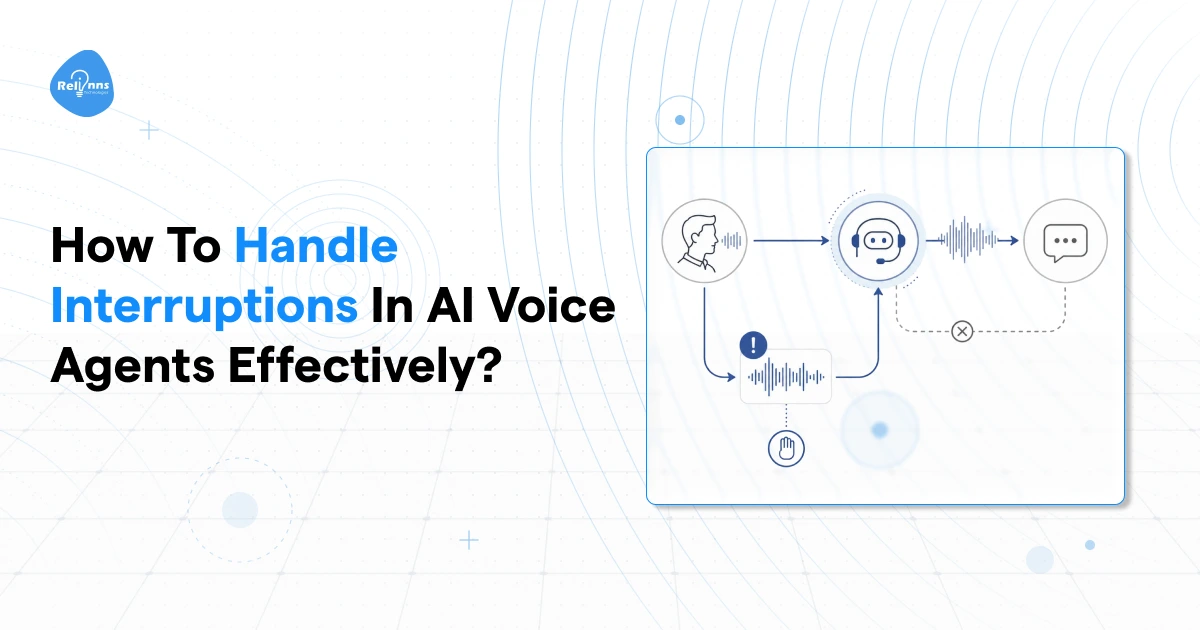
Most teams building AI voice agents treat interruptions in voice agents as a detection problem. Can the agent hear the caller cut in? Does it stop talking fast enough?
Detection is mostly solved. The real problem comes after.
An agent that stops correctly can still lose the workflow stage, repeat content the caller has already heard, or miss a correction. Voice AI interruptions look like a listening problem on the surface. They're a state management problem underneath.
That gap is what most demos don't show. It's why an agent that sounds human to callers during a scripted run falls apart the moment a real user says, "Wait, no."
Handling interruptions in voice agents isn't about detection. It's about what the agent does next.
The gap between those two things is where most voice agent deployments fail.
Stopping Isn't the Same as Recovering
When teams talk about interruption handling, they almost always mean the same thing: barge-in detection. The agent hears the caller speak mid-response, cuts the audio, and waits for new input.
But there's a second layer most people skip. And it's the one that determines whether the call works.
Interruptions in voice agents operate across two distinct problems:
Teams that spend months building a voice agent nail the first layer. The second one gets dropped.
And this isn't just a startup problem. OpenAI shipped a patch in March 2025 specifically to fix recovery issues in Advanced Voice Mode. Sesame AI openly admits they're "still in the valley on turn-taking and pacing." These are teams with mature voice AI stacks. If they're still working on it, the problem is harder than most demos suggest.
Interruptions in voice agents don't all look the same. Some are corrections. Some are impatient. Some are just a caller saying "uh-huh."
Interruption recovery in voice agents is a different engineering problem than detection. Treating them as the same is where most deployments break.
To fix this properly, you first need to know which kind of interruption you're dealing with. There are six.
Your Caller Can Interrupt Six Different Ways. Each One Needs a Different Answer.
Not all interruptions in voice agents are the same. And treating them like they are is exactly how systems break.
A caller saying "uh-huh" mid-sentence is doing something completely different from a caller who says "wait, I gave you the wrong number." One should be ignored. The other needs the workflow to update immediately. The agent that can't tell the difference will either talk over corrections or freeze on backchannels.
Here's how the six types break down:
“GPT-family models continue correctly after a backchannel filler only 7 to 31 percent of the time. Gemini 2.5 models handle the same scenario at 62 to 68 percent.”
Source: IHBENCH Benchmark
Filler happens on nearly every real call. Not an edge case. And it gets harder in multilingual voice AI deployments because backchannel words vary across languages entirely. "Uh-huh" in English has a dozen equivalents in Arabic, Hindi, and Tagalog, none of which sound the same.
Pushback is the other thing that teams underestimate. Interruptions in voice agents with pushback intent require the recovery logic to hold the workflow state while de-escalating. That's a harder problem than it sounds. The agent needs to be empathetic without dropping the thread. Detecting pushback and angry callers is an engineering consideration in its own right, not just a prompt tweak.
One more thing: noise compounds all six types. A filler misheard as a correction, or a correction lost under background traffic, pushes voice AI interruptions into the wrong classification path entirely. Noise and overlapping speech in voice agents make every row in that table harder to get right.
Knowing the type is step one. The step most teams skip is building the right response architecture for each.
The Failure Isn't Dramatic. That's Why Teams Miss It.
Bad interruption recovery doesn't crash anything. There's no error log, no obvious breakage. What you get is the agent quietly doing the wrong thing.
Four ways this shows up in production:
- The agent re-reads the content that the caller had already interrupted
- A correction gets acknowledged but not applied. The caller said, "Use my work email." Booking went to the personal one anyway.
- The workflow stage gets lost, and intake restarts from the beginning
- The agent confirms something the caller never agreed to
None of these is catastrophic in a single call. Across thousands of them, they are.
Research from the IHBENCH benchmark tested 26 model configurations as conversation length grew. 24 of them showed a negative recovery slope. Handling interruptions in voice agents gets harder the longer the call runs. That's not fixable with a better prompt.
In HIPAA-compliant voice workflows like healthcare scheduling or insurance FNOL intake, this means wrong data entering systems. A corrected policy number was ignored. A patient booked on the wrong date.
In enterprise voice workflows, a missed correction is not a conversational hiccup. It is a data integrity failure. The cleanup costs more than the call saved.
Voice AI interruptions look invisible in demos and expensive in operations. The two environments are just that different. And voice agent guardrails built at the architectural level, not the prompt level, are the only reliable fix for interruptions in voice agents at scale.
The architecture that prevents this is not complicated. But it requires three things running at the same time.
Three Layers Every Voice Agent Needs to Handle Interruptions Cleanly
The architecture for handling interruptions in voice agents isn't one thing. It's three separate processes running in parallel while the agent is mid-response.
- Streaming voice activity detection (VAD).
The agent continuously listens for audio, even while it's speaking. The moment the caller starts up, this layer fires.
- Streaming transcription.
Within roughly 100ms of the caller starting to speak, a partial transcript comes through. The system gets usable content before the caller even finishes their sentence.
- Semantic classifier.
This is the layer that separates solid systems from broken ones. It reads that partial transcript and asks one thing: is this a real interruption or just a backchannel? Only genuine interruptions trigger barge-in.
Expert Tip: Without the semantic layer, you're flying blind. The agent either ignores genuine interruptions or stops every time someone says "uh-huh." Both ruin the call, just in different directions.
When a barge-in occurs, three things need to happen together: the TTS stream cuts, the half-spoken response drops, and the conversation state rolls back to match the new input. Skip any one of these, and the recovery falls apart.
How cleanly that TTS cut happens also depends on your audio protocol. WebRTC vs SIP for audio streaming is worth understanding before you commit to a telephony stack.
On latency: for voice AI interruptions to feel natural, the full response loop must close in under 700ms. Above 900ms, callers notice. Production deployments at scale typically land around 600ms, which leaves enough headroom for function calls on top. More on improving voice agent latency if you're still chasing that threshold.
One more thing: the semantic classifier is only as good as the model behind it. Choosing the right LLM for voice agents directly affects how well interruptions in voice agents are classified at the edges, such as a correction phrased as a question or pushback that sounds perfectly calm.
Barge-in gets the agent to stop. What happens next is where the real engineering lives.
After the Interruption: Why the State Machine Matters More Than the Model
The instinct is to fix recovery through better prompting. Clearer instructions, more context in the system prompt. That approach has a ceiling, and it's lower than most teams expect.
Your voice AI prompting strategy shapes how the agent talks. It doesn't control which state the workflow is in, which data was just corrected, or what the agent had already said before the caller cut in. Interruptions to voice agents are a state-management problem. The model processes language. The state machine keeps the workflow honest.
Here's what that layer actually looks like:
The heart-content tracker is the piece people miss most often. If the agent was halfway through confirming a booking when the caller cut in, the agent needs to know exactly what was heard and what wasn't. Otherwise, it repeats the first half or skips the confirmation entirely. Both create problems downstream
On rollbacks: soft rollback returns to the last turn and keeps the slots already captured. Hard rollback resets to a checkpoint and discards the transient state. Most interruptions in voice agents call for soft. Hard rollback is for when the call has genuinely derailed.
The tool/action validator row in that table is worth pausing on. Without it, the agent can verbally confirm a refund, quote a price, or schedule a callback that no system has actually processed. Preventing hallucinated commitments is one of the more underrated parts of getting interruption recovery in voice agents right at scale.
The model processes language. The state machine keeps the workflow on track. Both are required. One without the other creates agents that sound good on a call and fail operationally afterward.
That's what architectural guardrails actually mean in practice. Not a prompt instruction. A system built around the model.
Getting this right in the build is straightforward. The gap appears when teams skip the testing phase.
Build an Interruption Test Suite, Not Just a Demo Script
A polished demo script proves nothing about how your agent handles interruptions in voice agents under real conditions. Stress testing a voice agent before launch means running it through deliberate, messy scenarios across the specific workflows you're deploying into. Every vertical has its own profile of voice AI interruptions, and the ones that break your system usually aren't the dramatic ones.
One thing worth doing in demos: show the failure before you show the fix. Run the same scenario with poor recovery, then with clean recovery. Buyers in regulated environments have seen enough scripted demos. Showing you understand what breaks builds more trust than showing it never breaks.
Expert Tip: Voice agent regression testing after every model update is not optional. Recovery behavior can shift when the underlying LLM gets updated, even if nothing in your prompt has changed. A correction that resolved cleanly last month might not next month.
And once it's live, four numbers will tell you whether the recovery is actually holding up.
Four Numbers That Reveal Whether Your Interruption Handling Is Actually Working
Start with your voice agent monitoring playbook if you have one. Containment rate and transfer rate are in there. They tell you whether calls finish. They don't tell you whether the interruptions in voice agents are being handled well along the way.
The four metrics that actually surface recovery problems:
1. False-barge rate.
How often does the agent cut its own response because of a backchannel that should have been ignored? A high number here means filler handling is broken. Every "uh-huh" is stopping the call.
2. Reprompt rate.
How often does the caller have to repeat themselves? Some is normal. Sustained reprompts concentrated in a single section of the workflow usually indicate a specific classifier failure rather than a general audio problem.
3. Wrong-intent rate.
How often does the agent misclassify the caller's input after an interruption, taking the wrong path? A correction read as a filler. Pushback is treated as a topic switch. These look fine in the transcript until you check what the system actually did next.
4. Audio-related transfer rate.
Not every transfer is a failure. A well-designed AI to human handoff preserves the conversation state and captured details when the agent cannot recover safely.
This is where interruption recovery in voice agents either holds or quietly falls apart at scale.
Expert Tip: The containment rate indicates whether calls are resolved. The false-barge rate and the reprompt rate indicate whether the responses were resolved cleanly. Track both from day one. Waiting until someone complains means the data you needed is already gone.
All of this is fixable. But it requires treating interruptions in voice agents as a system design problem, not a model problem.
Interruption Handling Is a Workflow Problem, Not a Listening Problem
Detection was the first problem. It's mostly solved. What determines whether a voice agent actually holds up in production is what it does in the seconds after it stops talking.
Six interruption types, each needing a different recovery. Three architecture layers running in parallel. A state machine that keeps the workflow honest regardless of how the caller behaves. And four metrics that tell you whether any of it is working after you ship.
In healthcare, insurance, and logistics, this isn't a UX problem. Missed corrections and lost workflow state create operational failures. The fix is architectural, not conversational.
Build the state machine. Test against real messy behavior. Track the right metrics from day one.
If you want to see how post-interruption workflow recovery works in a live scenario specific to your vertical, we run those demos. Book a session, and we'll show you the failure case and the fix on the same call.