AI Voice Agents for Healthcare: 2026 Detailed Breakdown
Date
Aug 31, 26
Reading Time
18 Minutes
Category
AI in Healthcare
Share


TL;DR
- AI voice agents for healthcare manage patient calls, bookings, reminders, report-status checks, intake, follow-ups, and routine insurance queries.
- They connect with EHRs, scheduling platforms, patient portals, and telephony systems to complete workflows instead of merely answering questions.
- Healthcare providers should automate low-risk, high-volume workflows first: appointment reminders, booking, report-status queries, and pre-visit instructions.
- Every deployment needs controlled medical knowledge, accurate clinical speech recognition, identity verification, and clear human-handoff rules.
- HIPAA, GDPR, consent, encryption, data retention, audit logs, and signed vendor agreements must be built into the architecture.
- Measure containment rate, handle time, no-show reduction, patient satisfaction, escalation accuracy, and cost per resolved interaction before scaling.
The average healthcare call still starts with friction. Patients wait on hold, front-desk teams repeat the same answers, and missed calls quietly turn into missed appointments.
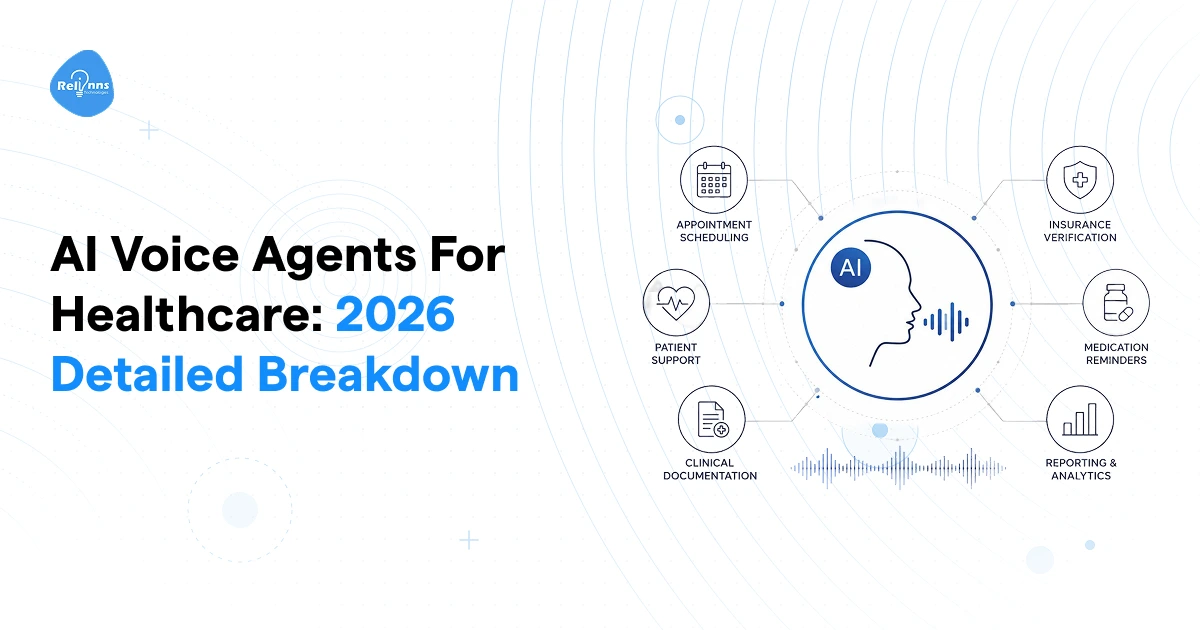
AI voice agents in healthcare help hospitals, clinics, telehealth platforms, and diagnostic labs automate the calls that overwhelm patient access teams. They book appointments, answer routine questions, send reminders, check report status, route urgent cases, and hand off to staff when a patient needs a human.
Unlike old phone trees, healthcare voice agents understand spoken requests and act on them. They can connect with EHRs, scheduling systems, patient portals, and follow-up workflows, making voice AI in healthcare more than a support tool. An AI voice agent for healthcare serves as a 24/7 digital front desk, built for patient communication at scale.
What Are AI Voice Agents for Healthcare?
AI voice agents for healthcare are phone-based AI systems that speak with patients, understand their requests, and complete routine workflows without front-desk involvement.
They can book appointments, reschedule visits, answer common questions, check lab report status, send reminders, collect intake details, and route urgent calls to staff. When connected to an EHR, PMS, scheduling system, or patient portal, the agent can read live information, update records, and pass the conversation to a human when the call needs clinical judgment.
Unlike general AI voice agents for customer service, healthcare deployments also require PHI protection, medical-vocabulary accuracy, identity verification, and clinical escalation rules.
AI voice agent in healthcare is a phone-based AI that holds a real conversation with patients. Not "press 2 for scheduling." Actual dialogue.
It listens, understands the request, connects to your EHR, and acts on it. Healthcare voice agents handle scheduling, billing, reminders, and follow-ups with no human required. At certain U.S. hospitals, AI-powered assistants now manage 60%+ of inbound scheduling calls, cutting wait times and staffing costs.
Voice AI in healthcare is past the pilot stage. An AI voice agent for healthcare is production infrastructure. That's what an AI voice agent in healthcare actually delivers.
How They Differ From IVR, Chatbots, and Human Receptionists
Most healthcare orgs have tried at least one of these already. The problem isn't that the older tools are bad, it's that they were built for a different job. Voice AI in healthcare sits in a category of its own, and the differences matter when you're deciding what to actually deploy.
| System | What It Does | Limitation |
| IVR | Routes callers through menu options | Rigid, frustrating, breaks on anything outside the script |
| Chatbot | Handles text-based support | Not built for patients who pick up the phone |
| Human receptionist | Handles calls with judgment and empathy | Expensive, limited to business hours, can't scale with call spikes |
| AI voice agent | Handles spoken workflows end-to-end with live system access | Needs proper compliance setup, guardrails, and EHR integrations to work well |
The gap between IVR and an AI voice agent in healthcare is bigger than most people expect. IVR traps patients in menus. Healthcare voice agents hold an actual conversation, pull your patient's record, and take action. An AI voice agent for healthcare isn't a smarter phone tree. It's a different tool entirely. And unlike a human receptionist, it doesn't go home at 6pm.
Why Healthcare Providers Are Adopting AI Voice Agents
This isn't about chasing an AI trend. The hospitals and clinic networks actually deploying voice AI in healthcare aren't doing it because it's interesting. They're doing it because the alternative, more staff, longer hold times, and missed calls, is getting harder to defend. The demand drivers are operational. And they've been building for years.
Patient Access Is Broken
Your front desk is the first thing a patient experiences. And for most health systems, it's overloaded. Calls go unanswered. Hold times stretch past 5 minutes. Patients calling after hours hit voicemail. Appointment booking requires three transfers. It's not a staffing failure. It's a volume problem that no reasonable headcount can fix.
Healthcare Call Volumes Are Repetitive
The honest reality is that the majority of calls coming into a clinic or hospital don't need a trained person to handle them. They follow the same patterns, day after day. An AI voice agent in healthcare handles exactly this category of call, at scale, without fatigue.
Typical repetitive queries healthcare voice agents handle daily:
- Appointment booking
- Rescheduling
- Clinic hours
- Doctor availability
- Insurance accepted
- Report status
- Pre-visit instructions
- Prescription refill status
- Follow-up reminders
These nine query types account for the bulk of inbound call volume at most mid-to-large health systems. Voice AI in healthcare doesn't need to handle every call. It just needs to handle these. When it does, your human staff can focus on calls that need them.
Administrative Labor Is Becoming the Bottleneck
Front-desk staff aren't the problem. The work is. Booking confirmations, repeat status checks, rescheduling requests that follow a script these consume hours that should go toward patients who actually need support. 50 to 70% of call center volume at most health systems falls into the automatable bucket. An AI voice agent for healthcare moves that work off the desk entirely. What's left for your team is worth their time.
Patients Still Want Voice for Urgent or Sensitive Healthcare Needs
Don't assume patients want to self-serve everything. A 68-year-old calling about post-surgery instructions isn't opening a portal. Someone asking about a worrying test result wants to hear a voice. Healthcare voice agents work best when they handle the repetitive calls and route the emotional, urgent, or complex ones to a person immediately. Voice AI in healthcare earns trust by knowing its own limits.
How Do AI Voice Agents Work in Healthcare?
Understanding the mechanics matters, especially if you're the one signing off on the build. An AI voice agent isn't a black box. It's a system with distinct layers, and each one has to work correctly for the whole thing to hold up in a clinical environment.
Core Architecture: Three Components Running in Real Time
- ASR (Automatic Speech Recognition): Converts what the patient says into text the system can process. Accuracy on medical terms like "Lisinopril" or "CABG" is non-negotiable here.
- NLU (Natural Language Understanding): Figures out what the patient actually means, not just what they said. "Can I move my Thursday appointment?" gets interpreted as a reschedule request, not a yes/no question.
- TTS (Text-to-Speech): Converts the agent's response back into spoken audio. Good TTS sounds natural. Bad TTS sounds like a bus station announcement.
The Healthcare Knowledge Layer
Generic LLM responses are a liability in a clinical setting. A voice AI healthcare deployment needs a controlled knowledge base, not open-ended generation. If a patient asks about their pre-colonoscopy prep instructions and the agent improvises, that's a patient safety issue.
The knowledge layer should cover:
- Clinic policies and operating hours
- Doctor schedules and availability
- Insurance plans accepted
- Pre-test and pre-procedure instructions
- Post-op guidelines
- Escalation protocols
- FAQs specific to your facility
Healthcare voice agents only answer from what's been verified and approved. That's the difference between a useful tool and a liability.
EHR Integration: Deeper Than an API Call
With 96% of U.S. hospitals having adopted FHIR APIs, the infrastructure for connecting voice agents to clinical systems already exists. But "connected" and "integrated" aren't the same thing.
Successful AI voice agents for healthcare deployments achieve bi-directional integration with platforms like Epic, Cerner, and MEDITECH, meaning the agent can read patient records and write back confirmed bookings, reschedules, and intake data. That's what makes it useful. A surface-level API connection that can only pull a name and DOB isn't enough to automate real workflows.
Inbound vs. Outbound Flows
Most people think about inbound first, patients calling in to book, check status, or ask questions. But outbound is where AI voice agents in healthcare often drive the bigger ROI.
Outbound flows include appointment reminders, no-show recovery calls, post-discharge check-ins, and prescription refill nudges. Same technology, different trigger. The agent initiates the call rather than receiving it.
What Makes Healthcare Voice AI Different From General Voice AI
Three things separate a healthcare deployment from a generic one:
| Factor | Why It Matters |
| PHI handling | Every conversation may contain protected health information. HIPAA compliance, BAAs, and encrypted storage aren't optional. |
| Medical vocabulary | The ASR model needs training on clinical terminology. Mishearing a drug name has real consequences. |
| Escalation rules | The agent must know exactly when to stop and transfer. No general-purpose voice AI has those rules built in for a clinical context. |
Voice AI in healthcare operates inside tighter guardrails than any other industry. That's not a constraint, it's the point.
Where AI voice Agents Fit Across Healthcare Organisations
Not every healthcare org has the same problem. The use cases that matter to a 10-branch hospital chain are different from what a telehealth startup needs. Here's where AI voice agents in healthcare map most directly to real operational gaps, broken down by segment and the person who usually owns the decision.
| Healthcare Segment | Best Voice Agent Use Cases | Buyer |
| Multi-specialty hospitals | Appointment calls, department routing, insurance queries, discharge follow-ups | COO, CDO, VP Operations |
| Single-specialty clinics & polyclinics | Booking, no-show recovery, pre/post-visit instructions | Practice Owner, Operations Manager |
| ASCs & day surgery centers | Pre-op instructions, post-op check-ins, scheduling coordination | Medical Director, Admin Head |
| Corporate hospital chains | Cross-branch routing, centralized booking, patient follow-up at scale | CDO, VP Operations, CTO |
| Telehealth platforms | Patient onboarding, session reminders, re-engagement calls | CTO, CPO, Head of Clinical Ops |
| Diagnostic labs & imaging centers | Report status queries, home collection booking, prep instructions | COO, CTO, Franchise Ops Head |
| Online therapy platforms | Intake calls, therapist matching, session booking, crisis routing | CEO, CPO, Clinical Ops |
| Psychiatric & counselling clinics | First-contact intake, appointment reminders, between-session check-ins | Clinical Director, Operations Head |
The pattern across all of these is the same. High call volumes, repetitive query types, and a front desk that can't keep up.
Voice AI in healthcare solves the same core problem regardless of segment. What changes is the specific workflow and who signs off on the build. Healthcare voice agents deployed at a diagnostic lab chain look different from ones running at a telehealth platform, but the underlying logic is identical.
Key Healthcare Use Cases for AI voice Agents
These are the workflows running in production across hospitals, labs, clinics, and digital health platforms right now.
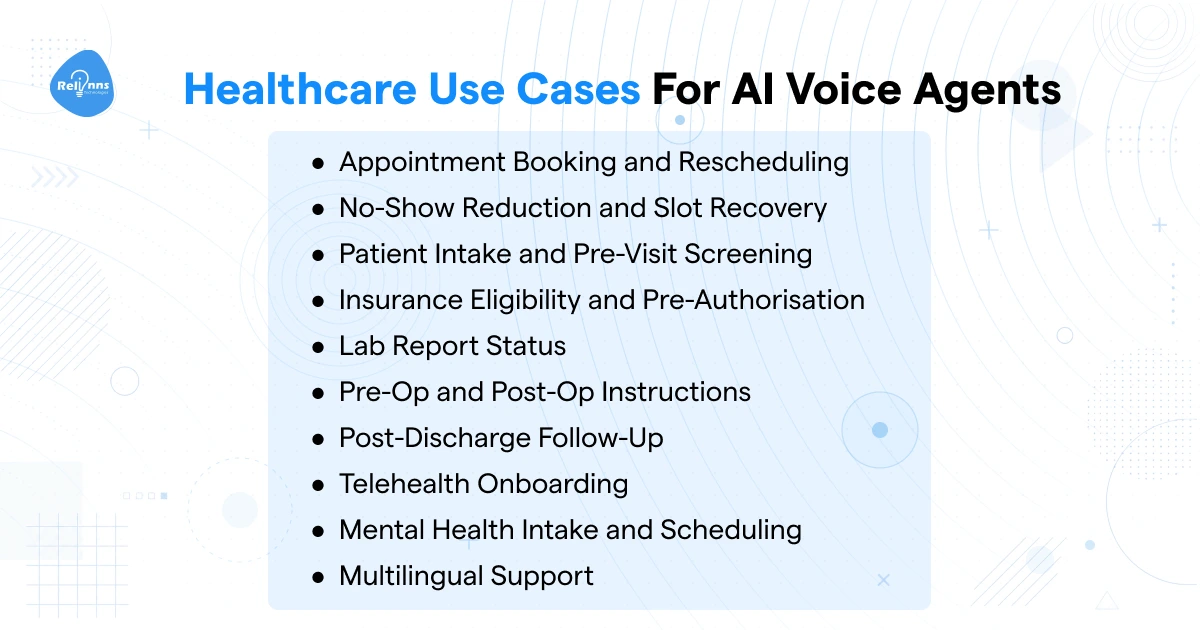
- Appointment Booking and Rescheduling: Checks real-time availability, confirms the slot, updates the EHR, and sends an SMS or WhatsApp confirmation. Highest-volume use case across every healthcare segment.
- No-Show Reduction and Slot Recovery: Outbound reminders at 48 and 24 hours. If the patient cancels, the agent immediately offers alternatives and activates the waitlist.
- Patient Intake and Pre-Visit Screening: Collects demographics, reason for visit, and basic symptom information the day before arrival. Intake and routing only, not diagnosis.
- Insurance Eligibility and Pre-Authorization:Captures insurance details, checks eligibility, and chases documentation. Hands off exceptions to billing staff with full context already captured.
- Lab Report Status: 40 to 60% of diagnostic lab inbound calls are patients asking if their report is ready. The agent verifies identity, checks status, and sends the download link.
- Pre-Op and Post-Op Instructions: Outbound calls the day before a procedure. Check-in calls at 24 and 72 hours post-procedure. Patients arrive prepared and complications get flagged early.
- Post-Discharge Follow-Up: Structured check-ins on medication adherence and recovery. Red-flag responses escalate to a nurse immediately, which is what directly reduces readmission risk.
- Telehealth Onboarding: Confirms first appointments, covers platform setup, and re-engages drop-offs before the first billable session is lost.
- Mental Health Intake and Scheduling: Booking, intake questions, and between-session reminders. Any distress signal triggers an immediate transfer to a clinician.
- Multilingual Support: Arabic, Hindi, French, and other languages for UAE, UK, and Canadian markets. A voice agent that only works in English excludes patients before the call starts.
Benefits of AI voice Agents in Healthcare
The benefits of deploying an AI voice agent in healthcare stack across four areas: operations, patient experience, revenue, and clinical quality. None of these are soft wins. They're measurable, and they compound once the system is running at full volume.
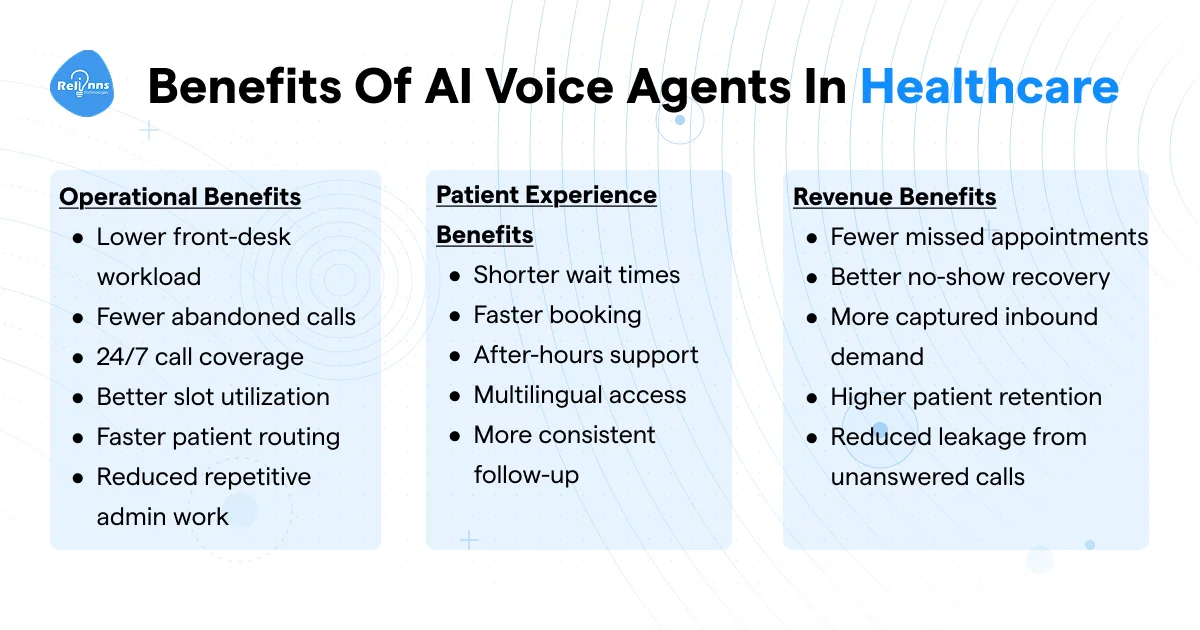
Operational Benefits
Healthcare voice agents take the repetitive call load off your staff so they can handle work that actually needs a person.
- Lower front-desk workload
- Fewer abandoned calls
- 24/7 call coverage
- Better slot utilization
- Faster patient routing
- Reduced repetitive admin work
Patient Experience Benefits
Patients notice wait times and callback failures more than most ops teams realize. Voice AI in healthcare fixes the parts of the experience that erode trust quietly.
- Shorter wait times
- Faster booking
- After-hours support
- Multilingual access
- More consistent follow-up
Revenue Benefits
Unanswered calls are lost revenue. An AI voice agent for healthcare captures demand that currently falls through the cracks.
- Fewer missed appointments
- Better no-show recovery
- More captured inbound demand
- Higher patient retention
- Reduced leakage from unanswered calls
Clinical Operations Benefits
This is the benefit set most CTOs and COOs underestimate going in. Better intake and earlier escalation have downstream effects that go well beyond the call center.
- Better intake quality
- More consistent pre and post-care communication
- Earlier escalation of risk signals
- Less manual documentation burden
Risks and Limitations of AI voice Agents in Healthcare
Any CTO or COO doing proper due diligence on voice AI in healthcare should be asking about failure modes, not just success metrics. The risks are real, they're manageable, but they don't disappear because a vendor skipped them in their pitch deck. Here's what to actually pressure-test before you deploy.
| Risk | Why It Matters | Mitigation |
| Hallucinated medical advice | An agent that improvises clinical answers creates direct patient safety risk | Lock responses to a verified knowledge base, no open-ended generation, hard escalation rules for clinical questions |
| PHI exposure | Every patient conversation may contain protected health information | HIPAA and GDPR controls, end-to-end encryption, access logging, signed BAAs |
| Poor escalation design | Patients get stuck in automation loops when they need a human | Explicit handoff triggers, low confidence thresholds, easy opt-out at any point |
| Accent and language errors | Misheard requests lead to wrong bookings or missed urgency signals | Multilingual ASR testing across your actual patient population before go-live |
| Integration gaps | Agent can't complete the workflow if the EHR or PMS connection isn't solid | Full API readiness audit before deployment, not after |
| Patient distrust | A share of patients, especially older ones, will resist AI in a care context | Upfront disclosure, genuine opt-out to a human, no forced automation |
The security risks go beyond a data breach scenario. 2026 research on voice agent governance flags a broader threat surface: privacy leakage, privilege escalation, resource abuse, and behavioral attacks that can manipulate agent responses. Basic access controls aren't enough.
Healthcare voice agents need layered defenses built into the architecture, not added later.
The honest limitation I'd flag: no voice agent for healthcare performs well out of the box in a clinical environment. Every deployment needs domain-specific training, tested escalation logic, and an ongoing review process.
The orgs that treat it as a one-time implementation tend to hit problems at month three. The ones that treat it as a system they actively manage don't.
HIPAA, GDPR, and Healthcare Compliance Requirements
Compliance isn't a checklist item you handle at the end of a voice AI deployment. It's the foundation everything else sits on. Get it wrong and you're not looking at a performance problem. You're looking at regulatory exposure, patient trust damage, and in some jurisdictions, significant fines. This section covers what AI voice agents in healthcare actually need to meet, by geography.
HIPAA Requirements for US Healthcare Voice AI
Every patient call handled by a voice agent may contain protected health information. Names, dates of birth, insurance IDs, diagnoses, medications, appointment reasons. HIPAA treats all of it as PHI, and your vendor is legally a Business Associate the moment they process it.
Every HIPAA-compliant voice agent must meet the following requirements before processing patient information:
- Signed Business Associate Agreement with the vendor before any PHI is processed
- End-to-end encryption for voice data in transit and at rest
- Role-based access controls limiting who can access conversation logs
- Full audit logs of every interaction, accessible for compliance review
- Minimum necessary data principle: the agent only collects what the workflow requires, nothing more
- Data retention policy with defined timelines and deletion procedures
- Breach response protocol covering detection, notification, and remediation
Healthcare voice agents that skip any of these aren't just non-compliant. They're a liability waiting to surface at the worst possible time.
GDPR Requirements for UK and EU Healthcare Voice AI
For healthcare operators in the UK or EU, GDPR adds a layer on top of existing health data regulations. Patient voice data is special category data under GDPR, which means the bar for lawful processing is higher than standard personal data.
Key requirements for an AI voice agent for healthcare operating in these markets:
- Explicit consent or a clear lawful basis for processing voice data, documented before the call
- Data minimization: collect only what's needed, retain only as long as necessary
- Right to access and erasure: patients can request their call data and have it deleted
- Data Processing Agreements with every vendor in the chain, not just the primary one
- Cross-border transfer controls: if the vendor processes data outside the UK or EU, standard contractual clauses or equivalent safeguards must be in place
The post-Brexit UK GDPR largely mirrors EU GDPR in practice. Healthcare operators running across both jurisdictions should treat them as aligned but verify specifics with legal counsel, particularly on transfer mechanisms.
GCC Healthcare Data Protection Considerations
UAE, Saudi Arabia, and Qatar all have active health data protection laws requiring local data hosting, explicit consent, and documented data processing agreements. The GCC regulatory landscape is still developing, which makes clear vendor documentation more important, not less. Confirm your vendor can host patient data within the relevant jurisdiction before signing anything.
AI Disclosure and Patient Consent
Yes, the agent should say it's an AI. Upfront, every call. Several US states legally require it, but the real reason is simpler: patients who find out after the fact lose trust in the provider, not just the technology. Keep the disclosure natural, offer a genuine opt-out, and make the path to a human easy.
Human Handoff: When AI voice Agents Should Escalate
The quality of an AI voice agent in healthcare deployment isn't measured by how many calls it contains. It's measured by how well it knows when to stop. The handoff from AI to human is not a failure state. It's a designed feature. Healthcare voice agents that don't escalate correctly are the ones that end up in incident reports. Get this right and you've built something patients and clinicians can actually trust.
Medical Red Flags
These trigger an immediate transfer to clinical staff. No retry, no clarification loop. The moment any of these come up, the agent hands off with full context.
- Chest pain or pressure
- Severe or uncontrolled bleeding
- Difficulty breathing
- Any expression of suicidal ideation or self-harm
- Post-surgery complications: fever, wound issues, unusual pain
- Suspected medication reaction or overdose
The agent's job here is to transfer fast and pass everything it heard. The clinician picks up with context, not a cold call.
Administrative Exceptions
Not every escalation is a medical emergency. Some calls just need a person, and the agent should recognize that without making the patient ask twice.
- Patient expressing anger or significant frustration
- Billing dispute or charge query requiring review
- Insurance denial requiring a human to advocate or explain
- Appointment conflict involving multiple providers or complex scheduling
- VIP patient or account flagged for direct staff handling
- Any request with legal or compliance implications
For these, the handoff goes to the right team, not just the next available agent. Routing matters as much as the transfer itself.
Low-Confidence AI Responses
Every voice AI in healthcare system has a confidence threshold. Below it, the agent shouldn't guess.
If the agent can't confidently interpret what a patient said after one clarification attempt, it should transfer. Not apologize three times. Not loop through the same question. Transfer, with a brief summary of what was captured so far.
The threshold itself matters. Too high and you're escalating routine calls that the agent should handle. Too low and patients get stuck in an automation that can't help them. Most well-tuned healthcare voice agents set the confidence cutoff somewhere between 70 and 80% and adjust based on call category.
Appointment booking can tolerate a lower threshold. Anything touching clinical information should sit higher.
The builder who deployed a real clinic voice agent noted this directly: the calendar sync was the hardest part, but fallback design was the most consequential. A confused agent that tries to wing it is worse than no agent at all.
Sensitive Conversations
Some clinical areas carry emotional weight that AI shouldn't try to carry alone. An AI voice agent for healthcare should have stricter escalation rules built specifically for these categories, not the same generic threshold applied to everything else.
Mental health calls require fast, low-barrier access to a person. A patient calling an oncology department about treatment results isn't in the same emotional state as someone rescheduling a dental cleaning. Fertility patients dealing with failed cycles, parents calling about a sick child, families navigating end-of-life care. These aren't edge cases. They're predictable call types that every hospital and specialist clinic handles regularly.
Healthcare voice agents in these contexts should escalate earlier, not later. The correct design is a topic-level escalation rule, not just a confidence score. If the call topic matches a sensitive category, the threshold drops and the human handoff happens faster. The patient might not even notice the difference.
But they'll notice if they're forced to repeat their situation to an AI that isn't equipped to hold that conversation.
AI voice Agents vs Healthcare Chatbots vs AI Agents
These three get lumped together constantly, and that confusion leads to bad purchasing decisions. They're not competing tools. They serve different channels, different patient types, and different workflow complexity levels. An AI voice agent in healthcare is the phone layer. A chatbot is the text layer. An AI agent is the workflow automation layer. You'll likely need all three eventually, but you deploy them for different reasons.
| Capability | Voice Agent | Chatbot | AI Agent |
| Main channel | Phone and voice | Website, WhatsApp, SMS | Multi-system workflow |
| Best for | Calls, booking, reminders | FAQs, form capture, self-service | Complex operational workflows |
| Patient fit | Strong for urgent situations and older patients | Strong for digital-first, younger patients | Mostly backend, minimal patient-facing interaction |
| Risk level | Medium-high (live patient conversations) | Medium | High if running autonomously |
| Healthcare use | Receptionist, outbound reminders, follow-up calls | Intake forms, FAQ handling, appointment self-service | Pre-authorization, care pathway automation, multi-step coordination |
The way I'd frame the decision: start with where your patients actually contact you. If the majority of your inbound volume is phone calls, voice AI in healthcare is the right first investment. If your patient base skews younger and digital-first, a chatbot moves first. If your bottleneck is a multi-step operational workflow like pre-auth or discharge coordination, an AI agent addresses that.
Healthcare voice agents handle the call. Chatbots handle the screen. AI agents handle the process behind both. They're layers in a system, not replacements for each other. The mistake most healthcare operators make is treating this as an either/or choice when the actual answer is sequenced deployment, starting with the highest-volume channel and building from there.
What Healthcare Teams Should Automate First
Don't try to automate everything at once. Start with workflows that are high-volume, rule-based, and easy to measure. Voice AI in healthcare delivers fastest when the first use case is narrow enough to validate quickly and scale with confidence.
| Priority | Workflow | Why Start Here |
| 1 | Appointment reminders | Low clinical risk, immediate ROI, easy to measure |
| 2 | Appointment booking | Highest call volume, direct impact on front-desk load |
| 3 | Lab report status | Repetitive queries, fully automatable, no clinical judgment needed |
| 4 | Pre-visit instructions | Reduces day-of friction and staff prep calls |
| 5 | Post-visit follow-up | Higher value but needs tested escalation logic first |
| 6 | Insurance and pre-auth support | Valuable once EHR and payer integrations are solid |
Get reminders and booking right before touching anything downstream. An AI voice agent in healthcare that handles those two workflows well gives you the operational proof, the patient feedback, and the integration confidence to expand. Healthcare voice agents that try to do everything on day one rarely do anything well.
Implementation Roadmap for Healthcare AI voice Agents
Most failed voice AI deployments share the same root cause: they skipped steps two through five and wondered why step six was a mess. Here's the sequence that actually works.
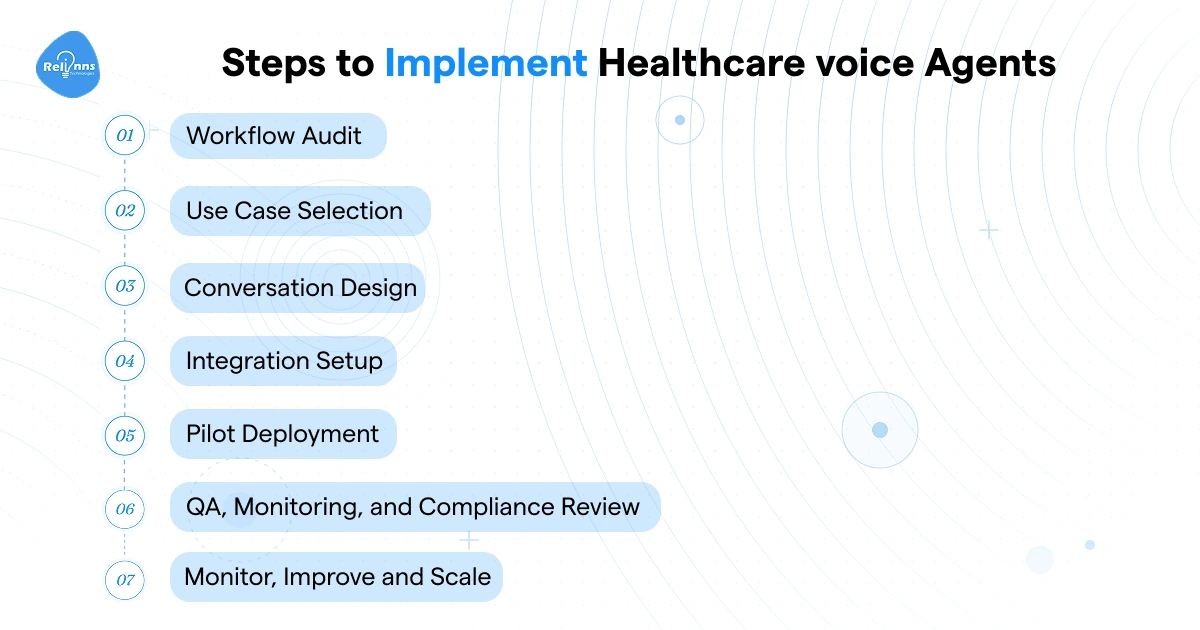
- Phase 1) Workflow Audit: Map your current call types, volumes, abandonment rates, average handle time, staffing cost per call, and where escalations happen. You can't automate what you haven't measured.
- Phase 2) Use Case Selection: Pick one or two workflows. Appointment reminders and booking are the right starting point for most healthcare operators. Don't try to automate the full phone system on day one.
- Phase 3) Conversation Design: Map every patient intent, fallback path, handoff trigger, compliance disclosure, and identity verification step. This is where most teams underinvest and later regret it.
- Phase 4) Integration Setup: Connect telephony, EHR or PMS, scheduling system, CRM, and SMS or WhatsApp confirmation. Voice AI in healthcare without live system access is just a fancy IVR.
- Phase 5) Pilot Deployment: Run with one department, branch, or call type. Not the whole organization.
- Phase 6) QA, Monitoring, and Compliance Review: Review call transcripts, failed intents, escalation accuracy, false positives, patient complaints, and PHI handling. An AI voice agent in healthcare needs active monitoring, not just a launch.
- Phase 7) Scale: Expand to more workflows and locations only after performance on the pilot is stable and measurable. Healthcare voice agents earn the right to scale. They don't start there.
ROI of AI voice Agents in Healthcare
The ROI case for an AI voice agent in healthcare isn't complicated. It sits across four measurable buckets. Track these and you'll have everything you need to justify the investment internally.
Cost Savings
- Reduced call handling time per interaction
- Lower front-desk workload across shifts
- Fewer after-hours staffing needs
- Reduced call abandonment rate
Revenue Recovery
- More appointments booked through 24/7 availability
- Recovered no-shows via outbound reminders
- Filled cancellations from waitlist activation
- Higher patient retention from consistent follow-up
Patient Experience Impact
- Average speed to answer
- First-call resolution rate
- Booking completion rate
- Patient satisfaction scores
- Complaint volume
Operational Quality
- Escalation accuracy
- Documentation completeness
- Follow-up completion rate
- Missed call rate
Just remember this formula,
Monthly ROI = Recovered appointment revenue + labor hours saved + reduced missed-call leakage minus AI platform and implementation cost.
Healthcare voice agents that can't produce numbers against these metrics within 60 days of going live aren't being monitored correctly.
How to Choose a Healthcare AI voice Agent Vendor
Most vendors will show you a polished demo on a clean use case. That's not the test. Push on compliance documentation, real integration depth, and what happens when the agent doesn't understand the patient. Voice AI in healthcare lives or dies on the details vendors skip in sales calls.
- Healthcare compliance readiness: Ask for HIPAA documentation, BAA terms, GDPR controls, audit logs, encryption standards, data retention policy, and role-based access. If they can't produce these quickly, that's an answer.
- EHR and practice management integration: Confirm support for your specific EHR, whether it's Epic, Cerner, MEDITECH, or a regional PMS. API connectivity, webhook support, and bi-directional scheduling write-back are non-negotiable for AI voice agents in healthcare.
- Voice quality and latency:Test real calls, not scripted demos.Response latency above 1.2 seconds kills the conversation feel. Ask to call a live instance with edge-case inputs.
- Conversation design depth: Healthcare voice agents need carefully mapped escalation paths, fallback handling, and exception flows. Ask to see a real conversation design document, not a flowchart slide.
- Multilingual support: If you operate in the UAE, UK, Canada, or serve diverse US populations, confirm tested language support, not just "we support 20 languages" on a features page.
- Analytics and monitoring: Look for dashboards covering containment rate, escalation accuracy, drop-offs, failed intents, and sentiment signals. If the vendor doesn't have this, you're flying blind.
- Human handoff support: The agent should transfer, summarize context, and log the interaction. A cold transfer with no context handed over defeats the purpose.
Build vs Buy vs Custom AI voice Agent Development
Off-the-shelf tools work for simple, low-volume use cases. But most mid-to-large healthcare operators hit their limits fast, usually around EHR integration, compliance controls, or workflow complexity. Here's how the options stack up.
| Option | Best For | Limitation |
| Off-the-shelf tool | Small clinics with basic booking needs | Limited customization, generic compliance posture |
| Platform plus configuration | Mid-sized healthcare providers with standard workflows | May hit integration walls with complex EHR setups |
| Custom AI voice agent | Hospitals, chains, telehealth platforms, and diagnostic networks | Higher upfront investment, needs a capable technical partner |
| Full healthcare AI system | Multi-location or regulated workflows needing voice, chat, WhatsApp, and RAG together | Requires end-to-end build, not a vendor install |
For healthcare organizations running real complexity, a custom-built voice AI in healthcare is the only option that scales without hitting walls. That means an AI voice agent for healthcare integrated with your EHR, telephony stack, scheduling system, WhatsApp layer, RAG knowledge base, and human escalation workflow. Not a voice bot dropped into your phone system. A system built around how your organization actually operates.
Multilingual and Geo-Specific Considerations
Language isn't a nice-to-have in healthcare voice AI. In UAE and GCC markets, Arabic support is a baseline expectation. In Canada, French is a legal requirement in Quebec. In UK NHS-adjacent services, Hindi and South Asian language populations are significant.
A voice AI in healthcare that only works in English excludes patients before the call starts. That's an access problem, not a feature gap. Healthcare voice agents serving these markets need tested multilingual ASR, not just a languages-supported list on a spec sheet.
Patient Trust and Consent
Tell patients they're talking to an AI. Upfront. Every time. Disclosure isn't just a compliance requirement in most US states. It's the difference between a patient who trusts the interaction and one who feels deceived when they find out later.
For older patients, anxious callers, and non-native speakers, the framing matters. Keep it simple: "I'm an AI assistant, and I can help with X, Y, and Z. You can speak to a staff member at any time."
When the agent fails or misunderstands, the recovery is a fast, clean transfer with no dead air. An AI voice agent for healthcare earns trust through transparency and graceful exits, not by pretending to be human.
KPIs to Track
If you're not measuring these, you don't actually know if your voice AI in healthcare deployment is working.
- Containment rate: percentage of calls resolved without human transfer
- Average handle time: per call, compared to pre-deployment baseline
- No-show rate change: before and after outbound reminder flows go live
- Patient satisfaction (CSAT): post-call surveys on AI-handled interactions
- Escalation accuracy: are the right calls actually reaching humans
- Cost per resolved interaction: the number that closes the ROI conversation
Final Takeaway: Should Healthcare Providers Use AI voice Agents in 2026?
Yes. But not as a generic receptionist bot. The real value of an AI voice agent in healthcare sits in high-volume, repetitive, low-risk workflows: booking, reminders, report status, pre-visit instructions, post-care follow-up. Healthcare voice agents deliver measurable returns when they're integrated with your EHR, scheduling system, WhatsApp layer, and human escalation workflow. Not before.
Frequently Asked Questions
Which is the best voice AI for managing patient communications at scale?
A custom-built AI voice agent for healthcare integrated with your EHR, scheduling system, WhatsApp, and escalation workflows outperforms any off-the-shelf tool at scale.
Which is the best voice AI for claim intake automation?
Healthcare voice agents built with pre-auth logic, payer coordination workflows, and human handoff for exceptions deliver the strongest claim intake results.
Sources:
https://www.nature.com/articles/s41746-025-01776-y
https://www.retellai.com/blog/ai-for-healthcare-how-ai-agents-help-with-patient-screening