AI Voice Agents vs Human Agents: Detailed Comparison for 2026
Date
Sep 02, 26
Reading Time
11 Minutes
Category
AI Voice Agents
Share


TL;DR
- In the AI agent vs human agent comparison, AI wins on speed, scale, availability, and consistency for predictable calls.
- Human agents remain stronger at empathy, complex problem-solving, negotiation, high-value sales, and sensitive conversations.
- The best model is hybrid: let AI handle routine inquiries and transfer complex calls to humans with full context.
- Compare performance using containment rate, escalation rate, first-call resolution, average handle time, and cost per resolved call.
- Audit your call types before automating. Route repetitive workflows to AI while keeping humans responsible for judgment-heavy interactions.
AI handles volume. Humans handle complexity. The best support operations run both.
That's the short answer to the AI agent vs human agent debate, and most businesses already know it somewhere in the back of their mind. What they're missing is clarity on exactly where to draw the line.
This blog breaks that down through a complete human receptionist vs voice agents comparison across cost, availability, empathy, and decision-making. The real question is which call types should be automated and which still require human judgment.
You'll see when to deploy each, what the ROI looks like in real numbers, and how to build a voice agent support operation that doesn't force you to choose. Because framing the ai agent vs human agent question as either/or is the wrong starting point entirely.
What is an AI Voice Agent?
An AI voice agent is software that talks to your customers over the phone, handling calls the way a human rep would, but without the shift schedule, the sick days, or the coffee breaks. It listens, understands the caller's needs, and responds in a natural-sounding voice. Modern ones don't just follow scripts.
They handle open-ended conversations, pull data from your CRM in real time, and hand off to a human when things get complicated.
The distinction becomes clearer when comparing AI voice agents vs IVR systems: IVR follows fixed menus, while voice agents interpret natural language and complete actions.
The Technology Behind the Voice
Three core technologies make this possible. Strip any one of them out and the whole thing falls apart.
1. Automatic Speech Recognition (ASR) is the ears of the system.
It converts everything the caller says into text in real time, fast enough that the conversation doesn't feel stilted. Accuracy here is what separates a good voice agent from a frustrating one.
2. Natural Language Processing (NLP) is the brain.
Once ASR hands off the text, NLP figures out what the caller actually means, not just what they said. It catches intent, pulls out key details like account numbers or dates, and even reads the emotional tone of the conversation.
3. Text-to-Speech (TTS) closes the loop.
It converts the agent's response back into audio. Top systems today hit response latencies of under 1,200 milliseconds, which is fast enough that most callers don't notice they're not talking to a person.
Why Businesses Deploy AI Voice Agents
When you're fielding 500 calls a day and 60% of them are "where's my order" or "what are your hours," you don't need a human for that. That's the core business case, and it's a strong one.
The ai agent vs human agent calculation changes fast when you run the numbers on call volume.
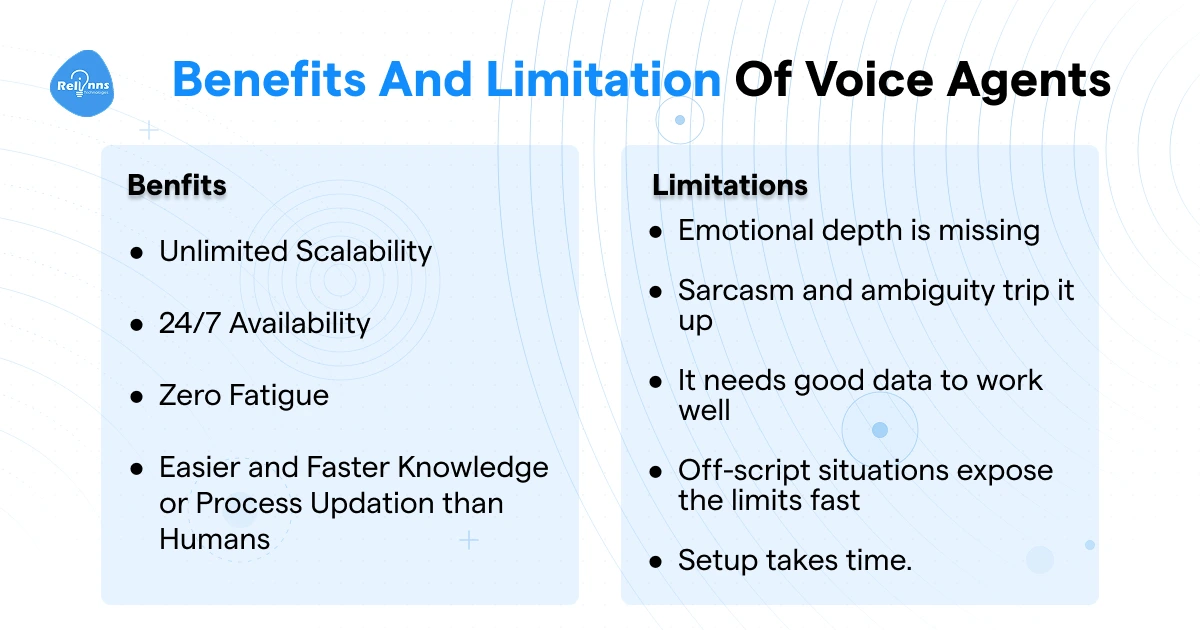
Unlimited Scalability: A human agent handles one call at a time. An AI voice agent handles thousands simultaneously without any drop in response quality. For a logistics company processing 10,000 shipments a day, that's not a nice-to-have, it's an operational necessity.
24/7 Availability: Your customers don't stop having questions at 6 PM. AI runs round the clock with zero additional staffing cost. A hospital, for instance, gets appointment booking handled at 2 AM without a single agent on the floor.
Zero Fatigue: Call number 800 gets the same tone, accuracy, and patience as call number one. Human agents burn out. AI doesn't, which means your service quality stays consistent even during peak hours when human performance tends to dip.
Limitations of AI Voice Agents
Before you go all-in, know where it breaks down. Because it does break down, and ignoring that is how you end up with angry customers and a bad reputation.
- Emotional depth is missing. AI can detect frustration but can't respond to it the way a person can. It reads signals; it doesn't feel them.
- Sarcasm and ambiguity trip it up. Callers who are vague, heavily accented, or indirect can confuse even well-trained systems.
- It needs good data to work well. Garbage in, garbage out. A poorly trained voice agent confidently gives wrong answers.
- Off-script situations expose the limits fast. When a caller's problem doesn't match any trained pattern, the ai agent vs human agent gap becomes obvious.
- Setup takes time. Basic deployment is quick, but a properly integrated system tied to your CRM and booking tools takes weeks to build right.
If you want to overcome most of these limitations and make your AI voice agent sound as human as possible.
Where Human Agents Outperform AI Voice Agents
AI will keep getting better at handling calls. But there's a ceiling it hasn't broken through yet, and probably won't for a while. The ceiling is human judgment. Not just empathy in the abstract, but the messy, real-time ability to read a situation and respond to what's actually happening, not what the script says should be happening.
That's where the ai agent vs human agent gap is most visible, and most consequential.
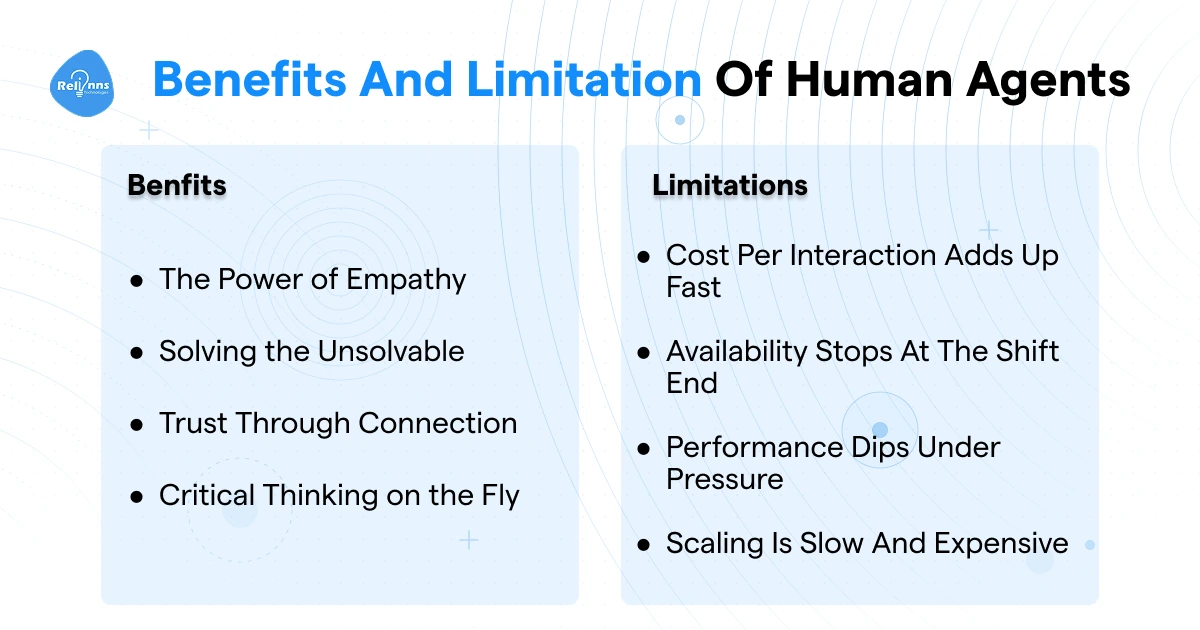
The Power of Empathy
A human agent hears the slight tremor in a caller's voice. The pause before they answer. The frustration sitting just underneath a polite sentence. And they adjust instantly, softening their tone, slowing down, or just saying "I'm sorry, that sounds really stressful" and meaning it. AI can detect sentiment signals, yes.
But detecting frustration and responding to it like a person are two different things. Customers in distress don't want their emotion logged. They want to feel heard.
Solving the Unsolvable
Real support problems don't arrive pre-categorized. A customer calling about a billing dispute that's also tied to a delivery failure that's also connected to a loyalty account error, that's not a dropdown menu situation.
Human agents think across the problem, consult a colleague mid-call if needed, and find a path forward. When things go off-script, they build a new script on the spot.
Trust Through Connection
People buy from people. A well-timed joke, a shared moment of frustration, a rep who remembers your name from last time. These are the micro-interactions that turn a support call into a brand memory.
No AI voice system replicates that authentically yet. And in high-ticket industries like insurance or healthcare, that trust is what drives retention.
Critical Thinking on the Fly
Human agents make judgment calls. When a caller's request is vague, contradictory, or just unexpected, a good agent reads the full context and decides what's actually right for the customer and the business.
That's not a rule. It's experience. And in the ai agent vs human agent comparison, this is the capability that keeps humans irreplaceable at the top of the call complexity ladder.
Limitations of Human Agents taking Calls
Human agents are your best asset for complex, high-stakes calls. But running your entire support operation on them is expensive, inconsistent, and hard to scale. When you map the ai agent vs human agent comparison honestly, the human side has real constraints that compound fast as call volume grows.
- Cost per interaction adds up fast. A customer service rep in the U.S. earns around $35,000 a year. Factor in training, benefits, and management overhead and you're looking at roughly $0.60 per minute of interaction time. Across hundreds of calls a day, that's a significant line item.
- Availability stops at the shift end. Human agents work scheduled hours. Customers don't. Any call that lands outside business hours either goes unanswered or requires expensive overnight staffing.
- Performance dips under pressure. High call volumes cause fatigue, and fatigue causes errors. A rep handling their 80th call of the day doesn't perform the same as they did on call five. Consistency is the first casualty of burnout.
- Scaling is slow and expensive. You can't double your call capacity overnight. Hiring, onboarding, and training a new agent takes weeks, sometimes months. Which means when demand spikes, your team either drowns or you scramble.
This is exactly where the ai agent vs human agent calculus starts shifting toward automation for high-volume, predictable tasks.
When to Use AI Voice Agents
If you're running a support operation and your agents are spending half their day answering the same ten questions, that's not a people problem. That's a routing problem. And the ai agent vs human agent decision gets a lot clearer once you audit what your call volume actually looks like. Automating the right workflows cuts first response times by up to 55%, according to Master of Code. That's not a marginal gain. That's your queue going from backed-up to instant.
High-Volume Repetitive Inquiries
This is where AI earns its keep. Order status checks, account lookups, password resets, business hours, prescription refill confirmations. If your team is answering the same question 200 times a day, a human shouldn't be doing that work. A 3PL handling 15,000 shipments daily can't staff enough agents to field every "where's my parcel" call. An AI voice agent resolves those instantly, at scale, without a queue forming.
24/7 Availability
Your customers don't have business hours. A patient trying to book a diagnostic appointment at 11 PM doesn't want voicemail. A logistics buyer tracking an urgent freight shipment on a Sunday morning doesn't want to wait until Monday. AI keeps your lines open around the clock at zero additional staffing cost. Closing for the weekend is a revenue decision, not just an ops one. AI removes that tradeoff.
Cost Efficiency
The numbers here are hard to argue with. A human-handled call runs between $3 and $6. An AI-handled interaction costs $0.25 to $0.50. For routine, predictable calls, that's a 30-40% reduction in operational expenditure without any drop in resolution quality. The ai agent vs human agent cost gap only widens as your call volume grows.
AI voice agents are cheaper than human agents for routine calls, but cost should be measured correctly. A human-handled call may cost around $3 to $6 per resolved interaction, while AI voice agents usually reduce that cost for predictable tasks.
The key is to compare cost per resolved call, not only cost per minute. A low per-minute rate means little if the voice agent creates long calls, failed resolutions, or frequent human handoffs.
Enterprise pricing depends on call volume, telephony, voice model, LLM usage, CRM or EHR integration, compliance needs, and monitoring setup. For a full cost breakdown, read our guide on how much voice agents cost:
Structured Conversations and Data Collection
AI performs best when conversations follow a logical path. And a lot of valuable support work does exactly that.
- Intake and discovery: Structured pre-call information gathering that auto-populates your CRM before a human ever picks up
- Identity verification: Collecting account numbers and confirming caller identity upfront, which shaves 30 to 45 seconds off every escalated interaction
- Post-call surveys: Triggered automatically after resolution, with smart follow-up questions based on what the caller actually experienced
These aren't flashy use cases. But they're the ones that quietly make your whole operation faster and cheaper.
When to Use Human Agents for Calls
AI handles the volume. Humans handle the weight. And there's a specific category of calls where sending a customer to an AI voice agent isn't just ineffective; it actively damages trust. The AI agent vs human agent question has a clear answer here: when the stakes are high, the emotion is real, or the problem doesn't fit a pattern, you need a person on the line.
Emotionally Sensitive Conversations
A customer calling to dispute a life insurance claim after losing a spouse. A patient confused and scared about a diagnosis. A retail buyer furious about a failed delivery during a product launch. These aren't support tickets. These are moments where how you respond determines whether that customer stays or leaves for good. Human agents read the room, adjust their tone in real time, and say things like "I'm really sorry you're going through this" and actually mean it. No AI does that yet.
Complex Issue Resolution
Some problems arrive already messy. A billing dispute tied to a cancelled order tied to an account merge that happened six months ago. That's not a script situation. Human agents think across the full context, ask the right follow-up questions, loop in a colleague if needed, and find a solution that fits the specific situation. When the path doesn't exist, humans build one. AI follows rules. Humans break them when the customer's situation demands it.
High-Value Sales Conversations
Closing a $50,000 annual logistics contract doesn't happen over a voice bot. High-ticket B2B sales runs on rapport, timing, and the kind of back-and-forth that only works between two people. Human agents pick up on hesitation, respond to objections with context and personality, and build the kind of relationship that makes a renewal automatic. The ai agent vs human agent distinction here isn't subtle. One closes deals. One routes calls.
Ambiguous or Unpredictable Inputs
Customers are rarely as clear as we'd like them to be. Heavy accents, fragmented sentences, requests that don't map to any category in your system these trip up even well-trained AI. A human agent asks a clarifying question, reads the context, and figures it out. They adapt mid-conversation without the caller ever noticing. That flexibility is genuinely hard to replicate, and for customers who fall outside the predictable majority, it's the difference between resolution and frustration.
ROI Breakdown: Human Agents vs AI Voice Agents
Numbers cut through the debate faster than anything else. So let's put the AI agent vs human agent comparison where it actually matters for a business decision: cost, management overhead, operational efficiency, and what your customer actually experiences on the other end.
| ROI Dimension | Human Agent | AI Voice Agent |
| Cost per minute | ~$0.60/min | ~$0.08/min |
| Annual investment | ~$35,000/agent + benefits + overhead | Setup + maintenance only |
| Management overhead | Recruitment, onboarding, scheduling, supervision, performance reviews | Initial setup, minimal ongoing oversight |
| Availability | Scheduled hours only | 24/7, no gaps |
| Scalability | Hire to scale, weeks to onboard | Scales instantly with volume |
| Operational efficiency | Excellent for complex, high-touch calls | Handles thousands of simultaneous routine interactions |
| Customer experience | Empathy, rapport, 20% higher retention | Speed, consistency, instant resolution |
| Profitability impact | Loyalty-driven retention gains | Up to 38% profitability boost, up to 72% cost reduction for retailers |
| Best for | Complex issues, emotional conversations, high-value sales | FAQs, status checks, bookings, data collection |
Metrics to Compare AI Voice Agents and Human Agents
Human Agent ROI
Investment: A customer service rep in the U.S. earns around $35,000 a year. Add training, benefits, and overhead and you're at roughly $0.60 per minute of interaction time. That number doesn't shrink as volume grows. It compounds.
Management overhead: Every human agent comes with a full operational tail. Recruitment, onboarding, scheduling, supervision, performance reviews. You're not just paying for the call. You're paying for everything that keeps that person on the floor and performing.
Operational efficiency: Human agents are excellent at complex, high-touch interactions. But they work scheduled hours. Any call that lands outside that window either waits or goes unanswered, which is a real cost that rarely shows up in the staffing budget.
Customer experience: This is where human agents genuinely win. Empathetic service drives a 20% higher customer retention rate. That's not a soft metric. Retention has direct revenue impact, and humans build it in ways AI currently can't match.
AI Voice Agent ROI
Investment: AI voice agents run at approximately $0.08 per minute. That's an 80 to 90% cost reduction compared to a human agent. For a business handling 1,000 calls a day, that gap becomes a serious financial argument very quickly.
Management overhead: Initial setup and ongoing maintenance, yes. But once it's running, there's no shift scheduling, no performance monitoring, no recruitment cycle. The operational complexity drops significantly after deployment.
Operational efficiency: AI runs 24/7, handles thousands of simultaneous interactions, and never slows down during peak hours. For high-volume, predictable workflows, it outperforms any human team on pure throughput.
Customer experience: AI doesn't build emotional rapport. But it does deliver speed and consistency, and for routine interactions, that's what customers want. Fast answers, no hold music, immediate resolution.
The business case for AI is hard to ignore at scale. Companies that have deployed AI voice agents report profitability improvements of up to 38%, with retailers seeing operating cost reductions as high as 72%. But the businesses leaning on human agents are seeing something different: customer retention rates climbing above 20% through empathetic service.
The honest read on the AI agent vs human agent ROI question is this: AI wins on cost and scale, humans win on loyalty. Build your operation to take both.
Why Smart Support Strategies Combine Both
The businesses getting this right aren't choosing between AI and human agents. They're building a system where each one handles exactly what it's good at, and neither one steps into the other's territory. That's the actual answer to the ai agent vs human agent debate in 2026. Not one or the other. Both, in the right order.
Here's what that looks like in practice:
Route by call type, not by availability. AI takes every predictable, high-volume call first. FAQs, status checks, appointment bookings, identity verification. Humans get the calls that actually need them: escalations, complaints, high-value conversations.
Let AI prep the handoff. When a call does need a human, the AI has already collected the caller's name, account details, and reason for calling. The human agent walks in with full context, not a cold start. That alone cuts handle time significantly.
Protect your agents from burnout. An agent fielding 80 repetitive calls a day burns out faster and performs worse. Offload the routine volume to AI and your human team focuses on the work that actually requires them. Retention improves. So does call quality.
Use AI data to train humans better. Every AI interaction generates call data, sentiment patterns, resolution rates. That's a feedback loop your human team can learn from. The ai agent vs human agent model works best when both sides are improving each other.
Scale without hiring. When the call volume spikes, AI absorbs it. Your human team stays the same size, same quality, same focus.
How Do You Choose the Right Strategy for Your Business?
Start with your call data, not your assumptions. Pull up last month's inbound volume and categorize every call type by one question: does resolving this require human judgment, or does it follow a predictable pattern?
If more than 40% of your calls are repetitive and predictable, AI should be handling them. That's not a bold claim. That's basic operational math.
Run a Quick Call Audit First
Before choosing AI or human agents, audit your call data:
- Monthly inbound call volume
- Top 10 call reasons
- Average handle time by call type
- Escalation rate
- Repeat-call rate
- Cost per resolved call
- After-hours missed calls
- Compliance-sensitive call categories
If most calls are repetitive, AI should handle the first layer. If calls involve judgment, emotion, or compliance risk, keep humans in control.
A few other signals that point toward AI deployment:
- Your agents are spending significant time on status updates, bookings, or FAQ-type queries
- Call volume spikes seasonally and hiring can't keep up
- You're operating across time zones or need after-hours coverage without the staffing cost
And signals that point toward keeping or expanding your human team:
- Your average call involves multi-step problem solving or negotiation
- You serve enterprise clients who expect senior-level attention
- Your industry carries regulatory or emotional sensitivity requirements (healthcare, insurance, legal)
The ai agent vs human agent decision isn't permanent either. Most operations start with AI on Tier 1 calls, measure the results for 60 to 90 days, and then expand automation from there as confidence builds.
The direction is clear. AI handles more volume every year, gets better at understanding context, and costs less per interaction as the technology matures. But the calls that need real human judgment, emotional intelligence, and creative problem solving aren't disappearing. They're becoming more valuable precisely because everything else gets automated.
The future of support isn't AI replacing humans. It's AI making human agents significantly more effective by clearing the noise so they can focus on the calls that actually matter. That shift is already happening. The question is whether your operation is built for it.
The ai agent vs human agent question has a practical answer: use AI where volume and predictability are high, keep humans where judgment and empathy matter, and build the infrastructure to connect both cleanly. That's what a modern support operation looks like.
Why Relinns Custom Voice Agent Solutions Are Best for Your Business
Most AI voice agent vendors sell you a platform and leave you to figure out the rest. Relinns builds the whole system around your actual call flows, your existing tech stack, and your specific industry requirements.
Whether you're a hospital managing 400 daily appointment calls, an insurance company fielding claim status queries, or a logistics operator drowning in WISMO volume, Relinns designs custom AI solutions that fit the operation, not the other way around. Built on Retell AI with full CRM and EHR integration capability, multilingual support, and enterprise-grade compliance. The ai agent vs human agent balance gets configured for your context, not a generic template.
Book a live demo and see it handle your actual call types.
Frequently Asked Questions (FAQ)
Can AI voice agents fully replace human agents?
No. AI handles high-volume, predictable calls. Humans handle judgment, emotion, and complexity. The best operations run both.
What does an AI voice agent cost compared to a human agent?
Human agents cost ~$0.60/min. AI voice agents run at ~$0.08/min. That's an 80 to 90% cost reduction.
Which industries benefit most from AI voice agents?
Healthcare, insurance, ecommerce, and logistics. All share high inbound volume with large percentages of predictable, repeatable queries.
How long does it take to deploy an AI voice agent?
Basic deployment takes a few days. A fully integrated system tied to your CRM or EHR takes two to four weeks.