Voice Agents for Logistics: Why Most Firms Deploy It Wrong :\
Date
Aug 31, 26
Reading Time
10 Minutes
Category
AI in Logistics
Share


Key Takeaway
- AI voice agents for logistics deliver the highest ROI when deployed on internal workflows like failed delivery recovery, driver coordination, and freight booking not just on customer-facing tracking calls.
- A failed delivery that goes unresolved for 24 hours costs three times more than the first attempt, making rapid NDR (Non-Delivery Report) intervention a critical area for voice AI automation.
- Integration depth: Real-time read and write access to TMS, WMS, and courier APIs is the main factor separating successful AI voice agent deployments from those that stall or underperform.
- Human handoff design is essential: without seamless escalation and full context transfer to human agents, AI voice agents often create more problems than they solve in logistics operations.
You're looking at 400 failed deliveries from last week. Each reattempt costs between $3 and $10. That's up to $4,000 in avoidable losses, and your team hasn't even started on this week's queue yet. The obvious fix is to hire more support staff or bolt on a tracking chatbot. That fix is wrong.
Where Most Teams Start (And Why It's Not Enough)
Most logistics companies exploring AI voice agents start in the same place: customer-facing tracking calls. WISMO queries, shipment ETAs, delivery status updates. The pitch sounds clean and the numbers hold up. Up to 70% of inbound support calls in logistics are automatable. That's real. It's also the smallest part of the problem.
The calls that cost your operation the most aren't customer calls.
They're internal. NDR rescheduling loops. Driver attendance confirmations. Broker load coordination done over the phone with no documentation trail.
This is where operations bleed money quietly, and AI voice agents for logistics built for these workflows return a different ROI entirely.
This breakdown covers where voice AI in logistics actually works, which sub-segments see the sharpest returns, and what separates an AI voice agent deployment for logistics that pays off from one that stalls at the pilot stage.
The teams seeing the biggest returns aren't using this technology to answer tracking calls at all.
The Standard Pitch (And Why It's Only Half the Story)
Most content about AI voice agents for logistics starts in the same place: a customer calls to ask where their parcel is. The agent checks the TMS, reads out the ETA, handles rescheduling if needed. No hold times. Available at 3am.
Companies using AI voice agents for customer service this way report 50-70% deflection on inbound call volume. The tech is mature, the ROI math closes fast. And if this is where your team is exploring voice AI in logistics, you're not wrong.
But the use case has a ceiling.
It sits at the edge of your operation where cost-per-interaction is already low.
The real cost in logistics compounds inward.
- A failed delivery that goes unresolved for 24 hours costs the courier 3x more than the first attempt.
- A driver who can't confirm attendance until the dispatcher manually calls them creates a scheduling cascade that ripples through the day.
- A freight booking confirmed over the phone with no system update falls through at handoff, and nobody catches it until the load is already late.
The tracking call problem, to be direct, gets more credit than it deserves.
Where most teams stop (and why it matters)
AI voice agents for logistics companies that stop at customer-facing automation are solving 20% of the problem. The other 80% sits inside the operation.
That's where the difference between inbound voice automation and internal ops workflows starts to matter.
The technology hasn't changed dramatically since 2023. What's changed is which workflows teams point it at, and whether your voice agent can hand off to a human when things get complicated.
The logistics companies cutting operational costs at scale aren't starting with customer calls. They're starting with NDR.
Voice Agent Use Cases in Logistics: Where the Deployment Actually Goes
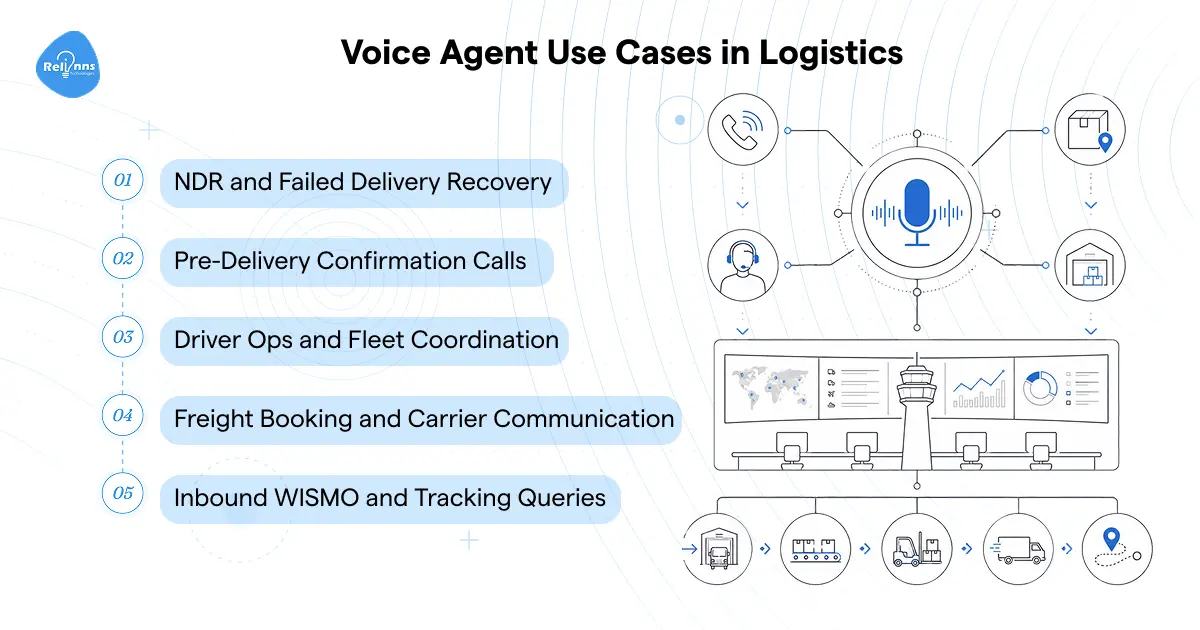
Five areas where AI voice agents for logistics are returning measurable operational value in 2026. Not a ranked list. Priority depends entirely on your sub-segment and where your ops team is bleeding the most hours right now.
NDR and Failed Delivery Recovery
When a delivery fails, the clock starts immediately.
The agent triggers an outbound call within minutes, not hours. It captures customer intent (reschedule, redirect, cancel), pushes that update into the courier system in real time, and closes the loop before the reattempt queue backs up.
These are AI agents that trigger downstream actions across multiple systems, not just a voice interface logging a note for someone else to action later.
Courier companies deploying this for first-attempt failures report 25-35% improvement in first reattempt success rates. Fewer failed second attempts means lower cost-per-delivered-unit at scale.
Pre-Delivery Confirmation Calls
An outbound call 2-4 hours before the delivery window. Confirms the address, checks someone's home, flags access issues before the van leaves the depot.
Proactive rather than reactive.
Courier companies running this at scale report 20-30% reduction in first-attempt failures. The call costs pennies to automate. The failed delivery it prevents costs dollars to fix.
Driver Ops and Fleet Coordination
Shift confirmation, attendance checks, compliance document reminders, hands-free route updates mid-trip.
Fleet managers running 500+ vehicles can't manually call every driver at shift start. That's not scalable, and most dispatch teams know it.
Voice AI in logistics applied to driver ops handles bulk outbound confirmation, logs responses automatically, and flags non-responses for the dispatcher to follow up on.
Drivers get route re-optimization during trips without touching a screen.
And how the agent handles edge cases depends entirely on prompting. A driver reporting an accident mid-route needs a completely different response path than one confirming shift attendance.
Freight Booking and Carrier Communication
Load details provided by phone, captured by the agent, matched to available capacity, confirmed back to the caller.
No dispatcher bottleneck. No documentation gap sitting between the call and the system.
Freight brokers and aggregators running this report 30-40% reduction in administrative time per booking.
The improvement isn't coming from AI doing anything clever. It's coming from every conversation immediately becoming structured data in a system.
Inbound WISMO and Tracking Queries
AI voice agents for logistics deployed on inbound tracking still deflect 50-70% of call volume.
That frees your support team for exceptions that actually need human judgment.
But the agent needs a solid knowledge layer connecting it to live order data to answer accurately. Without that integration, you get a voice interface that confidently gives customers wrong ETAs. Which is worse than putting them on hold.
These five use cases work differently depending on which segment of logistics you run. The ROI calculation changes significantly by sub-segment.
Which Voice Agent Use Cases Apply to Your Logistics Segment
Five sub-segments. Each has a different primary pain and a different deployment starting point. Where you begin matters more than most vendors admit.
Courier Companies and Last-Mile Delivery
If you're running 10,000+ shipments a day, you're looking at roughly 1,500 failed deliveries in your NDR queue every morning. That's the math at a standard 15% failure rate. No ops team manually works through that volume.
AI voice agents for logistics in this sub-segment function as a triage layer. They handle standard rescheduling calls, route redirects, cancellations.
They escalate the unusual ones. And after the voice call closes, a follow-up confirmation goes out via WhatsApp AI agents so the customer has the rescheduled window in writing, with no additional agent time spent.
The NDR queue gets smaller. The ops team works exceptions instead of volume.
Warehouses and Fulfillment Centers
Primary pain here is floor coordination and inventory accuracy, not customer communication. Voice-directed picking, SOP delivery for new hires, maintenance issue logging by voice.
The agent gives real-time bin-level instructions pulled directly from WMS data through a retrieval layer connecting the agent to live WMS data. That live connection is what earlier voice systems couldn't do, and it's why this use case actually works now when it didn't in 2022.
Picking accuracy improvements of 15-25% are documented across deployments. Onboarding time for new pickers drops because the agent walks them through tasks in real time instead of a printed sheet they can't read while carrying a bin.
Fleet Operators and Truck Aggregators
For operators running 500+ vehicles, manual driver coordination eats 20-30% of dispatch team time before the day even starts. Shift confirmation, attendance checks, compliance document follow-up. Voice AI in logistics applied to this layer runs bulk outbound confirmation at shift start, logs every response, and flags non-responses for the dispatcher to action. The dispatcher then calls 30 people instead of 300.
Oversight stays the same. Manual effort drops significantly.
Hands-free route updates mid-trip matter here too. A driver gets re-optimized routing without touching a screen, which is a safety consideration as much as an efficiency one.
3PL Providers and Ecommerce Fulfillment
3PL operators managing 10+ merchant clients can't manually update each one on inventory exceptions and shipment delays. The AI voice agents for logistics deployed here handle routine SLA update calls automatically. Inbound receiving confirmations, exception escalation, delivery milestone alerts.
The merchant-facing side overlaps with AI voice agents for ecommerce, which use the same live fulfillment data to handle shoppers’ order-status, delivery, and return calls.
Merchants get timely updates. Account management handles actual problems instead of status calls.
And for merchants who prefer chat over a phone update, agentic chatbots for client-facing portals run alongside the voice layer so clients get updates through whichever channel they actually check.
Freight Brokers and Load Boards
Brokers handling 500+ loads a month spend a disproportionate share of time on confirmation calls that should take 90 seconds but consistently run longer. Dispatcher is occupied. Notes from the last call are in someone's inbox rather than in the platform.
The agent captures load details, matches to capacity, confirms back to the caller, and puts everything in the system immediately. No documentation gap sitting between the call and the record.
For brokers running a portal alongside voice, AI chatbots for broker portal communication handle async load queries so voice handles time-sensitive confirmations and chat handles everything else.
Knowing which use cases fit your sub-segment is the easy part. Knowing what makes the deployment actually work in production is where most teams get stuck.
What Separates a Voice Agent Deployment That Works From One That Doesn't
Voice quality isn't the hard part anymore. Sub-500ms latency in production is achievable on current platforms, and making the voice sound natural is a solved problem for most logistics call types. The infrastructure choice between WebRTC and SIP still matters for telephony compatibility in specific logistics environments, but it's not a blocker. That's not where deployments fail.
Integration Depth: The Real Differentiator
What determines whether AI voice agents for logistics actually return ROI is integration depth.
An agent that can't read from your TMS and write back to your courier API in real time is a phone script with a better voice. The LLM powering the agent's responses also matters here, specifically for domain-specific terminology.
Courier codes, shipment statuses, TMS field names. A general-purpose model that doesn't understand your operational vocabulary gives technically fluent but operationally wrong answers. That's a real problem on a driver coordination call.
Human Handoff: The Most Common Failure Point
Human handoff design is the step teams skip most often, and it causes the most visible failures.
Logistics calls go wrong in unpredictable ways. A customer gives an address the system can't parse. A driver reports an accident mid-route. A freight broker disputes a rate.
The agent needs to escalate to a human without losing context, without the customer re-explaining from scratch. Teams that skip this end up with an agent that creates support tickets instead of closing them. That's a worse outcome than no agent at all.
Multilingual Support: Ground-Level Reality
Multilingual support matters at the ground level, not just customer-facing.
Calls in the UAE require Arabic. Driver ops in South Asia require Hindi or regional languages. Warehouse floor staff across large US fulfillment centers require Spanish.
Voice AI in logistics that only works in English covers roughly 40% of the actual call surface in most Tier 1 operations.
Compliance and Regulated Logistics
And for cold chain and pharma logistics, compliance isn't optional.
Every call log, every exception flagged, every instruction delivered by voice needs to land in your compliance reporting layer. Compliance requirements in regulated logistics aren't just about what the agent says. They're about what gets recorded and whether your auditor can pull it in 10 minutes.
An agent whose output sits in a dashboard nobody checks is a liability.
Before you sign off on any AI voice agents for logistics deployment, run through this:
- Real-time system integration into TMS, WMS, and courier API
- Human handoff logic with full context transfer
- Multilingual support matched to your actual call surface
- Production latency under 500ms
- Compliance logging connected to your reporting layer
Miss two of these and the deployment will underperform. Not because the AI was bad. Because the building around it wasn't finished.
Most deployments that fail don't fail because the AI was bad. They fail because the integration was shallow and the handoff logic was an afterthought.
What Changed in 2026 (And What It Means for Your Deployment Timeline)
Three things shifted in the last 18 months that actually change the calculus here.
Latency, Post-Call Actions, and Integration
Latency dropped below 500ms on production platforms. Generative AI capabilities powering post-call actions arrived at the ops layer, meaning the agent now triggers downstream workflows after the call closes.
Not logs a note for someone else to action. Actually updates the TMS, pushes a rescheduling request, sends the WhatsApp confirmation.
And integration tooling matured enough that connecting a voice agent to a TMS takes days, not a multi-month IT project.
The Shift From Technical to Strategic Barriers
The technical barriers that stopped logistics companies from deploying AI voice agents for logistics in 2023 are gone.
The barriers now are strategic.
- Which workflows do you automate first?
- How do you measure ROI on ops workflows that don't have clean before/after metrics?
- How do you design handoff logic that doesn't break when calls go sideways?
The build vs off-the-shelf AI decision alone changes your timeline and total cost significantly. A platform doesn't answer these questions for you.
How Fast Teams Are Actually Moving
The teams moving fast treat voice AI in logistics as an operations layer, not a technology experiment.
They pick one entry point, NDR is the most common, measure the right metrics (reattempt success rates and cost-per-resolved-exception, not CSAT or call quality scores), and expand.
Scaling voice agents across the operation is a genuinely different challenge from the initial deployment. Most teams underestimate how much the second sub-segment differs from the first.
AI voice agents for logistics built in-house versus with a specialized build partner is a 3-6 month difference in deployment timeline. That difference compounds.
How Relinns Builds Voice Agents for Logistics Operations
Relinns builds custom AI agents for logistics operators across courier, 3PL, fleet, and freight sub-segments on Retell AI and Elevenlabs infrastructure.
The build covers TMS/WMS/CRM integration, human handoff design, multilingual configuration, and post-call analytics. Not an off-the-shelf product handed over with a setup guide. A production deployment built around your specific workflows and your specific call surface.
Capability Scope and Why It Matters
The capability specifics matter here. Sub-500ms latency on production deployments. Arabic, Hindi, and Spanish support for GCC, South Asia, and US logistics markets. Agentic post-call actions that trigger the next step in the workflow rather than just logging a transcript.
The custom AI development scope includes compliance-ready call logging for pharma and cold chain operators where audit trails aren't optional.
Who Relinns Works With
Relinns works with enterprise clients including Manchester City FC, Apollo etc. with production deployments across Healthcare, Insurance, and Logistics.
If you're comparing options, the top AI voice services in 2026 covers the broader vendor landscape. And if you're still at the stage of evaluating build partners generally, the AI consulting firms breakdown is worth reading before you shortlist.
If your operation runs 5,000+ shipments a day or manages 500+ vehicles, there's an AI voice agents for logistics deployment case worth scoping properly. Scope the investment before booking a demo, then book a live session to see a production logistics workflow running.
Voice AI in logistics in 2026 is an ops tool, not a customer service upgrade.
The operators treating it that way are pulling ahead on cost and delivery performance. The ones waiting for a cleaner use case are creating a gap that gets harder to close every quarter.