9 Quick Wins From AI Voice Agents in Customer Service
Date
Aug 31, 26
Reading Time
11 Minutes
Category
AI Voice Agents
Share


TL;DR
- AI voice agents handle natural phone conversations, access business systems, update records, create tickets, and transfer calls with context.
- Production deployments can resolve 40–70% of inbound calls, costing roughly $0.03–$0.04 per minute compared with about $0.70 for human agents.
- They address five common problems: call-volume spikes, limited operating hours, repetitive queries, inconsistent answers, and context loss during transfers.
- The nine quickest wins are overflow handling, after-hours support, FAQ deflection, order-status queries, appointment management, caller authentication, warm handoffs, satisfaction surveys, and complaint intake.
- Start with one narrowly defined workflow and measure call deflection, resolution rate, handle time, CSAT, and operating cost before expanding.
- Choose providers based on production readiness, integration depth, and whether they deliver a complete deployment or only infrastructure.
Your support team answers the same five questions, hundreds of times a day. Where's my order? What are your hours? Can I reschedule? Most of it never needed a human in the first place.
By 2026, 80% of organizations plan to deploy some form of automated voice support. And it's not just trend-chasing. Production-tested AI voice agents for customer service are already resolving 40-70% of inbound calls without a human agent touching them. The cost difference is stark: human agents run at ~$0.70 per minute. AI runs at $0.03 to $0.04. By 2029, 80% of customer issues are expected to resolve without any human involvement.
This blog covers 9 specific wins from AI voice agents for customer service. Production data, real use cases, and what voice AI customer support actually looks like when it works.
What Are AI Voice Agents?
Think of it as a phone agent that never clocks out.
An AI voice agent picks up the call, understands what the customer is saying in plain English, and responds in real time. No "press 1 for billing, press 2 for support." And most importantly, No infuriating music while you are on hold. The caller talks, and the system handles it.
The pipeline is straightforward. The caller speaks, a speech-to-text engine transcribes it, a language model processes the request, and a text-to-speech engine speaks the response back. The whole loop runs in 600-800 milliseconds, fast enough that the caller doesn't feel the gap.
This is where AI voice agents for customer service break from what came before. IVR systems force callers down a fixed menu tree, and if you say something off-script, the whole thing breaks. Voice agents understand free-form speech. A caller can say "I ordered something three days ago and haven't heard anything" and the system knows what to do.
Voice AI customer support isn't a chatbot with a microphone stuck on top. Chatbots handle text on websites and messaging apps. Voice agents are built for live phone calls, with all the messiness that brings: interruptions, background noise, people changing their minds mid-sentence.
What makes AI voice agents for customer service worth deploying is what happens beyond the conversation itself. Every call gets logged, CRM records update automatically, and tickets are created without any manual wrap-up. When a call needs a human, the agent transfers it with a full context summary already attached. The human picks up being informed, not cold.
That last part matters more than most vendors admit.
5 Most Common Problems in Customer Service
Every operations leader I've spoken to describes the same situation. The phone queue is backed up, the team is stretched, and half the calls are things a FAQ page should be handling.
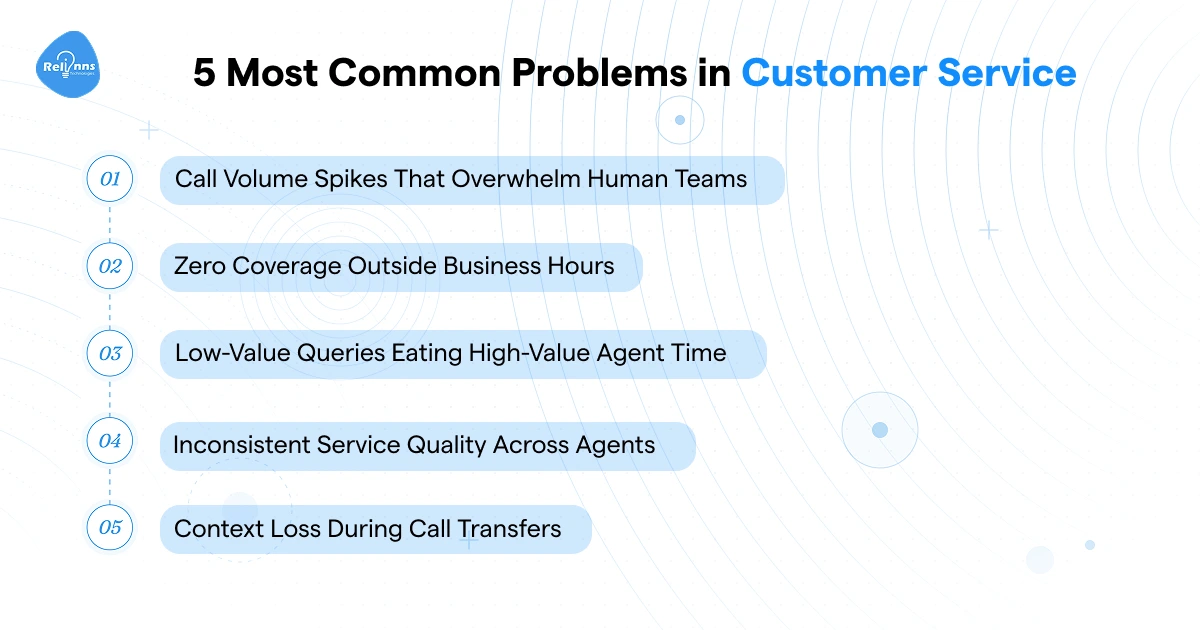
These are the five problems that show up most often in customer service operations. And they're the exact problems AI voice agents for customer service are built to fix.
1. Call volume spikes that overwhelm human teams
Peak season hits. A product goes out of stock. The delivery network has had a bad week. Suddenly your team is fielding 3x normal call volume with the same headcount. You can't staff up fast enough to absorb the spike.
50-70% of those inbound contacts are repeat, automatable queries that don't need a human to resolve, but they're sitting in the same queue as the complex ones, slowing everything down.
2. Zero coverage outside business hours
Support lines close at 6pm. Customer problems don't. A patient needs to reschedule an appointment at 9pm. A shopper has a return question on Sunday morning. The only option they get is a voicemail box or an email form. Those missed contacts don't just create frustration. They turn into negative reviews and churn.
3. Low-value queries eating high-value agent time
"Where is my order?" "Is my report ready?" "What are your opening hours?" These questions make up the bulk of inbound call volume at most contact centers. WISMO queries alone account for 40-60% of inbound call volume in logistics and ecommerce operations. Your agents aren't paid to answer that. But they spend most of their shift doing it.
4. Inconsistent service quality across agents
A customer calls on Monday morning and gets a sharp, well-rested agent. They call again on Friday afternoon and get someone who's been on the phone for six hours.
The answer they receive is different. In regulated industries like insurance and healthcare, an inconsistent answer to a policy question is a compliance issue, not just a bad interaction.
5. Context loss during call transfers
A caller explains their issue to the first agent, gets transferred, and has to explain the whole thing again. This happens because most support stacks don't pass context between handoffs.
Each repeat explanation adds 2-3 minutes to handle time and signals to the caller that your internal systems don't talk to each other. Context handoff failure ranks as a top driver of poor CSAT scores across contact center operations.
These five problems aren't unique to any one industry. They show up in ecommerce, healthcare, insurance, and logistics. Teams adopting AI voice agents for customer service aren't doing it for the novelty. They're doing it because these problems carry a direct cost, and voice AI customer support has started delivering measurable results against them.
How AI Voice Agents Fix These Problems
The problems above aren't new. What's changed is that there's a working answer to each of them.
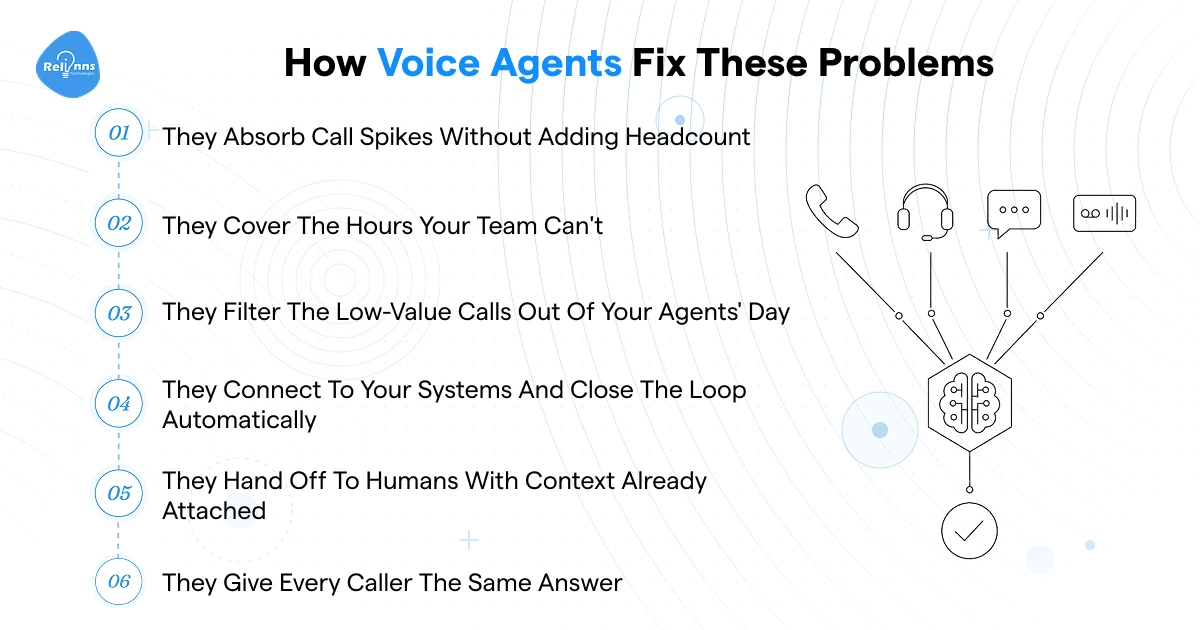
They absorb call spikes without adding headcount
When 400 calls hit the queue at once, your team either stretches or breaks. A cloud-native voice agent infrastructure spins up concurrent call capacity in seconds. No hiring lag, no emergency overtime, no calls going unanswered because the queue backed up. Businesses running 200-500 daily calls can route overflow to voice agents during peak windows and the customer experience stays the same. The caller doesn't know they hit a spike. They got an answer.
They cover the hours your team can't
Your team clocks out. AI voice agents for customer service don't. A patient calling at 11pm to reschedule an appointment gets the same response as one calling at 10am. A shopper checking order status on a Sunday gets a real human like answer, not a voicemail box. For operations running across time zones, this isn't a bonus feature. 24/7 coverage with no handover gaps is the baseline expectation, and voice agents deliver it at a fraction of what overnight staffing costs.
They filter the low-value calls out of your agents' day
Order status. Appointment confirmation. Account balance. Store hours. These queries don't need a trained agent. They need a system that can look up the answer and say it back. Voice agents take first contact on this entire category. Production deployments consistently report 60-70% call deflection rates when the scope is well-defined. Your agents spend their shifts on calls that need actual judgment, not database lookups.
They connect to your systems and close the loop automatically
This is the part most vendors undersell. An AI voice agent for customer support that's integrated with your CRM doesn't just have a conversation. It logs the call, updates the customer record, creates a ticket, and closes the interaction without anyone touching it. No manual wrap-up. No transcription errors. No data entry that happens three hours later when the agent gets a free moment. That removes 3-5 minutes of post-call work per interaction. Across 300 calls a day, that's real capacity back in your operation.
They hand off to humans with context already attached
When a call needs a human, voice AI customer support systems pass a structured summary to the receiving agent: who called, what the issue is, what was already discussed, what action is needed. The human agent picks up informed. The caller doesn't repeat themselves. This single capability drives measurable CSAT improvement in contact centers that deploy it well. I'd argue it's underrated compared to the deflection metrics everyone leads with.
They give every caller the same answer
A voice agent pulls from one knowledge base. No fatigue, no variation by shift, no agent improvising around a policy they half-remember. In regulated industries, consistent answers aren't a quality metric. They're a compliance requirement. AI voice agents for customer service deliver that consistency by default, on every call, at any volume.
9 Quick Wins: Top Use Cases for AI Voice Agents in Customer Service
Most contact centers know they have an automation gap. What they don't know is where to plug it in first. The safe instinct is to wait for a bigger budget or a cleaner roadmap. But the problems aren't waiting. These nine use cases are where AI voice agents for customer service deliver results fast, not after a six-month implementation, but in the first few weeks after go-live.
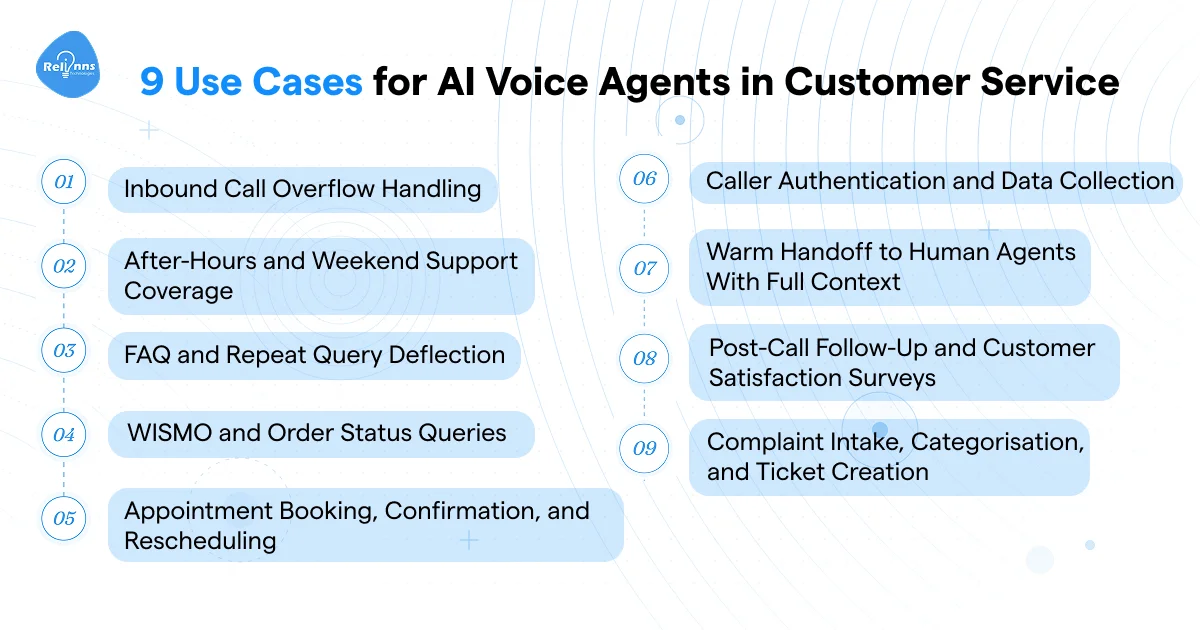
They're the workflows that voice AI customer support teams start with because the win is immediate and the ROI is straightforward to calculate.
1. Inbound Call Overflow Handling
When call volume spikes during a product launch, a service outage, or a seasonal surge, the queue backs up and callers start abandoning.
A voice agent absorbs the overflow in real time, handles the call, and gives the caller an answer instead of a hold message. Zero abandoned calls during peak windows is a result teams report consistently once overflow routing is in place.
2. After-Hours and Weekend Support Coverage
Support lines close. Customers don't. A voice agent covers your phones outside business hours, handling FAQs, booking requests, and status queries with no human on shift.
AI voice agents for restaurants can continue handling reservation changes, opening-hour questions, menu inquiries, and order-status requests when staff are busy or unavailable.
Urgent issues get flagged and queued for the next available agent with a full call summary already attached. 24/7 coverage at a fraction of overnight staffing cost.
3. FAQ and Repeat Query Deflection
Store hours, return policies, account balances, service availability. These calls shouldn't reach a trained agent, but they do, hundreds of times a day. A voice agent handles this entire category without touching the queue, and it does it consistently regardless of call volume.
AI voice agents for retail can automate store-hour questions, return-policy requests, product availability checks, and order updates across multiple locations.
Your agents spend their shift on calls that actually need them.
4. WISMO and Order Status Queries
“Where is my order?” is the most common inbound support question handled by AI voice agents for ecommerce, especially during promotions, seasonal peaks, and delivery disruptions.
For logistics providers, AI voice agents for logistics can also communicate shipment locations, delivery windows, delays, and proof-of-delivery information without requiring an agent.
A voice agent pulls the order record in real time, reads back the status, and closes the call. No agent touch required. 40-60% of inbound call volume in logistics falls into this category alone, which means the deflection impact is large from day one.
5. Appointment Booking, Confirmation, and Rescheduling
Callers book, confirm, or reschedule through a natural conversation. The agent checks live calendar availability, locks the slot, and sends a reminder before the appointment date. No hold time waiting for a receptionist. No back-and-forth.
No-show rates drop when reminders are automated and booking is frictionless across every channel your patients or customers use.
6. Caller Authentication and Data Collection
Before a call reaches a human agent, the voice agent verifies the caller's identity and collects the relevant details upfront: account number, order ID, issue type.
The human agent receives a pre-qualified, structured handoff. Average handle time drops because the agent starts informed, not from scratch. First-contact resolution rates rise as a direct result.
7. Warm Handoff to Human Agents With Full Context
When escalation is needed, the voice agent doesn't just transfer the call. It passes a structured summary: who called, what the issue is, what was already discussed, and a sentiment flag if the caller is frustrated. The human agent picks up informed. The caller doesn't repeat themselves, and that single change has a measurable impact on CSAT scores in every contact center that deploys it correctly.
8. Post-Call Follow-Up and Customer Satisfaction Surveys
After a resolved interaction, an outbound voice agent calls back to confirm resolution and collect a satisfaction rating. Responses log directly into the CRM with no manual entry. Dissatisfied customers get flagged immediately for follow-up, not discovered three days later in a batch report. The feedback loop closes automatically, which means your team knows what's broken before it compounds into a bigger problem.
9. Complaint Intake, Categorisation, and Ticket Creation
When a caller raises a complaint, the voice agent captures the full issue, categorises it by type, urgency, and department, and creates a structured ticket in the helpdesk before any human touches it. Nothing gets lost between the call and the internal record. Complaint resolution cycles shorten and SLA compliance improves because the ticket is accurate and already sitting in the right queue.
You don't need to deploy all nine at once. Pick the use case where your team feels the most daily pain and start there. If you're in logistics, start with WISMO. In healthcare, start with appointment booking.
If your queue backs up every Friday afternoon, start with overflow handling. AI voice agents for customer service work best when the scope is tight and the success metric is defined before go-live. One well-scoped deployment that works beats a broad rollout that breaks in week three.
And once the first one runs cleanly, the next one is a much shorter build.
Best Voice AI Companies for Conversational AI Customer Support
Most vendor comparison lists read like they were written for a CTO with a full engineering team on standby. If you're a Head of Support or COO trying to get something working in your contact center by next quarter, that's not useful. The platform you pick determines voice quality, integration depth, and how fast you actually reach production. Three things worth checking before you shortlist anyone.
Three criteria that separate a useful vendor from a demo that sounds good:
1. Production readiness. Can it handle background noise, interruptions, accents, and callers who change their minds mid-sentence? A clean demo in a quiet room is not the same as 200 concurrent calls on a Monday morning.
2. Integration depth. Can it connect to your CRM, helpdesk, and ticketing system in real time during the call, not just log a transcript afterward? If it can't update a record mid-call, it's not automating your support operation.
3. Deployment model. Do you get a working system at the end, or a platform login and a documentation link? For non-technical teams, this is the difference between a six-week pilot and a six-month build.
[Read our full breakdown of the top AI voice agent companies here]
Relinns builds production-grade AI voice agents for customer service on top of Retell AI and ElevenLabs, the two strongest infrastructure options available. If you want the best underlying tech without taking on the engineering work yourself, this is the practical path.
Relinns Technologies
Relinns’ AI voice agent development services cover call flow design, CRM integration, escalation logic, testing, and go-live. You don't need an internal AI team. They work on your existing telephony stack without requiring a platform migration, and they bring deployment experience across healthcare, insurance, ecommerce, and logistics.
The edge cases in your industry aren't surprises to them. Post-deployment support is part of the engagement, not an optional add-on billed separately. Best for mid-to-large businesses that want a working system, not a DIY toolkit.
Because your workcases require a custom solution which you have control over end to end which off the shelf voice AI is solutions wont be able to provide you.
Retell AI
Voice agent infrastructure for developers
Strong sub-second latency at 600-800ms with interruption-safe conversational flow. Multi-turn context retention holds up well across complex support calls. Native CRM, helpdesk, and ticketing integrations. Post-call analysis produces structured output covering issue type, resolution status, and sentiment per call. Usage-based pricing with no platform fee. HIPAA compliant and SOC2 certified, which matters in regulated industries.
The limitation worth knowing: you need technical resources to build, configure, and maintain the agent. There's no out-of-the-box customer service setup. Retell's platform doesn't include call flow design, domain-specific support logic, or CRM integration work. That's what Relinns adds, handling the build on top of Retell's infrastructure so the operational team gets the performance without the internal engineering requirement.
ElevenLabs
AI voice synthesis and generative AI Platform
The voice quality is the best available right now. Natural pacing, emotional tone, and intonation that holds up across long calls. Voice cloning lets you build a branded voice that matches your company identity. Wide language and accent coverage makes it viable for multilingual support operations. Fast TTS latency, broad model options across vocal profiles.
The limitation is structural: ElevenLabs is a voice synthesis platform, not a full AI voice agent for customer support. Building a working support agent on top of it requires significant additional engineering: STT pipeline, LLM reasoning layer, call logic, CRM connectors, and escalation handling. None of that ships with the platform. Relinns handles the complete build on top of ElevenLabs, so you get the voice quality with a production-ready support system around it.
These nine use cases cover the range of where AI voice agents for customer service deliver measurable wins. Overflow handling. After-hours coverage. WISMO deflection. Context-intact escalations. Each one has a working answer, and the technology to deliver it exists now.
The gap isn't the technology. Most teams that haven't deployed yet are stuck on execution: who builds it, how it integrates with existing systems, and what support looks like after go-live.
Relinns handles all of that. Strategy, build, CRM integration, escalation logic, testing, and go-live on a single engagement. Built on Retell AI for voice infrastructure and BotPenguin for chatbot and agent workflows, the stack is production-tested Voice agents across Healthcare, Insurance, Ecommerce, and Logistics. The edge cases in your industry aren't surprises to the team.
This isn't a pilot handover. Every AI voice agents for customer service engagement Relinns scopes is built for production from day one, with post-call analytics and ongoing support included, not sold separately.
If you're running 100+ inbound calls daily and want to find the best voice AI for customer service fit for your specific operation, a scoping conversation takes 30 minutes.