The Complete Guide to ASR Models for Voice Agents
Date
Aug 24, 26
Reading Time
9 Minutes
Category
AI Voice Agents
Share


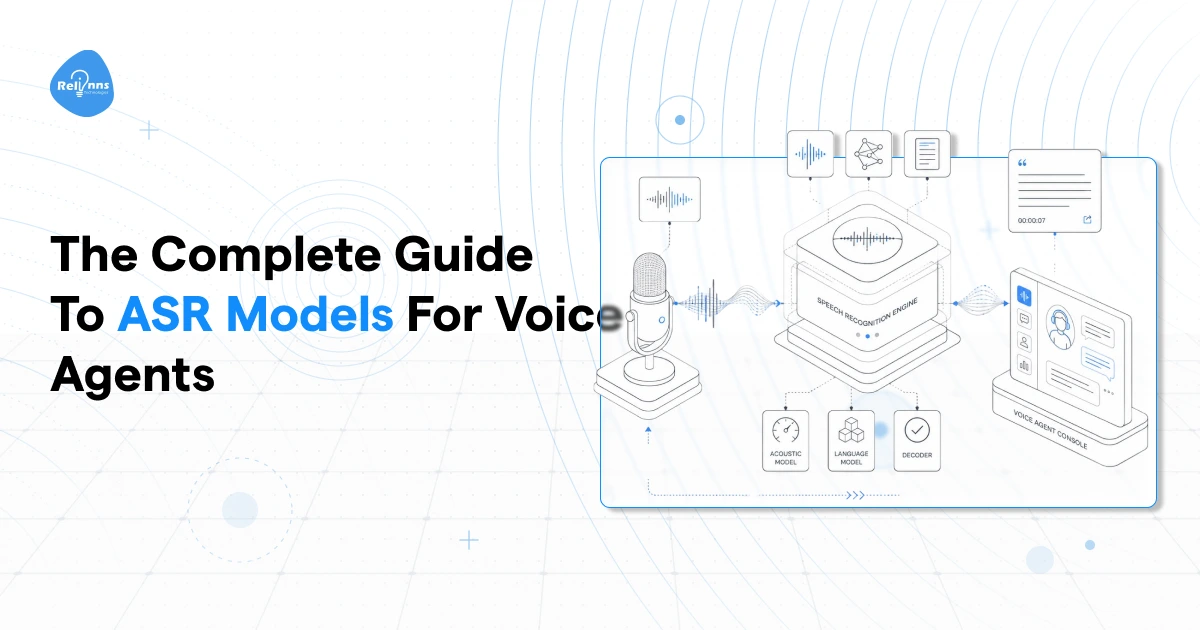
Teams pick their ASR models for voice agents the same way every time. Pull up a leaderboard, sort by word error rate, and pick the model sitting at the top. Done. Ship it.
Except that's not how voice agents actually fail.
Here's the number that matters more than any WER score: your entire agent needs to respond in under 800 milliseconds to feel like a real conversation. Not the LLM. Not the text-to-speech. The whole pipeline, start to finish. In the AI voice stack, ASR sits right at the front of that clock, which means every millisecond it burns is a millisecond your LLM doesn't get.
But speed isn't even the scary part.
ASR is the sensory layer. It's how your agent hears. And if it mishears something, the downstream LLM doesn't make a small mistake and course-correct. It reasons from a transcript that's already wrong. It builds a whole response on a broken premise and never knows it.
So the real question was never "which ASR model has the best score." It's "what happens when this one gets it wrong."
Something breaks long before your LLM ever sees the words.
That dependency defines the speech-to-speech vs STT LLM TTS comparison. Cascaded systems expose ASR as a separate accuracy and latency layer, while native speech models do not.
The WER Leaderboard Trap
The math here is simple. Lowest WER wins, so buyers chase it.
And on paper, the field looks tight. Whisper large-v3 has a mean WER of around 7.44%. Parakeet clocks in close behind at 7.49%. AssemblyAI publishes 4.35% on its own benchmark suite, which reads like a clear win if you're scanning a spec sheet. This is how most teams pick their ASR models for voice agents. Sort by the number, take the top row, move on.
It's a reasonable instinct. Nobody wants to guess.
But here's the catch nobody mentions on the leaderboard page: those numbers came from audio that doesn't sound anything like your callers. Clean mics. Scripted sentences. No background noise, no accents stacked on top of a bad phone line. Best ASR for voice agents on paper and best ASR for voice agents based on your actual call volume are two entirely different rankings.
The leaderboard number and the number your customers live with almost never match.
Word Error Rate Is Lying to You
Here's how WER actually works. It counts substitutions, insertions, and deletions between what was said and what was transcribed, then averages them into one tidy percentage. Every wrong word counts the same as every other. That's the whole method, and it's still how most teams rank ASR models for voice agents today.
Sounds fine until you sit with it for a second.
Say a model swaps "is" for "was" somewhere in a sentence. Barely matters. Nobody's confused, nothing downstream breaks. Now say it swaps "50mg" for "15mg" in a medication instruction. That's a real problem, maybe a dangerous one. Same WER hit, both times. The metric can't tell a typo from a mistake that could hurt somebody, and neither can most of the teams ranking ASR models for voice agents off that single number.
I didn't fully get this until I saw the actual research. Apple ran a study on ASR evaluation and found something wild.
Expert Tip: Transcripts with 9% WER had just 1.4% "major errors," the kind that actually change what a reader understands. The aggregate score wildly overstates how broken most transcripts are. And in the dosage case above, it just as easily hides the one error that matters most.
This is the same blind spot that lets hallucinated entities slip through untouched.
| Real-world scenario | Typical WER (2026) | What actually gets measured instead |
| Controlled dictation | Under 3% | Per-word confidence scores |
| In-car / road noise | 5–10% | Intent accuracy above 95% |
| Multilingual call center | 10–18% | Key entity WER |
| Heavily accented speech | 8–15% | Accent robustness parity |
None of this shows up when you're picking the best ASR for voice agents off a leaderboard. It only shows up once real calls start hitting the system.
So if WER can't tell you which errors actually matter, something else has to.
One Bad Transcript, Five Broken Systems
Caller says: "Cancel my appointment on the fifteenth." STT hears: "Cancel my appointment on the fiftieth." Everything after that sentence is now wrong.
That's it. That's the whole failure. One word, one date, and it doesn't stay contained. The intent classifier reads "fiftieth" and moves on like nothing happened. The database query pulls the wrong record. The confirmation message goes out with a date that doesn't exist on the calendar. Nobody upstream flagged it because nothing upstream knew to.
This is why entity accuracy matters more than any single benchmark score when you're picking asr models for voice agents. AssemblyAI's Universal-3 Pro reports a 16.7% missed-entity rate, the lowest among major vendors, and 30% fewer hallucinations than Whisper-class models. That number matters more than clean-audio WER once your agent is making tool calls it can't take back. Reschedule the wrong appointment, charge the wrong amount, send a form to the wrong record. There's no undo button on a call that already happened.
And in healthcare or finance, a misheard entity isn't just an error anymore. It's PII sitting in the wrong file, a compliance problem waiting to surface. This is exactly why voice agent guardrails exist, not as a nice-to-have, but as the thing standing between one bad transcript and a much bigger mess.
The error doesn't stay where it started. It spreads.
The Best ASR Models for Voice Agents Right Now
This whole market breaks into four buckets, really. Managed cloud APIs built for teams that want accuracy without owning infrastructure. Streaming-first models tuned specifically for live conversation. Open-weight models for anyone who needs to own the serving layer, usually for cost or privacy reasons.
Finally, multilingual voice AI agents need models built for language coverage and accent resilience, sometimes at the expense of raw precision.
Every vendor you've heard of fits into one of these, whether they market it that way or not.
So here's where the best ASR models for voice agents actually sit right now, tier by tier, with the numbers that matter more than a leaderboard rank.
| Model | Type | Clean WER | Real-world WER | Streaming | Best fit |
| AssemblyAI Universal-3.5 Pro (Realtime) | Managed API | ~4.3-4.5% | ~10.1% | Yes | Highest accuracy, live diarisation, call-center assist |
| Deepgram Flux / Nova-3 | Managed API | ~5.2% | ~9.4-12% | Yes, native turn detection | Conversational turn-taking, interruption-heavy bots |
| OpenAI gpt-4o-transcribe / gpt-realtime-whisper | Managed API | ~5.3-6.2% | Unspecified | Yes (realtime variant) | Teams already on OpenAI's Realtime/Agents stack |
| Google Chirp 3 | Managed API | Not published as one figure | - | Yes | GCP/Dialogflow CX-native enterprise deployments |
| Mistral Voxtral (Mini / Realtime) | API + open weights | ~8.7% multilingual | Strong on noise | Yes, sub-200ms configurable | Edge, private-cloud, cost-sensitive multilingual |
| NVIDIA Parakeet-TDT-CTC 110M | Open weights | ~7.5% | - | Self-hosted only | Fastest English inference on owned infra |
| NVIDIA Canary Qwen 2.5B / Canary-1B-v2 | Open weights | ~1.6-5.6% | 2.41% @ 10dB SNR | Self-hosted | Top open leaderboard result, strong noise tolerance |
| Whisper large-v3 / Distil-Whisper | Open weights | ~7.4-7.5% | - | Chunked, not native | 99+ languages, huge ecosystem, easy drop-in |
Worth knowing, even though it didn't make the table: IBM Granite Speech 3.3 8B achieves around 5.85% WER by training with deliberately injected synthetic noise. It's built to address exactly the enterprise-robustness gap that most open models leave.
Look at that table long enough, and a pattern shows up. The lowest WER doesn't always win the best-fit column. Deepgram trades a slightly higher error rate for the fastest turn detection. Canary trades a narrower use case for noise tolerance nothing else on this list matches. Nobody's winning on every axis, and that's the point.
I'd take a slightly worse WER with native turn detection over a cleaner transcript that hesitates for half a second every time. That hesitation is what a caller actually notices.
This table pairs well with our breakdown of the best LLM for voice agents, since the two decisions usually get made in the same week.
Knowing the models is only half the job, though. The other half is knowing which one actually matches the job sitting in front of you.
Matching the Model to the Job
None of the specs above mean anything until you match your ASR models for voice agents shortlist to the job you're actually building.
The Quick Decision Table
| Use case | Recommended first choice | Why |
| Call-center real-time agent assist | AssemblyAI Universal-3.5 Pro Realtime or Deepgram Flux | Live diarization and turn detection matter more than raw batch WER |
| General virtual assistant | OpenAI gpt-realtime-whisper or Deepgram Flux | Clean SDK path, or best-in-class turn-taking |
| Embedded / edge device | Azure Embedded Speech, Mistral Voxtral Realtime, or Parakeet | The only well-documented on-device routes |
| Multilingual support | Google Chirp 3 or AssemblyAI for quality, Meta MMS for long-tail coverage | Locale breadth beats single-language SOTA |
| Regulated / clinical | Self-hosted Whisper, Canary, or IBM Granite with redaction | Data residency and HIPAA constraints override convenience |
Running a call center? Stop optimizing for the cleanest transcript and start optimizing for how fast the model tells you the caller's done talking. That's why AssemblyAI and Deepgram Flux sit at the top of that row, not because either one is "the best" ASR model for voice agents in some abstract sense, but because live diarization and turn detection are what your agents lean on all day, every call. Weighing this against a full call center agent build? This is the layer that decides whether it feels sharp or feels like an IVR with better marketing.
Building something embedded or edge-deployed instead? You don't get five good options. Azure Embedded Speech, Voxtral Realtime, and Parakeet are among the few routes with real documentation. Everything past that is a science project.
And if you're regulated- healthcare, finance, anything with an audit trail attached- the whole calculus flips. Self-hosted Whisper, Canary, or Granite with proper redaction wins even when a cloud API scores better on paper.
Match the model to the constraint that can't bend, not the metric that looks best on a slide. Data residency isn't a preference at that point, it's the thing that makes every other column on this table irrelevant.
What the Table Doesn't Show
None of this accounts for how the audio reaches the model in the first place. Telephony and WebRTC route sound very differently, and that choice quietly decides which asr for voice ai options are even on the table before you've compared a single WER number. Worth a look at WebRTC vs SIP for AI voice agents before you lock anything in.
Picking the right model for the job still leaves one question sitting there, unanswered. Whether you rent it or run it yourself.
Buy the API or Build the Stack
Here's the math nobody runs before they commit.
Self-hosting a Whisper-class model isn't free; it just shifts the cost elsewhere. You're looking at an L4 or RTX 4090-class GPU with roughly 10GB of VRAM, at $0.30 to $0.50 per hour in cloud rental. Add another $500 to $1,000 per month once someone actually has to maintain the thing.
The crossover point is clearer than most vendors want you to know. Below roughly 2,400 to 3,000 hours of monthly transcription, the API wins. Full stop. Above 10,000 hours, self-hosting pulls ahead meaningfully, 2 to 3x cheaper. The wide gap in the middle is where most teams overthink a decision that the volume number should've already made for them.
Before You Commit
- Test endpointing and interruption quality on your actual call audio, not clean samples.
- Check word-timestamp stability and diarization drift in the presence of overlapping speech.
- Confirm handling of brand names, order IDs, and locale-specific number formatting.
- Model real invoice behavior under silence, retries, and long-held connections.
- Verify regional data-processing requirements against your compliance needs.
Run these before you sign, not after. If you haven't mapped your actual voice agent costs, or thought through what happens to this decision once you scale past your pilot, that's the moment this math stops being theoretical.
Even the right model, at the right budget, will drift on you if nobody's watching it.
Catching Drift Before Your Customers Do
Here's the part almost nobody budgets for. Cloud vendors update their models silently. Punctuation rules change. Number formatting shifts. None of it shows up in a WER report, because WER was never measuring for it in the first place.
So you need your own tripwire. Confidence score shadow logging does this well: route every transcription that falls below a 0.70 confidence threshold into a review queue. That single habit surfaces real acoustic gaps faster than any random sampling ever will, because you're only looking at the calls that were already struggling.
And when confidence stays low on a call, the right move isn't to let the agent guess their way through. It's handing off to a human. I'd rather lose a few seconds to a handoff than lose the whole interaction to a bad guess dressed up as confidence.
This is exactly why a monitoring playbook and real regression testing aren't optional extras; they're the difference between catching drift in a dashboard and catching it in a customer complaint. The same logic applies to knowing exactly when to hand off to a human instead of pushing through.
The model that wins this year won't be the one quietly running unchanged next year.
Where This Heads Through 2027
The direction is pretty clear from here. More models built streaming-native from the ground up, not retrofitted. Diarization and redaction baked into the ASR layer itself, rather than bolted on afterward. More private and edge deployment options as compliance pressure continues to build.
And continued RL-tuned transcription aimed squarely at killing hallucinations, not just shaving WER. Keep an eye on SpecASR-style speculative decoding too; it's one of the few speed techniques built specifically for ASR rather than borrowed from general LLM serving.
None of that changes the core point here. The best ASR model was never the one sitting atop a leaderboard. It's the one that matches your latency budget, your vocabulary, and the deployment constraints you actually have, not the ones a vendor's pricing page assumes you have.
If you're weighing this decision for your own voice agent build, our team's spent enough time in this exact tradeoff to shortcut most of it for you. See how we approach AI voice agent development.