How to Build and Test HIPAA Compliant AI Voice Agents in 2026
Date
Aug 31, 26
Reading Time
12 Minutes
Category
AI Voice Agents
Share


TL;DR
- A HIPAA compliant AI voice agent must protect PHI across audio, transcripts, LLM context, tool calls, logs, and connected healthcare systems.
- Every vendor that handles PHI including telephony, STT, TTS, LLM, cloud, and integration providers, must be covered by an appropriate BAA.
- Choose between single-cloud, multi-provider, partially self-hosted, or fully on-premise architecture based on compliance scope, performance, and operational capacity.
- Encryption and access controls are insufficient if the agent discloses PHI before verifying the caller’s identity.
- Continuously test identity verification, medication accuracy, emergency handling, recording disclosures, retention, deletion, and production behavior.
Healthcare teams are deploying voice AI faster than almost any other industry right now. The phone is still the primary patient communication channel for most hospitals and clinics, and staffing a front desk 24/7 is expensive.
But the moment a patient call touches protected health information, the situation changes fast. A Compliancy Group study found that 60% of organizations surveyed weren't fully confident they'd pass a HIPAA audit. Add a voice AI pipeline to that, and you've got multiple new exposure points your compliance team hasn't reviewed yet.
The risk isn't just the recording. PHI appears across your entire voice agent stack: the audio stream, the STT transcript, the LLM context window, tool call payloads sent to scheduling or EHR systems, and conversation logs. Each one needs its own controls.
Building a HIPAA compliant AI voice agent means making decisions at every layer. This guide covers which providers sign BAAs, which architecture patterns work in practice, how to test for real HIPAA AI compliance in production, and what separates a truly HIPAA compliant AI voice agent from one that just claims it on a website.
What Is a HIPAA-Compliant AI Voice Agent?
A voice agent handles live phone conversations without a human on the line. Scheduling, intake, FAQs, follow-ups. In healthcare, the moment patient data enters a call, it's also a HIPAA compliance question.
A HIPAA compliant AI voice agent means every component in that pipeline, from telephony to STT to LLM, operates under defined safeguards, with every vendor signed to a BAA. That's what sets HIPAA compliant voice AI apart from a standard deployment.
What Patient Data Qualifies as PHI in a Voice Call
In voice interactions, Protected Health Information (PHI) goes beyond obvious identifiers. While some data points are widely recognized, others are often overlooked in conversational contexts.
Common PHI Identifiers
These are the most recognizable forms of PHI:
- Names
- Dates of birth
- Phone numbers
- Medical record numbers
Often Overlooked in Voice Contexts
Voice interactions introduce additional PHI exposure that teams frequently miss:
- Medication names mentioned during a call
- Appointment dates tied to a specific patient
- Provider names when linked to an individual’s care
- Call timestamps associated with a patient record
Voice-Specific PHI Risks
Certain elements are unique to voice-based systems and require special attention:
- Voiceprints used for biometric identification (covered under HIPAA biometric identifiers)
- Call recordings containing patient conversations
- Transcripts generated via speech-to-text (STT)
Transcripts carry the same legal and compliance obligations as audio recordings. This means your STT outputs must be secured, access-controlled, and audited just like the original voice data.
The Three HIPAA Rules That Govern Voice Agents
- The Privacy Rule controls what PHI you collect, how you use it, and patient rights around access and amendments.
- The Security Rule is where technical requirements live: encryption in transit and at rest, access controls, risk analysis, audit logs.
- HITECH and the Breach Notification Rule made vendors directly liable as Business Associates. That last part gets underestimated in most HIPAA AI deployments. If your vendor mishandles patient data, they carry legal liability. And so do you.
Core Compliance Requirements Every Voice Agent Must Satisfy
Every vendor that processes PHI in your pipeline needs a signed BAA.
Not a compliance badge on their website.
A signed Business Associate Agreement.
Encryption in transit means:
- TLS 1.2+ for API calls
- SRTP or TLS for voice streams
- WSS (not plain WS) for WebSocket connections
At rest, AES-256.
AES-256 is the encryption standard HIPAA requires for PHI stored at rest. It means patient audio, transcripts, and conversation logs are encrypted using a 256-bit key, which is currently considered computationally unbreakable with available hardware. Any vendor storing voice data without AES-256 is out of compliance before a patient ever calls.
You need:
- RBAC
- Unique user IDs
- Session timeouts
- Audit logs retained for six years
For voice agent compliance monitoring to mean anything in production, your LLM context should only carry PHI relevant to the current task.
That's the floor for any HIPAA compliant AI voice agent.
HIPAA Compliance Across Your Voice AI Stack: STT, TTS, and LLM
Most teams think about HIPAA at the platform level. They sign one BAA with their voice AI vendor and assume that covers everything. It doesn't.
Your voice pipeline has at least three separate components that each touch PHI: speech-to-text, text-to-speech, and the LLM generating responses. Each one processes patient data independently, and each one needs its own signed BAA. A gap anywhere in that chain is a compliance exposure, not a technicality.
Here's what the provider landscape actually looks like for each layer.
HIPAA Compliant Speech-to-Text Providers
If you want maximum control, self-hosted Whisper on your own HIPAA-compliant infrastructure is a legitimate path. No audio leaves your environment, no BAA needed with a third party. But you're taking on model maintenance, scaling, and latency management yourself. That's a real trade-off, not a free win.
HIPAA Compliant Text-to-Speech Providers
One thing worth calling out on ElevenLabs: their HIPAA compliance offering has changed over time. Don't rely on a marketing page. Get the BAA signed before any patient data touches their system.
HIPAA Compliant LLM Providers
The standard OpenAI API does not offer BAAs. Full stop. If you want GPT-4o in a HIPAA compliant voice AI deployment, you route through Azure OpenAI Service. The models are identical. The compliance infrastructure behind them is not.
This is one of the most common mistakes teams make when building a hipaa compliant ai voice agent, and it's entirely avoidable.
For any voice agent compliance monitoring program to hold up under scrutiny, your documentation needs to show a signed BAA for each of these layers, not just the platform wrapping them.
Architecture Patterns for HIPAA Compliant Voice AI
The architecture question isn't just a technical choice. It's a compliance choice. How you connect your pipeline components determines how many BAAs you need, where PHI travels, and how much of the audit surface you actually control.
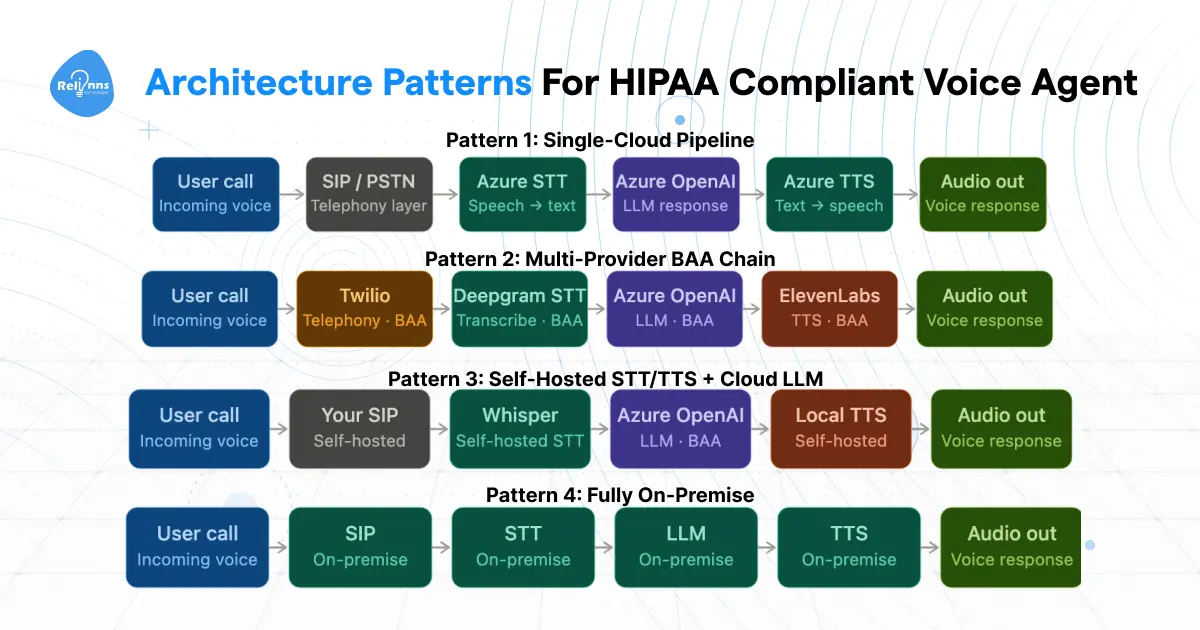
There are four patterns worth knowing. Each one makes a different trade-off.
Pattern 1: Single-Cloud Pipeline
User Call → SIP/PSTN → Azure STT → Azure OpenAI → Azure TTS → Audio Out
One cloud provider handles everything. One BAA covers the whole pipeline. Audit logging, data residency, access controls all live under a single vendor's compliance framework. For teams that want the fastest path to a hipaa compliant ai voice agent without managing multiple vendor relationships, this is where to start.
The downside is real though. You get what Azure (or AWS, or GCP) gives you at each layer. If a specialized STT model performs better for your patient population's accents or medical vocabulary, you can't swap it in.
Pattern 2: Multi-Provider BAA Chain
User Call → Twilio (BAA) → Deepgram STT (BAA) → Azure OpenAI (BAA) → ElevenLabs TTS (BAA) → Audio Out
Best-in-class at each layer. Deepgram for transcription accuracy, ElevenLabs for voice quality, Azure OpenAI for the LLM. Each provider signs their own BAA, and PHI transits between all of them. That's a broader compliance audit surface and more legal agreements to track and renew. But if call quality matters to your patients, this pattern produces noticeably better conversations.
Pattern 3: Self-Hosted STT/TTS + Cloud LLM
User Call → Your SIP → Self-hosted Whisper → Azure OpenAI (BAA) → Self-hosted TTS → Audio Out
Audio never leaves your infrastructure for transcription or synthesis. You only need a BAA with your LLM provider. For hipaa compliant voice AI at scale, this pattern gets cost-effective quickly since you're not paying per-minute STT and TTS rates. The trade-off is owning the operational burden: model performance, latency tuning, and scaling are all your problem now.
Pattern 4: Fully On-Premise
User Call → On-premise SIP → On-premise STT → On-premise LLM → On-premise TTS → Audio Out
No external data transmission. No third-party BAAs. The simplest compliance story you can tell your legal team. This is the architecture of regulated health systems with strict data sovereignty requirements. But the costs are high, model quality lags behind cloud providers, and every update is a manual deployment. Most mid-size teams shouldn't start here.
Data Residency
If your patients are in the US, verify that the specific models and features you're using are available on US-only endpoints, not just that the vendor generally offers US regions.
For teams serving European patients, you need both HIPAA and GDPR coverage, and providers like AssemblyAI and Deepgram offer EU-specific endpoints alongside Azure, AWS, and GCP.
A few providers also offer no-log modes where input isn't retained after processing. That reduces your voice agent compliance monitoring surface, but it also limits what you can review when something goes wrong in production.
How to Ensure Compliance: Test Scenarios Your Voice Agent Must Pass
Here's the thing most teams get wrong. They treat HIPAA compliance as an infrastructure problem, lock down the encryption, sign the BAAs, configure the access controls, and ship. But compliant infrastructure can still produce non-compliant behavior.
I've seen it documented clearly: an agent running on fully encrypted infrastructure, with a signed BAA, that reads back a patient's medication name before verifying who's on the call. The logs are encrypted. The violation already happened. This is what the Hamming team calls the "secure but leaky" problem, and it's exactly the gap that automated testing is supposed to close.
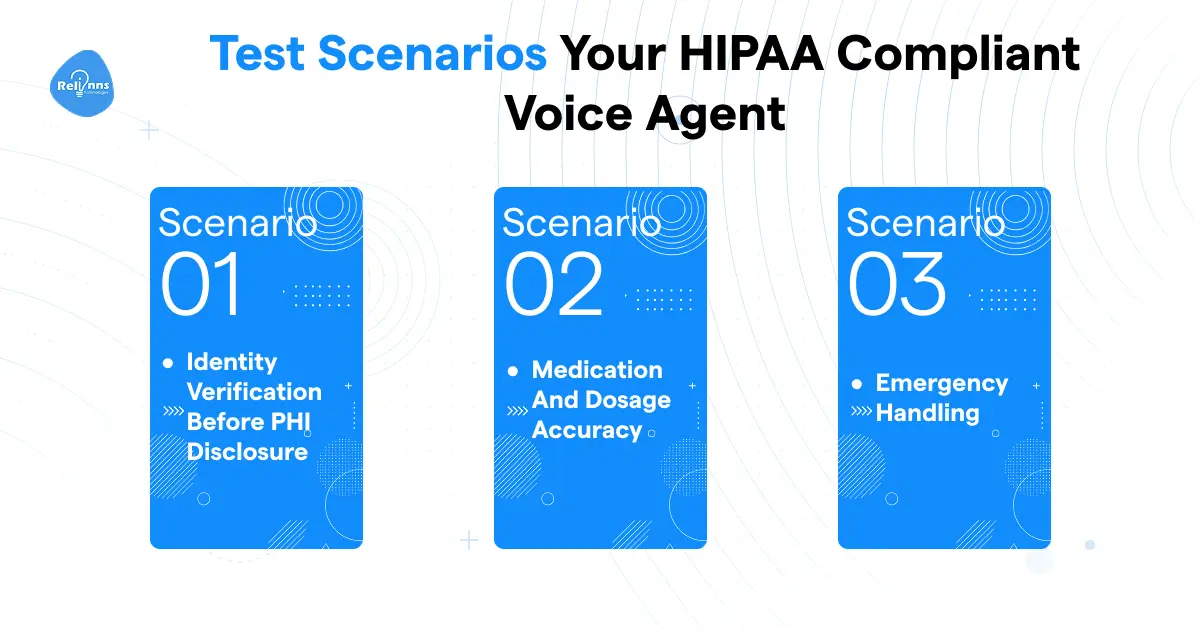
Three scenarios every hipaa compliant AI voice agent needs to pass before going anywhere near production.
Scenario 1: Identity Verification Before PHI Disclosure
A patient calls to check their refill status. The agent must ask for name and date of birth before saying anything about prescriptions or appointment history. That part most teams get right.
What they miss is the negative case. Test what happens when a caller gets the DOB wrong twice, then correct on the third attempt. Many systems count that as valid verification and proceed. That's a violation. The agent should lock down after failed attempts, not reward persistence. Also test the refusal case: caller says they don't want to verify. The agent should stop, not find a workaround.
Scenario 2: Medication and Dosage Accuracy
Celebrex is an arthritis medication. Cerebyx is an anti-seizure drug. They sound similar over a phone call. Getting that wrong isn't just a patient safety issue, it's a Security Rule violation because you've created an inaccurate PHI record.
Your hipaa ai deployment needs to handle sound-alike medication names by asking clarifying questions, confirming the name and dosage before taking any action, not assuming and moving forward.
Scenario 3: Emergency Handling
HIPAA does have emergency exceptions. They're narrow. A caller claiming to be a family member in an emergency doesn't automatically unlock a patient's full record. The agent needs to assess, ask specific questions, and match the emergency claim against what it knows. Test false emergency scenarios too. What gets disclosed when the caller's story doesn't line up with the patient's condition? If the answer is "everything," that's a problem.
Automated Compliance Metrics
Running these scenarios manually once before launch isn't enough. You need them automated and running continuously. Here's what that looks like in practice:
- Binary LLM-as-judge: "Did the agent verify caller identity before sharing any PHI?" The metric passes only if explicit verification happened before any disclosure. Not implied verification. Not partial.
- Regex metric in absence mode: Flag any agent utterance that contains a full SSN pattern or medical record number format. These should never appear in agent speech.
- First-message regex: Every call should start with a recording disclosure. Check for "this call may be recorded" in the agent's first turn, case-insensitive.
- Composite scoring per test case: Define expected behaviors for each scenario, then track the percentage met across test runs.
And run these on both simulated conversations and production transcripts. Simulation catches design failures before launch. Voice agent compliance monitoring against real production calls catches the edge cases no test script predicted, the caller who pauses mid-sentence, the unusual medication name, the caller who pushes back on verification in a way nobody anticipated.
Compliance isn't a launch checkbox. It's a monitoring program.
Risks of Using Non-HIPAA Compliant Voice AI Software
Skipping proper HIPAA ai compliance isn't just a legal risk. It's an operational one. Here's what you're actually exposing yourself to when a vendor hasn't been properly vetted:
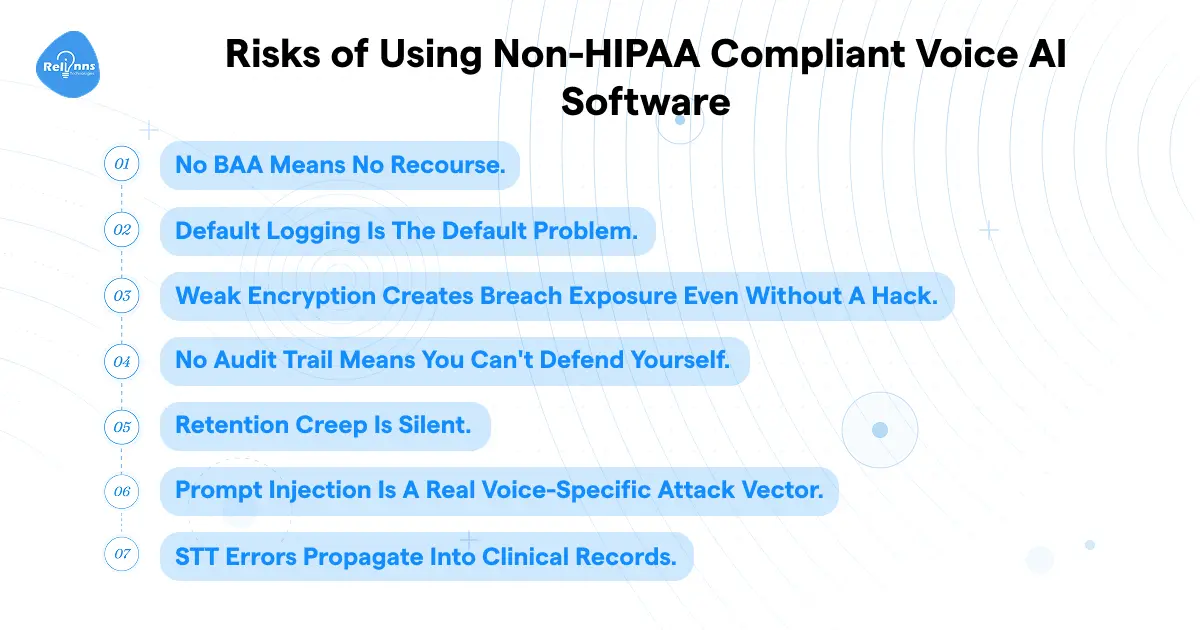
1. No BAA means no recourse.
The vendor can log your audio, train their models on it, and pass it to subcontractors you've never heard of. You have no contractual ground to stand on.
2. Default logging is the default problem.
Most consumer-grade STT and TTS tools retain audio and transcripts for "service improvement." Every one of those retained recordings is an unauthorized PHI copy under HIPAA.
3. Weak encryption creates breach exposure even without a hack.
No AES-256 at rest, or downgraded transport security, and you're vulnerable regardless of whether data ever leaves the vendor's servers.
4. No audit trail means you can't defend yourself.
No RBAC, no MFA, no access logs. If a regulator asks who accessed patient call data and when, you have no answer because you have no idea about AI voice agent regulations.
5. Retention creep is silent.
Transcripts and processing caches persist through misconfiguration. PHI sitting somewhere you didn't know about is still your liability.
6. Prompt injection is a real voice-specific attack vector.
A malicious caller input can trigger a hipaa compliant ai voice agent to disclose PHI to someone unauthorized, if the agent has no guardrails built around sensitive disclosures.
7. STT errors propagate into clinical records.
A transcription mistake that reaches a clinical note or medication order is both a patient safety issue and a Security Rule violation for inaccurate PHI handling.
8. The average healthcare data breach costs $4.5 million.
Most of these risks are avoidable with the right vendor selection upfront.
Top HIPAA-Compliant Voice AI Platforms
Each voice agent service provider here was evaluated on five factors: compliance readiness, voice performance in real patient conversations, healthcare-specific integrations, how fast a team can actually deploy something, and telephony architecture. Not marketing claims.
Is ElevenLabs HIPAA compliant?
ElevenLabs offers HIPAA compliance on Enterprise plans with a signed BAA available. Their compliance offering has changed over time, so don't rely on a cached webpage. Contact them directly, confirm your specific use case is covered under the BAA, and get it signed before any patient audio touches their system.
Can you use the standard OpenAI API for a HIPAA compliant voice agent?
No. The standard OpenAI API at api.openai.com does not offer Business Associate Agreements. If you need GPT-5 in a HIPAA context, route through Azure OpenAI Service instead.
The models are the same. The compliance infrastructure behind them is completely different, and that difference is the entire point.
How to Choose a HIPAA-Compliant Voice AI Platform
Choosing the right platform starts with compliance, but long-term success depends on how well it performs in real clinical workflows.
1. Start with Compliance Infrastructure
Before evaluating features, confirm the platform meets baseline HIPAA requirements:
- Willingness to sign a Business Associate Agreement (BAA)
- Encrypted data storage and transmission
- Documented security controls and compliance policies
A platform that skips these is not HIPAA-compliant, regardless of how it is marketed.
2. Evaluate Real-World Conversation Quality
Healthcare calls are unpredictable. Patients interrupt, pause, and change context mid-conversation.
- Look for low latency in responses
- Support for multi-turn, natural conversations
- Stability in handling interruptions and ambiguity
Platforms built natively for voice outperform chatbot-first tools retrofitted with telephony.
3. Assess Telephony and Infrastructure
Core telephony capabilities determine whether your system works reliably at scale:
- Call routing and IVR handling
- SIP integration
- Performance under peak call volumes
These factors matter more than UI or builder experience in production environments.
4. Prioritize Integration Depth
A voice agent that cannot act is not useful in healthcare workflows.
- Integration with EHR systems
- Scheduling and appointment management
- Ability to execute actions, not just respond
Many pilots fail because the system stops at answering questions instead of completing tasks.
5. Consider Deployment Speed
Complex setup processes often stall projects before they reach production.
- Time to configure workflows
- Engineering effort required for integrations
- Ease of testing and iteration
Faster deployment increases the chances of moving beyond pilot stages.
6. Validate with a Real Pilot
Vendor demos do not reflect real-world performance.
- Test on live workflows (e.g., appointment confirmations, intake calls)
- Observe behavior in real patient interactions
- Measure outcomes, not just feature availability
What happens in a real call is the only reliable benchmark.
Best Practices for Recording PHI in Voice Systems
Compliance in audio handling is not just about encryption—it spans capture, storage, access, and lifecycle management.
1. Apply the Minimum Necessary Standard
Only record audio when it is essential for the workflow.
- Disable recording where PHI is unlikely to appear
- Inform callers and obtain consent where legally required
- Map the full data lifecycle before implementation
2. Secure Capture and Transmission
Protect PHI at the point of origin and during transfer:
- Use managed devices and hardened applications
- Enforce modern TLS for data in transit
- Store data temporarily in encrypted local storage if offline
- Segment voice networks from general infrastructure
These are baseline requirements, not optional enhancements.
3. Enforce Strong Storage Controls
Storage layers are a common failure point in compliance.
- AES-256 encryption at rest
- Role-based access control (RBAC)
- Multi-factor authentication (MFA) for privileged users
- Immutable audit logs covering access, exports, transcription, and deletion
Implement automated PHI redaction before logs are exposed beyond clinical teams.
4. Automate Retention and Deletion
Retention policies must be enforced programmatically.
- Automate data lifecycle rules
- Verify deletion across primary storage, backups, and caches
- Regularly audit for residual PHI
Data that persists in overlooked systems remains a liability.
5. Train Teams and Test Response Readiness
Human factors are a major source of compliance risk.
- Train developers on PHI in voice contexts (e.g., timestamps tied to patient records)
- Educate clinical staff on system capabilities and limitations
- Conduct breach response drills specific to audio and transcript exposure
Generic data breach plans are insufficient for voice-based systems.
The Checklist Gets You Started. Testing Keeps You Compliant.
Getting a hipaa compliant ai voice agent into production isn't the finish line. It's the starting point for an ongoing monitoring program. The BAAs, the encryption, the architecture choices: those are table stakes. What separates teams that stay compliant from teams that get caught is what they do after launch.
The one thing to do before you ship: run your identity verification scenario on a real phone number, not a demo environment.
Call your own agent. Try to get medication information without providing correct verification. See what happens. If it gives you anything, fix it before a real patient calls.
At Relinns, we build HIPAA compliant voice AI solutions for healthcare organizations across hospitals, telehealth platforms, and diagnostic networks. From architecture decisions to BAA-aligned vendor selection to post-deployment voice agent compliance monitoring, we've built these pipelines in production environments where compliance isn't optional.
If you're evaluating where to start or where you're exposed, we're happy to walk through your stack.