Best LLM for Voice Agents in 2026: Detailed Comparison Guide
Date
Aug 24, 26
Reading Time
12 Minutes
Category
AI Voice Agents
Share


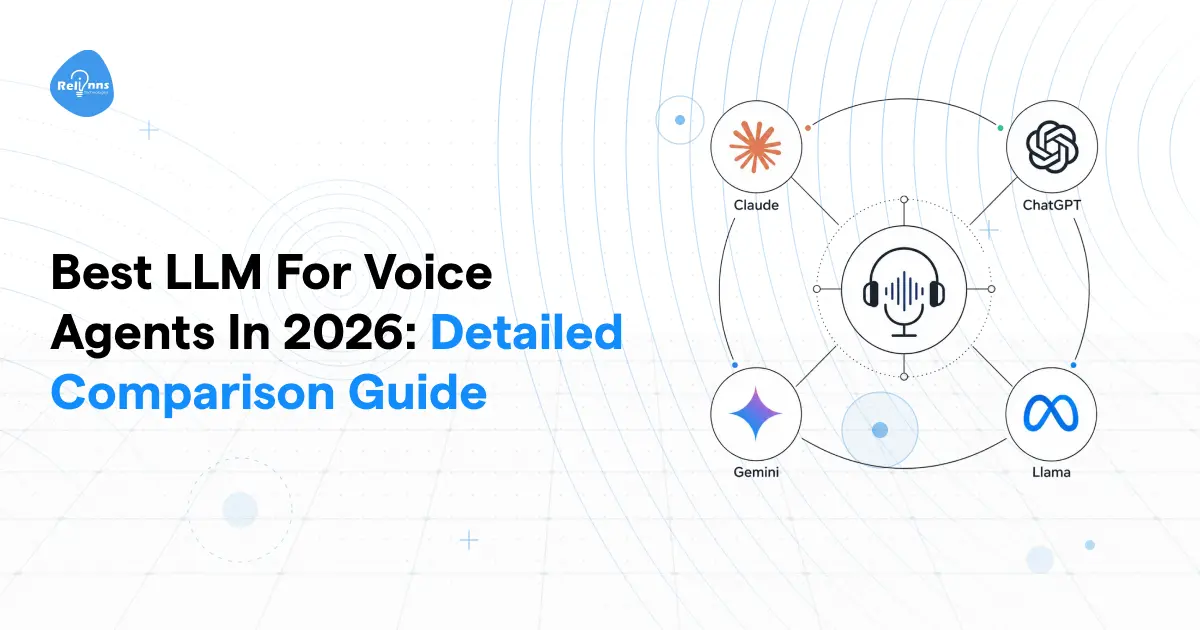
GPT 4.1 is the best LLM for voice agents in 2026. Not GPT 5.5, not the newest model in the lineup.
GPT-5 adds 800ms or more per turn due to its reasoning step. On a live phone call, that's dead air the caller hears. GPT 4.1's sub-400ms response time and 1-million-token context window make it the clear choice for real-time production voice.
But "best for most" isn't "best for yours." The right AI model for voice agent work shifts based on your context size, call volume, reasoning needs, and compliance requirements. And a lot of teams I've seen get this wrong by defaulting to the newest release.
Picking the best LLM for voice agents the right way means knowing four things: latency, context, reasoning complexity, and cost. This guide works through all of them.
What Are Voice Agents?
Voice agents are software that handle spoken conversations without a human. Inbound: answer calls, book appointments, handle FAQs. Outbound: payment reminders, follow-ups, collections.
They connect directly to your backend systems. CRM, calendar, EHR, WMS. A hospital's voice agent can book an appointment and send a confirmation SMS during a normal conversation, with no staff involved.
Don't confuse them with IVR. "Press 1 for billing" is a menu tree. Voice agents understand natural language and respond dynamically to what the caller actually says. How well that works depends almost entirely on the LLM underneath.
The best LLM for voice agents is what separates an agent that sounds genuinely capable from one that collapses the second the conversation goes off-script. Not every AI model for voice agent work is built for real-time speech. And the best LLM for voice agents handling booking calls is a different choice from one running complex claims workflows.
What Are LLMs?
LLMs (large language models) are neural networks trained on huge text datasets to understand and generate language. Simple version done.
For voice agents, a more practical definition: they're the intelligence layer sitting between your caller's words and the agent's response. STT converts audio to text. TTS converts text back to audio. The LLM runs everything in between, reading intent, generating responses, executing function calls, keeping context across turns.
The main options in production today are GPT, Claude, Gemini, and self-hosted open-weights models like LLaMA. They don't all perform equally as an AI model for voice agent deployments. The best LLM for voice agents on a live call does all of that in under 700 milliseconds. Some hit it. Many don't. And the best LLM for voice agents in a compliance-heavy workflow is a completely different conversation from a high-volume booking agent.
Why Do Voice Agents Need an LLM?
STT converts your caller's speech into text. TTS converts text back to audio. That's all they do.
The LLM is what turns those two pipes into a real conversation.
Take it out and you're back to a scripted IVR tree. Rigid, predictable, broken the moment a caller says something outside the decision tree. And they always do.
The LLM interprets messy real-world speech: incomplete sentences, mid-thought corrections, accents, ambiguous requests. It generates on-policy responses, executes function calls (book the slot, update the CRM, pull the insurance policy detail), and holds context across 20 to 30 conversation turns without losing the thread.
That last part is what most teams underestimate when they're spec-ing out their architecture.
The best LLM for voice agents scores well on one thing: doing all of this reliably while a person is actively waiting on the line. Benchmark scores on text-writing tasks tell you almost nothing about this. The AI model for voice agent work faces a constraint text AI never does: there's no retry. The caller is live.
That's why the best LLM for voice agents is a different decision from any other LLM selection you'll make.
Why Does the Right LLM Matter for Voice Agents?
Pick the wrong AI model for voice agent work and you don't get a bad demo. You get a bad product after go-live, where every failure is audible.
A 3-second delay in a text chatbot is invisible. On a phone call it sounds like the line dropped. A 2-second TTFT on every turn in a 30-turn call adds 60 seconds of dead air across the conversation. On a 4-minute booking call, that's 25% of the interaction that's just silence.
Poor streaming behavior breaks TTS rhythm, producing choppy audio even when the words are correct. A model that hallucinates under partial or ambiguous speech will invent a medication name in a healthcare call or confirm an appointment that doesn't exist.
None of this shows in demos. It shows in containment rate, transfer rate, and CSAT three weeks after launch.
The best LLM for voice agents gets tested on one thing: real call conditions, not benchmark leaderboards. And the best LLM for voice agents shapes your per-minute infrastructure cost, your compliance exposure, and whether callers stay on the line long enough to convert.
Key Criteria for Evaluating LLMs in Voice Agent Workflows
Most text-AI benchmarks test writing quality and factual accuracy. None of that tells you whether a model holds up on a live phone call. Choosing the best LLM for voice agents means scoring against an entirely different list.
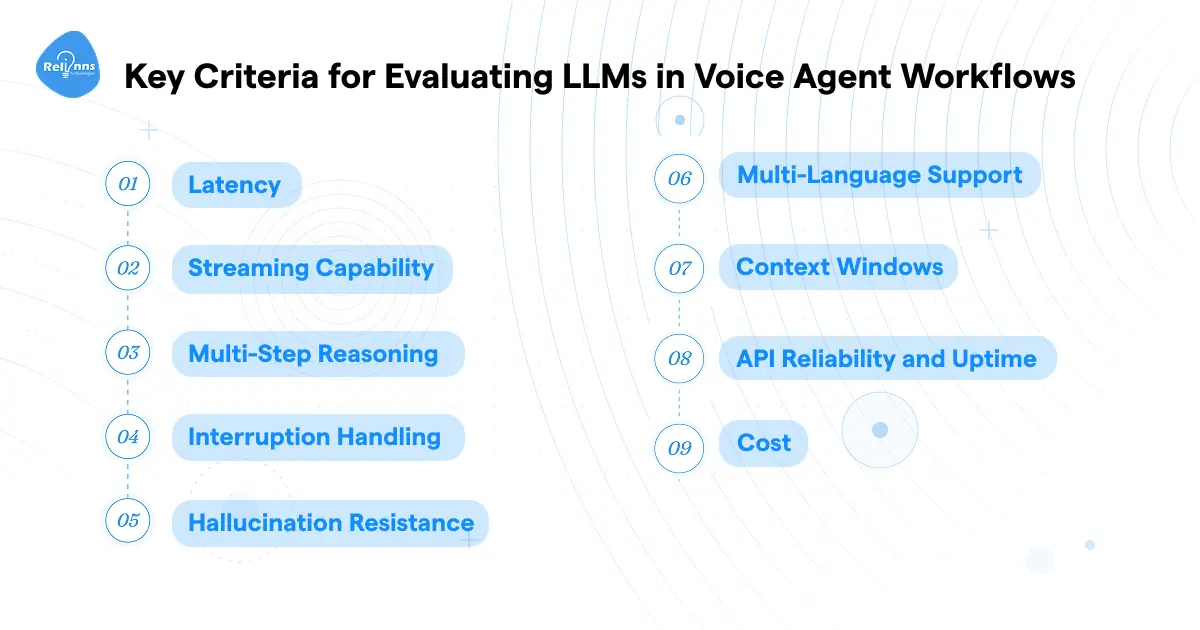
1. Latency
Target under 700ms time to first token (TTFT) for text-mode LLMs in a cascaded pipeline. Natural conversation breaks above 1,500ms voice-to-voice response time. Cold starts can run 3-5x slower than warm requests, which hits hard during traffic spikes.
2. Streaming Capability
Voice agents synthesize audio from the first tokens received. Bursty, irregular token output produces choppy speech even when the final words are right. Models that front-load coherent output work in voice. Models that build toward it don't.
3. Multi-Step Reasoning
Complex calls chain: retrieve info, call a function, explain the result, follow up. Most teams overestimate how complex their calls actually are. Reasoning models that add a "thinking" pause before output break real-time conversation flow.
4. Interruption Handling
Callers correct themselves, change topics, and redirect mid-sentence. Models that need a full prompt restart on interruption create a noticeably broken experience. Graceful recovery means picking up context and continuing, not restarting the turn.
5. Hallucination Resistance
Partial or clipped speech inputs increase hallucination risk in weaker models. In healthcare, insurance, or finance, a hallucinated policy number or medication name is a direct liability. Better models acknowledge uncertainty rather than generating a confident wrong answer.
6. Multi-Language Support
Performance drops sharply for less-common languages, even in otherwise capable models. Benchmark scores are heavily English-weighted. Test your actual target language specifically before committing to any model.
7. Context Windows
Most standard calls fit under 10,000 tokens. Long context becomes important for RAG-heavy agents, large policy document retrieval, or pulling 18 months of account history into the prompt. GPT 4.1 and Gemini 3.0 Flash both offer 1M token windows.
8. API Reliability and Uptime
Rate limits and provider incidents hit live calls directly. There's no retry when a caller is on the line. Enterprise SLAs from Azure OpenAI or GCP carry contractual reliability commitments worth paying for in production.
9. Cost
The cheap-model penalty (lower containment rate, more human transfers) usually costs more than the token savings. Ask which AI model for voice agent work gives the highest containment rate per dollar, not the lowest per-token price. A fully loaded human agent runs $3,000-$4,000 per month. A premium LLM setup is a fraction of that.
Run every candidate through this list before you build. The best LLM for voice agents scores well across most of these, not just the one dimension your team is focused on.
The 4 Leading LLMs for Voice Agents
The production voice AI market has landed on four real choices: OpenAI's GPT family, Anthropic's Claude, Google's Gemini, and self-hosted open-weights models like LLaMA, Mistral, and Ultravox.
Most teams run GPT 4.1 and only move off it when something forces the decision. That's not brand loyalty. It's what 40 million calls per month on the Retell AI platform actually backs up. Picking the best LLM for voice agents means understanding which of these four fits your specific constraints, not just which one scores highest on a leaderboard.
Use this table for a fast read before the detailed breakdowns.
| Model | Best For | TTFT Speed | Context Window | Cost/min |
| GPT 4.1 | Most production voice agents | Fast | 1M tokens | ~$0.025 |
| GPT 5.5 | Complex reasoning, async analysis | Slower | Up to 270K | ~$0.06 |
| Claude Sonnet 4.6 | Regulated workflows, structured prompts | Competitive | 200K tokens | ~$0.06 |
| Gemini 3.0 Flash | High-volume, retrieval-heavy | Very fast | 1M tokens | Low |
| Self-hosted (LLaMA/Mistral) | Compliance, custom fine-tuning | Variable | Variable | Infrastructure only |
1. GPT (OpenAI)
The GPT family covers more deployment scenarios than any other provider. But "GPT" without specifying which model is like ordering "food." The sub-models matter.
GPT 4.1 is the best LLM for voice agents running standard production workflows: appointment booking, FAQ handling, lead qualification, inbound customer support. 1M token context window, sub-400ms first token, reliable function calling. Start here unless a specific constraint moves you off it.
GPT 4.1 mini runs roughly 4x cheaper on input tokens. On short, structured calls (menu routing, basic FAQs, simple outbound reminders), callers can't tell the difference from the full 4.1 model. The right AI model for voice agent deployments at high volume where call structure is predictable and repeatable.
GPT 4.1 nano at $0.10 per million input tokens handles background tasks well: language detection, intent classification, inbound or outbound call routing decisions. Don't run it as the primary model on a customer-facing live call.
GPT 5.5 adds stronger reasoning and better multi-step function calling, but the reasoning step adds 800ms or more per turn. On a live call, callers hear that as dead air. Use it for genuinely complex flows like claims processing, or for async post-call analysis where latency is invisible to the caller.
GPT 5 mini hits a similar latency profile to GPT 4.1 with slightly better reasoning at marginally more cost. Worth A/B testing if your call mix has more reasoning-heavy turns. GPT 5 nano competes at the cost floor alongside 4.1 nano for routing tasks.
One admission worth making: the best AI model for voice agent work isn't always the newest release. GPT 4.1 came out in April 2025. Most production voice agents in 2026 still run it.
2. Claude (Anthropic)
Claude's edge is instruction following, specifically holding fidelity on a long, detailed system prompt across a 30-turn conversation. In that dimension, it's ahead of the others.
Claude Sonnet 4.6 / 4.5 is the best LLM for voice agents running in regulated environments: insurance workflows, healthcare compliance, financial services. It costs more. $3 per million input tokens vs $2 for GPT 4.1, and $15 per million output vs $8. That premium earns its place only when prompt compliance is non-negotiable across the full call.
Claude Haiku 4.5 is faster and cheaper, but noticeably weaker on long conversations and edge cases. Useful as a fallback in mixed-routing setups where simpler turns get handled cheaply.
The AI model for voice agent compliance work is Claude Sonnet. For standard production, the cost premium is hard to justify.
3. Gemini (Google)
Gemini Flash has closed the quality gap fast. A year ago I wouldn't have put it at this level.
Gemini 3.0 Flash / 2.5 Flash / Flash Lite gives you the lowest cost in the lineup, the fastest time-to-first-token, and a 1M token context window that matches GPT 4.1. Conversational quality on natural turns has improved sharply in 2026. It still trails GPT 4.1 on complex instruction following, but for high-volume retrieval-heavy deployments where context length and cost matter more than instruction accuracy at the margins, it earns a real look.
If you're running 50,000+ minutes a month on simple structured calls, Gemini Flash deserves an A/B test against GPT 4.1 mini before you commit.
4. Self-Hosted / Open-Source
Self-hosting gives you two things no API provider can: data sovereignty and zero per-token cost at scale. The trade-off is real engineering effort, and it's not small.
LLaMA, Mistral, Nemotron, and Ultravox are the main candidates. Nemotron 3 Nano at 30 billion parameters now nearly matches GPT-4o performance, which wouldn't have been true 12 months ago. Ultravox 0.7 is the first open-weights speech-to-speech model performing well on long multi-turn voice benchmarks.
The best LLM for voice agents in a compliance-constrained environment (HIPAA on-premise, GDPR data residency) is almost always a self-hosted option. The economics also flip past roughly 40,000 minutes per month, where the infrastructure cost undercuts any API pricing.
So, Which LLM Is Right for Your Voice Agent?
Answer four questions in order. The first constraint that applies picks your model.
Is the call real-time and latency-sensitive?
Almost always yes. That eliminates GPT 5.5 reasoning variants and Claude Opus from most live call deployments right away.
Does the conversation load a very large context window?
Full policy documents, 18-month account histories, or RAG-heavy knowledge bases push you toward GPT 4.1 or Gemini 3.0 Flash. Both sit at 1M tokens.
Does the call require genuinely complex multi-step reasoning?
If yes, GPT 5.5 or Claude Sonnet 4.6. But be honest here. Most calls that get labeled complex in planning sessions are 80% routine.
Is there a hard per-minute budget cap?
GPT 4.1 mini, Gemini Flash Lite, or GPT 5 nano for high-volume, simple, structured workflows.
| Use Case | Recommended Model |
| Appointment booking, FAQ, lead qualification | GPT 4.1 |
| Insurance claims triage, technical support | GPT 5.5 or Claude Sonnet 4.6 |
| High-volume outbound, simple structured calls | GPT 4.1 mini or Gemini Flash |
| Regulated healthcare or financial workflows | Claude Sonnet 4.6 |
| Compliance-constrained, proprietary data | Self-hosted (LLaMA / Mistral) |
| Async post-call analysis, summarization | GPT 5.5 (latency is irrelevant) |
The best LLM for voice agents only gets complicated when you skip the framework and go straight to the comparison table. The AI model for voice agent selection starts with your constraints, not the model's marketing page. And the best LLM for voice agents running a booking flow is a genuinely different answer from one running a regulated insurance workflow.
8 Most Common Mistakes When Picking a Voice AI LLM
The same eight mistakes come up when teams build their first voice agent. Knowing them upfront is worth more than any comparison table. Even if you think you've already found the best LLM for voice agents for your use case, run through this list first.
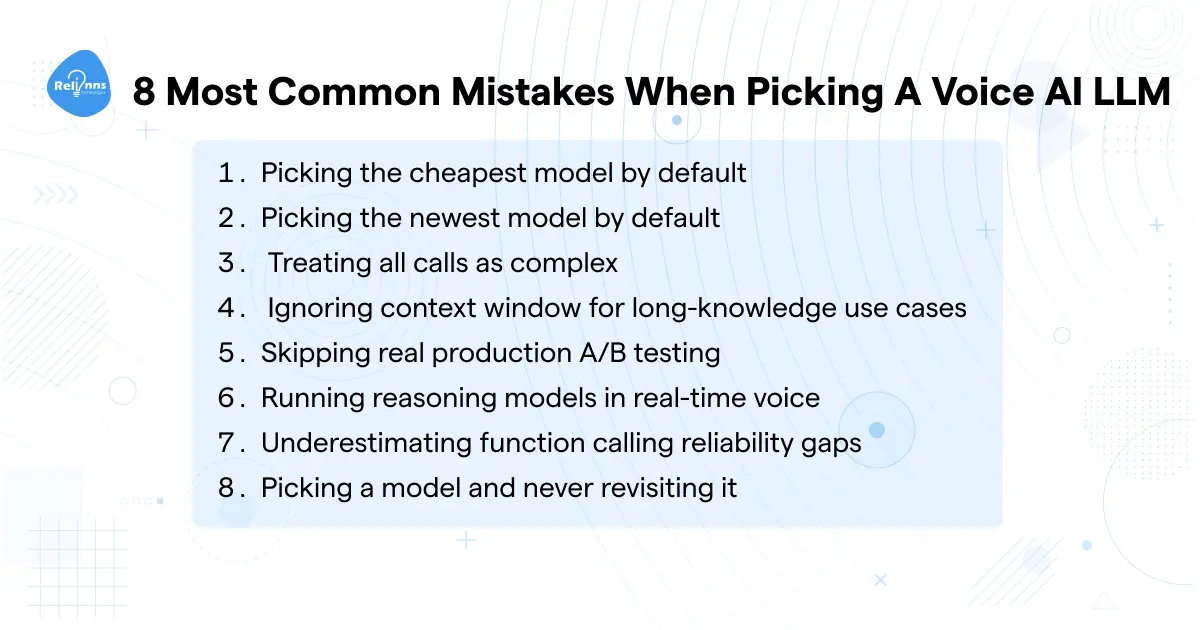
1. Picking the cheapest model by default
LLM cost is a small slice of all-in per-minute cost. Saving $0.005/min and losing 5 points of containment costs far more in human transfers and repeat calls than the token savings ever cover.
2. Picking the newest model by default
Newer is not faster. GPT 5.5 reasoning models add 800ms or more per turn. On a 30-turn call, that's 24 seconds of extra dead air the caller sits through.
3. Treating all calls as complex
Most calls labeled "complex" in planning sessions are 80% routine with one or two hard turns. Run GPT 4.1 on the routine portion and transfer the genuinely hard turns to a human. A reasoning model on the whole call wastes cost and adds latency with no quality gain.
4. Ignoring context window for long-knowledge use cases
A 200K model handling a 400K token prompt truncates silently.
No error thrown. Just wrong answers. Match the context window to your actual prompt size: system instructions, retrieved knowledge, and projected transcript length together.
5. Skipping real production A/B testing
Benchmarks don't replicate phone call conditions. The only valid test is two models running on the same live caller traffic for a week, with the same prompt, voice, and telephony. Compare containment rate and call transfer rate.
6. Running reasoning models in real-time voice
Reasoning models pause to think before generating output. Callers hear silence and assume the connection dropped. Disable reasoning mode or pick a non-reasoning model for live calls.
7. Underestimating function calling reliability gaps
Nano and lite-tier models drop function calling accuracy in ways that don't appear in basic conversational quality tests. A model that holds a conversation but misses 15% of function calls produces a broken experience regardless of how natural it sounds.
8. Picking a model and never revisiting it
Schedule a quarterly review against real production metrics: containment rate, call duration, and CSAT. The best LLM for voice agents in Q1 2025 isn't automatically the right AI model for voice agent work in Q3 2026. The market has moved too fast for set-and-forget decisions.
How Much Does Each LLM Cost Per Minute on a Real Voice Agent?
Most teams look at the LLM token price and stop there. That's the wrong number to optimize.
Take a realistic scenario: 5,000 minutes per month, 4-minute average call, knowledge base attached, one function call per turn. The cost stack looks like this:
| Component | GPT 4.1 Setup | GPT 5.4 Setup | Cost-Extreme Setup |
| Voice engine | $0.07/min | $0.07/min | $0.07/min |
| LLM | ~$0.025/min | ~$0.06/min | ~$0.005/min (4.1 nano) |
| Telephony | $0.015/min | $0.015/min | $0.015/min |
| All-in | ~$0.11/min | ~$0.145/min | ~$0.09/min |
| Monthly @ 5K min | ~$550 | ~$725 | ~$450 |
The premium setup costs $175 more per month. The cost-extreme setup saves $100. Neither number is what you should be focused on.
A fully loaded human agent costs $3,000-$4,000 per month. The entire voice agent stack, even on the premium tier, is a fraction of one agent salary. The LLM line item is not where the budget decision lives.
What actually matters: a 5-point drop in containment rate from running a cheap model generates more cost in human transfers and repeat calls than $100 per month in token savings covers.
The right question when picking the best LLM for voice agents isn't which AI model for voice agent work has the lowest token price. It's which model produces the highest containment rate per dollar at your call volume.
That question almost always points to GPT 4.1 for standard production deployments. The best LLM for voice agents isn't the cheapest one. It's the one that handles the call.
Choose the Model That Best Fits Your Workflow
GPT 4.1 wins for most production deployments. Move off it only when a specific constraint forces the decision. That's the short version.
But picking the best LLM for voice agents is one decision in a much longer chain. STT, TTS, orchestration, function calling, compliance requirements, CRM integration, EHR or WMS connections, prompt engineering, testing, monitoring.
The model selection takes an afternoon. Getting everything else right takes months.
Most CTOs and COOs we talk to don't actually want to own that process.
They want the outcome: calls handled, appointments booked, queries resolved without a human agent on the phone.
The AI model for voice agent work is infrastructure. And infrastructure is not your core business.
Relinns builds and deploys production-grade AI voice agents on the right stack for your vertical. Healthcare, insurance, logistics, ecommerce. We handle the model selection, the integration, the prompt engineering, and the ongoing monitoring so your team doesn't have to context-switch into a technical problem that isn't theirs to solve.
The best LLM for voice agents is the one that's live, calibrated to your use case, and not sitting on your engineering team's backlog.
Book a live demo or schedule a discovery call to see it running on your workflow.