AI Voice Agent vs Traditional IVR: A Simple, Clear Breakdown
Date
Aug 25, 26
Reading Time
8 Minutes
Category
AI Voice Agents
Share


TL;DR
- IVR follows fixed menus and predefined routes. It does not understand language, infer intent, or adapt when callers change direction.
- AI voice agents interpret natural speech, maintain context, handle mid-call pivots, access live systems, and complete actions during the conversation.
- IVR remains useful for authentication, secure number collection, queuing, hold management, and routing predictable calls.
- Voice agents fit conversations requiring flexible intent recognition, CRM or EHR access, outbound workflows, and end-to-end resolution.
- The strongest architecture often combines both: IVR manages the structured front end, while the voice agent handles conversation and resolution.
- Avoid replacing everything at once. Pilot the five highest-volume call types, validate integrations and compliance, then expand after performance is stable.
"IVR" and "AI voice agent" get used in the same breath so often that it's easy to assume they're roughly the same thing with different marketing behind them. If you've walked out of a vendor demo still unsure which is which, that's the industry being sloppy with its own terminology.
The distinction between AI voice agents and traditional IVR systems matters, though. Both sit on a phone line and handle calls without a human picking up, but the mechanisms behind each are different in ways that change what you can actually do with them.
This blog covers where IVR systems are strong, where they fall apart, and how voice agents differ. The goal is a clear picture of the AI voice agent vs traditional IVR systems comparison before you walk into any vendor meeting.
Before comparing them, you need to understand what each one does when a call comes in.
IVR Has Been Running Phone Lines for Decades. Here's Why That Made Sense.
IVR gets a lot of unfair criticism right now, and part of that is because it keeps getting compared to things it was never designed to do. When you're thinking about the AI voice agent vs traditional IVR systems debate, it's worth being honest about what IVR actually does well first.
IVR is deterministic. You script every path, define every menu option, and the system executes exactly what you built. No surprises, no interpretation. A caller presses 2 for billing and gets billing. That predictability has real value.
Banks have run IVR systems for decades to handle balance checks, branch hours, and account routing. Simple calls, known outcomes, nobody needs to touch it. That's the right use case for the technology.
IVR is also cheap to run and easy to audit. Because every path is scripted, compliance teams know exactly what the system will do with caller data. In regulated industries, that's nothing.
What IVR Does Well
- Routes calls to the right department or queue
- Navigates callers through preset menu options
- Plays back recorded information like hours, locations, and status updates
- Handles department selection at high call volumes
One thing worth clearing up: IVR is not a voice agent, a voice bot, or anything close to an AI system. It doesn't understand language. It doesn't infer what a caller means. It matches keypad inputs to pre-mapped outputs, and that's the full extent of it. The AI voice agent vs traditional IVR systems comparison is often confusing precisely because people treat these as points on the same spectrum. They're not.
The problem isn't that IVR is bad technology. The problem is what happens the moment a caller's need doesn't fit the menu.
The Call That Never Made It Through
IVR does reduce your inbound call volume. That metric looks good on a dashboard, and it's true.
But that number doesn't tell you what it filtered out. IVR deflects the easy calls and sends the hard ones to your team anyway. The caller checking store hours: handled. The caller is trying to reschedule with a condition on the appointment: sitting in a queue, getting frustrated.
That's the pattern. Everything that requires a decision, a lookup, or a real back-and-forth lands with your staff, regardless.
66% of patients face access challenges, including difficulty reaching their provider. Many move to another practice rather than calling back.
Source: RXNT, 2025
When callers hit a dead end in a menu that doesn't fit their situation, most don't retry. They hang up. That lost call doesn't show up as a cost anywhere. It just becomes a customer you never hear from again.
Call abandonment rates in high-volume operations can exceed 30% during peak hours.
This is what makes the AI voice agent vs traditional IVR systems comparison worth taking seriously. IVR systems look fine in your call handling metrics until you count what never arrived. Look at the full AI voice agent vs traditional IVR systems picture, and the gap shows up in abandoned calls, stalled workflows, and customers who moved on without a word.
AI voice agents handle frustrated callers differently, including detecting caller frustration in real time before a call drops. That's something IVR can't do. And the broader AI voice agents vs human agents question starts exactly here.
AI voice agents don't just pick up faster. They work differently in how they process what a caller is asking for.
What an AI Voice Agent Is Actually Doing When It Picks Up
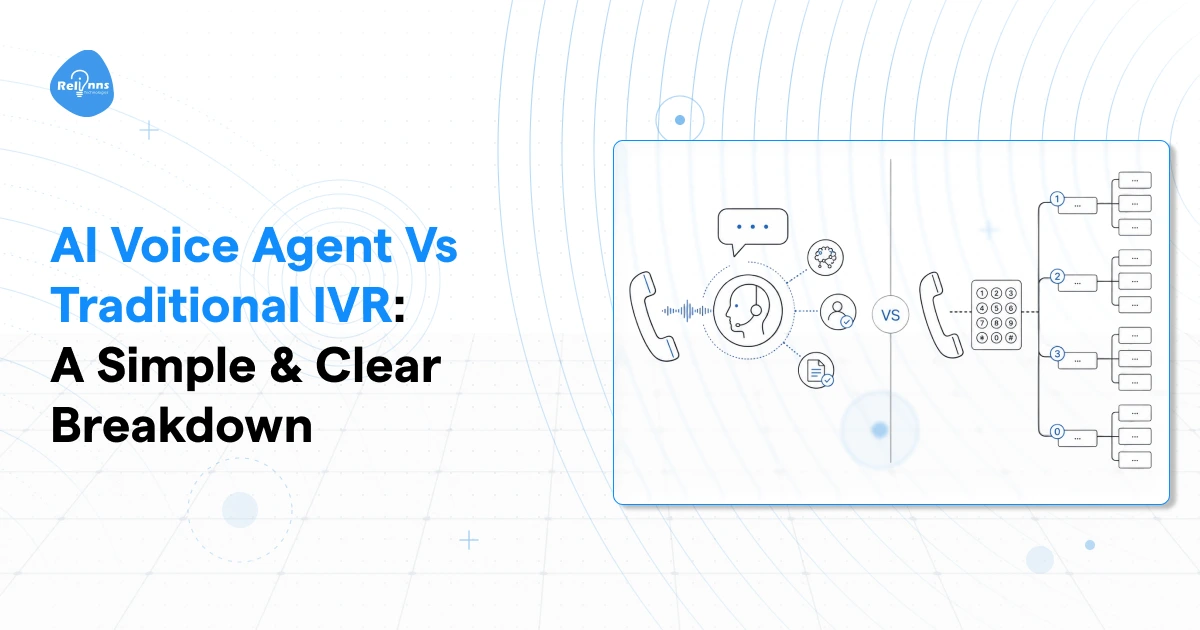
When a call hits an IVR, the system waits for a keypad input, matches it to a path, and executes. That's the full loop.
An AI voice agent starts differently. It listens to what the caller actually says and figures out what they mean. No menus, no pressing 2 for billing. The caller says, "I need to reschedule my Thursday appointment," and the agent interprets that, confirms it, and acts. That's NLP, natural language processing, doing the work underneath.
This is where the distinction between AI voice agents and traditional IVR systems stops being abstract. One matches inputs to scripts. The other infers intent from language.
And because the agent isn't locked to a script, it handles mid-call pivots. A caller who starts with a billing question and then asks to reschedule doesn't get rerouted. The conversation just continues.
The bigger difference is live data access. A well-built voice agent pulls from your CRM, your EHR, and your ticketing system in real time, looks up what's relevant, and writes structured outcomes back after the call ends. No human involved.
Outbound is where the gap really shows up in practice. An IVR system can't call an insurance company to verify a patient's benefits. An AI voice agent can. It initiates the call, navigates the automated system on the other end, extracts the information, and logs it. A complete workflow with nobody on your team lifting a phone. The inbound vs outbound voice AI distinction matters here and is worth understanding before any vendor conversation.
One honest limitation in the AI voice agent vs traditional IVR systems picture: the agent is only as good as its integrations. No CRM connection means no real-time lookup, which means stalled calls. The AI handles the conversation; your data infrastructure determines what actually gets resolved. Also, how the voice itself sounds affects whether callers stay on the line more than most people expect. For the full technical picture on how these systems are built, this covers it.
Expert Tip: The strongest voice agent deployments start narrow. Identify your 20-30 highest-volume call types. If the AI handles those cleanly, it covers 70-80% of your real call load. Build from there.
With both systems defined, the comparison becomes a lot sharper.
IVR vs AI Voice Agent: The Actual Differences
Many vendors will tell you that voice agents are just a smarter IVR. Better conversation, faster responses, same basic job. That framing is wrong and leads to unrealistic expectations about what you're buying.
The two systems run on completely different logic. IVR is deterministic. Every path is written in advance, every outcome is fixed, and the system does exactly what it was scripted to do. An AI voice agent is probabilistic. It reads what the caller says, infers intent, weighs context, and dynamically selects a response. It wasn't told what to do for this specific call. It figured it out.
That gap is real, and it changes what each system can and can't handle.
The comparison between AI voice agents and traditional IVR systems becomes more useful once you stop treating it as a ranking. These aren't competing for the same job.
"IVR brings structure and reliability. Voice AI brings adaptability and conversational fluency. The strongest deployments use both."
A practical hybrid looks like this: the IVR handles authentication and initial routing at the front; the voice agent takes over for the actual resolution; and the IVR manages queuing and transfer logic if the call escalates. IVR systems do the structural work well. Hold management, secure number collection, and routing queues. Voice AI handles the conversation, intent reading, and outcomes.
Most of the AI voice agent vs traditional IVR systems decisions that go wrong do so because someone tried to replace the whole stack when they should have layered the two. Two things worth knowing before you commit to any architecture: latency affects caller experience more than most expect, and the LLM running underneath the agent determines how well it handles ambiguous requests.
Knowing how they differ is useful. Knowing which one fits your actual situation is what matters.
When to Use IVR, When to Deploy a Voice Agent, and When to Run Both
Most people reading this already have IVR in place and are trying to figure out what to add, not what to replace. That's the right framing for the AI voice agent vs traditional IVR systems decision.
Stick with IVR when:
- Call flows are fully predictable, and your menu options actually cover what callers need
- You mainly need queuing, hold management, and transfer to a live agent
- Your industry's compliance requirements restrict how unstructured conversation data gets handled
- Call types are simple and well-mapped enough that a menu works fine
Deploy a voice agent when:
- Calls regularly involve multi-step requests or open-ended questions
- Abandonment rates are high, or you have gaps in after-hours coverage
- You need outbound automation: payment reminders, appointment follow-ups, and benefits verification
- Resolution rate matters more than routing speed. You want calls finished, not just transferred.
Run both when:
- You're in a regulated industry where IVR handles the secure front-end, and the voice agent handles resolution
- You're transitioning incrementally and want to layer capability without ripping out existing infrastructure
That last scenario is more common than people admit. Most operations running IVR systems today don't need to start over. They need a layer that handles the calls their setup was never built for.
The AI voice agent vs traditional IVR systems split looks different depending on your industry. Healthcare, insurance, ecommerce, customer service, and lead qualification each have different call patterns and different thresholds for where that decision tips.
Before you deploy either, there are a few things most vendors skip over in the sales conversation.
What Nobody Explains Before You Switch
The ai voice agent vs traditional ivr systems pitch from vendors focuses on what the agent can do. What they skip is what has to be true on your end for any of that to work.
The single biggest failure point in voice AI deployments is the capture of names, spelling, and addresses. If a caller's information isn't already in a CRM that the agent can reference, the resolution rate drops fast. The agent can't verify who they're talking to, can't pull context, and ends up handling the call blind. That's not a model problem. It's a data infrastructure problem.
Which leads to the thing most vendors won't say directly: your CRM or EHR integration determines resolution rate more than the AI model itself. A well-connected agent on a mid-tier model outperforms a frontier model with no live data access. Every time.
IVR systems created limited compliance obligations because the data was structured and bounded. Voice AI changes that. Unstructured conversation data falls into a different compliance category, and your governance requirements become stricter the moment you deploy it. That's a real scope item to plan for before you go live. Privacy and security for voice agents covers what that actually involves.
One honest take on the AI voice agent vs traditional IVR systems transition: incremental beats rip-and-replace every time. Pilot with your five highest-volume call types, get those working cleanly with live system integration, and build from there. Upfront costs for voice AI are real. Total cost of ownership over time usually shifts the math, but that case is easier to make after a working pilot than before. Stress test your agent before full rollout, get clear on what this actually costs, and have a scaling plan ready before you commit.
Expert Tip: Run a pilot on your five most common call types before full deployment. If the agent handles those cleanly with live system integration, the rest of your rollout has a blueprint.
The clearest path forward is to know exactly what you need automated and to work with a team that builds to that specification.
Ready to Build This for Your Call Surface?
Once the distinction between AI voice agents and traditional IVR systems is clear, the next question is what it looks like in your specific environment.
Relinns builds voice AI systems end-to-end. Telephony integration, CRM and EHR connectivity, knowledge base setup, and compliance layer. Built to your call types and infrastructure, not a generic platform dropped in and left to configure itself.
We work across healthcare, insurance, ecommerce, and logistics. Each one has different call patterns and thresholds for where the AI voice agent vs. traditional IVR systems' decision tips. If you're still comparing vendors, the top voice AI services worth knowing are covered here. If you want to understand what the build actually looks like, start here.