AI Voice Agents for Ecommerce: 2026 Detailed Breakdown
Date
Aug 31, 26
Reading Time
10 Minutes
Category
AI in Ecommerce and Retail
Share


Key Takeaway
If your support calls go unanswered or are handled poorly, you don't just lose a ticket but you lose the customer and their future orders, since shoppers who have a bad support experience are twice as likely to leave for a competitor.
Voice agents for ecommerce can answer 60 to 80 percent of predictable call types, like order tracking and returns in under three minutes, slashing per-call costs from $5-8 with humans to as little as $0.50-1.50, and freeing up human agents for edge cases.
Outbound AI voice agents recover abandoned carts at a 30 to 45 percent conversion rate, which is about triple what email gets, and ten recovered carts a day at a $200 average order value adds up to $700,000 in extra annual revenue.
A voice agent that isn't connected to your live order management system, CRM, and product catalog is just a FAQ reader; it needs real-time data access to actually resolve customer calls and not just deflect them.
Trying to use old IVR scripts with AI voice agents guarantees a bad experience; you need to design prompt flows around intent and natural conversation, and set up clear escalation triggers so humans step in only when it actually matters.
Every ecommerce brand hitting $5M+ revenue has made the same bet: fix support through chat. Add a chatbot. Hire agents for email. Build a help center. The playbook is well-worn, and most teams follow it without questioning it.
The gap it leaves is the phone.
Customers calling after a failed delivery don't want to type. Shoppers with a return question mid-checkout don't want to wait 48 hours for an email reply. A buyer worth $300 in order value who calls before purchasing will not stay on hold for eight minutes.
A voice agent for ecommerce fills this gap, covering the calls that chat and email were never designed to catch. This blog covers what that gap costs you, what a well-built voice agent can do in production, and how to deploy ai voice for ecommerce without the mistakes most teams make.
To understand the full scope of what modern voice agents can do, this breakdown of what AI voice agents are covers the foundation.
The Ecommerce Support Crisis No One Talks About
Peak season hits. Orders triple. Your support queue doubles overnight. Email response times climb from 4 hours to 48. Chat goes offline at 11pm. Your phone line either goes unanswered or routes to a voicemail no one checks.
- The Blind Spot in Your Metrics
Most support metrics boards track chat CSAT and email resolution time. Almost none track what happens to customers who called and got nothing.
- What's Actually Flooding Your Phone Lines
WISMO queries (where is my order) make up 40 to 70% of inbound call volume at most ecommerce operations. Returns and delivery exceptions add another 20%. Pre-purchase product questions, payment failures, and address corrections account for the rest.
These aren't complex queries. They're high-frequency, predictable, data-dependent calls that a trained agent answers in two minutes before moving to the next one. At 300 calls a day, that's 10 hours of agent time on questions with one-sentence answers already sitting in your OMS.
- Why Customers Still Call
Phone is the channel customers reach for when stakes are highest. A delayed shipment. A missing item. A failed payment before a gift deadline. These aren't moments for a chat widget.
- The Revenue Problem Hidden as a Support Problem
They call. And most ecommerce brands have either no answer or a human who starts from scratch asking for the order number the customer already gave the automated menu. That disconnect is a revenue problem, not a support problem. It shows up in your churn rate, not your support cost report. That's exactly why it stays invisible for so long.
What Bad Customer Experience Actually Costs You
Customer service failures don't show up as line items. They show up as churn.
Research from Salesforce and McKinsey points to the same pattern. Customers who contact support and get a poor experience are twice as likely to leave. For ecommerce brands where repeat purchase rate drives 30 to 40% of total revenue, that compounds every quarter.
1. The Direct Cost Is Already Measurable
An average ecommerce brand spends $5 to $8 per resolved human agent call. At 300 calls a day, that's $1,500 to $2,400 daily in support costs before accounting for missed calls or after-hours abandonment.
2. Missed Calls Don't File Complaints
A customer who waits four minutes during a peak window and hangs up buys from a competitor. No ticket. No record. A lost order.
Cart abandonment tied to unanswered pre-purchase questions is another hidden layer. Around 70% of shoppers abandon carts. A segment of them had a question they couldn't get answered fast enough, and no one on your team ever knew.
3. The Revenue Case for AI Voice
Outbound AI voice targeting abandoned carts converts at 30 to 45% in documented deployments.
At $200 average order value, ten recovered carts a day is $2,000 in daily revenue the abandoned queue would otherwise hold permanently and that's before any deflection savings enter the calculation.
4. You're Measuring the Wrong Comparison
Most ops teams compare chatbot cost versus voice agent cost. The right comparison is voice agent cost versus the revenue it recovers and the churn it prevents. That frame changes everything once you understand what chatbots and live chat could fix, and what they couldn't.
Why Chatbots and Live Chat Have Already Failed
The pitch was convincing. Deploy a chatbot, deflect 60% of tickets, cut support costs in half. Thousands of ecommerce brands bought it.
The Tickets kept coming.
Deflection numbers were real. Chatbots reduced the volume of simple FAQ queries reaching human agents. The demos didn't show the other side. Deflection isn't resolution. A customer whose query gets answered with a canned response that doesn't match their specific order situation doesn't count as resolved. They count as someone about to call your phone line.
Platforms like BotPenguin have raised the floor for what chatbot automation can do. Script-based bots that broke on any input variation are now AI-driven systems that handle multi-step flows, pull live order data, and process returns without a human in the loop. Agentic chatbots built for ecommerce have reduced ticket volumes in ways that weren't possible four years ago.
Text still has a ceiling.
Customers escalate to voice when they're frustrated, when the stakes are high, and when they need confirmation rather than information. Live chat has the same ceiling plus a staffing problem. Running it 24/7 requires headcount. Peak season demand doesn't wait for your agent's shift.
Chatbots handle high-frequency, low-stakes text queries well. Live chat handles nuanced conversations during business hours. Neither was built for the high-stakes, time-sensitive call that ecommerce generates at its worst moments.
Voice fills that gap. Understanding what that means in production, versus what it's been confused with for years, changes how you'd scope a deployment.
What AI Voice Agents Actually Are (And Aren't)
Press 1 for order status. Press 2 to speak with an agent. If that experience has burned you before, the idea of a voice bot on your support line probably feels like a step backward.
A voice agent for ecommerce is a different category.
Modern voice AI uses large language models to understand natural speech in real time. A caller says "I ordered the blue hoodie three days ago and my tracking hasn't updated" and the agent understands the intent, pulls the order, checks the shipping status, and responds in a natural back-and-forth. No menu. No "I didn't understand that, please try again."
The gap between IVR and a built voice agent is the same as the gap between a search bar and a language model. One pattern-matches against a fixed menu. The other understands what the caller is trying to accomplish.
A voice agent differs from a human in edge cases. Emotionally charged situations, escalated disputes, and calls requiring judgment outside the agent's trained scope still need a human. The agent handles 60 to 80% of calls that follow predictable patterns and routes the rest with full context captured, so the human doesn't restart the conversation.
For detail on where that handoff should happen and how to design it well, this comparison of AI voice agents vs human agents covers the decision points. For what makes ai voice for ecommerce sound credible in production rather than mechanical, the guide on making AI voice sound human is worth reading before configuring a single prompt.
Knowing what the technology can do matters. Knowing which six use cases produce the fastest results matters more.
Top 6 Use Cases of AI Voice Agents in Ecommerce
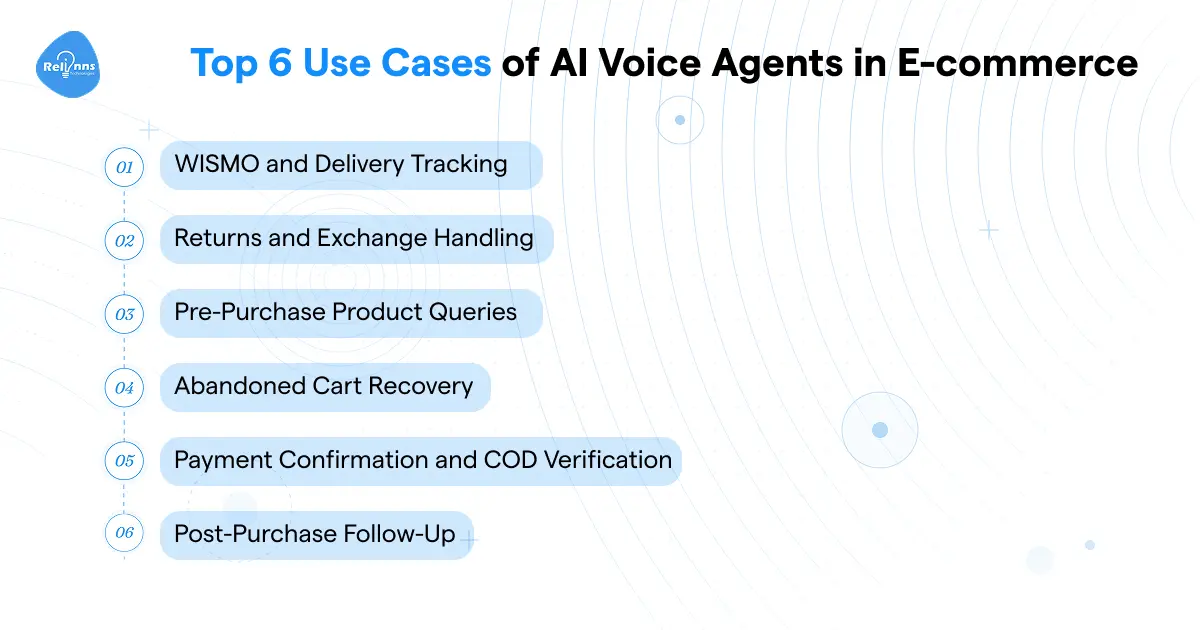
The use cases split into inbound and outbound. Most brands start with inbound because the volume is immediate. Outbound is where the revenue impact shows up faster. This inbound vs outbound voice AI breakdown covers both deployment models in depth if you want a full comparison before scoping.
Inbound Use Cases
WISMO and Delivery Tracking
Forty to seventy percent of inbound ecommerce call volume is some variation of "where is my order." The caller has an order number, a delivery expectation, and a question. The answer sits in your OMS. A voice agent pulls it in real time and gives the caller a direct response in under 30 seconds. For agents with live OMS access, resolution rate on these calls runs above 85%, and no agent time is spent.
The same tracking workflow powers AI voice agents for logistics, which handle delivery updates, delay notifications, rescheduling, and proof-of-delivery requests.
Returns and Exchange Handling
Returns involve more steps than WISMO but the logic is structured. Eligibility check, return window confirmation, label generation trigger, timeline communication. The voice agent walks through each step, captures the required information, and initiates the process. Customers get confirmation before the call ends. Your agents get the edge cases only.
Pre-Purchase Product Queries
High-value shoppers call before buying. Size questions, compatibility checks, delivery timelines for specific gift dates. These calls convert to purchases when answered in real time. A voice agent configured for lead qualification handles this flow and moves interested callers toward checkout, turning what would've been an unanswered call into a completed order.
For omnichannel sellers, AI voice agents for retail can also answer questions about store availability, local inventory, pickup windows, and return policies.
Outbound Use Cases
Abandoned Cart Recovery
A shopper added items, reached checkout, and left. An outbound voice agent calls within the hour, references the specific items in the cart, and offers to complete the order. Conversion rates on outbound cart recovery calls outperform email sequences by a wide margin. Published data shows 40% conversion on abandoned checkouts via voice against a 5 to 10% email average.
Payment Confirmation and COD Verification
For brands operating cash-on-delivery in markets like the UAE or Saudi Arabia, confirmation before dispatch reduces return-to-origin rates and the logistics cost that follows. For subscription or installment models, pre-payment reminders cut failed charges and the inbound support spike they generate.
Post-Purchase Follow-Up
A call three days after delivery asking about the product experience generates review data, catches unresolved issues early, and creates a re-engagement touchpoint. For teams running AI voice agents in customer service roles, this ranks among the highest-CSAT use cases because customers rarely expect proactive outreach. The ones who get it remember it.
Each of these use cases depends on one thing above everything else: what the agent can see in your systems during the call.
How AI Voice Agents Integrate With Your Ecommerce Stack
A voice agent without backend access is a FAQ reader with a microphone. The integration layer separates a voice agent that resolves calls from one that only answers them.
The minimum viable stack needs three connections:
- Your order management system
- Your CRM
- and your product catalogue.
With these three data sources live, the agent handles the majority of inbound query types without human involvement.
OMS integration is non-negotiable.
Without live order data, the agent can't confirm status, initiate returns, or verify delivery timelines. This connection passes order ID, customer identifier, status, and tracking information to the agent during the call, in real time.
CRM sync gives the agent customer history.
A caller who returned an order last month and now asks about a replacement gets handled differently than a first-time buyer. That context reduces friction and lifts resolution quality on calls that sit between routine and complex.
WhatsApp AI runs as a parallel channel in markets where WhatsApp is the primary communication layer. UAE, Saudi Arabia, and UK segments often want WhatsApp follow-up after a voice interaction. Connecting both channels to the same customer record keeps the experience coherent.
On infrastructure, latency is the variable most teams underestimate. A voice agent that responds in three seconds feels broken. Sub-800ms response time is the threshold for natural conversation.
This guide covers practical methods to reduce voice agent latency. LLM selection affects both speed and accuracy, and matching the right model to your use case changes production performance. The WebRTC vs SIP decision affects call quality and reliability at volume.
The integration architecture is solvable. The mistakes that kill deployments happen before the first call is ever made.
What to Get Right Before You Deploy
Three mistakes show up in voice agent deployments that underperform.
1. Deploying without a knowledge base
A voice agent performs at the level of what it knows. Without a structured knowledge base covering your return policy, product details, delivery zones, and escalation triggers, the agent defaults to generic responses that frustrate callers rather than resolving them.
Building this foundation before launch is the highest-impact pre-deployment step. It's also the one most teams skip because it looks like prep work rather than product work.
2. Scripting conversations instead of designing them
IVR logic runs on fixed scripts. Voice AI runs on intent. Teams that port old IVR scripts into AI flows get IVR-quality experiences from AI infrastructure.
Prompt design for voice agents requires a different mental model. The agent needs to handle variation, not match patterns against a decision tree.
3. No escalation design
An agent without a clean handoff destroys CSAT faster than no agent at all. Define your escalation triggers before launch:
- Frustration signals
- Out-of-scope requests
- High-value customer flags.
Map the handoff with full context transfer so the human agent doesn't restart the conversation from zero.
Build versus platform is a separate decision that deserves careful analysis. This comparison breaks down the tradeoffs by business size and use case. For teams planning above 1,000 calls per day, this guide on scaling voice agents covers the infrastructure considerations that matter at that volume.
Get those three things right and the ROI numbers start making sense in a way you can put in front of your CFO.
The ROI Breakdown: Numbers That Matter
The case for a voice agent for ecommerce isn't philosophical. It's arithmetic.
Here's what the numbers look like across standard ecommerce deployments:
The cost-per-call gap
This is where finance teams pay attention. A brand handling 500 calls per day and spending $3,000 to $4,000 daily on agent costs can bring that figure to $250 to $750 with 70% automation. The human team handles the remaining 30%, the complex calls that justify their rate.
Abandoned Cart Recovery Is a Revenue Metric
The abandoned cart recovery number deserves a standalone calculation. At $200 average order value and 10 recovered carts per day, ai voice for ecommerce generates over $700,000 in incremental annual revenue before deflection savings enter the picture. That's not a support metric. That's a revenue metric.
The Figure Most Teams Miss: Time-to-Scale
The figure most teams miss is time-to-scale. A seasonal spike requiring three weeks of hiring, onboarding, and ramp-up becomes a configuration change. The agent handles 50 calls or 5,000 on the same infrastructure, with no lag between demand and capacity.
This guide on current voice agent pricing models breaks down costs so you can build an accurate business case. For what different platforms offer at different price points, this breakdown of top AI voice services covers the current market.
Final Say on Using Voice Agents for Ecommerce
Ecommerce support isn't a cost problem. It's a capacity problem.
Chat and email handle the volume your agents can process during business hours. AI voice for ecommerce handles the calls that don't wait for business hours, the customers who call when stakes are high, and the outbound moments that recover revenue before it disappears permanently into an abandoned cart.
The deployment model matters. Integration quality and escalation design are what separate a voice agent that resolves 70% of calls from one that sits unused on your stack.
Relinns builds custom AI voice agents for ecommerce brands across the US, UK, and UAE. If you want to see the stack running against your actual call types, book a live demo.