How Firms are Using Voice Agent for Lead Qualification in 2026
Date
Aug 31, 26
Reading Time
8 Minutes
Category
AI Voice Agents
Share


TL;DR
- A voice agent can contact new leads within seconds and qualify them before a sales rep gets involved.
- It runs consistent BANT questions covering budget, authority, need, and timeline.
- Inbound agents qualify prospects who already showed interest. Outbound agents must first earn attention and confirm consent.
- Voice agents reduce response delays, after-hours gaps, manual CRM entry, and inconsistent lead scoring.
- A reliable setup needs clear qualification rules, strong prompts, a relevant knowledge base, CRM integration, and early call monitoring.
- Teams must plan for TCPA, GDPR, HIPAA, call-recording consent, data security, and human handoff.
- Voice agents support sales teams by filtering weak leads and routing qualified prospects to the right rep.
The average field sales rep costs $105,482 a year. 64.8% of that time goes to non-revenue tasks. That's $68,352 per rep, per year in salary spent on admin work, not deals.
The biggest chunk of that waste is lead qualification. Calling prospects, asking the same questions, logging notes into a CRM. No rep was hired for that.
AI for lead qualification replaces that entire manual loop. A voice agent for lead qualification calls every new lead within seconds, runs a BANT script, scores responses in real time, and routes only the warm ones to your team. No delays. No missed calls. Firms already using a voice agent for lead qualification in 2026 are pulling ahead, and AI voice agents are the tool they're using to do it.
What Is Lead Qualification?
Lead qualification is the process of deciding whether a prospect is worth a sales rep's time. That's it. No fancy definition needed.
Practically speaking, it's the bridge between a marketing qualified lead (MQL) and a sales qualified lead (SQL). Your marketing team fills the top of the funnel. Lead qualification is what decides who gets a sales rep's attention. Get it wrong, and your AEs spend half their week on calls that were never going to close.
This is where a voice agent for lead qualification earns its place. AI agents now sit at that MQL-to-SQL handoff, running the filter before a human rep gets involved.
The Three things that kill most qualification processes are: No budget, No decision-making authority, and No timeline.
Any one of those disqualifies a lead. Modern qualification also factors in intent signals and firmographic fit, not just BANT answers. That's why AI for lead qualification has moved beyond simple scripted calls.
A voice agent for lead qualification handles all of this in the first conversation, automatically.
Key Criteria for Lead Qualification
BANT is the most widely used qualification framework, and it's where most teams start.
Budget
Can they fund your solution? Not just whether they have money, but whether this problem is in their current spend cycle. If it isn't budgeted, you're selling uphill.
Authority
Are you talking to the decision maker, or someone who needs to ask their boss? Get to the right person before the call ends. If you can't, disqualify and move on.
Need
Does your product solve a problem they have right now? Not a hypothetical one.
Timeline
Buying this quarter, or "maybe next year"?
This single question separates your real pipeline from your wish list. A voice agent for lead qualification asks it on every call, without fail.
Enterprise teams often layer in MEDDICC, which adds Decision Process, Champion, and Competition. More thorough, but slower to run.
Using a voice agent for lead qualification means all four criteria get covered in every call. How natural those questions sound depends on how you prompt the agent. Most teams underinvest here. For teams running AI for lead qualification at scale, prompt design is the difference between accurate scores and noise.
Traditional vs. AI-Enabled Lead Qualification
The difference between traditional and AI-enabled lead qualification is straightforward when you lay it out.
An SDR calls leads manually, asks questions differently depending on the rep, and works within business hours. Add more leads and you add more headcount. A voice agent for lead qualification calls within seconds, runs the same script on every call, and the cost doesn't move when volume doubles.
The numbers make the case. But the channel matters too.
Some firms use chatbots for text-based qualification on their site. That works for low-friction inbound. Voice is where intent signals are sharper. Someone who picks up a call and answers your BANT questions is a warmer lead than someone who filled out a form. That's why AI for lead qualification via voice is the approach firms with high-volume pipelines are moving to. And whether that meansbuilding custom or going off-the-shelf is the first real decision a voice agent for lead qualification project runs into.
Why Manual Lead Qualification Fails
Manual qualification fails for four specific reasons, and each one has a dollar amount attached.
1. Speed
Research from InsideSales tracking 5.7 million inbound leads found conversion rates are 8x higher when a prospect is contacted within 5 minutes. Fewer than 0.1% of leads get that. An SDR with a full call queue can't move that fast, no matter how good they are.
2. Inconsistency
Different reps skip different BANT questions. One rep disqualifies a lead the next rep would have booked a demo with. Your pipeline scoring becomes unreliable, and you can't trust the numbers you're reporting.
3. After-hours blindspots
A prospect fills out a demo request at 10pm. Your team calls at 9am. They've already booked with a competitor. That's not fixable with better training.
4. Volume ceiling.
One SDR handles 40-60 calls a day at best. That ceiling doesn't move. This is where human agents structurally fall short, and it's where both inbound and outbound gaps widen at scale.
AI for lead qualification removes all four of these constraints. A voice agent for lead qualification runs 24/7 and asks the same questions on call one and call ten thousand. That's the gap a voice agent for lead qualification closes.
Benefits of Using Voice Agents for Lead Qualification
The benefits of using a voice agent for lead qualification stack up fast when you look at each one against a specific pipeline problem.
1. Instant first touch.
The agent calls within seconds of a form submission, before your rep has even been assigned the lead. Conversion rates are 8x higher when a prospect is contacted within 5 minutes. That timing gap is where leads go cold.
2. Consistent scoring, every time.
Same BANT questions, same logic, same CRM output on every call. Your pipeline data becomes reliable in a way it never is when humans run the script differently each time.
3. 24/7 global coverage.
US leads after 5pm, UK leads in the morning, UAE leads during Ramadan hours. Customer-facing qualification workflows don't clock out.
4. Real-time scoring and routing.
The agent scores the lead during the call itself. Warm leads transfer live. Cold leads get a follow-up sequence triggered automatically, no rep needed.
5. Cost per SQL drops.
Teams report 70%+ reductions in cost per qualified meeting. Fewer SDR hours per booked demo is a real budget impact, not a rounding error.
The vertical depth matters too. Healthcare teams use it for patient intake pre-qualification. Insurance firms screen inbound policy inquiries before a human touches the lead, with dedicated voice agents for insurance already built around that workflow.
AI for lead qualification across these industries works because the voice sounds natural enough to hold attention. And latency is what separates a good call from a dropped one. A voice agent for lead qualification built on slow infrastructure fails before the first BANT question lands.
How Do Voice Agents Handle Lead Qualification?
Voice agents don't just answer questions. They run a structured qualification workflow: the same logic a trained SDR uses, minus the fatigue and timezone gaps. The agent runs on large language models, pulls from a RAG knowledge layer for product-specific answers, and behaves like a custom AI agent with agentic capabilities built around your criteria.
Inbound Lead Qualification Flow
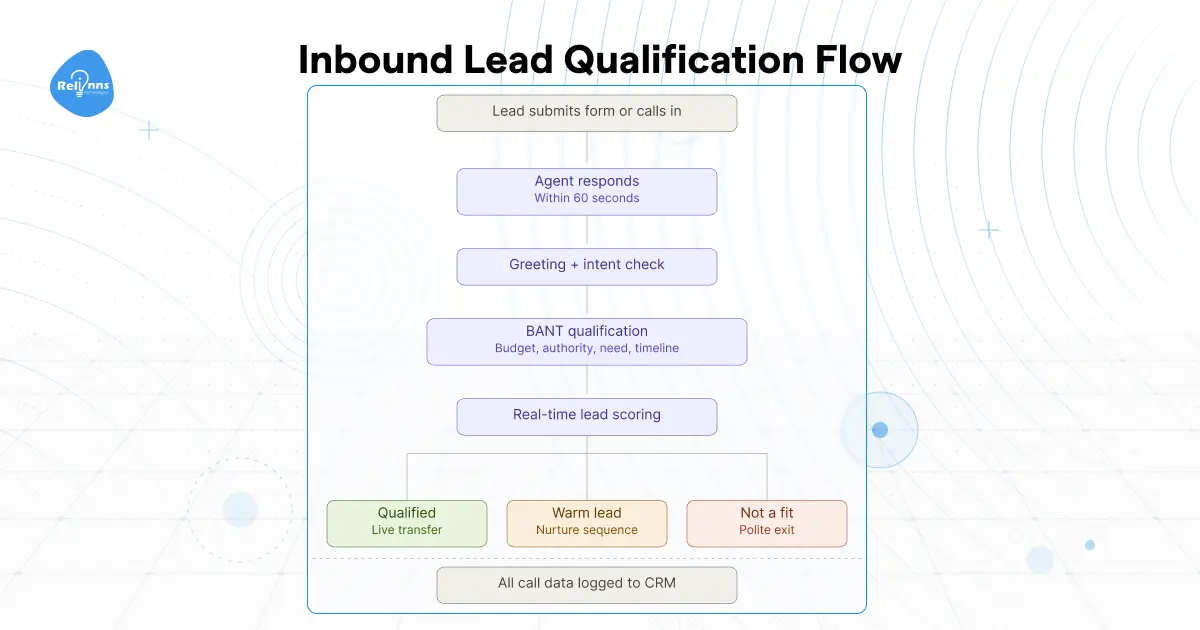
The inbound flow is the simpler of the two.
A prospect submits a form or calls in. The agent calls back within seconds, confirms intent, and runs BANT questions in conversational format. Not a script recitation. Just a call.
As the prospect answers, the agent scores in real time and routes automatically: qualified leads get transferred live or booked on a calendar, warm-but-not-ready leads enter a nurture sequence, and not-a-fit calls end cleanly. Everything logs to CRM automatically: answers, score, outcome, call recording.
The prospect already reached out. That's a warmer starting point. Inbound and outbound flows are structured differently for that reason. A voice agent for lead qualification here just needs to not waste that intent.
Voice AI customer service instincts apply, and a voice agent for lead qualification that sounds natural turns "interested" into "booked."
Outbound Lead Qualification Flow
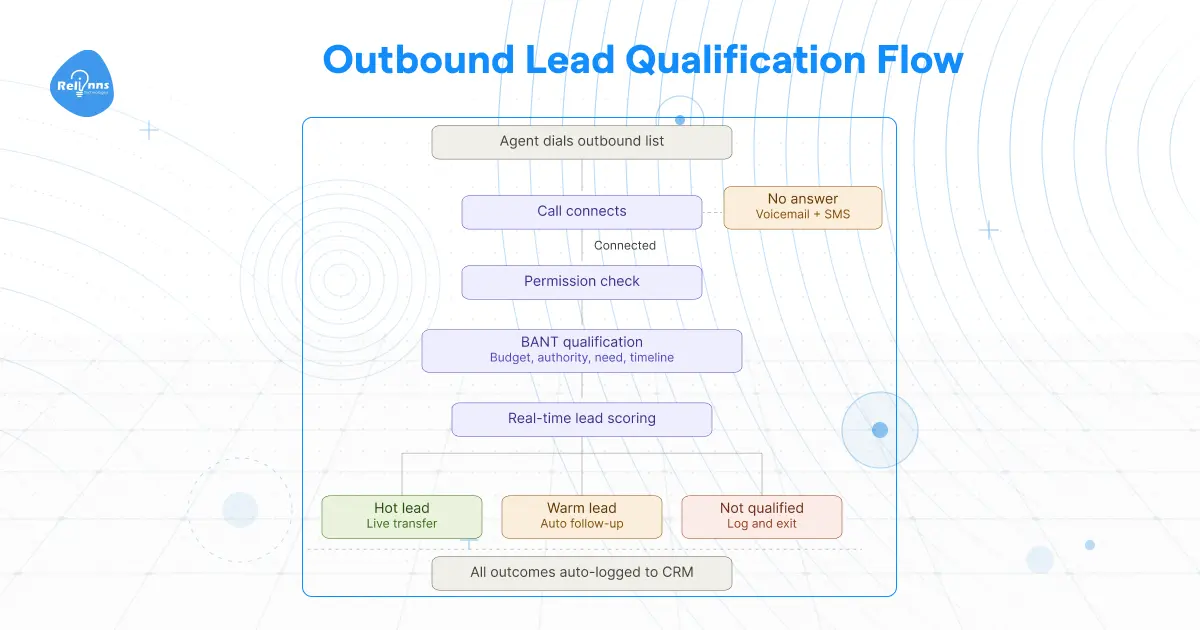
Outbound is harder. The prospect didn't ask for the call.
The agent dials a list: cold leads, aged contacts, event registrants, PPC form fills. It introduces itself, confirms the right person, then asks: "Is now a good time for two quick questions?" Running a voice agent for lead qualification outbound means earning attention before qualifying anyone.
Hot lead: live transfer with full context passed to the rep. No answer: voicemail plus automatic SMS. All outcomes log.
Some firms pair outbound calls with WhatsApp follow-up sequences, especially in GCC markets. Life insurance outbound qualification runs exactly this way. AI for lead qualification via outbound takes more prompt design work than inbound.
The opener is where most voice agent for lead qualification builds fail first. Review your inbound vs outbound logic before writing your script.
Easy Steps to Build a Voice Agent for Lead Qualification
If you want to build a voice agent for lead qualification, there's a full guide here. But the core process breaks down into five steps, and where most teams get stuck is almost always step two.
Step 1: Define what a qualified lead means for your business.
Budget threshold, company size, decision-maker role, timeline window. Write it down before touching any tooling. If you can't define a qualified lead in one sentence, the agent can't either. That's where the whole build starts.
Step 2: Design your conversation flows and prompts.
Map inbound and outbound separately. Write BANT questions that sound like a conversation, not a form. Cover objection-handling paths and fallbacks for when the agent doesn't follow a response. Prompt design is where most builds fall apart. The questions are too vague, the routing logic isn't specific enough, and the agent starts mis-scoring leads from call one. Read up on voice AI prompting before writing a single question.
Step 3: Choose your tech stack.
Which LLM you pick affects response quality and latency. WebRTC and SIP have different trade-offs depending on your infrastructure. Check platform options before committing to one provider.
Step 4: Build the knowledge base.
The agent needs product knowledge, FAQ answers, and objection responses. A weak knowledge base makes a voice agent for lead qualification start disqualifying leads it should be booking.
A thin knowledge layer is the most common reason deployments underperform in the first 30 days.
Step 5: Connect to CRM and go live carefully.
Map outputs to CRM fields. Set scoring thresholds. Run a pilot on 50-100 leads first. Listen to the recordings. AI for lead qualification only improves if someone watches the early calls and fixes the gaps before scaling. Then open up volume.
What You Should Be Aware Of? The Flip Side of AI for Lead Qualification
AI for lead qualification earns its place. But there are five things that trip firms up, and most don't surface until after go-live.
1. Compliance isn't optional.
In the US, TCPA requires prior express written consent before automated outbound calls go out. In Europe, GDPR applies. Skip the consent mechanism and you're looking at real legal exposure.
2. Regulated verticals need specific infrastructure.
A voice agent for lead qualification in healthcare captures patient data on the call. That's HIPAA territory. Insurance qualification calls handle policyholder data. Both require HIPAA-compliant infrastructure, not a standard API setup.
3. Prompt quality determines output quality.
The agent runs exactly the logic you give it. Vague questions produce meaningless scores. This is a design problem, not a platform one.
4. The build vs buy decision is real.
Off-the-shelf platforms get you live in days. Custom-built systems take 4-8 weeks but fit your workflow cleanly. The trade-off depends on how differentiated your qualification criteria are.
5. Handoff quality matters as much as scoring quality.
If the transfer from agent to rep is clunky, the qualified lead goes cold in 30 seconds. A voice agent for lead qualification isn't just a filter. It's the first impression before your rep picks up.
Final Word
Voice agents don't replace sales reps. They replace the part of the job reps shouldn't have been doing in the first place.
SDRs should be closing. A voice agent for lead qualification handles the filter. Your reps take it from there.
Relinns builds voice agents for lead qualification on Retell AI, CRM-integrated, 24/7, across Healthcare, Insurance, Logistics, and Ecommerce. If you're figuring out where AI for lead qualification fits in your pipeline, start with the right AI consulting partner and the right ML-backed voice stack. Book a demo to see it on a live call.