AI Voice Agents for Insurance: Use Cases, Tools, and ROI in 2026
Date
Aug 31, 26
Reading Time
11 Minutes
Category
AI in Insurance
Share


Quick Summary About AI Voice Agents for Insurance
- Voice AI for insurance resolves calls, legacy IVR only routes them. The technology difference is significant: real-time policy data access, adaptive questioning, live system updates, and post-call automation.
- The business case is arithmetic. Human agents cost $0.42 to $1.08 per minute. AI costs around $0.08 to $0.29. At meaningful call volumes, that gap funds the entire deployment and then some.
- FNOL is the hardest call type to automate because questions need to adapt mid-call by claim type. Platforms that handle this well are genuinely different from ones that don't.
- The 7 most widespread use cases are FNOL intake, policy servicing, renewals and lapse prevention, billing and payments, fraud triage, catastrophe surge response, and live agent assist.
- Integration depth determines whether AI resolves or merely deflects. Connect to policy admin systems, CRM, and billing platforms before going live.
- Compliance is non-negotiable. SOC 2, HIPAA, PCI DSS, TCPA, state disclosure rules, and full audit trails. Any platform without clear answers on all five isn't ready for regulated insurance.
- Custom-built solutions outperform configured SaaS at scale, in regulated markets, and wherever your workflows don't fit neatly into a vendor's template library.
A policyholder calls at 2am after a rear-end collision. Your agents are off. The call goes to voicemail. That policyholder starts shopping competitors by morning.
Scale that to hurricane season, and you're looking at 10,000 simultaneous FNOL calls overnight. No team absorbs that. And the math was already ugly before the storm: $0.42–$1.08 per minute, 15% annual turnover, six-month hiring cycles.
Customers want instant, 24/7, accurate service. Carriers can't staff it.
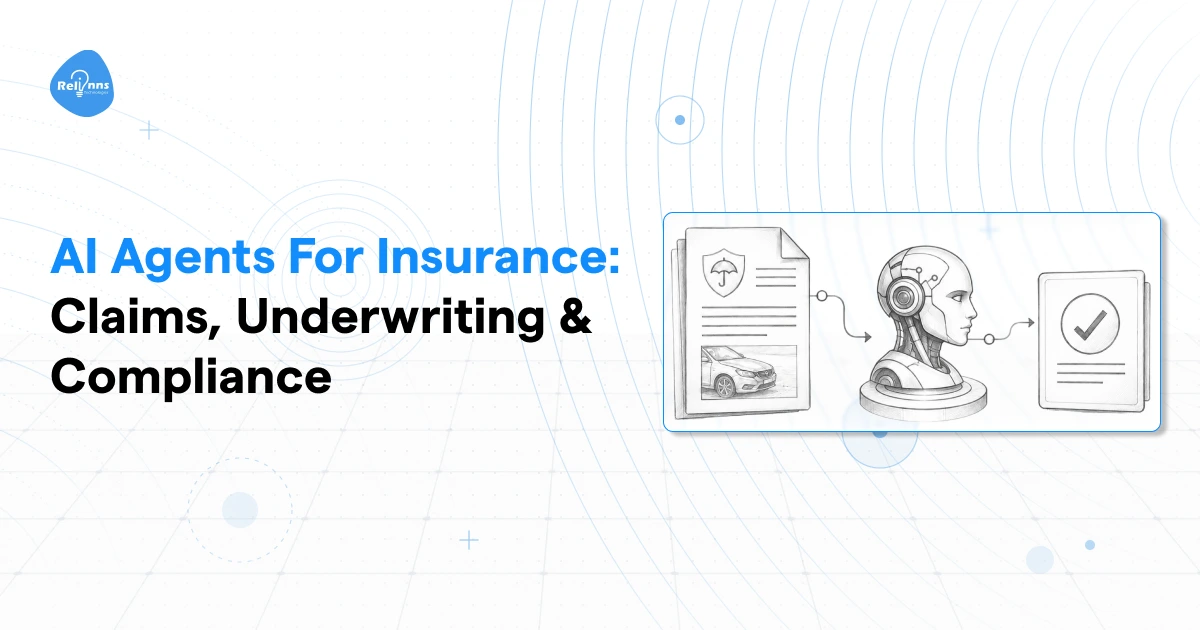
Voice AI for insurance is fixing this. This guide breaks down where AI voice agents create measurable value in insurance operations, from FNOL and claim intake automation to policy servicing, renewals, billing, and support-line automation. It also covers how insurers, brokers, and carriers should evaluate providers, compare platform types and deployment plans, and measure ROI before scaling voice AI across regulated workflows.
These capabilities overlap with AI voice agents for customer service, but insurance deployments require additional policy-system integrations, compliance controls, payment safeguards, and claims workflows.
Here's how.
What Is an AI Voice Agent for Insurance?
An AI voice agent is software that picks up the phone, understands what the caller actually means, pulls their policy data in real time, and completes the task. No menu trees. No "press 1 for claims."
The difference from IVR is simple: IVR routes calls, voice AI for insurance resolves them.
Legacy IVR hears "1" and transfers you. An insurance AI agent hears "I just hit a deer on the highway" and starts an auto claim, asks the right follow-up questions based on claim type, and routes to the right adjuster with a full transcript attached.
Under the hood of voice agent it's NLP understanding intent, ASR converting speech to text, an LLM reasoning through the response, and an integration layer talking to your policy systems live.
And voice still handles 53%+ of all insurance contact center interactions. That's not going anywhere soon.
An AI voice agent is built to understand intent, complete tasks, update systems, and escalate when needed. A voice bot usually follows narrower scripted flows, while an IVR mostly routes callers through menu options. General-purpose conversational AI can answer questions, but insurance voice AI needs policy access, compliance controls, claim workflows, and audit trails to resolve regulated calls safely.
Why Insurance Companies, Carriers, and Brokers Are Adopting AI Voice Agents
The business case isn't complicated. Insurance operations are under pressure from four directions at once.
- Staffing is broken. Hiring a claims rep now takes over six months. Annual turnover sits above 15%. You fill one seat and lose another before the new hire finishes training.
- The cost math doesn't work. Human agents cost $3 to $8 per call. Voice AI for insurance brings that down to around $0.42. At 10,000 calls a month, that gap is a budget line item your CFO will notice.
- Volume spikes are unpredictable and brutal. One hurricane. 10,000 simultaneous FNOL calls overnight. No human call center absorbs that. The most reliable AI voice agents for insurance scale instantly, with zero queue time, because there's no headcount ceiling.
And customers stopped tolerating hold times years ago. They want answers at midnight, claim initiation in under two minutes, and no transfers.
The compliance concern that held carriers back is also mostly gone now. Insurance AI agents read from the same policy data your human agents use. They can't go off-script. That's the answer your legal team has been waiting for.
Over 90% of insurers are actively investing in AI-driven service right now. The question isn't whether to adopt. It's which approach fits your operation.
The 5 Insurance Call Types AI Must Handle
Most conversations about voice AI for insurance jump straight to platforms and features. But before you evaluate any tool, you need to understand what your call center actually handles. Because not all insurance calls are equal, and the gap between them matters a lot when you're choosing what to automate.
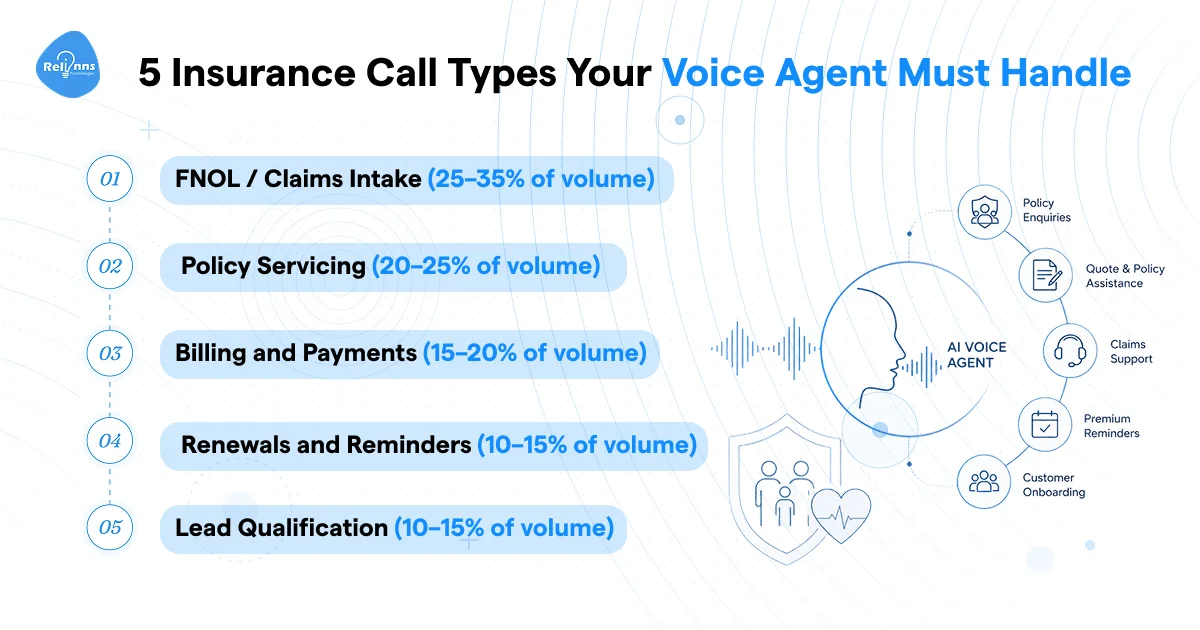
Here's how inbound volume typically breaks down:
1. FNOL / Claims Intake (25–35% of volume)
The caller just had an accident, a fire, a flood. The AI collects structured incident data, adjusts its questions based on claim type (auto vs. property vs. liability), assesses severity, and routes to the right adjuster. This is where insurance AI agents earn their keep.
2. Policy Servicing (20–25% of volume)
Coverage checks, address updates, adding a driver, requesting an ID card. Routine, high-volume, and almost entirely automatable.
For insurance brokers, the same workflow supports everyday service requests without adding pressure on account managers. The AI can handle certificate requests, check coverage details, collect endorsement changes, route claim status queries, send renewal reminders, and book time with an advisor when the request needs human review.
3. Billing and Payments (15–20% of volume)
Balance questions, payment processing, setting up instalment plans. Needs PCI-compliant handling. The most reliable AI voice agents for insurance handle this without storing card data in transcripts.
4. Renewals and Reminders (10–15% of volume)
Proactive outbound calls. Explaining premium changes, confirming renewal intent, processing payments. This is where insurance voice agent companies often show the clearest ROI.
5. Lead Qualification (10–15% of volume)
Discovery questions, eligibility screening, booking with an advisor. High value, often mishandled by generic bots.
Now, FNOL is the hardest call type by a significant margin. The caller is stressed, the conversation is emotionally charged, and the questions need to change mid-call depending on what the incident actually is. An auto accident requires completely different data than a burst pipe. Get the intake wrong and the adjuster works from bad information. That's not a service failure, it's a downstream claims problem.
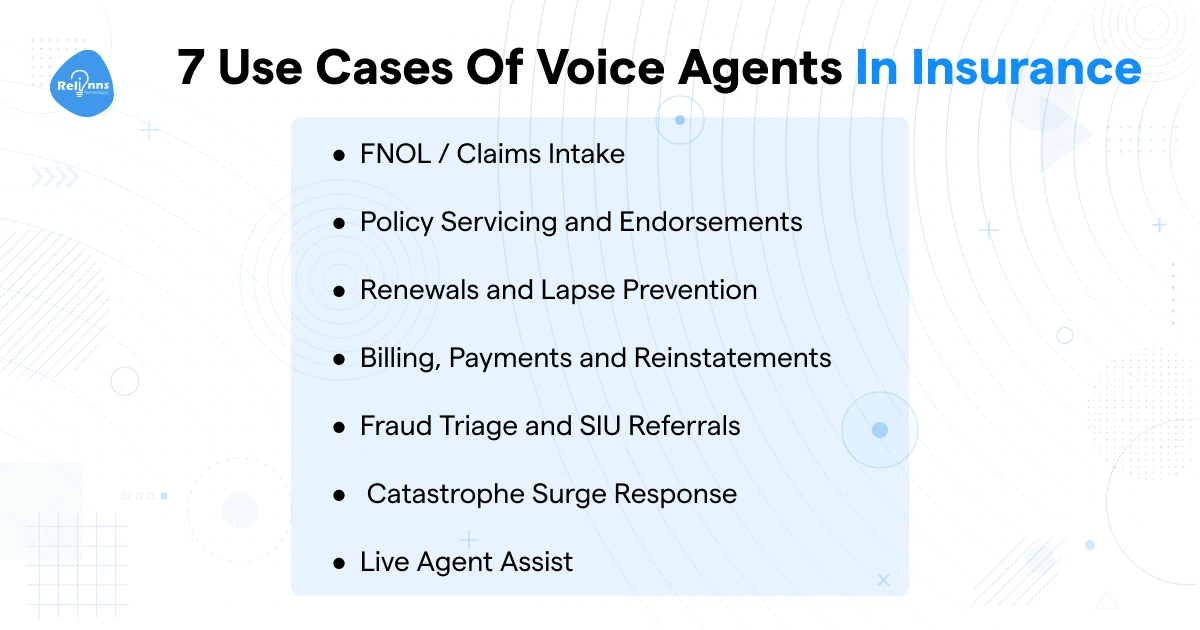
Top 7 Use Cases of AI Voice Agents in Insurance
Insurance AI agents are being deployed across nearly every touchpoint in the customer journey right now. Some carriers are starting with one use case, others are running four or five in parallel. Below are the seven most widespread applications where voice AI for insurance is delivering real, measurable results.
1. FNOL / Claims Intake
When a policyholder calls to report a loss, the AI picks up immediately, verifies their identity, and starts collecting structured incident data. The questions adapt mid-call based on claim type. An auto accident gets different questions than a house fire. The AI assesses severity, flags urgent cases, and routes to the right adjuster with a complete transcript attached.
The outcome: claims processing times drop by up to 70% when AI handles intake correctly. No missed data fields. No adjuster starting from scratch.
It also timestamps everything and logs consent checkpoints automatically, which makes your compliance team's life considerably easier.
2. Policy Servicing and Endorsements
Coverage questions, address changes, adding a vehicle, requesting an ID card. These calls make up 20 to 25% of inbound volume and almost none of them need a human agent.
The AI checks eligibility in real time against your policy admin system, makes the update, generates the document, and confirms it to the caller. Most insurance voice agent companies report 60 to 80% containment on policy servicing calls within the first 90 days.
3. Renewals and Lapse Prevention
This is where proactive outbound AI earns its money. The system identifies policyholders at risk of lapsing based on payment behavior and policy history, calls them before the deadline, explains any premium changes in plain language, and processes the renewal payment on the spot.
Carriers using AI for renewal outreach consistently report lower lapse rates and faster collection cycles compared to agent-led campaigns. And unlike an agent team, it runs at 2am without overtime costs.
4. Billing, Payments and Reinstatements
Balance queries, missed payment recovery, instalment plan setup, policy reinstatement after a lapse. The most reliable AI voice agents for insurance handle all of this with PCI-compliant payment infrastructure, meaning card data never sits in a call transcript.
Automated recovery workflows catch delinquent accounts before they escalate. Reinstatements happen instantly once eligibility is confirmed, with a full audit log generated automatically.
5. Fraud Triage and SIU Referrals
This one surprises people. AI doesn't replace fraud investigators, but it catches the signals they'd otherwise find hours later. During a claims call, the system cross-references behavioral patterns, claim history, and contextual inconsistencies in real time.
Suspicious cases get flagged and routed to your Special Investigations Unit with complete transcripts and risk scores attached. Early flagging means faster investigation and fewer fraudulent payouts slipping through.
6. Catastrophe Surge Response
A hurricane hits. 10,000 policyholders call overnight. Your contact center has 200 seats.
Voice AI for insurance absorbs the spike without queue buildup. The AI prioritizes urgent FNOL calls, handles policy status queries, sends proactive SMS updates to reduce repeat callers, and coordinates with repair vendors for faster resolution. No hold times. No missed calls. No reputational damage from a service failure during your most visible moment.
One regional carrier documented handling 4,000 FNOL calls in 48 hours post-storm with zero queue time after deploying AI. That's the real test.
7. Live Agent Assist
Not every call goes fully automated, and that's fine. For complex claims or emotionally difficult conversations, the best AI voice agents for insurance work alongside your human agents rather than replacing them.
The AI listens in real time, surfaces relevant policy information, suggests next-best responses, and flags compliance requirements as the conversation develops. After the call, it auto-generates a summary and action items. Agents handle more calls per shift, make fewer errors, and spend less time on after-call work. Average handle time drops. CSAT goes up.
Best Voice AI for Claim Intake Automation: Capabilities to Check
- Adaptive FNOL questions by claim type
- Identity verification
- Policy lookup
- Severity triage
- Adjuster routing
- Transcript and audit log
- Fraud/SIU flagging
- Post-call claim system updates
How AI Voice Agents Actually Handle Insurance Calls
Most people understand what voice AI for insurance does. Fewer understand what actually happens inside a call from the moment it connects to the moment it closes. So let's walk through it.
The phone rings. The AI picks up in under a second. It greets the caller, confirms identity through policy number or date of birth, and starts listening for intent. Not keywords. Intent. "I had an accident" and "I need to report a collision" trigger the same workflow.
Once intent is confirmed, the integration layer kicks in. The AI pulls the caller's policy data live from your policy admin system, checks billing status, and retrieves claims history. This happens in real time, not from a cached snapshot. That's what separates insurance AI agents from basic phone bots that read from static scripts.
For a billing query, the conversation resolves in two minutes. For FNOL, it gets more interesting.
FNOL calls use adaptive questioning. The AI starts with the basics, date, location, what happened, then branches based on claim type. An auto accident triggers questions about vehicle damage, injuries, and third parties. A property claim shifts to cause of loss, affected areas, and emergency services involvement. The questions change mid-call based on what the caller says. A human adjuster does this naturally. Good voice AI does it too.
When escalation is needed, the AI doesn't just transfer the call cold. It passes a full transcript, identified intent, collected data fields, and a severity flag to the receiving agent. The agent picks up knowing exactly what happened and what's already been captured.
Throughout all of this, consent checkpoints are logged, the call is recorded, and an audit trail is generated automatically. Your compliance team gets documentation without anyone lifting a finger.
After the call closes, the AI creates tasks, updates your CRM, generates relevant documents, and notifies the adjuster. The most reliable AI voice agents for insurance don't treat the call as the end of the workflow. They treat it as the start.
How to Choose the Best AI Voice Agent Provider for Insurance
Most carriers pick a platform based on a demo. That's how you end up with something that looks great on a scripted call and falls apart on your first live FNOL surge. Here are the criteria that actually matter.
1. Match your call volume to the right infrastructure: Under 5,000 calls a month, a fast no-code platform works fine. Between 5,000 and 200,000, you need something that handles traffic spikes without degrading call quality. Above 200,000, you're looking at enterprise-grade infrastructure with carrier-level uptime guarantees. The best AI voice agents for insurance at one scale are overkill or underpowered at another.
2. Know your technical capacity honestly: If you have an engineering team, you get more control and lower per-minute costs by building your own call logic. If you don't, a no-code platform with pre-built insurance templates gets you live faster. Neither is wrong. But picking the wrong one costs you months.
3. FNOL capability is non-negotiable: This is where most generic AI agents fail. You need adaptive questioning that changes by claim type mid-call, not a fixed script. Ask vendors specifically how their system handles a caller who starts with a billing question and pivots to reporting a new claim. The answer tells you everything.
4. Compliance architecture: SOC 2, HIPAA for health lines, PCI DSS for payment handling, TCPA for outbound campaigns, state-specific insurance disclosure rules. And audit trails for every conversation. A platform without a clear answer on all five of these is not ready for regulated insurance environments.
Health insurers must also account for the stricter PHI safeguards and clinical data controls required for AI voice agents in healthcare.
5. Integration depth: Voice AI for insurance that can't talk to your policy admin system, CRM, or billing platform can only answer questions. It can't resolve them. Ask for documented integrations with Guidewire, Duck Creek, Applied Epic, or whatever your stack runs on.
6. What happens after the call ends: Most insurance voice agent companies sell the conversation layer. Fewer automate what comes next: task creation, CRM updates, document generation, adjuster notification. If the workflow stops at hang-up, you're still doing manual work.
7. Setup speed vs. depth: Fast no-code deployment gets you live in days. Fully configured enterprise takes weeks or months but handles edge cases better. Decide which matters more for your first use case, then scale from there.
Here's how platform types stack up across these criteria:
| Criteria | No-Code Agencies | Mid-Market Platforms | Insurance-Native | Enterprise CCaaS | Custom-Built |
| Call Volume Fit | Under 5K/mo | 5K–200K/mo | 5K–200K/mo | 200K+/mo | Any |
| FNOL Adaptive Logic | Templates only | Configurable | Pre-built | Pre-built | Fully custom |
| Compliance Coverage | SOC 2 / HIPAA | SOC 2 / HIPAA / PCI | Full stack | Full stack | Full stack |
| Core System Integration | Basic CRM | CRM + billing | PAS + CRM + billing | Full enterprise | Built to spec |
| Post-Call Automation | Limited | Partial | Strong | Strong | Full |
| Setup Time | Days | Weeks | Days to weeks | Months | Weeks to months |
Custom-built voice AI for insurance outperforms off-the-shelf platforms on every criteria that actually matters at scale: integration depth, FNOL logic, compliance architecture, and post-call automation. Pre-built platforms make you fit your workflows to their limitations.
Purpose-Built P&C Insurance Voice AI vs General-Purpose Tools
A custom solution is built around how your operation actually runs. If you're handling serious call volume in a regulated market, a purpose-built AI agent will always outperform a configured SaaS product.
How to Deploy and Scale AI Voice Agents in Insurance
The carriers that get this wrong all make the same mistake: they start with FNOL. Here is how to deploy AI voice agents sustainably;
Don't. Start with billing queries or policy status calls.
High volume, low stakes, fast wins. Once your team trusts the system and your integration layer is proven, then move to complex call types.
Connect to your backend systems before you go live. Voice AI for insurance that can't access your policy admin system, CRM, or billing platform can only deflect calls, not resolve them.
That's a more expensive IVR. Integration first, deployment second.
Train on your actual call transcripts and policy documents. Generic templates produce generic results. Your callers use specific language, reference specific products, and have specific expectations. The AI needs to know that context before it takes its first live call.
The compliance step most carriers skip: TCPA consent documentation for outbound campaigns and state-specific coverage disclosure requirements baked into call scripts. Get your legal team to review call flows before go-live, not after your first complaint.
Once voice is working, extend the same agent logic to AI chatbots and WhatsApp Agents. You've already done the hard work of building the knowledge layer and integrations. Adding channels is straightforward at that point.
Track these KPIs from day one: automated resolution rate, voice containment, CSAT, average handle time, and cost-per-interaction. If you're not measuring containment weekly in the first 90 days, you're flying blind.
The common failure points, honestly: deploying before integrations are fully tested, skipping tuning after go-live when edge cases surface, and building no clear escalation logic so callers hit dead ends. All three are avoidable with a disciplined rollout.
The Future of AI Voice in Insurance
The shift that's already happening is from reactive to proactive.
Right now, most insurance AI agents answer calls. The next wave calls first. AI that identifies a policyholder whose renewal is 14 days out, checks their payment history, and places an outbound call to confirm renewal and process payment before the policy lapses. No agent involved. No manual campaign needed.
What makes this work is context. Future voice AI for insurance won't start a conversation cold. It'll access full policy history, claims records, payment patterns, and risk signals before the call connects. The conversation starts informed. That changes everything about how it sounds to the caller.
And then there's agentic automation. Voice becomes the front door. The caller reports a claim, the AI captures the data, and then autonomously completes the downstream workflow: updating the claims system, generating documents, notifying the adjuster, scheduling an inspection. Gartner projects agentic AI will resolve 80% of common service issues by 2029, cutting operational costs by 30%. That's not a distant prediction anymore.
The human plus AI balance is also settling into a clear pattern. AI handles volume, billing, status queries, renewals, and standard FNOL. Human agents handle fraud investigations, complex multi-party claims, and emotionally difficult conversations where judgment and empathy matter. Neither replaces the other. They divide the work sensibly.
The carriers that pull ahead in the next three years won't be the ones who deploy the most reliable AI voice agents for insurance the fastest. They'll be the ones who built systems that fit their specific workflows, compliance requirements, and customer base from the ground up. Off-the-shelf gets you started. Custom AI Solution gets you competitive.
If you're handling serious call volume and want voice AI built around your operation rather than adapted from someone else's product, that's exactly what Relinns builds. Book a consultation and we'll scope what's possible for your stack.