Can AI agents make outbound calls? The Whole Truth in 2026
Date
Aug 31, 26
Reading Time
8 Minutes
Category
AI Voice Agents
Share


TL;DR
- Outbound AI voice agents handle full conversations, not just automated dialing.
- Common uses include lead qualification, renewals, collections, confirmations, and reactivation.
- They automate dialing, conversations, qualification, routing, logging, and follow-ups.
- Compliance requires consent records, AI disclosure, DNC checks, and complete call logs.
- Start with a clean list, natural script, thorough testing, and gradual volume increases.
- Track contact rates, task completion, conversions, opt-outs, costs, and compliance flags.
Your reps aren't selling most of the week. Salesforce ran the numbers in 2024 and found reps spend 28% of their time selling. The rest goes to admin, dialing, and writing up the same call notes for the fifth time that day.
That gap is why outbound AI voice agents keep coming up in every RevOps conversation right now. And it's exactly the kind of work cold calling AI voice agents are built to take off your team's plate, freeing up time for calls that need a human. I'll walk through what outbound AI voice agents are, how they work, where they fit, and how to run one without tripping over a rule. That includes the line between outbound vs inbound voice AI, which matters more than people assume.
The FCC classified AI voice calls as artificial voice in 2024. What that means for your outbound strategy is more useful than it sounds.
The Outbound Problem Nobody Talks About Clearly
A human SDR costs $2 to $4 per dial once you factor in salary, benefits, and the manager reviewing their calls. Doubling call volume means doubling headcount. That's the whole playbook inside human-run outbound operations.
Picture eight SDRs doing 60 dials a day. At $3 a dial, that's $1,440 spent before anyone books a single meeting.
Cost gets the headline. I'd argue consistency is the bigger problem. Rep one sounds sharp on call ten. By call sixty, they're reading the script instead of meaning it, with no shared voice-agent performance metrics to keep anyone honest. That's the real gap once you look at how AI and human reps compare on outbound, not just the dial count.
And the CRM isn't much better. Reps log calls in batches at day's end, working from memory, and whatever skips a follow-up note disappears into the pipeline.
"81% of sales teams using AI saw revenue growth in 2024. Among teams without AI, that number drops to 66%."
Salesforce, 2024
This is the exact gap outbound AI voice agents are built to close. Cold-calling AI voice agents are already closing it, while most sales teams assume the slot is still theirs.
The cost problem is fixable. The scale ceiling is harder. That's where outbound AI voice agents come in. And it's where most teams get the explanation wrong.
What Outbound AI Voice Agents Actually Are (And What They Are Not)
This isn't the recorded-message robocall most people picture when they hear "AI is calling our leads now." That image (one track, hang-up before the third word) is wrong, and the numbers back that up. Gartner found 61% of B2B buyers prefer a rep-free buying experience as of 2024. And the tech caught up with that preference. Sub-800ms latency is the 2026 benchmark for response time, fast enough that the pause before the agent replies doesn't even register.
But the FCC puts AI voice calls in the same legal bucket as robocalls, both falling under "artificial voice" rules. Same label. I'd call this the most misunderstood fact in outbound AI right now: the legal label is the same, the capability is not.
Outbound AI voice agents hold real two-way conversations and handle objections as they come up, not off a script tree. Cold-calling AI voice agents build a fresh response for every call, based on what the prospect said moments earlier, not a pre-loaded line.
They aren't IVR systems, the press-1-for-sales kind. And they're not power dialers, since a dialer only speeds up dialing while a human still talks once someone picks up. The real difference, the one covered in voice bot vs voice agent, comes down to who's talking once the call connects: the AI, on both ends.
Under the hood, every outbound AI voice agent runs on the same three-step loop.
Speech-to-text catches what the prospect says as they say it. The LLM layer reads that for intent and tone, then writes the reply. Text-to-speech turns it into audio fast enough that nobody catches the seam.
Expert Tip: Sub-800ms latency is the 2026 industry benchmark for outbound AI voice agents. Below this threshold, the conversation feels natural. Above it, the prospect knows immediately.
Knowing what it is matters. Knowing where it works changes how you use it.
Where AI Voice Agents Are Running Outbound Calls Right Now
This isn't one use case stretched thin. It's a pattern. Outbound AI voice agents show up wherever a team is dialing the same kind of call, in the same way, hundreds of times a week.
Take lead qualification, the first row below. Convin documented a 10x jump in conversions from letting an AI agent pre-screen leads before a rep ever dials. That's the strongest argument for putting AI at the top of your funnel.
Look at the B2B rows here. That's not random. Cold-calling AI voice agents see the cleanest voice AI return on investment in B2B, mostly because the call reasons repeat themselves and the legal room to operate is wider than on the consumer side. Dormant lead reactivation is a good example. It revives a cold database without burning a single hour of rep time.
I've watched this play out across industries that don't share much else. Ecommerce outbound teams use it to chase abandoned carts and reorder nudges. QSR and restaurant chains run it for catering confirmations. And insurance operations lean on outbound AI voice agents for renewal and EMI follow-up calls that used to take up an entire team's morning.
The use case shapes the legal exposure. And the legal side is the one part most teams skip until it's too late.
Is This Legal? The Compliance Reality in 2026
The FCC settled this in February 2024 with ruling FCC-24-17. AI-generated voices count as "artificial or prerecorded voice" under the TCPA, same bucket as robocalls. Violations run $500 to $1,500 per call, not per campaign. Run cold calling AI voice agents through 10,000 unconsented numbers and watch that math turn ugly fast.
Then there's STIR/SHAKEN, the protocol carriers use to catch spoofed numbers. Get tagged as Spam Likely under it, and your connect rate craters before a prospect's phone even lights up.
Here's what trips up most B2B teams. The FTC's Telemarketing Sales Rule exempts business-to-business calls from Do Not Call rules. I think vendors oversell that exemption to close deals faster than they should. California and Florida run their own mini-TCPA rules on top of the federal one, and dialing someone's personal cell still needs consent, B2B reason or not.
The exemption follows the phone line, not your intent. Healthcare teams feel this most acutely, which is why HIPAA-compliant builds for healthcare deployments exist as a separate category, not a bolted-on checkbox.
Run through this before you launch your first campaign with outbound AI voice agents.
Compliance checklist:
- Written consent for any B2C consumer campaign
- Real-time sync with federal and state DNC registries
- AI disclosure within the first 3 seconds of every call
- Calls restricted to 8 am to 9 pm recipient local time
- Every call logged: timestamp, duration, outcome, opt-out status
- Opt-outs honored within 24 hours, the same baseline GDPR compliance for AI voice agents expects in Europe
None of that logging is busywork either. Recording timestamps and transcripts at scale means you're holding data that needs built-in PII and PHI redaction, not patched on after a client asks where their information went.
Expert Tip: Well-built outbound AI voice agents are often more compliant than human SDRs. They deliver every disclosure, never skip a step under pressure, and log each call without being asked twice. That consistency is also where real automated calling ROI comes from, since fines are the cost nobody budgets for until one lands.
Compliance is the floor. The teams scaling this well aren't just staying legal. They've built guardrails that enforce compliance automatically into the system, so it's impossible to break them by accident.
Running Your First Outbound AI Campaign (Without Getting Flagged as Spam)
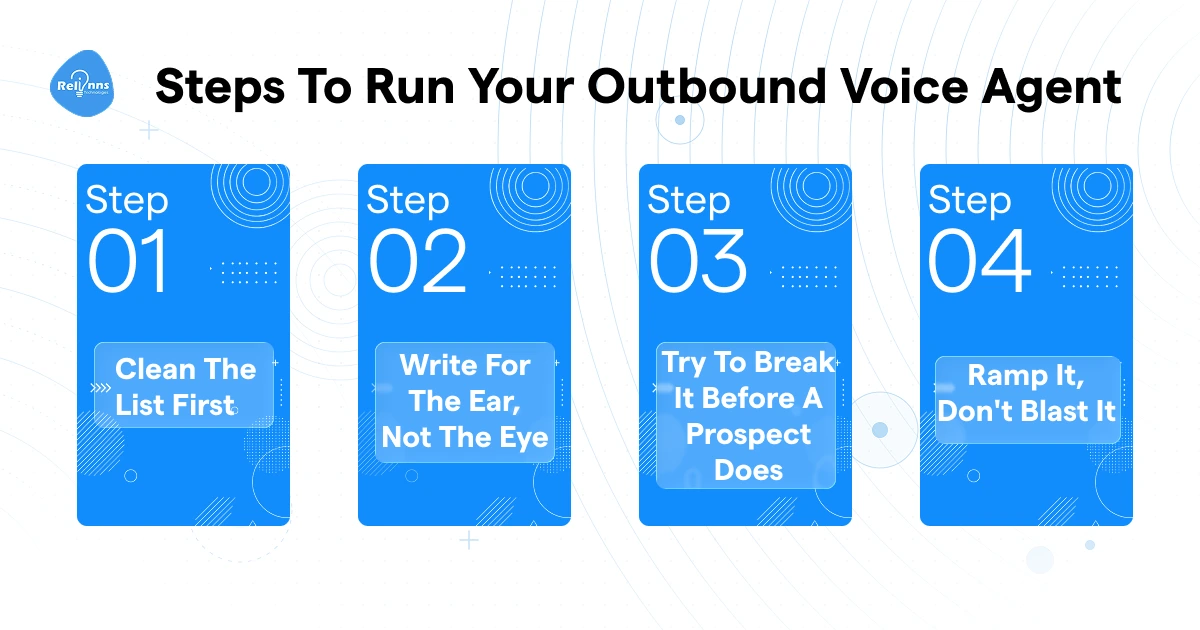
Four steps separate outbound AI voice agents that hold up in production from a pilot that quietly dies in week one.
Step 1: Clean the list first
Scrub for spam traps, verify that consent records exist, and cross-reference every number against DNC registries, both federal and state. Skip this and your numbers get flagged as spam within days. Sometimes hours.
Step 2: Write for the ear, not the eye
Short sentences, natural phrasing, no clause-heavy lines that read fine on a page and fall apart out loud. Building your first outbound AI voice agent means treating the script as half the build, not something bolted on after. Voice AI prompting is the actual skill that separates an agent that sounds human from one that sounds read.
Open every call the same way:
"Hi, this is an AI voice agent calling on behalf of [Company]. I'm a virtual assistant, not a human representative. I'm calling to [purpose]. This call may be recorded. Is now a good time?"
Step 3: Try to break it before a prospect does
Get your team on the phone with it. Throw accents, interruptions, and edge-case objections at it. If a teammate who doesn't know it's AI can't tell within 30 seconds, you're ready. Stress-test the agent properly, and that failure shows up in week one, not on a live call with a real prospect.
Step 4: Ramp it, don't blast it
Start at 50 calls a day to warm up your numbers with carriers. Volume on day one gets you tagged as Spam Likely before lunch. Stretch the ramp over two to three weeks instead.
If you're already seeing outbound calls flagged as spam, inspect number reputation, dialing volume, caller authentication, and complaint patterns before increasing campaign volume.
Expert Tip: Voicemails cut your future connect rate by 28% (Gong). Leave one only if it's short and specific with a callback number, or skip voicemail entirely once your connect rate is healthy.
Once it's live, this is what tells you whether cold calling AI voice agents are earning their place in your stack:
That last row is the real test. If the cost per meeting creeps past what your SDRs already cost, the AI voice agent cost savings you were counting on never materialize, and something upstream needs fixing before you add volume. These are the voice agent performance metrics worth checking weekly, not glancing at once a quarter. Measure ROI from the campaign properly and you catch the drift before it turns into a budget conversation nobody wants to have.
A few places I wouldn't point this at: existing enterprise accounts that need someone who remembers the last conversation, anyone mid-complaint, and anything touching emergency services. That last one isn't a judgment call. It's illegal.
Launch it and stay close to it. Monitor performance after launch, because outbound AI voice agents that worked in week one can quietly drift by week six.
The campaign sets up fast. What changes the results long-term is what's coming next in the technology, and it's already in early deployment.
What's Next for Outbound AI Voice Agents (And Why It Matters Now)
Three trends are already live in early deployments, worth knowing before you scope a vendor.
Emotion AI agents catch a shift in tone mid-call and adjust pace and word choice in real time, slowing down for confusion, trimming words for impatience. Multi-modal outreach runs one agent across voice, SMS, and email together, texting a calendar link mid-call without a human touching anything.
Multilingual outbound AI voice agents fit the same shift, since global teams need one agent fluent across markets, not five vendors stitched together. And predictive call timing skips time-zone math entirely, reading pickup history and email activity to dial when someone's statistically most likely to answer.
None of this is about cramming more calls into a day. Cold-calling AI voice agents aren't making outbound calls more frequent. They're making each call worth making.
Start with the full AI voice stack if you're building this for real, and check what outbound AI voice agents cost to run before you commit budget. Relinns builds outbound AI voice agents end-to-end, from script to the compliance layer.