AI Cold Calling: What It Is and How It Works in 2026
Date
Aug 31, 26
Reading Time
9 Minutes
Category
AI Voice Agents
Share


TL;DR
- AI cold calling increases dial volume and prevents follow-ups from being missed.
- Deployment options include assisted dialing, AI coaching, and fully autonomous calling.
- The workflow covers list verification, scripting, configuration, dialing, qualification, and CRM updates.
- AI handles prospecting volume, while humans remain better at discovery and negotiation.
- Performance depends on list quality, short scripts, clear handoffs, and weekly transcript reviews.
- Compliance requires consent checks, AI disclosure, DNC screening, opt-outs, and recording notices.
Cold calling generates more B2B pipeline than email and LinkedIn combined. Most SDR leaders know this. They also know their teams are burning out on it.
Reps dial 40 times a day. They connect with maybe two people. Follow-ups slip. Leads that needed eight touches got three. The cost per booked meeting climbs, and leadership's answer is the same: do more outbound.
That's the structural problem AI cold calling exists to solve. It changes what your reps spend their time on, not who they are.
But most buyers don't know what AI cold calling means in practice. Is it a tool? An AI cold calling bot that places calls for you? Something your dev team builds? The category is noisy. This blog is the clear version: what it is, how it works end-to-end, and how to get it running without five vendors and a compliance headache.
Before you evaluate any tool, understand what's broken. The numbers are next.
Cold Calling Works. Manual Cold Calling Doesn't.
Here's a stat that should make any SDR manager uncomfortable: it takes an average of 18 calls to connect with one prospect. Your rep is making 40 calls a day. That's two connections, on a good day.
And only 1% of those calls convert to a booked meeting. Not a closed deal. A first meeting.
The channel still works, though. 57% of B2B executives prefer a phone call when evaluating a solution. The problem isn't that phone outreach is dead. The problem is that the manual version of it is structurally broken.
Here's the part that stings more than the dial rate: according to SalesFrank's 2026 analysis, human SDRs follow up on fewer than 20% of leads after the first attempt. Not because your team is bad at their jobs. Because they're already on to the next dial, the next prospect, the next quota.
18 dials. One connected prospect. Your SDR is making 40 calls a day and still missing 80% of follow-ups. That's not a performance problem. It's a structural one.
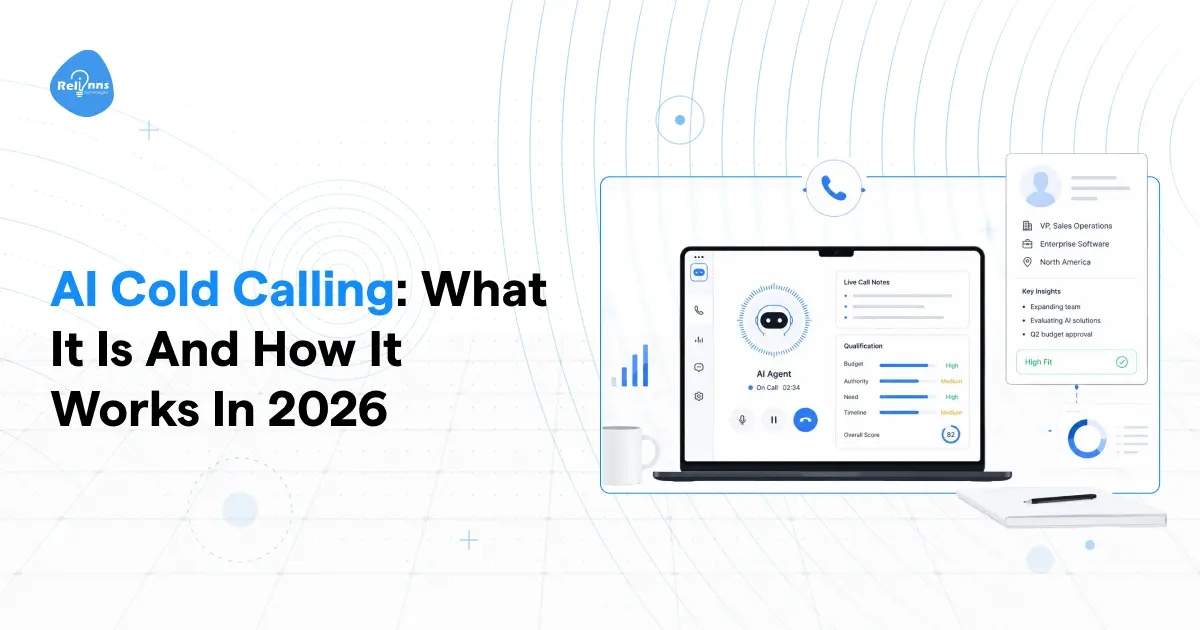
AI cold calling is the structural fix. Not "how do we coach reps to be better" but "how do we run the volume this channel actually requires without burning through people and budget." An AI cold-calling bot can make 200-500 calls a day, never skips a follow-up, and doesn't have off days.
That's the gap between AI and human agents most sales leaders miss. Companies replacing their manual SDR and receptionist workflows with AI aren't just cutting costs. They're running a volume the manual model was never capable of.
The follow-up failure rate hits harder than the dial rate. Here's what changed when AI entered the picture.
Everyone Thinks AI Cold Calling Means Robocalls. It Doesn't.
Most people hear "AI cold calling" and picture a robot voice reading a script at 1.5x speed. Something that sounds like a telemarketer, but worse.
That's not what this is.
Modern AI cold-calling systems usee." An actual two-way conversation.
The FCC's 2024 Declaratory Ruling clarified this. It classified AI-generated voice calls as "artificial" under TCPA, which pushed the whole industry away from simple autodialers toward conversation-first systems. So the technology got better partly because regulatory pressure demanded it.
But here's where the confusion still lives. The category covers three very different things, and buying the wrong one wastes money fast.
- AI-assisted dialing: your rep still talks; the ai cold calling bot handles parallel dialing, live transcription, and CRM logging automatically
- AI coaching: real-time in-call prompts and post-call analysis that help reps improve conversation by conversation
- Autonomous voice agents: AI conducts the full call end-to-end, no human on the line
Most companies running AI cold calling in 2026 are using the first two. Fully autonomous AI call center agents are growing fast, but have scope limits we'll cover later. Some teams are also experimenting with agentic AI approaches that go further than single-call automation.
Conflating these three modes is the most expensive buying mistake in this category.
The mode you deploy determines your ROI, your compliance exposure, and your outcome. The workflow for each looks completely different.
How AI Cold Calling Works: From Lead List to Booked Meeting
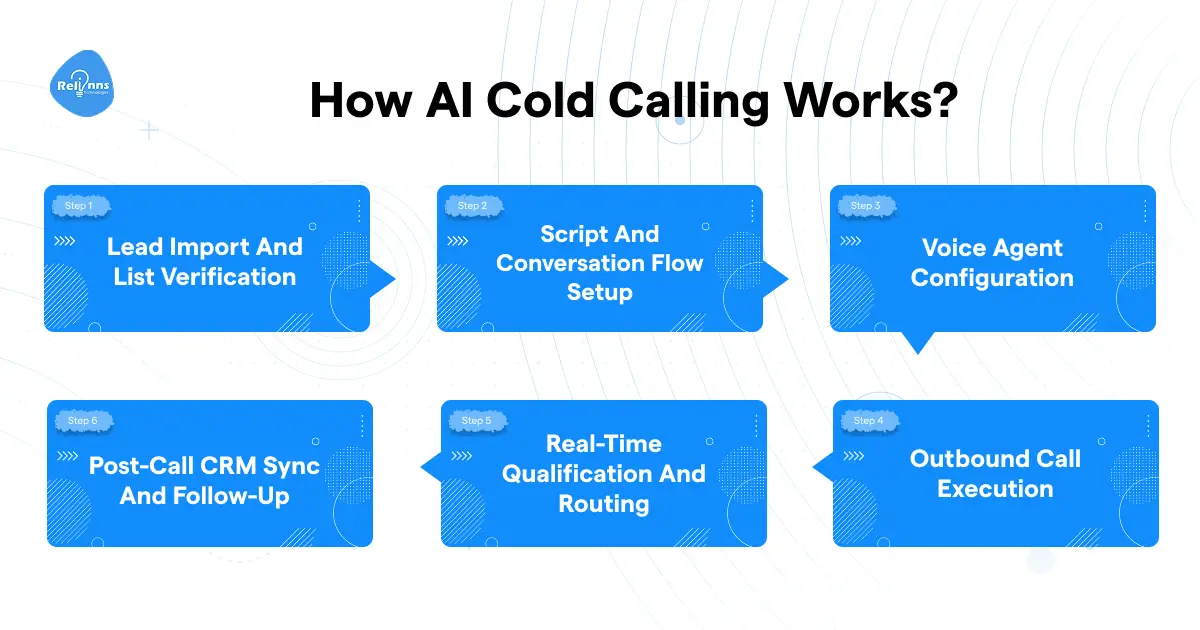
Most explanations of this skip straight to the technology. I'm going to skip that and walk you through what actually happens when you run an AI cold-calling campaign from start to finish.
Step 1: Lead Import and List Verification
You pull contacts from your CRM, an enrichment tool, or an inbound database. Before a single call goes out, you verify the numbers. This sounds obvious but most teams skip it. As Tomba's 2026 analysis puts it: "The bottleneck is rarely the dialer. It's the list." An AI cold calling system dialing bad numbers burns minutes just as fast as a human does, except at 10x the volume.
Step 2: Script and Conversation Flow Setup
Short opener. AI disclosure line. One reason for the call. One ask. That's it. You also define branching paths for common objections and set escalation triggers for when the call should go to a human rep. Keep the script tight. Long scripts break AI conversation flow.
Step 3: Voice Agent Configuration
This is where it gets interesting. Platforms like ElevenLabs give you 10,000+ voice profiles to choose from, including the ability to clone your own voice. Retell AI uses structured conversation flow nodes, which give you fine-grained control over how the agent responds at each stage. You set pacing, tone, and, if you're running multilingual outreach, language parameters too.
If you want to go deeper on how to build an AI voice agent from scratch, or understand the full voice AI stack underneath these platforms, those are worth reading separately.
Step 4: Outbound Call Execution
The agent places calls and runs a speech-to-text, LLM processing, text-to-speech loop with sub-100ms latency (per ElevenLabs' 2026 platform specs). The prospect hears a natural response with no noticeable pause. That latency number matters more than most buyers realize. Anything above 300ms starts feeling awkward in conversation.
The broader mechanics of AI agents making outbound calls also cover dialing permissions, answering-machine detection, retry logic, and telephony configuration.
The LLM layer underneath is what makes this different from a phone tree. It's reading context, not playing audio. And the telephony layer, which handles the actual call infrastructure, is a separate decision worth understanding before you deploy.
Step 5: Real-Time Qualification and Routing
The AI cold calling bot detects intent signals as the conversation moves. When a prospect hits the qualification threshold you defined, it either locks a calendar slot directly during the call or triggers a live transfer to a human rep with full context. No lead gets dropped between AI and human handoff. That transition is where many cheaper tools fall apart.
Step 6: Post-Call CRM Sync and Follow-Up
Transcript generated. CRM fields updated automatically. Follow-up sequences fire based on the call outcome. The system extracts structured data fields from the conversation: interest level, timeline, and budget signal. All of it logs without anyone typing a note. (SalesFrank's May 2026 breakdown covers this post-call automation layer in detail.)
The conversation layer gets the attention. But list quality decides whether the program actually scales. 30% bad numbers mean 30% of your AI minutes are wasted, and your number reputation is dinged.
The workflow is clean. The harder question is whether an AI cold calling bot can actually match a human mid-conversation. The honest answer depends entirely on which part of the call you're measuring.
The Honest Numbers: AI Cold Calling vs Manual Outreach
People want to know if AI beats their SDRs. That's the wrong question.
The right frame is which tasks AI should run and which your reps should own. Think of it as a routing map, not a scoreboard.
Start with the number that actually matters. At a 2% conversion rate, a human SDR making 40 calls a day books roughly one meeting every two days. An AI cold-calling system running 300 calls a day books 6. Same conversion rate. Six times the pipeline. (SalesFrank, May 2026)
That's not because AI is better at selling. It's because volume is the one variable your human team physically can't change without burning out or tripling headcount.
Here's how the full picture compares:
Sources: SalesFrank May 2026; Tomba 2026; Goodcall Feb 2026
The gaps where AI loses are real. Complex objections, multi-stakeholder discovery, and reading the hesitation in a CFO's voice. Those stay with humans. For a full cost breakdown of what running voice AI actually looks like per minute versus per rep, that's worth reading separately. And if you want a sharper view of how AI and human agents compare across customer-facing work beyond outbound, that covers the full picture.
High volume, zero burnout, perfect follow-up consistency. Sounds like the clear choice. But an AI cold calling bot has hard limits. Ignoring them is exactly how deployments go sideways.
Where AI Still Loses to a Human Rep
I want to be direct about this because most vendor content skips it entirely.
AI cold calling has real limits. Point an AI cold calling bot at a skeptical CFO mid-evaluation, and it will underperform a strong human rep almost every time. Complex enterprise discovery requires reading silence, catching the hesitation before someone says "I'm not sure about the budget," picking up on subtext that no NLP model consistently handles yet.
Same with deeply unstructured conversations. If a prospect wants to talk through their entire situation before they'll answer a single qualifying question, a human closes that gap better.
The AI books the meeting. The human closes the deal. That's not a workaround. It's the correct division of labor.
The winning model in 2026 is hybrid. AI cold calling handles the volume, follow-ups, and reactivation sequences. Your reps own the discovery, negotiation, and close. If you're figuring out whether to build custom AI or go with off-the-shelf, that routing decision shapes which architecture will actually fit your team.
Knowing where AI stops tells you exactly where to start. The best-run programs treat this as a routing map. Here's how to actually use it.
How to Use AI for Cold Calling
Running AI cold calling well isn't complicated. But most teams set it up wrong.
Start with your list, not your agent. ICP-filtered, duplicate-removed, phone-validated before you touch a single configuration setting. Bad numbers burn AI minutes the same way they burn rep time, just faster and at higher volume. (Tomba, 2026)
Write a tight script. Short opener, explicit AI identification line, one reason for the call, one ask. Add branching paths for your most common objections, and define clearly when the agent should hand off to a human. If your voice AI prompting is sloppy, the conversation breaks at the first real pushback. And if you want the agent to sound credible, read the tips on making an AI voice sound natural before finalizing the voice profile. (SalesFrank, 2026)
Segment by intent before you route. High-fit, high-intent accounts go to your human reps. Reactivation, confirmations, and lower-tier lead qualification go to AI. Don't mix them. (Salesforce Salesblazer, Dec 2025)
Review transcripts weekly. Patterns in objections become script improvements, and both your reps and your AI cold calling bot inherit the fix. (Akash Upadhyay, LinkedIn, Feb 2026)
One last thing: keep AI cold calling agents away from complex enterprise discovery. A multi-stakeholder deal needs a human in the conversation. And if you're running outreach across markets, multilingual AI voice agents behave differently enough to read the specific guidance before you scale. Latency also varies significantly by region, especially when dialing internationally.
Practices are clear, concept is clear. The part that ends programs isn't the strategy. It's the compliance layer most teams treat as a footnote.
Is AI Cold Calling Illegal?
Not in most B2B contexts. But the answer changes depending on how you configure it and who you're calling.
The FCC's 2024 Declaratory Ruling classified AI-generated voice calls as "artificial" under TCPA. For consumer outreach, that means prior express consent before dialing. B2B AI cold calling is different. Calling a business contact who fits your ICP is generally permissible, provided proper disclosure is made.
Before launching, review TCPA compliance requirements covering consent, disclosures, opt-outs, calling windows, and DNC screening.
A few non-negotiables, regardless of who you're calling:
- Disclose that the caller is AI at the start of every call. Multiple US states and EU regulations now require it. Not a suggestion. (SalesFrank, May 2026)
- Scrub against the DNC list before every campaign, not just the first one.
- In two-party consent states like California and Florida, all parties must be informed before you record. Build it into your opener. (Goodcall, Feb 2026)
The platform doesn't carry the legal risk. You do. An ai cold calling bot doesn't become compliant on its own. Your script, your list, and your disclosure language are what determine your exposure.
If you're running AI cold calling campaigns in regulated industries like healthcare or financial services, the requirements go deeper. HIPAA compliance, PII and PHI redaction, proper voice agent guardrails, and a solid privacy and security infrastructure all need to be built in from day one.
Compliance is handled at the script and list level, not the tech level. That means the right build partner matters as much as the right platform.
The Best Solution for AI Cold Calling
Two paths. Pick the one that fits your team.
If you have engineers on your team, two platforms lead the market in AI cold-calling infrastructure right now.
Retell AI powers 50M+ real-time calls per month and is on track to hit $50M ARR in 2025. At $0.07+/min, with SOC 2 Type 1 & 2, HIPAA, and GDPR compliance, it's built for technical teams who want full infrastructure control. Structured conversation flow nodes give you precise control at every stage of the call. (Wing VC/Yahoo Finance, April 2026; Orvera, Feb 2026)
ElevenLabs runs batch AI cold calling at thousands of parallel dials simultaneously, has 10,000+ voice options, including voice cloning, sub-100ms synthesis, and is SOC 2 Type II, HIPAA, and PCI DSS L1 certified. If voice quality and multilingual reach matter most, it's the stronger pick. (ElevenLabs, 2026; Cekura, April 2026)
If you'd rather skip the build entirely, Relinns deploys the ai cold calling bot stack in-house for you. Conversation design, telephony integration, CRM sync, compliance configuration, live transfer logic. One team owns it end-to-end. No post-launch vendor dependencies, no third-party support loop after delivery.
For comparisons before you shortlist, the top AI voice services, best AI consulting firms, and top AI contact center providers are worth going through first.
Last Word
The technology isn't the bottleneck. The decision is.
Most teams still running manual outbound aren't waiting on a better platform or clearer compliance rules. They're waiting on themselves. And every month of that wait is follow-ups that never ran, leads that went cold, and SDR budget burning at the same rate with the same results.
The gap between a verified lead list and a running AI cold calling program is weeks. Not a quarter. Not a six-month implementation cycle. Weeks.
If you want to understand how AI agents fit into your broader sales motion, or how inbound and outbound voice AI behave differently at scale, those are the right next reads.
And if you want your ai cold calling bot configured, built, and deployed without managing the build yourself, that's what Relinns does.