AI Agents That Finish the Work,Not Just Answer the Question
Stop moving data between tools by hand. Our AI agents run the workflow themselves and only pull you in when a real decision is on the line.


Most AI Agents Stop Where the Real Work Begins
They can answer questions, but they cannot complete the workflows behind them. Your team still connects systems, moves data, and closes every loop manually.
Answers Without Action
Your AI can explain an order status or refund policy. But when the customer needs something changed, a person must step in.
Disconnected Systems
Customer data, orders, logistics, and CRM records live across separate platforms. Employees become the bridge, copying information between them manually.
Delays That Cost Business
Leads go cold, onboarding stalls, and delivery issues escalate while tasks wait in inboxes or move between teams.
The problem is not whether AI can respond. It is whether AI can finish the job.
Why Build your AI Agent with Relinns?
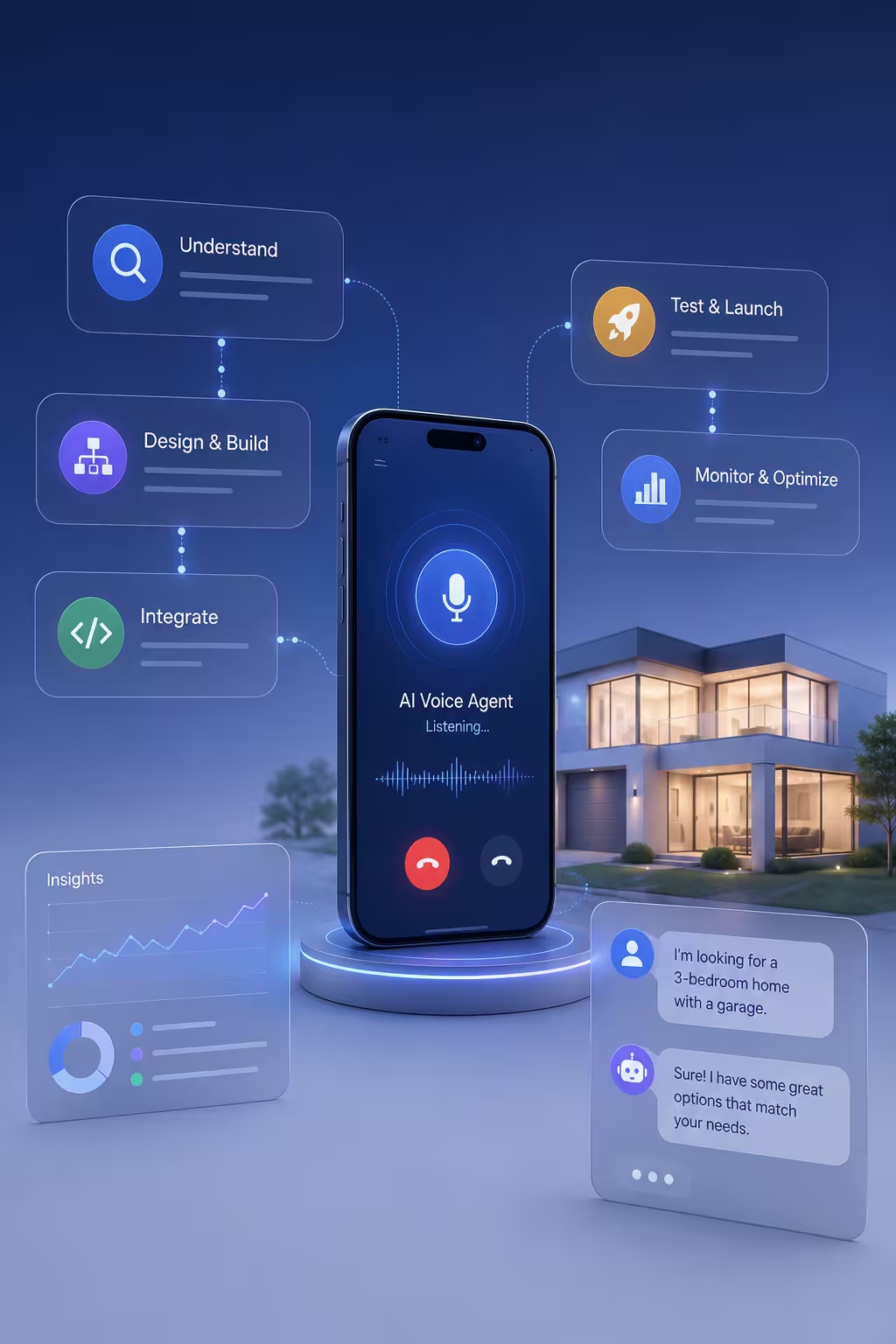
Relinns builds AI agents end to end: use case mapping, agent architecture, tool and API integrations, memory design, guardrails, testing against edge cases, deployment, and post-launch monitoring.
First Working Agent in 5 to 7 Days
Not a demo running on sample data. A working agent running on your actual tools, your actual APIs, handling your actual workflow.
Guardrails Built From Architecture
Approval limits, audit trails, and rollback paths are architecture decisions. Built in before the first line of code, not bolted on after something goes wrong in production.
Every Action Logged, Every Decision Traceable
You can see exactly what the agent did, which tool it called, and why it made that call. No black box between the task and the result.
Framework-Agnostic. No Vendor Lock-In.
LangChain, CrewAI, AutoGen, or a custom orchestration layer, whichever fits your stack. Every system we deliver allows model swaps and tool changes without rebuilding the pipeline.
Single Agent or Multi-Agent. Your Workflow Decides.
One agent when the task is linear. An orchestrated multi-agent system when the workflow branches across departments or tools. We scope to the job, not to what's easier to sell.
90-Day Post-Launch Support
Bug fixes, prompt tuning from real transaction logs, edge case handling, and weekly performance reviews for the first 90 days after go-live.
AI Agent Development by Industry
Agents earn their keep where a task spans multiple systems and someone is still stitching them together by hand. These are the industries where that gap costs the most, and where we have production builds running.
Healthcare
Multi-step intake and onboarding completion, care plan adherence tracking between sessions, pre-authorization and referral coordination across payer systems. HIPAA-aware architecture from day one, built to integrate with Epic, Cerner, and custom EHR systems.

Insurance & Finance

Supply Chain & Logistics

Ecommerce & Retail
What Makes Relinns the Right AI Agent Partner?
We don't propose six-month builds without proving the concept first. Every engagement starts with a working agent on your real workflow, scales on demonstrated results, and gives you a decision gate at each stage.

Production Track Record
We build on frameworks like LangChain and CrewAI when they fit. When they don't, we build the orchestration layer ourselves. Every agent ships with logging, error handling, and a tested fallback path before it touches live data.

No Vendor Lock-In
Framework-agnostic architecture. Swap models, tools, or orchestration without rebuilding the pipeline. Built on LangChain, CrewAI, AutoGen, or OpenAI's Assistants API, whichever fits your stack.

Working Prototype in 5 to 7 Days
A working agent on your actual tools, within the first week. Test it against real tasks before production scope is agreed. You see it work before you commit.

End-to-End Build
Use case mapping, architecture, memory design, integrations, guardrails, testing, deployment, monitoring. One team, full cycle.

Guardrails From Architecture
Approval limits, audit trails, and rollback paths built in from day one. Human checkpoints and permission scoping too. Nothing bolted on after something breaks.

90-Day Post-Launch Support
Bug fixes, prompt tuning from real logs, edge case handling. Weekly reviews for the first 90 days. After that, retainer-based monitoring and quarterly retraining.
How We Build Your AI Agent
Every engagement starts with your actual tools, your actual workflow, and your actual data. You see a working agent before production scope is agreed.
Discovery
We cover your current workflow, the systems the agent needs to talk to, the decisions that still need a human, and what success looks like in the first 30 days. No generic intake questionnaire.
Architecture Design
Agent framework, memory design, tool and API access, guardrails, and approval limits get mapped before a line of code is written.
POC Build
A working agent on your actual tools and a real slice of your workflow. Not a demo on sample data.
Integration and Development
Full build against your systems: APIs, CRMs, internal tools, and whatever else the agent needs to finish the task.
Testing
Edge cases, failure modes, and the paths where the agent should hand off to a human instead of guessing.
Deploy and Monitor
Live deployment with logging and tracing in place from day one, so every action the agent takes is visible.
Technology Stack
Discover the proven technology stack our engineers use to deliver reliable, production-ready AI agents.
 Large Language Models


GPT-4o, Claude 3.5 Sonnet, Meta Llama 3, Mistral, Google Gemini
 Speech Recognition (STT)

Deepgram Nova-2, OpenAI Whisper, Google Speech-to-Text
 Voice Synthesis (TTS)



ElevenLabs, Deepgram Aura, OpenAI TTS, Azure TTS, Amazon Polly
 Telephony & Orchestration



Twilio, Telnyx, SignalWire, WebRTC, SIP
 CRM & Scheduling



Salesforce, HubSpot, Microsoft Dynamics, Zoho, Pipedrive, Calendly, MS Bookings, Google Calendar
Agentic Frameworks
LangChain, LlamaIndex, AutoGen, CrewAI, OpenAI Assistants API
Security and Guardrails Built Into Every AI Agent We Build
Relinns delivers governed AI agents with permission scoping, audit logging, action traceability, and data handling controls aligned to global standards.
GDPR

Ensure GDPR-aligned agent workflows with consent handling, data minimization, and the right to erasure built into memory and logging systems.
PCI DSS

Support PCI-DSS-compliant agents for payment confirmation, refund processing, and billing workflows with secure handling and encrypted transaction logs.
HIPAA

Enable HIPAA-aligned healthcare agents with PHI protection built into memory, tool access, and integration layers. BAA-ready architecture.
SOC 2 Compliance

Achieve SOC 2-aligned agent deployments with secure architecture, encrypted storage, and consistent audit controls across every action the agent takes.
FERPA

Deliver FERPA-aligned education agents protecting student data through controlled tool access and permission scoping.
Human-in-the-Loop Controls

Approval gates on high-risk actions, configurable escalation thresholds, and full rollback paths for anything an agent does that needs a second look.
Frequently Asked Questions
How long does it take to build an AI agent?
A working prototype on your actual tools takes 5 to 7 days. Full production deployment, including integrations, testing, and guardrails, typically runs 4 to 8 weeks depending on how many systems the agent needs to touch.
What's the difference between an AI agent and a chatbot?
A chatbot answers a question and stops. An agent completes a task end to end, calling the tools and APIs it needs, and only stops to ask a human when a decision genuinely requires judgment.
Are your AI agents compliant with HIPAA, GDPR, PCI-DSS, and SOC 2?
Yes. Compliance requirements get built into the architecture before development starts, not added afterward. This includes PHI handling for healthcare agents, encrypted transaction logs for payment-facing agents, and consent-aware data handling across every deployment.
What happens if the agent gets something wrong?
Every agent ships with approval limits, audit trails, and rollback paths on high-risk actions. You define what counts as high-risk. Anything above that threshold routes to a human before it executes.
Can the agent integrate with our existing CRM and internal tools?
Yes. We build against your actual systems, Salesforce, HubSpot, internal APIs, ticketing tools, whatever your workflow already runs on, rather than asking you to adopt a new platform.
Do you build single agents or multi-agent systems?
Both. A single agent handles a linear task. A multi-agent system takes over when the workflow branches across departments or requires specialized agents working in sequence. We scope to what the workflow actually needs.
How does the agent hand off to a human?
Handoff points are defined during architecture design, not improvised at runtime. When the agent hits a decision outside its approval limits or confidence threshold, it pauses, flags the case, and routes it to the right person with full context attached.
Which frameworks and models do you build on?
LangChain, CrewAI, AutoGen, and OpenAI's Assistants API, paired with GPT, Claude, or Gemini depending on the task. The architecture stays framework-agnostic, so a framework or model change later doesn't mean a rebuild.
What support do you provide after launch?
90 days of bug fixes, prompt tuning from real transaction logs, and weekly performance reviews. After that, retainer-based monitoring and quarterly retraining keep the agent accurate as your workflow changes.
Do you build a proof of concept before full development?
Yes. Every engagement starts with a working prototype on a real slice of your workflow before we scope the full build. You see it work before you commit.