Human Receptionist vs Voice Agent: What’s the Real Difference?
Date
Aug 25, 26
Reading Time
8 Minutes
Category
AI Voice Agents
Share


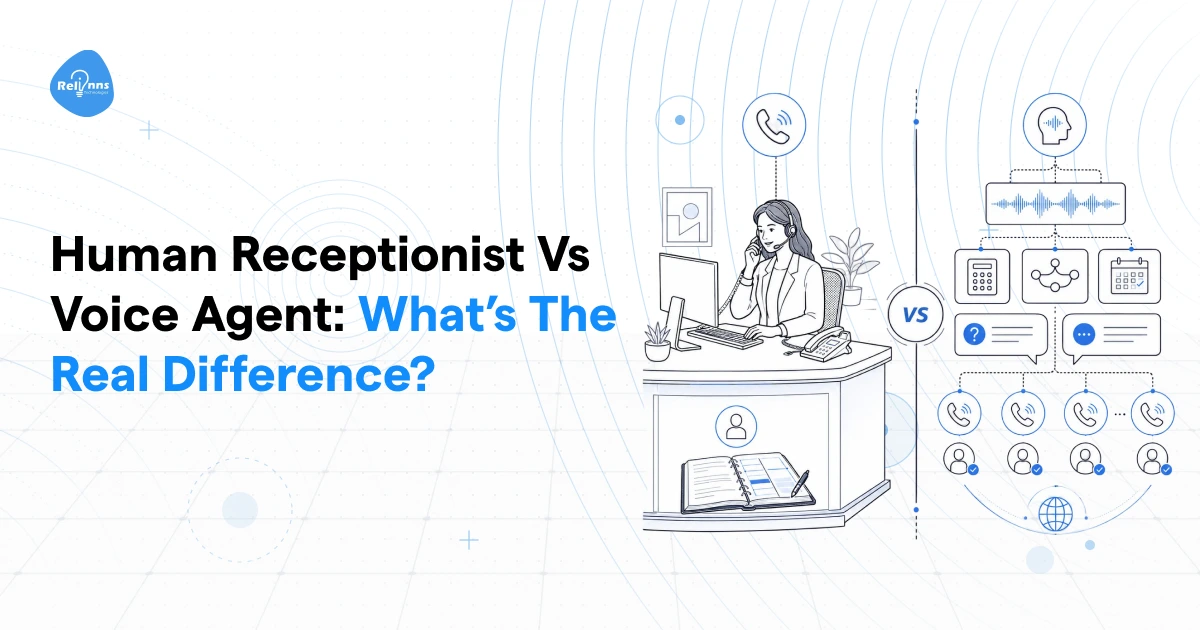
A caller rings your front desk at 11 PM. HVAC emergency. The new patient is trying to book before they change their mind. Voicemail picks up. They hang up and dial the next result on Google.
78% of customers buy from the first business that responds to their inquiry. Not the best-reviewed. The first one to answer.
That's the entire case for an AI receptionist.
This post covers what these systems are, how an AI voice agent vs human agent comparison shakes out in practice, and which four platforms are worth real consideration in 2026. If you're a COO or ops lead running a service business and the missed-call problem is costing you money, an AI receptionist may be the most direct fix available. This breakdown will help you figure out if that's true.
To set expectations: the evaluation and deployment process typically follows a few distinct steps.
First, define your requirements
Then evaluate your call flows and routine scenarios.
Next, you shortlist vendors, test them against your own data or pilot calls,
And then assess integration with your actual CRM and calendar systems.
Once a platform is selected, you'll go through setup, configuration, and a testing phase before going live. Knowing what’s ahead helps you budget your team’s time and keep implementation on track.
The missed call is the visible cost. What it masks is worse.
The $44,000 Problem Sitting at Your Front Desk
Most people think of a receptionist as a $35,000 line item. That's not the number. And it's why operations leaders who start pricing out an AI receptionist tend to have a bit of a moment when they see the full comparison.
Add payroll taxes and benefits (around 25% on top of base salary). Add the 8-12 sick days per year that still need coverage. Then factor in the churn: front desk turnover in service businesses runs at 50 to 75% annually, and replacing someone costs $5,000 to $15,000 in recruiting, onboarding, and lost productivity. The real number lands between $49,000 and $79,000 per year, fully loaded.
And that's before you factor in what a human front desk can't do. One call at a time. Business hours only. The quality varies depending on whether they had a bad commute that morning.
30 to 50% of inbound calls to service businesses come in after hours. They go straight to voicemail. The person you're paying $49,000 for isn't even in the building.
An AI receptionist runs 24/7, handles multiple calls at once, and doesn't have bad days. If you want to see how an AI voice agent compares to other options, the gap is larger than most operations leads expect.
The money is one problem. The mechanics of why a human setup breaks under volume is another.
What an AI Receptionist Actually Does (And How the Call Handling Works)
The common assumption is that an AI receptionist is a voice chatbot with a menu. Press 1 for billing, press 2 for support. That's not what these systems are in 2026.
Modern AI call center agents run a full processing pipeline. Speech-to-text converts what the caller says into text. Natural language understanding figures out what they want. An LLM generates a response. Text-to-speech delivers it back in a natural voice. And then the system takes real action. It books the appointment. It updates the CRM. It sends the follow-up SMS. All within the same call.
That's the full voice AI stack, and it's a different category from a phone tree.
The better way to think about an AI voice agent isn't "robot receptionist." It's replacing a single-threaded, 9-to-5 phone function with infrastructure that runs 24/7 and handles 50 calls at once. An AI receptionist doesn't just talk to people. It completes work. If you're curious about how these systems get built, the architecture is more approachable than it sounds.
What a modern AI call center agent handles:
- Answers on the first ring, every time, around the clock
- Book appointments directly into your calendar
- Qualifies inbound leads with structured questions
- Updates your CRM automatically after every call
- Transfers complex calls to a human with full context
- Sends follow-up SMS post-call
- Operates in 30+ languages without additional staffing
Knowing what it can do is the theory. Knowing how it holds up against a human in direct comparison is what matters.
AI Receptionist vs Human Receptionist: Where Each One Actually Wins
In terms of operational metrics, an AI receptionist wins in almost every quantifiable dimension: cost, availability, consistency, and the ability to handle 50 calls at once. The table below isn't closed.
But humans still hold real ground in one specific area: emotional complexity. When a caller is upset, asks a sensitive question, or hits an edge case the system wasn't trained on, a skilled human reads the room in ways AI can't yet match. Any vendor who tells you otherwise is overselling.
What the 2026 data shows: AI CSAT scores hit 4.2/5.0, human receptionists sit at 4.4/5.0. A 0.2-point gap. In 2024, that gap was 0.8 points. It's closing.
In a blind test by Tested Media in March 2026:
"73% of callers couldn't identify whether they were speaking to an AI or a human. Those who guessed 'AI' did so because of response speed, not voice quality."
Two things worth flagging. Modern AI voice agents are getting better at detecting angry callers in real time and adjusting their approach on the fly. And for healthcare, insurance, or any regulated industry, there are specific requirements around HIPAA-compliant deployments and voice agent data handling that apply regardless of which model you run.
For most service businesses, the question is: what percentage of your calls are routine? If it's 80% or more, an AI receptionist handles the bulk of your volume with better consistency and a fraction of the cost. The 20% that need a human should get one.
The table tells you what's theoretically possible. These three case studies show what actually happened.
Top 4 AI Contact Center Platforms in 2026
These four made the list because they have documented enterprise deployments, real customers, and the integration depth an AI receptionist needs to do useful work in production. If you want a broader list of AI voice platforms, that exists. But for a real buying decision in 2026, these are the ones worth your time.
Retell AI
This is where I'd start most service businesses looking to deploy an AI receptionist fast. It's built for production from day one, not demos.
The standout is latency optimization. Retell runs at a sub-800ms response time, which is the threshold where a conversation stops feeling like a recording. When a call needs to be escalated, it is handed off to a human with a full conversation summary already waiting. No caller has to repeat themselves.
CRM and calendar integrations are tight. Pricing is usage-based, which means costs scale with actual call volume rather than a flat fee you pay regardless of usage. Track record is strong in insurance deployments, healthcare, and customer service. And if making the voice sound human on calls matters to your brand, Retell's voice layer handles this better than most platforms in this category.
Real-world proof: the Everise deployment from Section 4. 65% ticket containment, zero wait time.
Best for: Service businesses wanting production-ready deployment with CRM depth and documented enterprise results.
PolyAI
PolyAI is a contact center infrastructure for large enterprises. Not for the mid-size team figuring out their first deployment. This is for organizations that run 1,000+ calls per day and have contractual uptime requirements.
Both the Atos and Hopper deployments from Section 4 ran on PolyAI. The reason Hopper works is its knowledge-base architecture. PolyAI uses RAG to pull from existing documentation in real time during calls, enabling the AI voice agent to handle complex, multi-turn queries without a rigid script. It also performs well for logistics and fulfillment operations where query complexity is high.
Pricing is an enterprise contract. If you're not at the scale where that makes sense, it won't.
Best for: Large organizations with mandatory uptime, high daily call volume, and inquiry profiles that go well beyond standard FAQ.
Vapi
Vapi is for technical teams. It's not a managed product. It's infrastructure.
You pick your own LLM for voice deployments, your own voice model, your own telephony protocol (WebRTC vs SIP). Every part of the stack is composable. If you have in-house developers and want to build exactly the call logic you need rather than fit a vendor's template, Vapi gets you from zero to working prototype faster than anything else on this list.
That control has a cost, though. Conversation design and prompting are entirely your responsibility. So is testing and reliability validation before you go live. Plan for that work upfront.
Pricing is usage-based with a low entry point, which makes it attractive for agencies managing multiple client builds.
Best for: Dev teams that need full architectural control and have the capacity to own configuration and testing end-to-end.
Bland.ai
Bland is built for outbound at scale. That's a different category from an inbound AI receptionist, and it's worth making the distinction clear.
If you're running EMI reminders, appointment confirmation campaigns, or lead qualification at scale, Bland runs thousands of simultaneous outbound AI calling sessions with consistent adherence to script. Works well for ecommerce recovery campaigns and QSR order confirmation at volume. Pricing is per minute and among the most competitive for outbound-heavy use cases.
The Gap Between Picking a Platform and Getting It Right
The platforms above are real. The results are real. But there's a distance between "platform exists" and "deployment that works in your specific operation."
Getting an AI receptionist live isn't just signing up for Retell or PolyAI. It's building the knowledge base correctly so the agent doesn't fail on edge cases. It's mapping your call flows so escalations happen at the right moment, not too early and not too late. It's integrating with your actual CRM, your calendar, your existing phone infrastructure. And then testing it against real call patterns before a paying customer hits a problem.
Most teams underestimate that gap. And most platform vendors won't close it for you.
Relinns builds production AI voice agents on these exact stacks, Retell AI for most enterprise deployments.
The difference isn't the platform. Its configuration depth and knowing where deployments break before they go live.
Across healthcare, insurance, and logistics clients, the failure patterns repeat: knowledge-base gaps that cause the agent to give incorrect answers, escalation logic that routes too aggressively, and integrations that work in testing but fall over under real-world call volume. Having solved these problems across enough deployments means there's now a playbook for them.
If you're evaluating an AI voice agent for your operation and want to talk to someone who has deployed these platforms at enterprise scale, that conversation is worth having before you sign with anyone. See how Relinns approaches AI voice agent deployments.
AI-Only, Hybrid, or Human-First: The Right Model for Your Operation
Most people overthink this. It comes down to one number: what percentage of your calls are routine?
Most operations land on a hybrid. An AI receptionist handles 80% of the volume, and humans take the 20% that genuinely need judgment. That split reduces cost without creating friction for the callers who matter most.
Relinns builds and deploys production-ready AI voice agents on Retell AI for enterprise clients in healthcare, insurance, and logistics. If you're evaluating whether an ai receptionist fits your operation, it's worth a conversation with someone who's already deployed these systems at scale before you commit to a platform.
Frequently Asked Questions
Will callers know they're talking to an AI in 2026?
73% of callers in a 2026 blind test couldn't identify the AI (Tested Media). Those who guessed correctly noticed response speed rather than voice quality. If that gap matters to your brand, there are specific ways voice agents are designed to sound human on calls that further close it.
Is an AI receptionist HIPAA compliant?
With correct platform configuration and a signed BAA, yes. Retell AI and PolyAI both support HIPAA-compliant AI voice agent setup. But it's not automatic. Compliance lives in how you configure data handling, not just which platform you pick.
What does it cost to deploy?
The full-year cost for an AI receptionist ranges from $1,700 to $9,200, depending on call volume, compared with $49,000 to $79,000 for a fully loaded human front desk. Managed deployments take 1 to 2 weeks to go live. See the detailed AI voice agent cost breakdown for the full numbers.