How AI Voice Agents Detect Angry Customers: De-Escalation Steps
Date
Sep 02, 26
Reading Time
8 Minutes
Category
AI Voice Agents
Share


Key Takeaway
- AI voice agents de-escalate angry callers because they never become defensive or emotionally reactive.
- Angry customer calls cost up to three times more and lead to rapid customer loss after a single bad experience.
- Voice agents detect angry customers by reading pitch, speech pace, repetition, and abrupt silences together in real time.
- A clear four-step sequence; acknowledge, reflect, own, act—turns frustrated calls around and reduces agent burnout.
The assumption most ops leaders carry into their first demo is that angry callers will break it. The bot will loop. The customer will escalate. You'll end up with a worse outcome than if a human had just picked up the phone.
That assumption is wrong.
AI voice agents don't de-escalate frustrated callers because they're emotionally smart. They do it because they're architecturally incapable of getting defensive. The system doesn't get tired on call 200. It doesn't match a caller's aggression. It doesn't carry tension from the previous call into this one.
The difference between a system that holds under pressure and one that breaks is architecture, not empathy.
How voice agents detect angry customers before a conversation fully derails is a technical question with a specific answer. Anger recognition in voice AI flags frustration in the first 10 to 15 seconds of a call. But whether voice agents detect angry customers early enough to act on it depends entirely on how the detection pipeline was designed.
What signals cross the wire? And how does the system act on them fast enough to matter?
The Real Cost of Angry Customers
The real cost isn't the call itself. It's everything that happens after.
Angry calls cost 3x more to handle and run 3x longer than normal interactions. A contact center taking 4,000 calls a day with 20% angry-caller share absorbs that multiplier across hundreds of interactions daily. Escalation rates on those calls sit about 13x higher than on standard ones. You're not just paying more per call. You're paying for a chain of follow-on actions that compounds the original cost.
CSAT scores on escalated calls drop hard. And the downstream effect is real: 96% of customers will walk away from a company after a single poor service experience. Not multiple bad experiences. One.
Here's the part most teams misdiagnose. They see high angry-call volume as a training problem. It's not. It's a design problem. The agents handling those calls aren't under-skilled. They're under-supported by a system that puts them in the path of every frustrated caller as first responder.
The failure starts earlier in the chain. When customer service operations have no early warning layer, voice agents detect angry customers too late, after hold time has already made things worse. And when voice agents detect angry customers before frustration peaks, the cost curve changes. Anger recognition in voice AI is what makes that early detection possible.
The cost is quantifiable. The cause is less obvious. And it starts with what human agents are actually being asked to absorb.
Why Do Human Agents Sometimes Fall Short While Handling Angry Customers?
Every ops leader I've spoken to has tried the same fix first. More training. Better scripts. Empathy workshops. Role-play sessions for difficult callers.
It doesn't work. Not because the training is bad, but because the problem was never the agent's skill.
Here's what actually plays out. An agent starts Monday fresh. By call 10, they've absorbed two billing disputes, one cancellation threat, and a caller who told them exactly what they think of the company. Emotional labor accumulates across a shift in a way no amount of coaching prevents. The script they learned in the classroom dissolves under real-time pressure because humans are wired to match the energy coming at them. Angry caller? Defenses go up. That's not unprofessional, it's just how people work.
Then there's the structural piece. When a call does escalate, the customer sits in a queue waiting for a supervisor. That wait makes them angrier. By the time a manager picks up, the situation is worse than when the original agent flagged it. Intervention at that point is always reactive. There's no pre-emptive layer in the traditional model.
The system puts human agents in the path of every frustrated caller whether the situation requires a person or not. That's the design flaw.
It's also why how AI voice agents compare to human agents matters so much here. When voice agents detect angry customers before frustration fully peaks, humans step in only when they're actually needed. Anger recognition in voice AI is what makes that selective routing possible; the system catches the signal early, so your front-line team isn't absorbing every difficult call by default.
When voice agents detect angry customers consistently, your best people stop spending their day in emotional triage.
Remove humans from that first-responder position and the dynamic changes entirely. But only if the system replacing them can actually read the room.
How Do Voice Agents Detect Customer Emotions and Sentiment?
Most people picture sentiment detection as some kind of keyword scanner. Swear word detected, flag raised. But if that's all it were, the system would miss most angry callers entirely. The real question is what signals cross the wire before a conversation fully breaks down.
The Signals That Indicate Frustration
Anger doesn't announce itself cleanly. It shows up as a cluster of signals firing together, and a well-built system reads all of them at once.
Pitch shift is usually the first thing that changes. Under stress, the human voice rises in frequency. You don't have to say anything hostile for that signal to register. Pace changes too. Frustrated callers speed up, words running into each other as agitation builds. Resigned callers slow right down, which is its own kind of warning sign for the person who's already mentally checked out.
Then there's word choice. Loaded language, cancellation threats, comparative complaints like "the last person I spoke to told me something completely different." These aren't just keywords. They're intent signals. And when a caller starts repeating the same problem they've already described, that repetition tells the system the person feels unheard, which is its own escalation trigger.
Abrupt silences mid-sentence, or a caller talking over the agent before it finishes, both register as rising frustration too.
These moments also depend on interruption handling in voice agents, since the system must distinguish frustration-driven interruptions from ordinary conversational overlap.
For voice agents to detect angry customers accurately, the system reads all of these simultaneously, not one at a time. That's the difference between catching a problem at 30 seconds and catching it at 3 minutes. This kind of emotional cue recognition is what separates functional anger recognition in voice AI from systems that only react after things have already gone sideways.
And how the agent responds to those signals depends heavily on how natural the voice output sounds; a robotic reply to an already-frustrated caller makes things measurably worse.
The Real-Time Detection Pipeline
So what's actually happening under the hood?
Call audio hits a streaming speech-to-text layer first. Deepgram and Whisper are the common choices, producing a transcript in under 200ms. Fast enough to work inside a live conversation. From there, an NLU layer extracts intent, entities, and tone markers embedded in the transcript itself.
Then the LLM takes the full conversational turn and runs a sentiment pass. Not a keyword scan. A full-context read. The score updates every few seconds throughout the call not as a post-call summary sitting in a dashboard nobody checks. The system knows the caller is getting angrier in real time, while there's still something to do about it.
Those score updates trigger behavioral rules in tiers. Above the threshold, the agent runs normally. Drop below a set point and it shifts into an acknowledgment-first mode validation before resolution. Drop further and the full de-escalation sequence activates. Drop to the floor and it flags for human handoff, with context already packaged and ready.
The transport layer matters here audio arriving over a degraded or high-latency connection drops transcription accuracy, which cascades directly into detection quality. And the LLM powering the sentiment layer isn't interchangeable. Model choice directly affects how well the system reads ambiguous emotional states, the ones that don't come with obvious signals.
The whole pipeline only holds if it's fast enough. Sub-second response thresholds aren't just a user experience consideration they're what make real-time frustration detection useful on a live call rather than decorative.
Voice agents detect angry customers through this pipeline continuously, across the entire conversation. That's the architecture. Detecting the signal matters. What the system does with it in the next 3 seconds is what separates a recovered call from a churned customer.
Step-by-Step Implementation Guide
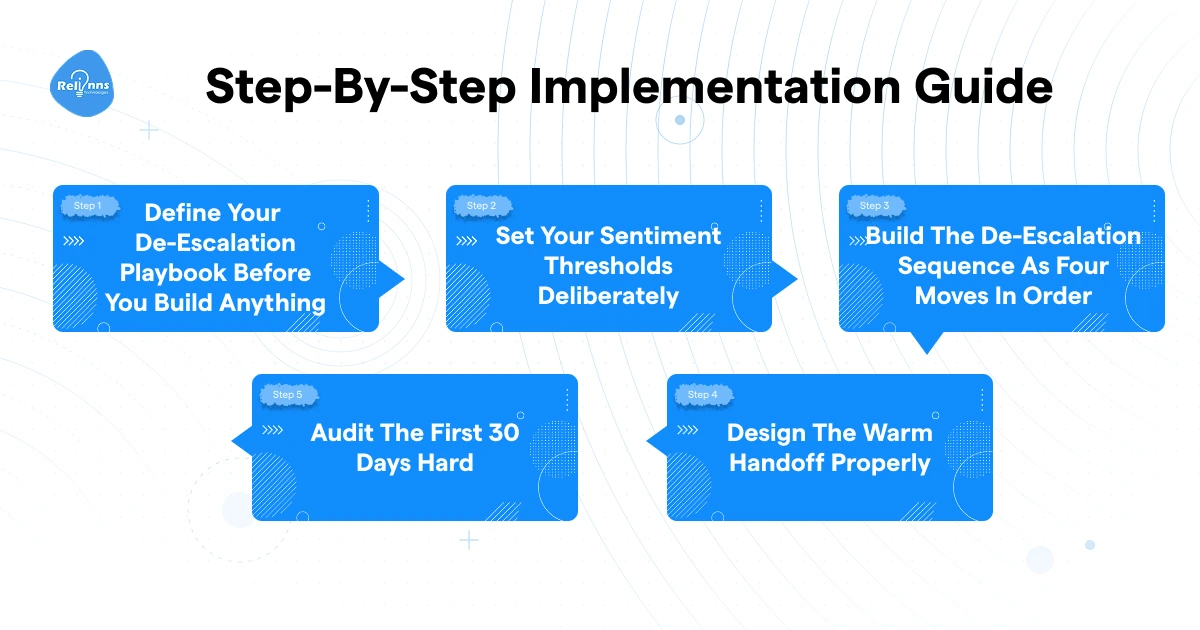
Getting this right isn't about flipping a switch. There's a specific order of operations that matters, and skipping steps early creates problems you'll spend months untangling.
Step 1: Define your de-escalation playbook before you build anything
Before you write a single prompt, decide what the agent is actually authorized to do. Can it issue a credit? Waive a fee? Transfer without asking? These aren't product decisions, they're business decisions and the agent can only execute what you've already answered for it.
Write your prompts in positive framing too. "When a caller expresses frustration, acknowledge the emotion before addressing the issue" works. "Don't be dismissive" doesn't. The agent needs to know what good looks like, not just what to avoid.
The voice AI prompting principles guide covers this in detail if you're building from scratch.
Step 2: Set your sentiment thresholds deliberately
Three tiers work well in practice: acknowledge tier, active de-escalation tier, handoff tier.
But the thresholds aren't universal. A missed delivery complaint in ecommerce and a claims denial call in insurance carry different emotional weight from the start.
Set your thresholds against your actual call types, not a generic template.
Also build the knowledge base the agent draws from before you finalize thresholds. The agent needs accurate policy knowledge to act on what it detects, otherwise it acknowledges the frustration and then stalls on the resolution.
Step 3: Build the de-escalation sequence as four moves in order
This is where voice agents detect angry customers and actually do something useful with that signal. The sequence is:
- Acknowledge the emotion first, before touching the problem
- Reflect what the caller said back to them, without parroting it word for word
- Own the situation on behalf of the company, no hedging language
- Give a specific next step immediately, not a holding phrase like "let me look into that"
That four-move sequence, run in order, is what turns a deteriorating call around. Most poorly configured systems fall apart here. They skip straight to resolution without validating the emotional state first, and the caller digs in harder because they don't feel heard.
Step 4: Design the warm handoff properly
When voice agents detect angry customers crossing the handoff threshold, the AI to human handoff becomes the highest-risk moment in the call.
The agent should brief the human in 2-3 sentences before the connection goes live. Context on the issue, the current emotional state, what's already been tried. The human picks up already oriented.
For inbound escalation flows, this handoff architecture is a design decision, not an afterthought. And if you're operating in regulated environments like healthcare, the caller sentiment scoring passed to the human at handoff carries compliance weight worth building around from day one.
Step 5: Audit the first 30 days hard
Pull 20 calls per week. Not the good ones. Random ones.
Look specifically for misread frustration signals, premature or delayed handoffs, and loops where the agent repeated itself after failing to resolve something. Fix the top three failure modes fast.
Anger recognition in voice AI improves with feedback, and the audit is what generates that feedback. It's also the bridge to scaling the system after the pilot where you can't scale a configuration you haven't stress-tested against your actual call mix.
Setup is straightforward. Knowing whether it's actually working requires the right numbers in front of you.
What Success Looks Like?
The metrics people usually track first are the obvious ones.
- Handle time
- CSAT
- Escalation rate.
And those do move when voice agents detect angry customers early and act on it correctly.
Handle time on angry calls typically drops 30-50% when the system catches frustration early and runs the de-escalation sequence before the call spirals. CSAT on escalated calls improves 20-40% against baseline. Human escalation rate drops too, but this one needs a reframe. The goal isn't to minimize escalations. It's to make sure only calls that genuinely need a human reach one.
The metric I'd actually watch first is staff burnout on the complaint-handling team. Run an anonymous survey at 30 days and again at 60. If your front-line agents aren't absorbing every difficult call as first responder, you'll see it there before you see it anywhere else.
And if you want to understand what this costs and how to model the ROI against those outcomes, the numbers are more straightforward than most vendors make them sound.
The real measure isn't how many angry calls the system handled. It's how many callers left the call with a resolution.
That reframe matters because it shifts what you're optimizing for. Not containment. Not deflection. Actual outcomes for the person who called in furious and needed something fixed.
Ecommerce support operations and logistics and courier operations see this most clearly. WISMO frustration drives the bulk of angry call volume in both, and resolution is often a single action away. Once voice agents detect angry customers early enough to route and resolve in the same interaction, the downstream numbers follow.
Anger recognition in voice AI isn't the feature. The outcome it makes possible is.
The numbers tell you the system works. The real proof is what your support team stops dreading on Monday morning.