What Are Voice Agent Guardrails? A Complete 2026 Guide for Business
Date
Aug 31, 26
Reading Time
9 Minutes
Category
AI Voice Agents
Share


TL;DR
- Voice agent guardrails control behavior, actions, compliance, escalation, and spoken responses.
- Effective protection requires six layers, not one content filter at the end.
- Guardrails must operate across user input, tool execution, and model output.
- High-risk actions need explicit confirmation, permission checks, and human escalation paths.
- Red teaming, automated evaluations, and continuous monitoring keep guardrails effective after launch.
Your AI Voice Agent Just Promised a Customer Their Loan Was Approved
The customer asked a simple question. "Can you guarantee I'll get approved for this loan?"
The AI voice agent said: "Yes, you'll definitely be approved."
One sentence. Real-time. No undo.
The call ended, and the lending company's legal team had a problem nobody had planned for.
Unguarded voice agents make calls like this every day, because they're trained to sound helpful, and nobody told them where to stop. Deloitte's 2026 AI governance report found that only 20% of organizations have mature AI governance models. The other 80% are running production agents without proper guardrails for voice agents.
And voice is unforgiving. Text you can edit. Chat logs you can retract. But spoken words? They're out. A verbal commitment from your AI carries the same weight as one from your sales rep, whether you intended that or not. Voice AI is fast enough to be useful and unguarded enough to be dangerous.
Multi-layer guardrails for agents exist for exactly this reason: one content filter at the output stage won't stop a confident-sounding hallucination mid-call.
The agent didn't malfunction. It did exactly what an unguarded model does. Understanding why starts with knowing what voice agent guardrails actually control.
The AI Model Does the Talking. Guardrails Decide What It's Allowed to Say.
Most people think guardrails are a content filter. Something that catches the bad stuff before it goes out. Block the slurs, flag the sensitive topics, move on.
That's about 10% of what voice agent guardrails do.
The fuller picture: they control behavior, the flow of conversation, escalation decisions, and the actions the agent can take at every point in a live call. Not just what it says at the end, but what it does throughout. That's a different job than filtering.
Voice agent guardrails are the rules, limits, and safety mechanisms that control how an AI voice agent behaves during live conversations. They keep it accurate, compliant, helpful, and aligned with your business's goals.
Voice agents are a specialized class of AI agents, and, like any agent, they make decisions on their own. The AI model supplies the intelligence. Guardrails supply the control. Take away the control layer, and you don't have an autonomous agent. You have a liability on a phone line.
That's the mental model worth holding onto. The model handles the how. Guardrails define the what and the when.
Multi-layer guardrails for agents go beyond a single safety check. They shape agent behavior at every stage of the conversation, not just the last sentence they speak.
But not all guardrails work the same way. There are six distinct types, and most deployments ship with two.
Text Gets a Second Chance. Voice Doesn't.
Teams that built AI chatbots usually have a review layer somewhere. Someone approves a response template, catches an off-brand phrasing, and tweaks the output before it goes live. That's just good practice.
Voice doesn't work that way.
There's no review window. The agent speaks, the caller hears it, and that's the record. Most teams carry their chatbot safety assumptions straight into a voice deployment and miss exactly this. The gap between the two is larger than it looks.
Callers trust AI voice agents at roughly the same level they'd trust a human rep. So when the agent sounds confident about something wrong, the caller doesn't push back. They believe it.
Text hallucinations are at least visible. The reader slows down; something looks off; they reread. Voice Agent hallucinations sound authoritative. Nobody interrogates a confident answer on a live call.
And manipulation is an audio-layer problem that chatbot safety doesn't address at all. Callers can apply emotional pressure, repeat demands, and social-engineer an unguarded agent in ways that are much harder to pull off in writing. Voice agent guardrails need to catch this at the input stage, not after the damage is done.
That's the real case for multi-layer guardrails for agents: a single output filter won't hold for a system operating in real time with no undo.
Voice needs interaction control built into the system, not just a content filter sitting at the output stage. That's what voice agent guardrails do.
So what does a properly guarded voice agent look like? There are six categories, and each targets a different failure mode.
Six Layers That Keep a Voice Agent Out of Trouble
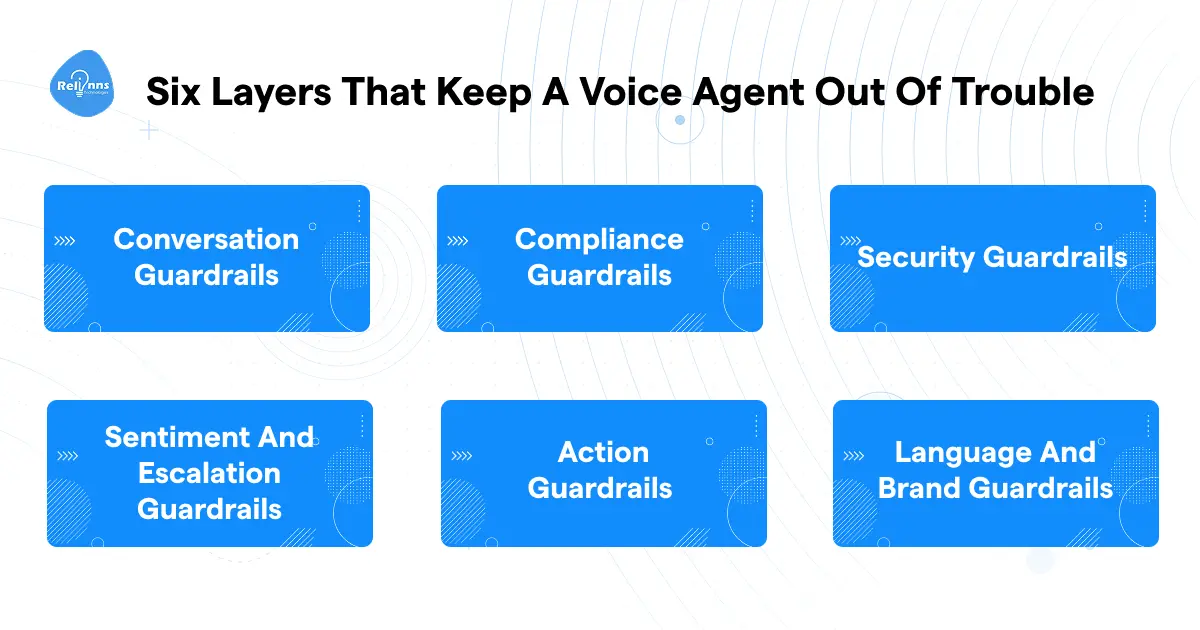
Protection for a voice agent isn't a single toggle you flip and walk away from. There are six distinct control types, each solving a different problem. Miss one and you've left a specific gap open.
1. Conversation Guardrails
These keep the agent on track. Approved topics, defined conversation flows, and hard limits on what it discusses. The agent books appointments, answers product questions, and handles returns. It doesn't speculate about competitor pricing or invent policy on the fly. When something falls outside the scope, it escalates instead of guessing.
2. Compliance Guardrails
Non-negotiable in regulated industries. In healthcare, HIPAA-compliant voice agents must read required disclosures before accessing patient data. In insurance and lending, the agent can't make unauthorized guarantees. These voice agent guardrails enforce those rules automatically, on every single call, without relying on anyone to remember.
3. Security Guardrails
Before your agent shares any account information, it should verify who it's talking to. PII and PHI redaction in voice agents is part of this layer, ensuring sensitive details remain out of call logs and transcripts. Security guardrails also flag suspicious behavior, such as a caller probing for information in patterns that appear fraudulent.
4. Sentiment and Escalation Guardrails
A frustrated caller who gets a scripted response will escalate fast. Detecting angry customers in voice AI requires real-time sentiment analysis during the call, not a post-call review. When frustration crosses a threshold, the agent de-escalates or transfers. It doesn't push through the script.
5. Action Guardrails
This is the one most teams skip until something goes wrong. Your agent should not cancel a subscription, process a refund, or confirm a booking without explicit confirmation from the caller. No gate, no action. That's the rule.
6. Language and Brand Guardrails
Every business has a voice. The agent should match the caller's tone and remain professional, even when the caller doesn't. Offensive language, off-brand phrasing, or anything that would embarrass your team in a screenshot - this layer catches all of it.
Key Insight: Most enterprise deployments start with conversation and compliance guardrails. Sentiment detection and action controls are where control breaks down at scale because they require real-time decision-making, not just filtering.
I'd argue the action layer is the most underrated of the six. It's the one that turns "the agent made a mistake" into "the agent made an irreversible mistake." Multi-layer guardrails for agents exist precisely because no single checkpoint catches everything.
Knowing the six types is necessary. Seeing what happens when you skip them is what makes the priority clear.
One Conversation. Real Legal Exposure.
Customer: "Can you guarantee I'll get approved for this loan?"
AI: "Yes, you'll definitely be approved."
Customer: "Can you guarantee I'll get approved for this loan?"
AI: "I can't guarantee approval. Eligibility depends on the lender's review process."
This isn't hypothetical. For AI voice agents for insurance and lending, this type of call happens the moment a deployment goes live without proper safety controls.
But the loan example is one failure mode. Here are three more that show up across industries:
PII leakage.
The caller claims to be an account holder. The agent reads out their balance with no identity check. The caller wasn't who they said. Voice agent privacy and security exposure starts exactly here.
Hallucinated policy.
The agent tells a customer there's a 30-day return window. There isn't one. Three weeks later, someone on your ops team decides: honor it and lose money, or refuse it and lose trust.
Brand violation.
Frustrated caller gets a cold, scripted response. They record it. Post it. That's your brand's voice in the public record.
In AI voice agents in healthcare, these failures don't stay in customer service territory. A missed disclosure or unauthorized data share becomes a regulatory problem fast.
Deloitte's 2026 AI governance report puts 80% of organizations in the "immature governance" category. That gap shows up first in production voice deployments, because that's where agents run without supervision.
Multi-layer guardrails for agents are designed to catch these failures before they reach a call recording. But they only work at the right checkpoints in the workflow, not just written into the system prompt.
The failure is predictable and preventable. But prevention requires guardrails placed at the right points in the conversation, not just at the start.
Guardrails Don't Live in One Place. They Run at Three Checkpoints.
Where you place your guardrails in the conversation flow matters as much as which ones you choose. This is an architectural decision that shapes everything about your AI voice stack. And it's where most teams realize that voice agent guardrails aren't a single catch-all gate sitting at the end of a call; they're a layered system running at three distinct points.
Multi-layer guardrails for agents cover every stage of a conversation turn: what the caller said, what action the agent is about to take, and what the agent is about to say aloud.
Checkpoint 1: User Input
Before the LLM does anything, the system checks what the caller actually said. Content safety, topic adherence, jailbreak attempts. The right approach is to run this in parallel with the LLM's initial processing, so it doesn't add noticeable delay. Lightweight classifiers handle this in under 50ms. Larger models add 600ms or more, and that's voice agent latency your callers will notice. Catch the problem here, before the model builds a response, and you never have to clean it up later.
Checkpoint 2: Tool Call Execution
This is the action layer. Before the agent books an appointment, processes a refund, or cancels a subscription, the system checks whether that action is actually authorized at this point in the conversation. Basic validation runs in microseconds: does the tool exist, are the parameters correct? Semantic checks on high-stakes fields like account IDs or payment amounts add a targeted model check on top. No action fires until it's been validated. That's the rule.
Checkpoint 3: Output
The final scan before text-to-speech fires. Factuality check against your agentic RAG knowledge base, PII scan, and compliance check. Streaming complicates this because the agent can start speaking before the check finishes. For short responses, buffer the whole output first. For longer ones, a sliding window catches most problems. Neither approach is perfect, which is exactly why strong input and tool-call checks matter so much. Stopping a problem early is always cheaper than stopping it mid-sentence.
Action Item: Before deploying any voice agent, map each of your six guardrail types to these three checkpoints. Input-only protection is not enough.
Voice agent guardrails only hold if each one is placed at the right point in the call flow. A rule in the system prompt and a check at the tool execution layer are doing completely different jobs. Treating them the same way is how gaps happen.
Architecture solves the structural problem. Implementation determines whether it holds in production.
Five Things That Separate a Demo From a Safe Deployment
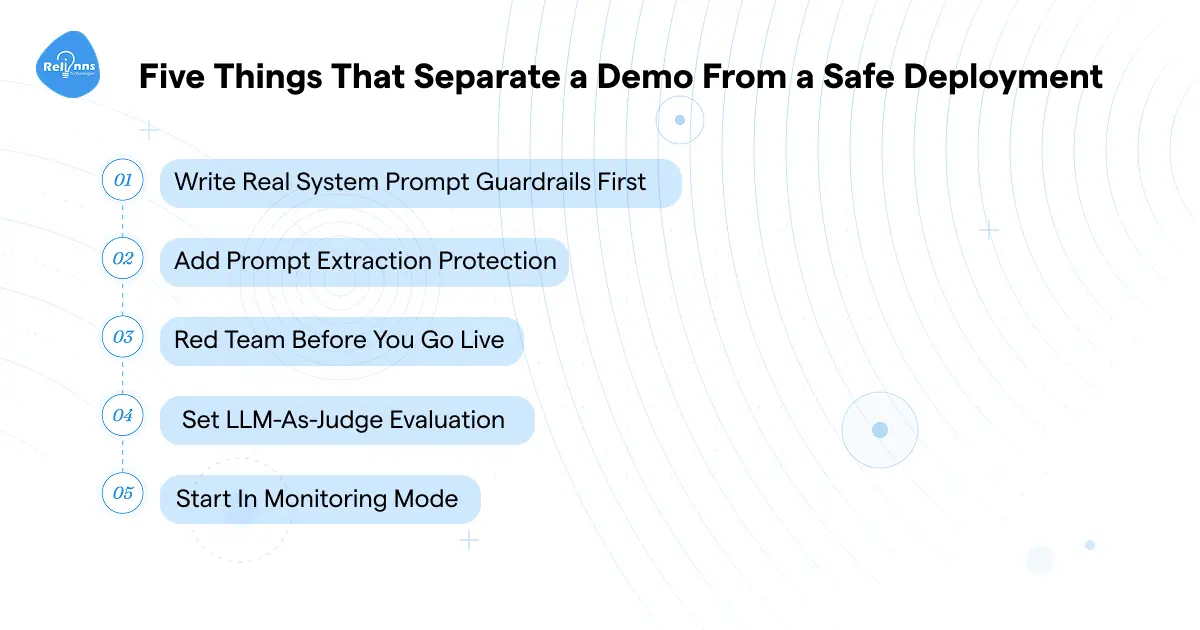
Most demos go well. Production is where things get interesting.
A working voice agent isn't the same as a safe one. The gap usually isn't the model. It's everything around it.
1. Write real system prompt guardrails first
Voice agent guardrails start here. Your voice AI prompting guide should define topic limits, required disclosures, how the agent identifies itself as AI, escalation triggers, and what it can't say under any circumstances. Vague instructions produce vague behavior at scale.
2. Add prompt extraction protection
Callers will try to get the agent to reveal its instructions. Configure it to decline twice, then end the call on the third attempt. It's a 10-minute system prompt addition that closes a real vulnerability.
3. Red team before you go live
Run structured simulation scenarios: social engineering, commitment pressure, PII extraction attempts, jailbreak prompts. Document failures. Fix them. Retest. Voice agent regression testing is about finding gaps before callers do.
4. Set LLM-as-judge evaluation
Configure automated call review to flag topic deviations, unauthorized commitments, and brand voice violations. Track pass/fail rates per guardrail type. And your voice AI knowledge base is the source of truth for factuality checks. The quality of that knowledge base determines how reliable this layer actually is.
5. Start in monitoring mode
Don't enforce hard blocks on day one. Tune escalation thresholds and sentiment sensitivity against real calls first. Once the settings are right, enforce. Going straight to hard blocks on a misconfigured agent creates a worse caller experience than no safety layer at all.
Production Readiness Checklist:
- System prompt covers topic limits, disclosures, escalation triggers
- Prompt extraction protection configured
- Voice Agent Red teaming has been done across all six guardrail types
- Automated evaluation active on every live call
- Monitoring dashboard tracking safety pass/fail rates by guardrail type
Platforms like BotPenguin let teams deploy AI agents across channels, with configurable voice-agent guardrails built into the workflow. Cuts setup time considerably, especially on the safety architecture.
Multi-layer guardrails for agents aren't a one-time configuration job. They need ongoing tuning after launch. The monitoring dashboard in step five exists for exactly that.
For the full technical picture, How to build an AI voice agent covers the stack from scratch.
Intelligence Gets the Agent Talking. Guardrails Decide When to Stop It.
Go back to the loan call from the opening. "Yes, you'll definitely be approved." That wasn't a model failure. The model did exactly what an unguarded model does: tried to be helpful. The missing piece was control.
The AI model provides intelligence. Voice agent guardrails provide control. You need both. One without the other isn't a deployment. It's a liability waiting for the right caller to find the gap.
For AI voice agents for customer service, every call is a brand interaction. In healthcare, insurance, or finance, every wrong sentence lands as a compliance event, not just a bad experience.
A layered protection framework built into the agent from day one closes that gap. Not by making the agent less capable. By making it reliable enough to actually scale.
At Relinns, we build voice agents with voice agent guardrails embedded in the design from the start. They're part of the architecture, not added after the pilot goes sideways.