GDPR Compliance for AI Voice Agents: Must Knows for You!!
Date
Aug 31, 26
Reading Time
9 Minutes
Category
AI Voice Agents
Share


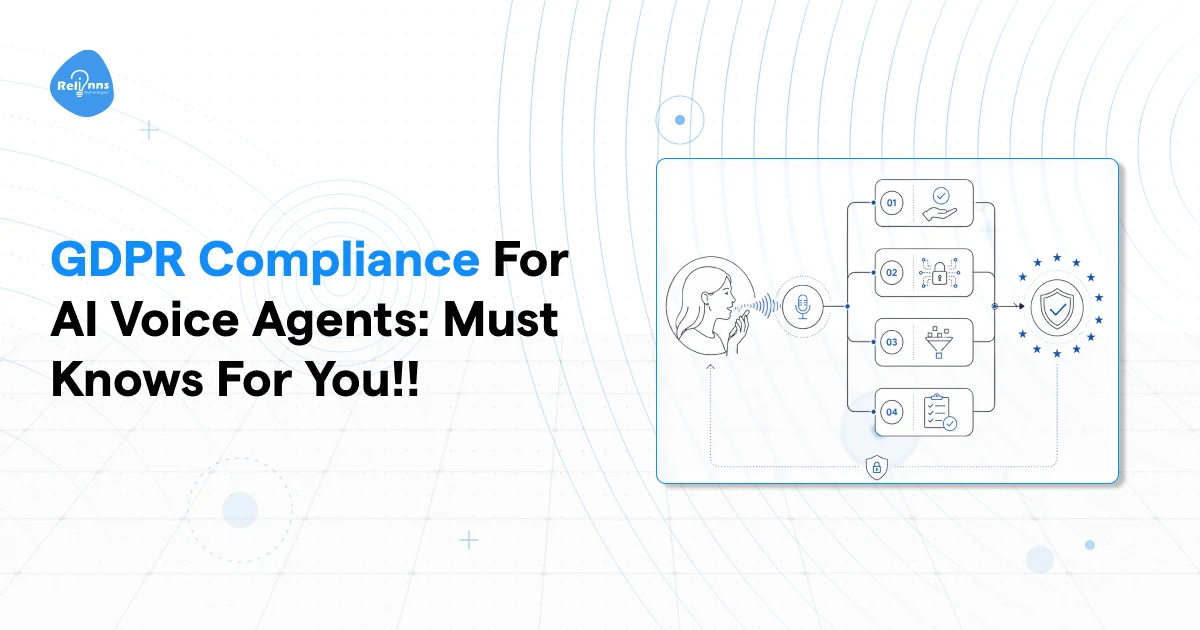
TL;DR
- GDPR compliance for AI voice agents requires more than a signed DPA, privacy notice, and encrypted storage.
- Each call creates separate data flows, including recordings, transcripts, CRM records, metadata, and analytics. Each needs an appropriate legal basis and retention rule.
- Voice used to identify or authenticate callers may qualify as biometric data under Article 9 and require additional safeguards.
- Businesses remain accountable for their telephony, ASR, LLM, cloud, and CRM sub-processors, including cross-border data transfers.
- Build disclosure, data minimization, automatic deletion, and executable data-subject rights into the architecture before deployment.
Your vendor told you it was compliant. You nodded, signed the DPA, and moved on.
That might be the most expensive assumption you've made this year. (literally and figuratively both)
AI voice agents process data that no other tool in your stack handles the same way. Real-time voice. Five separate data flows per call. And if any of it touches an EU resident, GDPR compliance for AI voice agents becomes more than a checkbox. It becomes the thing standing between you and a fine of up to €20 million, or 4% of your global annual turnover.
GDPR is only one layer of the broader AI voice agent regulations governing consent, disclosure, and data handling across markets.
Most teams handle this the same way they handle cookie consent. They shouldn't. GDPR compliance goes beyond a signed DPA and a privacy banner. GDPR-compliant voice agents are built differently from the ground up.
This blog is for whoever has already built and deployed one. We cover what most teams miss, what to ask your vendor, and why getting this right opens markets; a non-compliant deployment locks you out entirely.
But here's what makes voice data categorically different from every other data type your compliance team has already signed off on.
Your Email Compliance Policy Won't Protect You Here
Most teams assume GDPR compliance for AI voice agents works the same way it does for everything else they've deployed. Consent banner, signed DPA, data encrypted. Done.
That assumption breaks the moment your voice agent picks up a call.
Voice data is categorically different from form submissions or email records. The EDPB's own guidelines (02/2021 on Virtual Voice Assistants) make this explicit: voice can reveal a caller's health status, emotional state, age, and ethnic origin even when no sensitive topic comes up. The voice itself carries that information.
And here's where it gets legally serious. The moment your system processes voice to identify or authenticate a caller, that data shifts from ordinary personal data into biometric data under Article 9 of the GDPR. Article 9 processing is prohibited by default. The legal exceptions are narrow and require documentation that most deployments lack.
"GDPR violations carry fines of up to €20M or 4% of global annual turnover, whichever is higher. For voice AI, the exposure points are not obvious until they surface in a regulator review."
So the compliance framework you applied to your email stack doesn't transfer. GDPR compliance for AI voice agents requires an architecture built specifically for how voice data works, rather than borrowed from elsewhere.
That's why the privacy and security posture of your voice agent needs to sit in its own lane. GDPR compliant voice agents are built around this distinction from day one, not patched onto a general data protection framework after the fact.
And that's just the classification risk. A single call your voice agent handles creates not one but five separate and simultaneous legal obligations.
One Call, Five Legal Problems You Are Treating as One
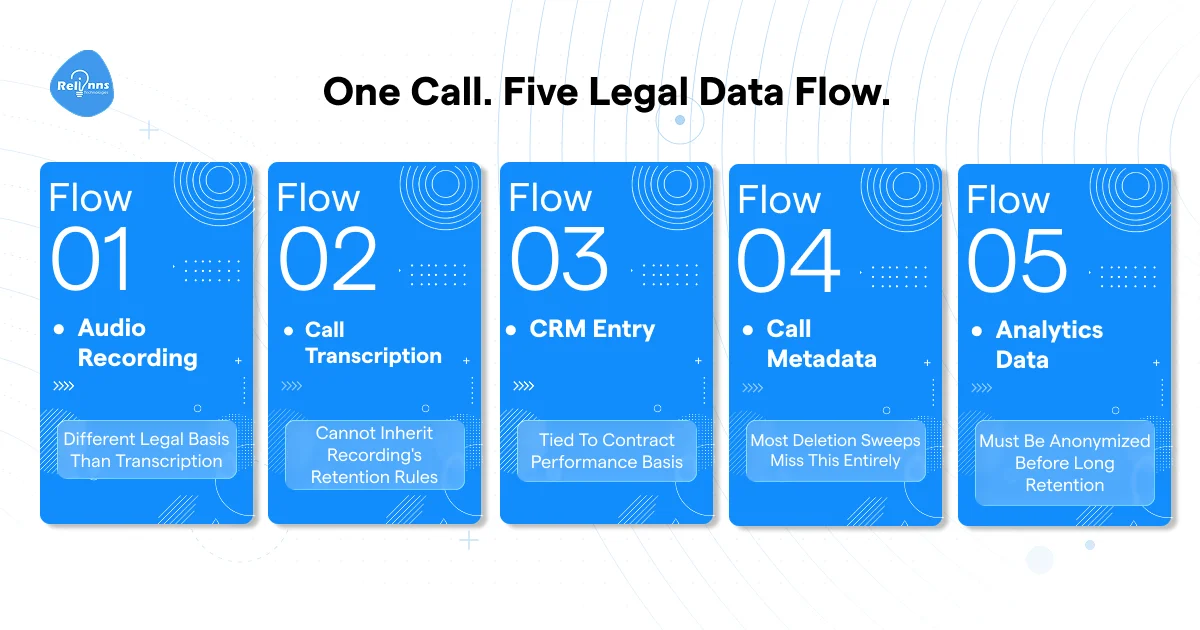
Most teams log a call as one event. One consent notice, one retention policy, one deletion rule. That's not how GDPR compliance for AI voice agents actually works.
A single call your agent handles produces five distinct data flows. Each one carries its own legal basis requirement, its own retention timeline, and its own deletion obligation. Treating them as a single block is the most common mistake in deployed voice systems.
Here's what one call actually generates:
"Treating all five flows as one GDPR obligation is the most documented compliance error in AI voice deployments."
The transcription row is what catches teams off guard most often. The audio recording and its text version are legally separate objects. Your retention policy for the recording does not automatically cover the transcript. A lot of teams assume it does, and that assumption creates gaps that surface badly in audits.
Call metadata is the other one worth watching. Timestamps, duration, language detected, call outcome. It feels like system data, not personal data. But under GDPR, if it can be linked back to an individual, it qualifies. Most deletion sweeps miss it entirely.
That's why GDPR compliance for AI voice agents has to be configured at the flow level, not just at the deployment level. If you haven't thought through PII and PHI redaction from your call transcripts, start there. GDPR-compliant voice agents handle each of these flows independently, with separate configuration rules applied to each.
Each flow also needs a different legal justification for the processing itself. Most deployments have named only one and applied it to all five.
Legitimate Interest Covers a Lot. Until It Doesn't.
There are three legal bases that cover most of what your voice agent does. Getting one wrong isn't a technicality. It creates a gap you can't explain to a regulator.
Contract Performance (Article 6(1)(b)) is the cleanest. Booking details, contact information, and records needed to actually deliver the service. Easy to document, hard to challenge.
Legitimate Interest (Article 6(1)(f)) is where most teams slip. It covers QA recordings and call logs kept for dispute resolution. But it requires a documented three-part balancing test showing your business interest doesn't override the caller's rights. Most deployments skip that documentation. That skip is the liability, not the recording itself.
Consent (Article 6(1)(a)) applies in two specific cases: disclosing that the caller is speaking to an AI before the call starts, and using conversation data to retrain your model. Consent has to be freely given, specific, and withdrawable. It can't sit in a terms page nobody reads.
GDPR compliance for AI voice agents most often breaks down at the legitimate interest layer. Not because teams are doing something wrong, but because they're not documenting why they're doing something right.
Expert Tip: If your vendor is using call data to improve their models without disclosing the legal basis, your business bears the liability. Under GDPR, you're the data controller. They're the processor. The accountability sits with you regardless of what they disclose or don't.
Unlike HIPAA, which operates on a covered-entity model where liability is more widely distributed, GDPR compliance for AI voice agents puts the controller in the spotlight first. Always. GDPR-compliant voice agents have the legal basis documented for each data flow before the system goes live, not six months after.
Name one of these wrong, and you've created a compliance gap you can't close quickly. But there are four risks that sit deeper than a wrong legal basis.
The 4 GDPR Risks Nobody Warns You About Before You Deploy
Most vendor pitches cover the upside. These four risks in GDPR compliance for AI voice agents don't come up until after you've signed.
Risk 1: You might already be processing biometric data
If your voice agent uses voice patterns to identify or authenticate a caller, that data shifts to Article 9. Special category. Prohibited by default, with narrow exceptions. It also triggers a mandatory Data Protection Impact Assessment. Most teams discover this after the system is already live.
Risk 2: Erasure requests hit your model, not just your database
GDPR Article 17 requires full deletion of a caller's personal data on request. Clean enough when it's a CRM record. But if that caller's conversation touched your knowledge base, embeddings, or fine-tuning data, it's not a row you can delete. It's inside the model. Practitioners who've received their first deletion request on a live voice system will tell you this is where GDPR compliance for AI voice agents gets genuinely hard.
Risk 3: The sub-processor chain nobody reads
A voice deployment runs through a telephony provider, an ASR engine, an LLM API, a CRM, and a cloud host. Every component is a data processor under Article 28 and needs its own compliant DPA. US-based LLM APIs used without Standard Contractual Clauses are an immediate cross-border transfer violation. Adding guardrails that limit data exposure at the agent level helps, but it doesn't replace a documented sub-processor audit.
Risk 4: US CLOUD Act exposure
If any vendor in your chain is US-incorporated, US authorities retain legal access rights under the CLOUD Act regardless of where the servers physically sit. Frankfurt data center, an American company. The CLOUD Act still applies. That conflicts directly with GDPR's fundamental rights provisions.
"The largest single GDPR fine on record: €1.2 billion against Meta in 2023. The basis was unlawful EU-US data transfers."
This is also why preventing your voice agent from generating outputs it can't account for is only part of what GDPR compliant voice agents need to get right. The data infrastructure underneath carries equal weight.
Understanding the risks closes one half of the problem. The other half is knowing what a compliant deployment actually looks like in production.
What a GDPR Compliant Voice Agent Actually Looks Like in Production
Here's the practical version. Four things that separate a GDPR compliant voice agent from one that's just had a DPA attached to it.
Data minimization is built into the logic, not bolted on
A booking agent should ask if 2 pm is free. It should not see whose appointment is already there. The agent queries only what the specific task requires for that interaction. Nothing more flows through, nothing more gets logged. This isn't a default configuration most platforms offer. You have to build it in deliberately, at the architecture level.
Caller disclosure that fires automatically
"This call is handled by an AI system. It may be recorded for quality purposes." That message has to trigger at the start of every call, before any voice processing begins. Not when a supervisor activates it. Not as a menu option. Systematic, every time, no exceptions. This is one of the non-negotiables in GDPR compliance for AI voice agents.
Retention rules at the flow level, not the deployment level
One blanket retention policy across all five flows isn't compliant. Each row needs its own rule. And auto-deletion must be enforced by the system, not by someone setting a calendar reminder.
Data subject rights that are actually executable
If a caller requests erasure of their data, you have one month. That means locating, exporting, and deleting every record tied to that individual: recordings, transcripts, CRM entries, and any derived analytics. Most deployments handle the database part fine. The recordings and transcripts are where teams get stuck.
GDPR compliance for AI voice agents doesn't end at launch either. Systems change. Prompts get updated, integrations shift, and the underlying voice AI stack that carries this data evolves. Monitoring your deployed voice agent for performance and compliance drift and running regression testing to catch compliance-breaking changes are how you stay compliant six months after go-live, not just on launch day.
Architecture gets you compliant. The vendor questions below keep you compliant as the deployment evolves.
8 Questions to Ask Your Vendor Before Signing Anything
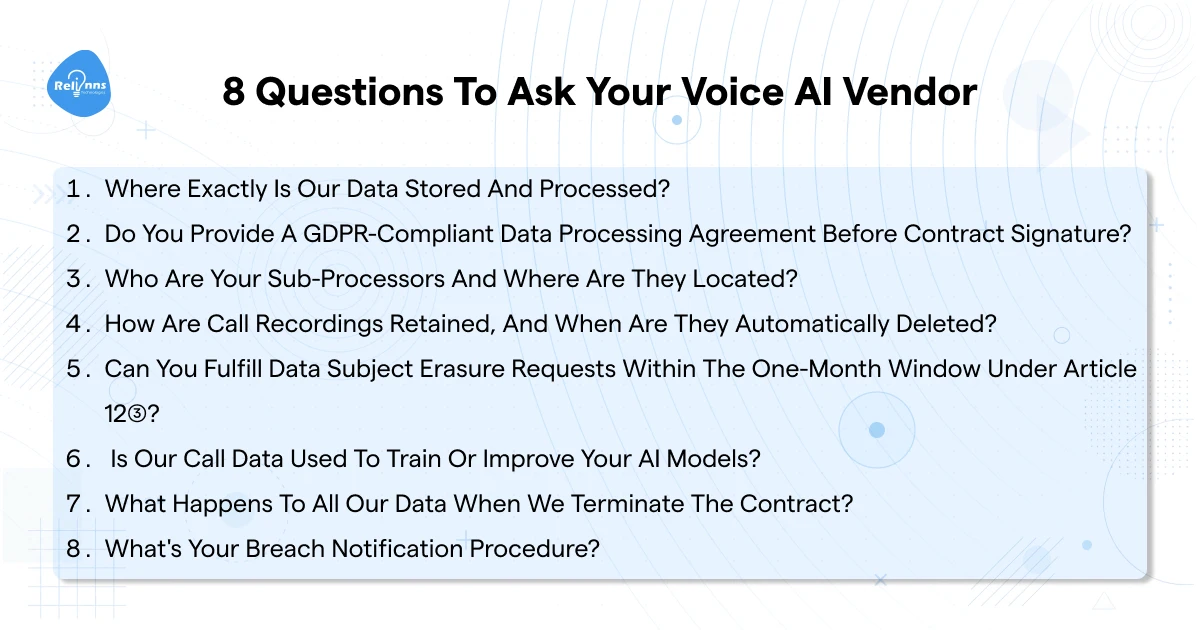
Most vendors will tell you they're compliant. The ones who actually are will answer these without hesitation.
Run through this before you sign anything. If a vendor stalls, deflects, or says "we'll share that after contract," that's your answer.
1. Where exactly is our data stored and processed?
Named EU/EEA data centers, not vague references to "European infrastructure."
2. Do you provide a GDPR-compliant Data Processing Agreement before contract signature?
Not after. Not "on request." Before you sign.
3. Who are your sub-processors and where are they located?
Every ASR engine, LLM API, and telephony provider. Full list, no exceptions.
4. How are call recordings retained, and when are they automatically deleted?
Auto-deletion with a defined window, not "we delete when asked."
5. Can you fulfill data subject erasure requests within the one-month window under Article 12(3)?
Ask for a walkthrough, not just a yes.
6. Is our call data used to train or improve your AI models?
If yes, what's the legal basis, and can you opt out?
7. What happens to all our data when we terminate the contract?
Returned or deleted, with written confirmation. Every byte.
8. What's your breach notification procedure?
You have 72 hours to notify the supervisory authority. Does their process get you the information you need in time?
Expert Tip: A vendor that can't produce a complete sub-processor list before contract signature is not ready for enterprise deployment. Ask for it in the first conversation, not the fifth. If it doesn't exist yet, that tells you exactly where their compliance maturity sits.
Understanding what GDPR compliance actually adds to the voice AI cost model of your deployment means accounting for what happens when compliance gaps surface in production, not just the build cost. When comparing AI voice agent platforms based on deployment requirements, GDPR compliance is one of the filters that separates platforms worth deploying from those that quietly create liability. It's not a box to tick at the end. It's a procurement question that regulated buyers ask on day one.
These questions protect you from fines and regulatory review. But the stronger case for getting this right is what it unlocks commercially.
Compliance Is Not the Cost. It Is the Entry Ticket.
Healthcare procurement teams treat GDPR compliance for AI voice agents as a hard filter. Non-compliant vendors don't make the shortlist. They don't get evaluated. They never see the RFP.
Insurance is identical. Regulated buyers in these verticals don't evaluate non-compliant vendors on merit. You're filtered out before the commercial conversation starts.
And the window to prepare is closing. EU AI Act compliance requires people to be informed when they are interacting directly with an AI system. Some voice AI deployments may also fall into high-risk categories based on their use, bringing additional risk-management, documentation, and human-oversight duties.
Teams that are GDPR-ready now already have part of that groundwork in place. Teams that aren't will be doing it under deadline pressure, and that costs significantly more.
There's also a direct line here to voice AI return on investment that most people overlook. GDPR compliance for AI voice agents signals something specific to a regulated buyer: you built the system properly, you know where every record lives, and you can delete it on request. That's not just legal hygiene. That's what enterprise contracts are built on.
How voice agents perform in healthcare environments, and AI voice agents for insurance operations, are the two verticals where this entry ticket pays off most directly. And if you want to understand what AI receptionist ROI actually looks like when the deployment is built correctly, start by measuring the ROI of your deployed voice agent.
The businesses building compliance into their voice agent architecture today aren't playing defense. They're qualifying for markets their competitors can't enter.
Relinns builds GDPR-aware AI voice agents for healthcare, insurance, and enterprise logistics teams. Book a consultation to audit your current deployment or scope a new one.