The Simplest Guide Explaining Voice Bot vs Voice Agent in 2026
Date
Aug 31, 26
Reading Time
11 Minutes
Category
AI Voice Agents
Share


TL;DR
- A voice bot follows predefined scripts and intent trees. A voice agent reasons toward a goal and adapts as the conversation changes.
- Voice bots work best for predictable, single-intent calls such as reminders, notifications, and mass cold outreach.
- Voice agents are better for multi-step conversations requiring context, CRM access, backend actions, sentiment detection, and informed human handoffs.
- Production voice agents need sub-800ms response latency and interruption handling within roughly 150ms to maintain a natural conversation.
- The article estimates autonomous resolution at 15–25% for IVR, 40–60% for voice bots, and 70–85% for voice agents.
- Use bots for high-volume filtering and agents for qualified or complex conversations. Migrate gradually while tracking containment, escalations, customer effort, and CSAT.
Architectural realities of real-time voice agents are messier than the demos suggest.
When a voice system's total response latency crosses 800ms, the caller hits dead air. The kind that makes you check if the call dropped. Anxiety spikes. Call abandonment climbs 40%. The conversation breaks.
Voice agent latency is often the first thing that breaks in a real deployment, and almost never the thing flagged in a demo.
"88% of AI voice agents never reach production environments, not due to inadequate LLM reasoning, but because of systemic delays accumulating across fragmented service layers."
Enterprise architecture diagnostics, 2026
88% of those systems never make it to production at all. The AI reasoning worked fine. The architecture underneath collapsed under real-world load.
In 2026, every vendor selling phone automation calls their product a "voice agent." Most are running a voice bot with a language model bolted on top. They look similar in a three-minute demo. Scale them to real call volume, and you see the difference fast.
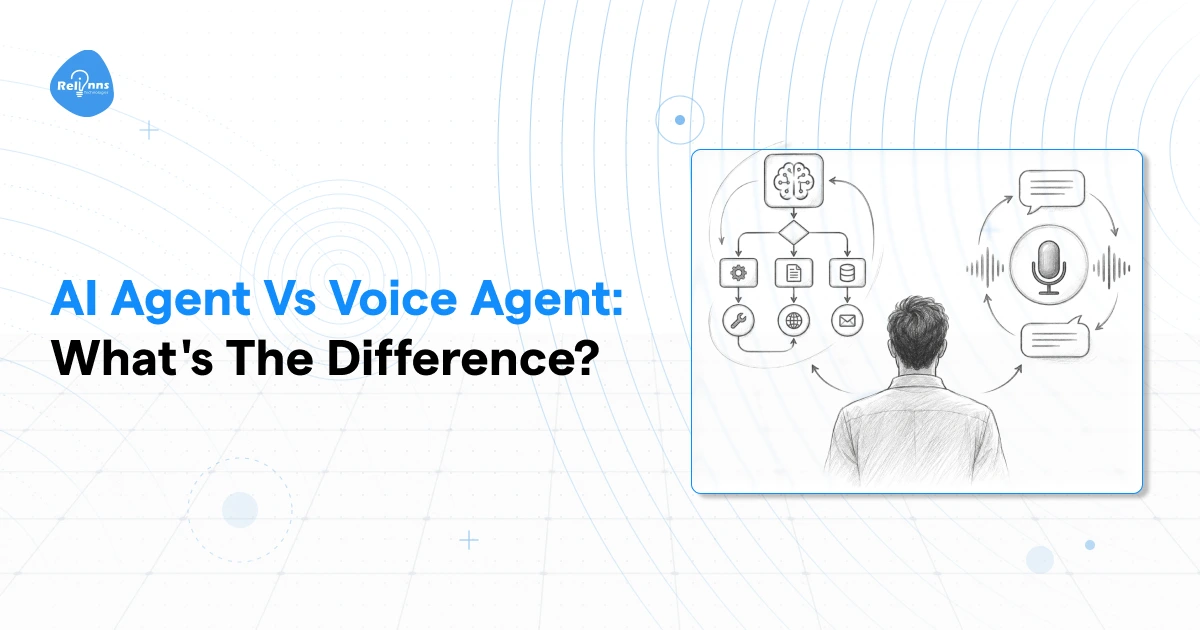
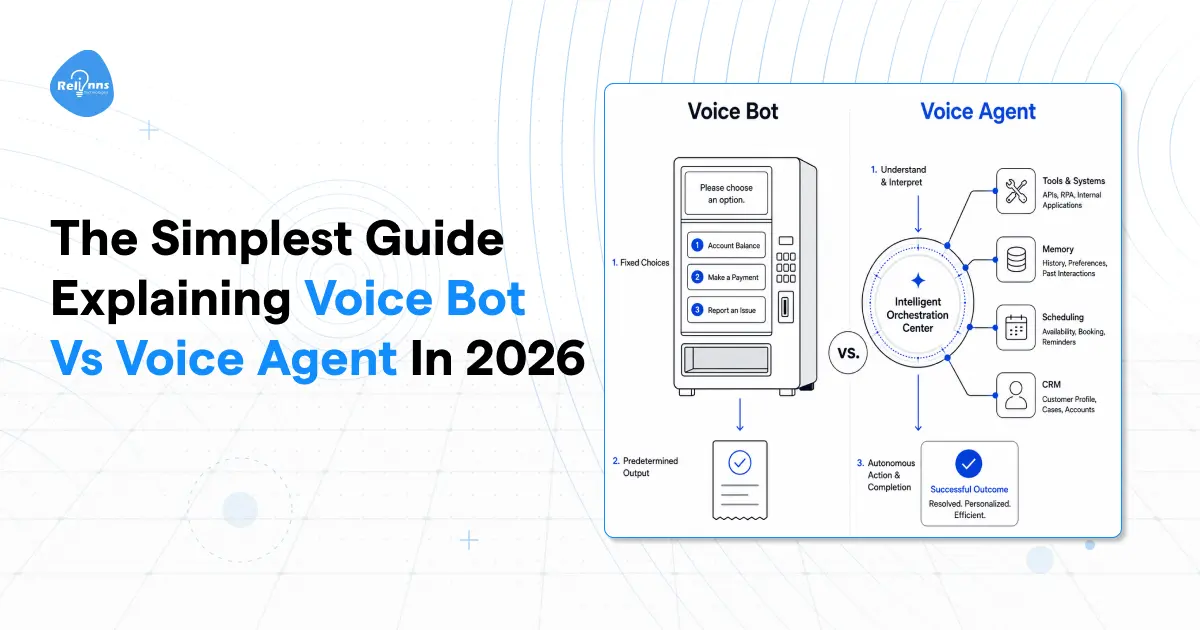
A voice bot runs on a script. A voice agent reasons toward a goal. They're not the same category of technology.
So what actually separates them? If you've been pitched AI voice agents by two or three vendors in the past few months and walked out more confused than when you walked in, you're about to get a clear answer.
It's a fundamental difference in what these systems are built to do at the architecture level. And that difference shows up in your resolution rates, your cost per call, and your CSAT scores.
The Voice Bot Had One Job. It Did That Job Well.
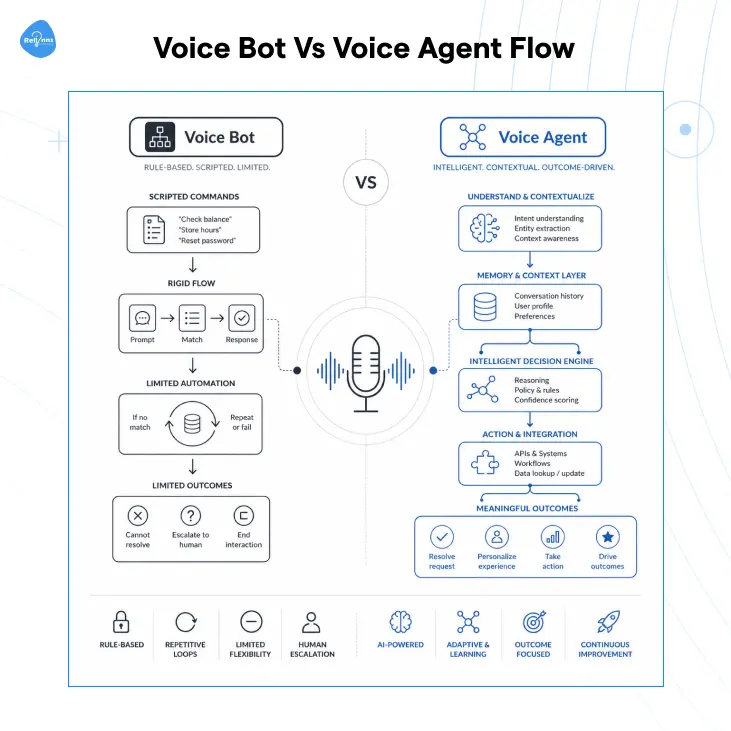
A voice bot is essentially a phone-based state machine. Give it a script, and it maps the caller's input to prebuilt intents, then routes or deflects accordingly. It holds no context and carries no memory across turns. If a caller goes off-script, the system doesn't follow.
For a long time, that was enough.
Think of it like a train. Fast, predictable, and reliable on the route it was built for. It can only go where the tracks were laid. A caller who asks something unexpected doesn't derail the system. They just get stuck at a stop that wasn't in the route.
Under the hood, it runs on predefined decision trees and keyword extraction. The system listens for trigger phrases ("billing," "cancel," "speak to someone"), maps them to preset flows, and executes them. It has no memory of what the caller said 10 seconds earlier. That turns out to be important.
- Script-based dialogue logic
- Linear conversation paths with fixed branching
- Maps caller speech to pre-trained keywords or intents
- No cross-turn context memory
- Collapses when a caller deviates from expected phrasing
- Best for: high-volume, predictable, single-intent calls
For certain jobs, this kind of scripted voice automation still earns its place. Appointment reminders, payment notifications, mass outbound cold filtering, where you're asking a simple yes-or-no to a large contact base. These are predictable, single-intent interactions that a voice bot handles at scale, at low cost, with no staffing overhead. Those are real commercial advantages worth naming.
The promise it made to enterprises was clear: handle the call volume your agents can't, answer calls outside business hours, and cut your cost per interaction. In the right context, it delivered on that.
The voice bot wasn't broken. The problem arrived when callers started doing things that scripts can't handle.
Your Customers Don't Follow Scripts. Your Voice Bot Does.
Real phone calls are messy. Callers interrupt themselves, start with one question and pivot to three others, use slang, and have accents that the system wasn't trained on. They pause mid-sentence while checking something on a different screen.
A voice bot assumes callers will state their problem clearly, wait patiently, and pick from the expected options. That assumption breaks almost every time.
The technical term for the ceiling voice bot hit is the intent-classification limit. The system can only resolve queries it was pre-trained on. A caller can move from a billing question to a cancellation threat to a retention conversation within 60 seconds. The bot doesn't track that shift. It runs out of road and hands off to a human agent, having consumed call time without resolving anything.
"Bots act as gatekeepers rather than problem solvers."
Most enterprises deployed a voice bot specifically to reduce agent workload. But 67-73% of callers who encounter one end up speaking to a human agent anyway. The bot didn't remove the agent call. It added a frustrating waiting stage before it.
And the customer fallout compounds it. 61% of people who have a bad automated phone experience report reduced brand loyalty. 23% abandon the interaction entirely and recontact later through a more expensive channel.
You've spent on the automation, but customers still had a bad experience, and agents still got the calls. Three losses from one deployment.
Scrapping the script-first model is the actual fix. More sophisticated scripts still break when real callers show up. A voice agent that reasons toward a goal handles these conversations differently at the architecture level.
Voice Agent: What Changes When You Replace the Script With a Goal
A voice agent runs on a goal, not a script. Give it the objective "book an appointment," and it figures out how to get there based on what you say, what the CRM shows, and what availability looks like.
Two callers with the same underlying problem can take completely different conversation paths, and both get resolved. The system decides what to do at each turn from context. That's what AI agents actually are.
The interruption handling shows this most clearly. A voice bot keeps talking through your interruption. A voice agent stops, clears the audio queue, and listens. That entire stop needs to happen within 150ms to feel natural to the caller.
I'll be direct about something here: it's harder to build correctly than most vendor demos suggest. Ask any vendor to test their barge-in under real background noise and time how long the pause lasts. You'll learn a lot.
Expert Tip: The 800ms Production Threshold
Sub-800ms total response latency is the production benchmark for conversational voice AI. Above it, callers hear dead air. Below it, the conversation feels natural. Voice bots running chained REST APIs across multiple vendor clouds frequently miss this. Integrated platforms like Retell AI hit it consistently because they co-locate media transport and AI processing on the same infrastructure.
Turn detection is different, too. A voice bot waits for silence to know you've finished your sentence, so every single turn has a built-in pause. Voice agents run a secondary AI model that reads your partial speech in real time and predicts when you've completed a thought. That pause drops to near-zero. Callers feel it immediately, even if they can't name what changed.
Sentiment detection adds another layer. Voice agents detect emotional signals in real time and track pace, pitch, and volume throughout the call. Frustration in a caller's voice triggers a different response than a calm account inquiry.
The system adapts the conversation or escalates to a human agent, preserving full context, before the caller reaches the point of demanding to speak to someone.
Backend actions also complete inside the call. The agent queries your CRM, updates the record, confirms the booking change, and ends the call with the work done. No follow-up task sits waiting. Understanding the AI voice stack underneath this helps when you're comparing platforms and trying to figure out why two products with identical feature lists perform so differently.
The architecture difference shows up in numbers you can put in a business case.
The Hard Data: What Enterprises Actually See After Switching
The table below covers the voice bot vs voice agent comparison across every metric that matters. Look at the resolution rate and cost columns first.
A comparison of AI voice agents vs IVR systems shows the same divide: IVR routes predefined inputs, while voice agents understand context and complete backend actions.
The cost column is the number that tends to catch people off guard.
Voice agents run $0.08-$0.20 per interaction. Voice bots run $0.30-$0.60. The more capable system costs less per call. That holds because voice agents resolve more calls without human intervention, so you stop paying the $5-$12 escalation cost on top of the automation fee.
Run the numbers at 10,000 calls per month. A voice bot resolves 40-60% without escalation, which means 4,000-6,000 of those calls still go to a human agent. At $5-$12 each, that's $20,000-$72,000 per month in escalation costs, on top of what you're already paying for the bot.
Cutting that escalation pool in half is what the resolution rate gap looks like in a spreadsheet.
The CSAT difference matters more than the gap suggests. A score of 3.6 means callers are leaving your automated channel with a neutral-to-bad experience.
Scores above 4.0 correlate with reduced churn in enterprise contact center deployments.
The difference between 3.6 and 4.2 is not due to rounding. That's the gap between customers who stay and customers who quietly switch.
And if your current baseline is IVR, you're starting from $0.65-$1.25 per call at 15-25% resolution. Most operators modeling voice agents against their IVR baseline close the business case in under 20 minutes. If your leadership is asking for the numbers, this table is most of the answer.
"Voice bots help businesses automate responses. Voice agents help businesses automate outcomes. The difference in that single word is worth measuring in dollars per call."
Before you write off voice bots entirely, there's a scenario where they still beat voice agents on purely economic grounds.
The Voice Bot Isn't Dead. It Just Needs a Different Job.
Voice agents outperform voice bots on every benchmark. Resolution rates, CSAT, and cost per interaction. The case for replacing one with the other looks airtight.
Except the benchmarks assume you're replacing like-for-like, and you're not.
Running a voice agent across a cold contact base of 50,000 names means paying for contextual reasoning, backend integration, and multi-turn logic on calls where none of that gets used. AI cold calling works differently: cold outreach is predictable, single-intent, and short. The contact either shows interest or they don't. You don't send your best salesperson to cold-call every name on a purchased list. Scripted outbound automation handles that volume at a fraction of the cost, and it does it well.
A voice bot earns its keep on exactly that cold list. The moment a contact says yes, the conversation changes. They have questions. They push back. They need an offer built and a booking confirmed. That's when a voice agent takes over.
The structure of inbound vs outbound voice AI is how high-performing teams split the work. Voice bots handle mass first-contact outreach and filter for genuine intent. Voice agents handle warm contacts who need a real conversation and real action.
The numbers on this model hold up. A car dealership using this structure captured 228 leads in a single month that would have otherwise gone unanswered. A medical diagnostic network saw 820% ROI in 30 days. In both cases, the cold outreach system built the qualified list. The lead qualification and closure were handled by the agent.
Expert Tip: When to Use Which
Use a voice bot when the call has a single predictable intent, no backend action is needed, and volume is very high.
Use a voice agent when: the caller may deviate, a system action is needed during the call, or resolution quality directly affects retention.
Use both when you have a large cold contact base and a smaller warm segment that needs quality handling.
The businesses seeing the biggest returns are not choosing one over the other. They are stacking them and measuring the delta.
From Legacy IVR to Live Voice Agent: What the Timeline Looks Like
Most migration projects take 4-8 weeks from kickoff to live deployment, covering 5-10 use cases. That's faster than most operations teams expect.
The migration has three phases. First, a workflow audit: document every IVR call flow and voice bot intent in your current system. This is where you find out how much of what your platform is "handling" is still escalating to agents. Second, the build and mapping phase: translate those flows into the voice agent platform, using no-code workflow tools for standard call types. Third, parallel operation: run both systems on separate call queues, validate resolution rates against your baseline, and only cut over when the numbers hold.
Start with the highest-volume, lowest-complexity cases: order status, appointment confirmations, payment reminders. Fast proof points without touching anything sensitive. If you want to go hands-on with the build side, the How to Build a Voice Agent guide covers the technical setup in detail.
From day one, track four things: containment rate, escalation frequency, customer effort score, and CSAT per interaction type. If one of those moves goes in the wrong direction, you catch it before the full cutover. Monitoring your voice agent playbook covers the dashboards and alert thresholds to set up early.
The voice bot doesn't retire in this model. It moves to the top of the funnel, handling outbound cold volume while the voice agent owns inbound resolution.
- Audit your top 10 inbound call reason codes
- Identify which are single-intent and predictable (voice bot territory)
- Identify which require backend action or multi-intent handling (voice agent territory)
- Pick the single highest-volume, lowest-complexity use case for the first voice agent build
- Set your baseline CSAT and resolution rate before go-live
The platform you build this on matters more than the timeline. Not all voice AI vendors are selling the same thing.
Before You Sign a Contract: 5 Questions Every Voice AI Vendor Has to Answer
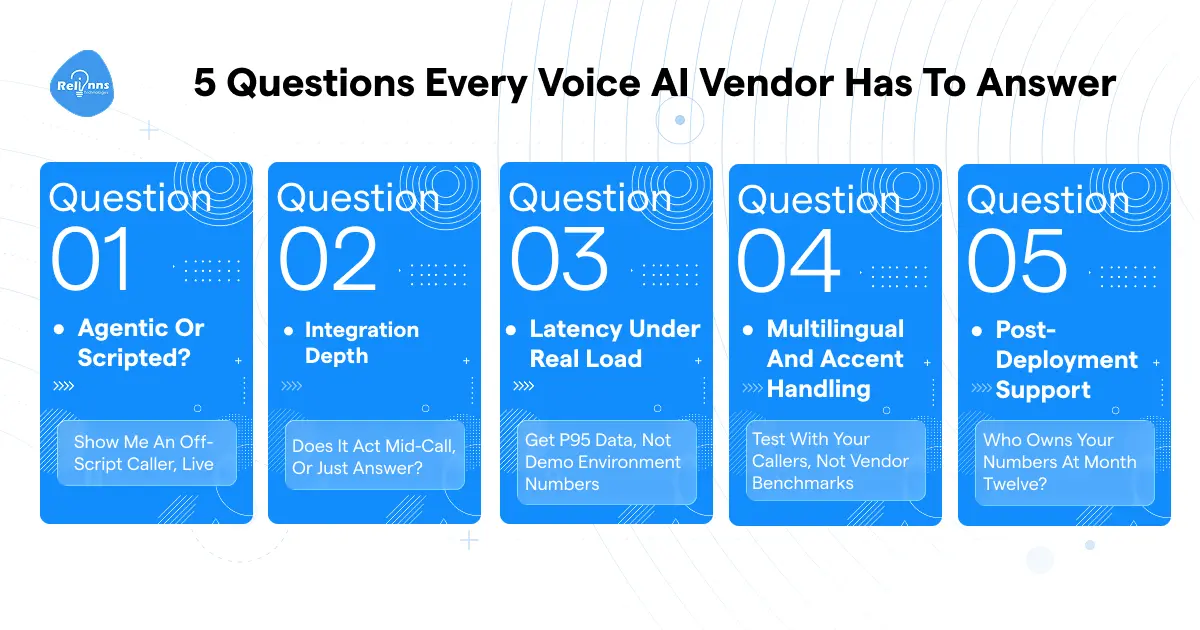
Every vendor shows you their best call in a demo. Your job is to find out what the worst call looks like.
1. Agentic or scripted?
Walk a vendor through this scenario: a caller asks something the system wasn't trained on. What does it do? A voice bot transfers, deflects, or plays a fallback message. A genuine agent reasons through the gap and continues the conversation. If the vendor redirects you to a feature sheet instead of showing you a live example, you have your answer.
2. Integration depth
Can the agent query your CRM, execute a credit, reschedule an appointment, and update the record during the same call? Or does it hand off for anything beyond answering a question? If the AI can't act, it's a smart router. Calling it a voice agent doesn't change what it does.
Ask also whether voice and text channels share a backend. Comparing AI voice agents vs chatbots helps determine whether a workflow belongs on phone calls, messaging channels, or both.
When Relinns builds voice agents alongside chatbot deployments through BotPenguin, context from a voice call carries into a follow-up WhatsApp or web chat interaction without the customer repeating themselves. Most single-channel vendors can't offer that.
3. Latency under real load
Sub-800ms total response latency is the production threshold. Ask for P95 data under concurrent load, not demo numbers. Median latency hides the variance. P95 and P99 tell you what a busy peak hour sounds like.
4. Multilingual and accent handling
Language support and accent support are not the same thing. Test with your actual customer base profile. Multilingual voice AI built for benchmark datasets breaks on the regional accents that represent your real call volume.
5. Post-deployment support
Some vendors ship and step back. The right partner monitors resolution rates, flags failure modes, and retrains the system as your products and policies change. Ask who is responsible for your performance at month 3 and month 12, not just at launch.
For regulated industries, work through the security and compliance requirements before reaching the contract stage. Compliance coverage varies between vendors more than the sales deck suggests.
- Demo latency under 500ms, but no P95 production data available
- "We support 100+ languages," with no accent variation testing offered
- Pricing per resolution event (creates unpredictable cost spikes at peak volume)
- No post-deployment SLA or performance review cadence
The companies getting this right in 2026 are not just cutting call center costs. They are turning every call into data that improves the next one.
Voice Bots Served Their Era. Voice Agents Are Building the Next One.
Voice bots worked. Worth acknowledging that before closing. They cut call volume, reduced staffing costs, and handled predictable interactions at scale. The intent-classification limit caught up with them as call complexity grew, and deploying a script-first system against conversations that needed reasoning was the actual failure.
Voice agents solve that at the architecture level. Goal-directed reasoning, real backend integration, barge-in within 150ms, sentiment-aware escalation. These are architectural differences, not feature upgrades. That distinction is between a system that routes calls and one that resolves them.
The companies pulling ahead have stopped asking, "How do we handle more calls cheaper?" They're asking: "How do we turn every voice interaction into a resolution that builds retention?" That reframe is the competitive advantage.
Voice bots still earn their place in cold outreach funnels. That's a practical allocation of tools, not a consolation. Most high-performing teams have already figured this out.
If you're building or rebuilding your voice channel, Relinns builds voice agents on Retell AI with full CRM, EHR, and WMS integration across Healthcare, Insurance, Ecommerce, and Logistics. Book a demo, and we'll show you a live call, not a slide deck.