Voice AI Agent Regulations in 2026: Country by Country Analysis
Date
Aug 31, 26
Reading Time
10 Minutes
Category
AI Voice Agents
Share


TL;DR
- Compliance in one market does not automatically satisfy another market’s voice AI agent regulations.
- Businesses must account for both the call’s origin and destination, including local consent, disclosure, recording, and opt-out rules.
- Voiceprints may qualify as sensitive biometric data and require separate consent, storage controls, and deletion schedules.
- Outbound campaigns generally carry greater regulatory exposure, with some penalties calculated per call or against global turnover.
- Use a five-layer consent stack covering contact permission, AI disclosure, recording, biometrics, and cross-border data governance before launch.
TCPA violations cost $500 to $1,500 per call, with no cap. Run a 10,000-call campaign without the right consent on file, and you're staring at more than $15 million in exposure. One country, one law, before your agent even leaves US soil.
I'd bet most teams treat voice AI agent regulations like a box they've already checked. Get TCPA compliance right in the US, bolt on a "this call uses AI" line, ship it. Done, right?
Not quite. That covers maybe a third of what governs a voice agent once it starts dialing real people in real places. Voice agent legal requirements are split by state before they're split by country. Disclosure timing gets specific down to the second in some markets. And the shape of voice AI agent regulations changes the moment your agent leaves US soil, because no one else has built their rulebook around the TCPA.
The country you'd bet is strictest probably isn't. And the market you know best, the one you built your entire policy around, might be the one working against you the most.
The UAE PDPL adds specific requirements for how voice data is collected, processed, stored, and transferred within the UAE.
One Compliant Market Doesn't Mean You're Compliant Everywhere
I see this constantly. A team nails US compliance, runs a clean campaign, and assumes they've covered voice AI agent regulations end-to-end.
They haven't. A policy that passes in the US doesn't travel. Not automatically, not ever.
Regulators split the problem into two separate questions: where the call originated, and where it landed. Origin rules and destination rules are two distinct legal concepts within any regulatory framework for voice AI. You owe compliance to both, not whichever one's easier to check off.
There's a definitional question most builders skip. What counts as an AI voice agent to a regulator? Not whether it sounds human. Regulators classify by function: automated or artificial voice. Sound as real as you want. On paper, it's a robocall, and that's where most voice AI agent regulations start.
That's a different rulebook than the one governing chatbots. Voice carries baggage text never had to.
And that gap shows up first in the fines. They're not small.
The Fines Have No Ceiling, and Every Call Counts on Its Own
Nobody reads the fine print until it's their fine. And the math on voice AI agent regulations changes fast once you stop treating this as a US-only conversation.
I'd sit on that US row for a second. "No cap" is doing a lot of work there. Most fines have a ceiling somewhere. TCPA doesn't. The EU row combines separate compliance layers. GDPR governs personal data, while EU AI Act compliance addresses obligations tied to the AI system itself.
Each call is a separate violation. A campaign is not one risk. It's thousands of them.
That's the part that trips most builders up when they're mapping voice AI agent regulations against a real campaign size. You're not budgeting for a fine. You're budgeting for a fine multiplied by every dial.
And it gets worse when your agent is placing the call rather than receiving it. Outbound calling draws the sharpest exposure across nearly every framework on this list, because you initiated contact nobody asked for. Inbound gets more legal room, though not a free pass, and the full inbound versus outbound breakdown is worth a read if you're running both.
If any of this is fueling cold outreach, the exposure above applies to you first, before anyone else on your team.
Money's the easy part to picture. The fines get the attention. But AI telephony compliance covers a lot of ground that has nothing to do with money.
The Rules Voice Calls Carry That SMS and Email Never Did
Text never had to deal with this. Voice does, and that's why voice AI agent regulations get complicated fast once you're placing real calls instead of sending copy. None of it shows up in a typical SMS checklist.
Live versus automated is a hard line almost everywhere. A human rep gets treated differently than a machine, and an AI voice always lands on the automated side, no matter how natural it sounds. Regulators built entire frameworks around that one distinction.
AI disclosure timing isn't vague either. The current US proposal wants an opt-out mechanism live within two seconds of the opening message. Miss that window and you're out of compliance before the caller's even said hello back.
And recording consent splits the world into two camps, and which camp you land in depends on where your caller happens to be standing.
I used to think one-party consent made things simpler wherever it applied. It doesn't. Your caller list rarely respects state lines. Assume the strictest rule is one dial away, every time.
Expert Tip: that two-second opt-out window is a latency problem before it's a legal one. Test it like you'd test time-to-first-response, not a disclaimer.
Get the recording disclosure right and you've handled a real chunk of AI voice calling laws. Pair it with solid caller authentication and you're ahead of most teams shipping right now.
This is the corner of voice AI agent regulations most SMS-trained teams miss, and it's not the last one.
The Compliance Layer Hiding in Every Voice Call: Your Caller's Own Voice
Almost nothing written about voice AI agent regulations covers this part: the sound of your caller's own voice.
Getting permission to place a call doesn't get you permission to build a voice template out of it. Those are two different asks. Most regulatory frameworks for voice AI treat them that way, even when nobody flags it upfront.
Voiceprints get filed as sensitive, special-category data in more places than most teams expect. GDPR puts them under Article 9 in the EU. The UK follows the same logic. Canada went further, in a real case: its privacy office investigated Rogers over its Voice ID system and found gaps in how consent and enrollment were handled, even though the voice authentication concept itself was fine.
China's PIPL wants separate, affirmative consent specifically for this. Brazil, South Africa, Mexico, and Saudi Arabia all treat voiceprints the same way. And Illinois' BIPA names "voiceprint" outright in the statute. No interpretation needed.
I'd flag this as the corner of voice AI agent regulations that gets skipped most, usually because recording consent already feels like the finish line. I won't pretend I can map every regulator's exact line without local counsel, but the pattern's consistent enough to build a policy around.
Expert Tip: recording a call and building a voiceprint aren't the same legal event. Storing audio for quality review sits fine in service-call territory. Matching that audio against a stored template to recognize a specific caller later creates a biometric identifier, and that needs its own consent and its own deletion schedule.
If your calls touch PII or PHI, or you're running anything in healthcare, this stacks directly on top of HIPAA obligations you probably already have a handle on. Worth reading through privacy and security alongside this one.
Biometrics are hard enough to track in one country. The rules keep changing everywhere at once.
The Rules Changed Three Times Since 2024, and They're Still Moving
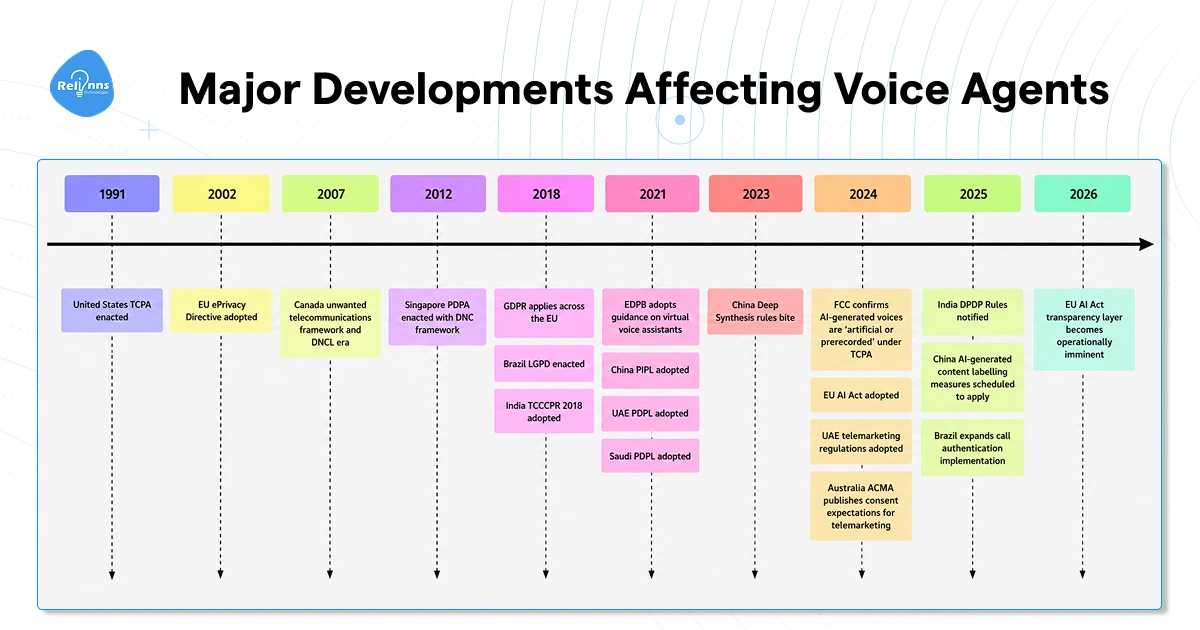
Eight rows below, and every one of them is proof that voice AI agent regulations don't sit still long enough to memorize.
Look at rows two and three together. A circuit court cut part of the FCC's rule loose in January 2025. Another circuit is questioning, right now, whether the FCC had the authority to write parts of it the way it did in the first place. That's not a regulatory framework for voice AI settling into place. That's one still getting argued out in federal court while you're trying to ship a product.
I'll say the obvious part out loud. No compliance policy written in 2023 survives this table untouched. Which is exactly why treating voice AI agent regulations as a box you check once, then forget, stops holding up somewhere around row three.
With that much movement, the country you'd bet is strictest is worth a second look.
The Country You'd Bet Is Strictest Probably Isn't
I set up a bet at the start of this piece: which country runs the toughest voice AI agent regulations? Most people say the US, because TCPA fines sound brutal and everyone's heard a horror story. Wrong guess.
The US lands in that bottom row because there's no single rulebook to point to. TCPA sets the floor, fifty states stack their own wiretap and disclosure rules on top, and a circuit court is chipping at the FCC's authority mid-stream. That's fragmentation, not strictness. The EU and UAE run one codified regulatory framework for voice AI, covering consent, disclosure, and biometrics under a single law you can read start to finish.
Treating US compliance as your ceiling is the most expensive assumption in this whole piece. Calibrate for the UAE, China, or the EU using a US-shaped policy and you'll walk straight into gaps. That's the real shape of voice AI agent regulations once you zoom out past one country. Pair this with the GDPR breakdown if the EU's on your list, and the multilingual agents piece if you're running one agent across several of these markets at once.
If no single country's rulebook is the template, you need a different kind of template altogether.
A Framework That Actually Travels: The Five-Layer Consent Stack
Everything up to this point has been the problem. This is the fix.
Call it the five-layer consent stack, the closest thing to one working template across every corner of voice AI agent regulations we've covered, from the US to Saudi Arabia. It holds up because it doesn't care which country you're calling into.
You've already met every one of these layers, though not stacked together like this. Origin versus destination is layer one. AI disclosure timing is layer two. Recording consent is layer three. The voiceprint question almost nobody asks is layer four. And layer five, the one almost nobody builds for, is where your data sits once the call ends.
Run a market through these five questions before writing a single line of script. Can't answer all five? You're not ready to dial there, no matter how tight your voice agent legal requirements look back home.
Treat this as a starting script, not a finished one:
"Hi, this is an AI assistant calling on behalf of [Company] about [purpose]. This call may be recorded. Say 'stop' or press [key] to opt out. Say 'agent' to reach a person."
Swap in local modules where the law asks for more. Japan wants the business name, caller name, and product type stated before any pitch starts, and the script above doesn't cover that.
Build to the strictest jurisdiction on your list. Relax only where a real legal review says it's safe. Building for the easiest market and hoping the rest catches up is backwards, and teams that do it end up rebuilding their voice AI agent regulations approach mid-launch.
From here, building the agent itself and testing it against your voice stack and guardrails is the next step.
A framework only holds up if you can prove you followed it.
Your Pre-Launch Compliance Checklist
Run through these six before your agent places a single call. This is what a pre-launch check against voice AI agent regulations actually looks like on the ground, not a checkbox exercise.
- Consent capture linked to the number at call time, not a spreadsheet checked before launch
- DNC or DND registry scrubbed in real time, not the night before
- AI disclosure and recording notice both in the opening line, every call, every market
- Voiceprint enrollment run as its own workflow, with its own consent and its own deletion schedule
- An evidential log per call: legal basis, consent artifact, script version, disclosure rendered, opt-out event, deletion schedule
- Cross-border storage reviewed before any recording or template leaves the jurisdiction
Get the DNC scrub timing wrong and the rest of your voice AI agent regulations work barely matters, because that's usually where enforcement finds a business first.
None of this has to get built from scratch, or alone. Monitoring it once it's live is its own job, and it's a lot easier when the checklist above is already part of the build, not bolted on after.
Designing Compliance In, Instead of Bolting It On Later
That checklist isn't just a list of tasks. Read it again and it doubles as a map of which markets are actually worth entering.
I'd treat the countries running the tightest, most codified voice AI agent regulations as the ones worth entering sooner, not the ones to avoid. The fines and friction for getting it wrong there are visible enough that almost nobody risks winging it. Getting the build right the first time pays off fastest exactly where the rules are hardest.
Bolting compliance on after launch costs more than building it in from day one. Every fine and court ruling covered above makes that case on its own.
If you're still deciding whether to build this in-house or bring in a team that's already solved it, custom versus off-the-shelf is worth a read, alongside what voice agents cost once compliance tooling gets priced in properly. Past one market, scaling and picking the right platform both lean on the same groundwork we just walked through.
Build the compliance layer first. Market expansion takes care of itself after that.
Relinns builds AI voice agents with compliance-by-design baked in from the first call, treating compliance rules for voice bots as the starting point, not a patch applied after a fine shows up. That's the real difference between chasing voice AI agent regulations after the fact and building around them from day one.