EU AI Act Compliance for Voice Agents: The August 2026 Deadline Explained
Date
Aug 25, 26
Reading Time
9 Minutes
Category
AI Voice Agents
Share


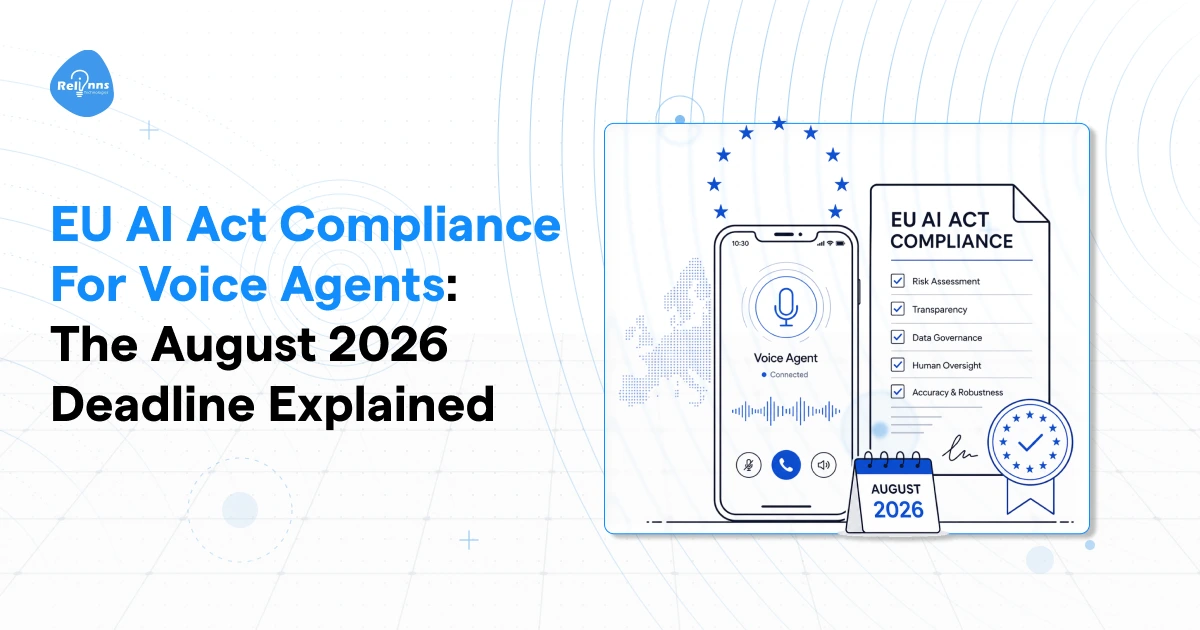
TL;DR
- The EU AI Act's transparency rules take effect on voice agents on 2 August 2026, not the 2027 date most people cite.
- If your agent talks to anyone in the EU, it has to say it's AI at the start of the call. The "they can obviously tell" excuse fails a formal test.
- Most business agents are limited-risk. But score a caller's emotion or sentiment and act on it, and you flip to high-risk.
- High-risk means conformity assessments, EU registration, and logging kept up to 10 years.
- Fines reach €15M or 3% of global turnover for transparency and high-risk misses, and buyers now want compliance docs before they sign.
- Compliance splits between your vendor and you: audit your opening scripts, make sure the disclosure gets heard, map your AI features, and log everything.
Most teams running a voice agent have quietly filed the EU AI Act under "deal with it later." The thinking goes: it's a heavy law aimed at high-risk stuff like credit scoring and medical triage, our little booking assistant isn't that, and anyway the real deadline is 2027.
Two of those three assumptions are wrong.
The transparency rules that catch ordinary voice agents kick in on 2 August 2026, not 2027. And they reach the exact kind of agent people assume is too simple to count. The friendly bot that books appointments and answers billing questions? It's in scope.
Before we get to the checklist, it's worth knowing what you're actually complying with, and why the date on your calendar is probably the wrong one.
What the EU AI Act actually is
Strip away the jargon, and it's one law: Regulation (EU) 2024/1689, the first broad, binding set of rules for artificial intelligence anywhere. Not guidelines. Not a voluntary code. Actual law with fines attached.
It works on risk. The more damage a system could do, the more it has to prove. And it's technology-neutral, so it doesn't care whether you're running an AI voice agent, a chatbot, or something else. It cares what the thing does.
One split matters more than the rest. The law hands duties to two parties: the provider who builds the system, and the deployer who runs it in the real world. Your vendor and you. Both carry weight, and neither can point at the other.
And like GDPR, this reaches across borders. If your agent talks to someone sitting in the EU, you're covered, wherever your company happens to be.
Here's how the rollout stacks up:
That August 2026 row is your row. For the bigger regulatory picture beyond this Act, we've mapped it out in our guide to voice AI regulations.
The law sorts every system into one of four risk buckets. Where your agent lands decides everything that follows.
The four tiers, and where your agent lands
The AI Act ranks everything by how much harm it could cause. Four tiers, top to bottom.
At the top sits unacceptable risk. This is the banned list: manipulation, social scoring, real-time biometric ID of people in public. If your system lives here, there's no compliance path. You just can't run it.
Then high-risk, for systems that make or shape consequential decisions about people. Credit scoring, hiring screens, medical triage. These carry the full weight of the law, which means a conformity assessment before you go live.
Below that is limited-risk, the transparency tier. And this is where most business voice agents actually sit. The bar here is simpler: tell people they're talking to a machine. That's Article 50, and we'll get to it.
At the bottom, minimal risk. Internal call transcription, that sort of thing. No mandatory rules at all.
So if you're running a receptionist-style voice agent that books slots and answers questions, you're almost certainly in that limited-risk row. Breathe easy.
Limited-risk sounds like a light lift. The catch is how easily one feature bumps you up a tier, and we'll get there. First, the duty that catches every agent.
Article 50: the duty nobody escapes
Here's the whole obligation in one breath: anyone who talks to your agent has to be told it's AI. Right at the start, before the qualifying questions, before you collect a thing. On an outbound call especially, a disclosure dropped somewhere in the middle doesn't count. It has to open the conversation.
Sounds easy. Then people reach for the loophole.
The law says you can skip disclosure when the AI nature is "obvious." So teams tell themselves, our caller can clearly hear it's a robot, we're fine. That's the trap. The EU AI Office runs a two-step test on that word. First, define who your audience actually is. Then ask whether a reasonably informed, observant person in that group would spot the machine, in that specific context.
And here's the thing. If you've spent months making your voice sound warm and human, it is never obviously AI. You engineered away your own exemption. The better your agent sounds, the more certain the disclosure requirement becomes.
There's a second layer people miss. Article 50 wants the synthetic audio itself marked, so machines, not just human ears, can detect it as AI-generated. Trouble is, those marks get stripped the moment audio is compressed or routed through old telephony, and the provenance trail snaps. So the mark has to survive the phone network, not just sit in a clean file nobody hears.
One more, quick. If you clone or custom-build a voice, that voice carries consent and rights baggage. Tennessee's ELVIS Act now treats a person's voice as a protected asset you can't just copy.
And none of this is voice-only. The same rule lands on chatbots, which is why a tool like BotPenguin discloses in text at first contact.
A couple of practical threads worth pulling: the work that goes into making a voice sound human, how disclosure timing shifts across inbound and outbound calls, and the TTS engine that generates the synthetic audio in the first place.
Article 50 is the floor. One common feature quietly pushes you through it into the high-risk tier, and most teams don't notice they've crossed.
The one feature that flips you to high-risk
Here's where teams get caught. The moment your agent reads emotion or sentiment from a caller's voice and does something with it, routes the angry ones, escalates the stressed ones, bumps priority based on tone, you've likely tripped Annex III. That's biometric categorization, and it drags an ordinary support line up into high-risk territory.
Think about how normal that feature sounds. "Detect frustrated callers and fast-track them." Product teams ship that without blinking. And in doing so they quietly rewrite their entire compliance obligation.
Other triggers sit up here too: credit and creditworthiness scoring, hiring screens, medical triage, voice-based identity checks, anything touching emergency response or law enforcement.
One mix-up worth clearing. Annex III point 5(a), eligibility for public benefits, is a duty on public authorities. Your private customer line doesn't get caught by that one, so don't let a nervous lawyer tell you otherwise.
But when high-risk does apply, the load is real. A conformity assessment before launch. A technical file. Registration in the EU's public database. Human oversight built in. And logging kept for as long as ten years under current guidance.
Expert tip: If your platform scores caller sentiment in real time, treat Annex III as your single most urgent item, ahead of Article 50.
So it's worth auditing what your stack already does. Plenty of platforms that detect angry or distressed callers run sentiment scoring by default. Same caution goes for voice-based caller authentication and for healthcare voice deployments, where triage logic pushes you into high-risk fast.
High-risk or not, getting this wrong isn't a slap on the wrist. Here's what the fines actually look like.
What getting it wrong actually costs
The fines scale with the sin. Break the banned-practices rules and you're looking at the top tier. Miss a transparency or high-risk obligation and you drop a band. For smaller firms the law applies the lower of the fixed sum or the percentage, but don't relax, because even that floor can wipe out a year.
And the fine isn't even the part that'll hurt first.
Compliance is now a procurement gate. Buyers in finance, healthcare and professional services are asking for AI Act documentation before they'll sign anything.
That's the real pressure. You can lose a deal in Q3 2026 long before any regulator comes knocking.
Fines land on someone specific. Before you fix anything, you need to know whether that someone is you or your vendor.
Who's actually on the hook?
The Act splits the job in two. Your vendor, the provider, has to build the capability to comply. You, the deployer, have to switch it on, set it up right, and prove it runs on real calls. Neither role covers the other. A poorly configured compliant platform is still your problem, not theirs.
This is exactly why comparing voice AI platforms on compliance readiness matters before you commit. A vendor that hands you disclosure as a config toggle and ships the documentation saves you months.
Knowing who owns what only helps if you know what to actually do. Here's the checklist.
The compliance checklist: do this now
Enough theory. If you run a voice agent and you serve anyone in the EU, here's the work, roughly in order of urgency.
1. Audit every opening script. Put a clear "you're speaking with an AI assistant" line at the very start of every inbound and outbound flow. This is the cheapest fix on the list and the one regulators check first. Start here today.
2. Make sure the disclosure gets heard. A caller can start talking over your greeting, which means the machine disclosure never actually lands. So hold the caller's input for a beat, let the disclosure finish, then open up to normal back-and-forth. That's a design decision in how you build the voice agent, not a line you paste into a script. It's the same muting logic that clean barge-in handling already uses.
3. Map your AI components. Go feature by feature and flag anything doing sentiment scoring, emotion detection, or automated routing. If you find one, run a DPIA and treat that system as high-risk.
4. Log for traceability. Article 12 wants automatic event logging across the life of a call. Keep the format standardized so monitoring and logging doesn't drag on call speed.
5. Wire in human oversight. You need a way to watch live calls, override the agent, and hand off to a person. Test that handoff path; don't just assume it works.
6. Keep the paperwork. Hold onto your provider's technical documentation plus your own risk notes, monitoring records, and complaint log.
7. Grill your vendor. Four questions before you sign: which foundation models run it, is disclosure a platform setting or custom dev work, does the logging meet retention needs, and can they demo the human handoff in staging?
Expert tip: You don't need to pay an external model to audit every single call for compliance. Local, in-pipeline checks do the same job without the per-call bill stacking up.
One rulebook down. Problem is, the AI Act isn't the only one watching your calls.
Two rulebooks on one call
The AI Act doesn't replace GDPR. They stack. GDPR governs the data your agent touches. The AI Act governs how the system behaves. A compliant agent has to clear both, at once, on the same call.
So consent to record and process is a separate box from disclosing the AI. We've broken down the data side in GDPR compliance for voice agents, and the recording piece specifically in call recording consent.
Which brings us back to the date everyone keeps getting wrong.
So do I really have until 2027?
You've probably heard 2027 thrown around, and there's a grain of truth in it. The proposed Digital Omnibus is talking about pushing some high-risk Annex III timelines to a late-2027 backstop. Real conversation, real date.
But it doesn't touch Article 50. Transparency still lands 2 August 2026. That's the piece that catches ordinary voice agents, and it isn't moving.
There's one narrow bit of relief. A short grace window into December 2026 exists, but only for generative systems already on the market before August, and only to add the machine-readable marking. Deploy something new after August and enforcement applies from day one.
The 2027 date is real. It just isn't your date. For voice agents, the one that counts is August 2026.
A few questions come up every time. Quick answers before you go.
The teams that sail through this treat compliance as an architecture decision, wired in while the agent is being built, not patched on the week before an audit. That's cheaper, and it holds up better.
If you're planning or rebuilding a voice agent with August 2026 in mind, that's the work we do at AI voice agent development. And if you're still weighing whether to build or buy, our take on custom vs off-the-shelf AI is a good place to start.
FAQ
We're not based in the EU. Does this even apply to us?
Yes, if people in the EU hear your agent. The law follows the output, not your office address. Same logic as GDPR.
Does the AI Act replace our US rules?
No. It sits on top of them. Calls into the US still fall under the TCPA, and this is an extra layer for your EU traffic, not a swap.
Is a basic AI receptionist high-risk?
No. A plain booking-and-answers agent is limited-risk. It only jumps to high-risk once it starts scoring people or making consequential decisions.
What about agents that switch languages mid-call?
Same rule, every language. A multilingual voice agent has to disclose it's AI in whichever language it's speaking, not just the one it opened with.