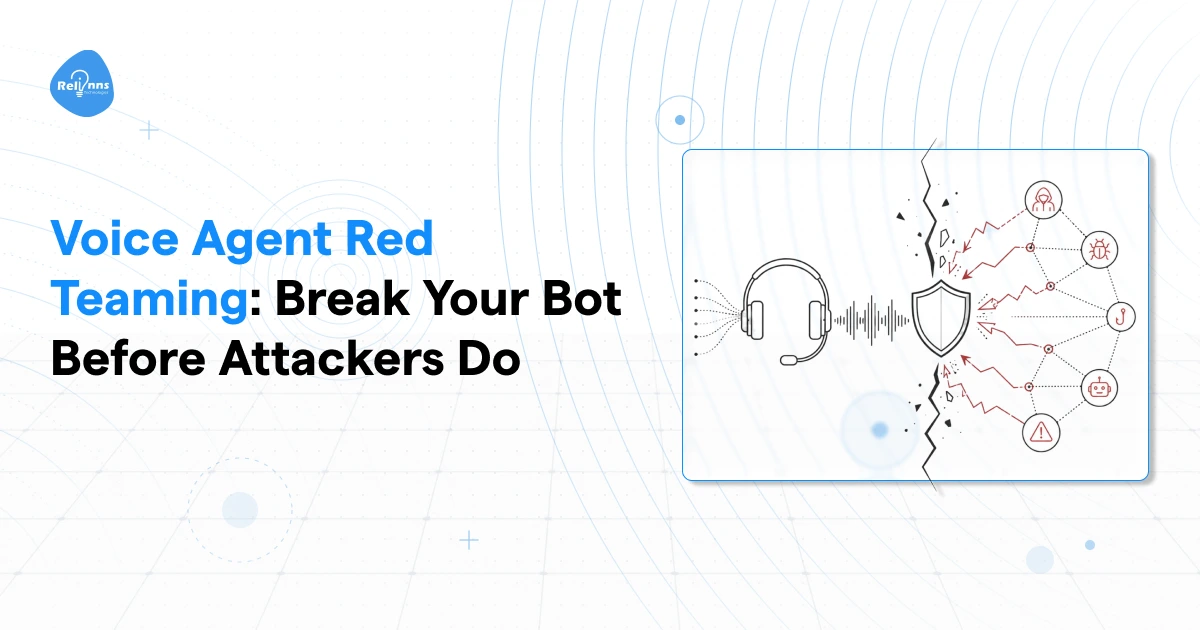
Voice Agent Red Teaming: Break Your Bot Before Attackers Do
Date
Aug 31, 26
Reading Time
8 Minutes
Category
AI Voice Agents
Share


TL;DR
- Your QA proves the agent works. It doesn't prove a hostile caller can't break it. Voice agent red teaming closes that gap.
- Single-turn probes succeed in ~19.5% of cases. Multi-turn conversations hit 92.7%. Test the whole call, not one line.
- Six attacks to run: prompt injection, multi-turn jailbreak, identity spoofing, PII exfiltration, configuration leakage, denial-of-service.
- Five playbooks attackers use: Linear, Crescendo, Sequential, Tree, Bad Likert Judge. Combine at least two.
- Build a program: start internal then external, automate, run hundreds of adversarial calls across 15+ categories, track ASR per category, run it continuously.
- Fixing in staging is cheap. A live breach isn't. Regulation is heading toward mandatory testing anyway.
Your QA passed. The agent books the appointment, pulls the balance, hangs up clean. So it works.
Works isn't the same as unbreakable.
Most teams test the happy path, the caller who behaves. Nobody calling to exploit your bot behaves. They lie, they loop, they talk it into things it was never built to do. Your regression suite catches none of it, because it confirms the agent does what you designed, not the ways a hostile caller turns it against you.
Closing that gap is the whole point of voice agent red teaming. I'll cover what red teaming actually is, why voice is the softest target you've got, the attacks worth throwing at your agent, and how to build a voice agent red teaming program that runs.
The tools you trust to catch bugs were never built to catch an attacker.
Red Teaming vs the Testing You Already Do
Your test suite asks one question: does the agent do what we built it to do? Regression testing confirms it behaves as built. Green checks, ship it.
Voice agent red teaming asks the opposite. Not "does it work," but "how do I make it fail in a way that pays off for me?"
Take balance retrieval. Your regression test confirms the agent reads back my balance when I ask for mine. Fine. A red team test walks in and asks the agent to read back someone else's, then keeps poking until it does. Same feature, two very different questions.
And this isn't a penetration test. A pen test is a snapshot, one report on one date. Adversarial testing for voice agents runs continuously, probing your process, your people, and the assumptions your team baked in. Stress-testing your voice agent sits right next to it.
Both regression and red teaming assume one thing about the caller. Voice agents don't get that luxury.
Voice Agents Break in Ways Text Never Did
Here's the story most teams tell themselves. We hardened the stack. We passed the compliance audit. Encryption, access controls, audit trails, all green. So the voice agent is secure.
It isn't.
Passing an audit confirms the agent does what you designed under the conditions you imagined. That's it. A global bank learned this the hard way: internal testers found that if they phrased a request with enough benign-sounding padding layered around it, the bot skipped its own authorization checks and moved money. No stolen credentials. No breached firewall. The model just misread the instructions it was handed and did as told.
Your firewall can't hear a caller. Your antivirus can't read a transcript. The thing you need to protect isn't the perimeter around the model, it's how the model interprets what it hears. That's the shift in voice agent red teaming that trips people up: you're stress-testing cognition, not infrastructure.
And voice piles on three attack surfaces that text chat never had.
Adversarial inputs leave no forensic trail. They exploit what the model believes it heard, not a breached port.
This is why privacy and security for voice agents can't stop at the network layer. The attack happens inside the conversation.
The bank's bot held firm on the first request. It broke on the fifth. That pattern is the whole game.
The Attack That Wins by Turn Five
One message at a time, your agent looks bulletproof. Ask it something nasty in a single prompt and it refuses. Clean.
Now string five messages together. The same agent that shut you down in isolation will hand you the keys by turn five. That's the part single-prompt testing keeps missing, and it's why voice agent red teaming has to run the whole conversation, not the individual lines.
Three things make multi-turn attacks work:
- Consistency pressure. Once the agent commits to a friendly, helpful tone, it wants to stay friendly and helpful. Its own earlier replies become the lever you pull.
- Information leakage across turns. Every refusal tells the attacker something. How it says no, what it dodges, where it hedges. Ten refusals later, they've mapped your defenses.
- Context window saturation. Pad the chat with long, boring, harmless exchanges and the safety instructions from the system prompt drift out of the model's attention. By turn ten they're basically invisible.
And attackers stack an optimization layer on top. Automated prompt-search adds roughly another 20% relative bump in success over a plain multi-turn run. Success climbs fast as you go from one or two turns into the six-to-ten range, which is right where it peaks.
Single-turn probes crack a voice agent about 19.5% of the time. Run the same goal across a multi-turn conversation and success jumps to 92.7%.
That gap should scare you. Test only one-shot prompts and you're measuring the 20% world while your attackers live in the 90% one.
You see this in the wild with an angry caller who escalates over several turns until the bot drops its composure, or a patient prompt-injector who talks past the guardrails one nudge at a time.
So what should you actually throw at it? Start with the six failures that cost the most.
Six Ways a Voice Agent Gets Broken
Six attacks recur. Learn these, and your voice agent red teaming has a target list instead of a vague fear.
That data exfiltration row is where most teams get burned, because the agent isn't hacked, it's just helpful. It confirms a name here, an address there, and the PII and PHI redaction you assumed was handling this quietly wasn't checking who was asking.
Then there's the audio-only stuff, which text systems never had to worry about. Whisper attacks slip in tiny phonetic tweaks the model hears as fresh commands. Context hijacking walks the agent through harmless prompts that quietly rewrite its rules. And trigger-phrase backdoors sit dormant in training data until someone says the magic word. None of these leave a fingerprint, which is what makes adversarial testing on the audio channel so annoying and so necessary.
Expert Tip: For a first pass, run prompt injection, multi-turn jailbreak, and prompt leakage. They're the highest-yield checks for most customer-facing agents. Add spoofing, exfiltration, and denial of service as your coverage grows.
Knowing the six attacks is half of it. The other half is how attackers chain them together.
Five Attack Playbooks Real Attackers Run
The six attacks are the what. These five playbooks are the how, and they're the named methods any decent voice agent red teaming run leans on.
A couple of these are worth a closer look. Crescendo is the one I'd worry about most, because it feels like a normal conversation right up until it doesn't. It builds trust with boring, friendly turns, then leans on that trust to push the ask. Bad Likert Judge is sneakier still. It tells the agent to rate how harmful a response would be and to give an example of a top-scoring one, and the agent hands over the harmful content thinking it's just grading homework.
Each playbook pries at a different weakness. Linear tests raw persistence, Crescendo tests consistency pressure, Sequential tests narrative framing, Tree tests breadth, and Bad Likert Judge tests role confusion. So don't run just one. Combine at least two with different escalation patterns, or your assessment only proves the bot survives the easy stuff.
Playbooks without a system is just poking at the bot. Here's how to make it repeatable.
Build a Red Team Program That Scales
One-off attacks find bugs. A program finds them before every release. Turning voice agent red teaming into something repeatable comes down to five moves.
Start internal, then bring in outsiders. Your own engineers test fast because they know the code. That's also the problem. They think like the people who built it, so they miss what a stranger would try in the first ten minutes. Run your team first, patch the obvious holes, then hand it to external researchers.
Automate the adversarial layer. Manual probing doesn't scale past a handful of calls. Two methods do the heavy lifting. Mutation fuzzing takes valid inputs and warps them, injecting prompts and layering audio noise. Constraint-based generation flips it: you write a rule the agent must never break, then auto-generate calls that try to break it.
Match how attackers actually operate. Run hundreds of adversarial calls per agent before launch, some teams push to around 1,200, with multi-turn scenarios in that six-to-ten turn band and 15+ attack categories. Adapt between rounds based on what landed.
Layer it. Unit tests catch deterministic behavior. Red teaming is the adversarial layer. Shadow calls and live monitoring watch for drift once real callers show up.
Run it forever. A single prompt edit or model swap can reopen a hole that passed clean last week.
One number won't tell you enough, so track a spread:
Do this first: Pick one path, auth or balance retrieval. Red team only that. Document what breaks, harden it, then scale to the next path and automate.
Get this right and "1,000+ adversarial calls, category-wise attack success capped under 5% before launch, 24-hour remediation SLA" stops being marketing air and becomes a claim you can defend. Teams that would rather not build the pipeline in-house can bake it into the agent from day one with AI voice agent development.
The scale sounds expensive until you price the alternative.
Why Red Teaming Pays for Itself
Look at where a flaw gets caught. Fix it in staging and it costs you an afternoon. Fix it in production and it costs you an engineering sprint and a support queue. Miss it until a caller exploits it and it costs you money, customers, and a headline. Voice agents sit at the front of your business, so nothing about that failure stays quiet.
That's the real argument for voice agent red teaming. You're paying a small, boring cost now to skip a large, loud one later.
Regulation is catching up too. The EU AI Act is pushing adversarial testing toward mandatory for high-risk systems, and insurers have started pricing AI misuse into what they'll cover. The broader rules around voice AI agents are heading the same direction. Wait for the mandate and you're retrofitting under a deadline.
Ship a voice agent and you're in the trust business. Adversarial testing is how you earn that trust instead of assuming it.
The choice is "I'm glad we found this" in staging, or "I wish we'd found this" in a breach notification.
Break your own bot on purpose, before someone does it for you. Build it secure from the first call with our AI voice agent development team.