What are White Label AI Voice Agents? A Simple Guide
Date
Aug 31, 26
Reading Time
6 Minutes
Category
AI Voice Agents
Share


TL;DR
- White labeling ranges from basic rebranding to complete vendor invisibility.
- A true white-label setup covers branding, infrastructure, and commercial ownership.
- Referral partners earn commissions; white-label partners own clients, pricing, and billing.
- Building provides maximum control but requires more time, money, and engineering.
- Licensing offers faster entry while preserving ownership if the contract protects it.
- Check branding, compliance, data portability, margins, support, and invoicing before signing.
White label AI voice agents get sold on one promise: put your logo on someone else's platform and call it yours.
Voice agents have already become standard infrastructure for handling calls, so it makes sense that people want their own name on that tech rather than someone else's.
But open the dashboard on most white label voice agent platforms, and you'll still spot the original company somewhere.
A login screen with a different logo. A billing email landing in your client's inbox from an address that isn't yours.
White labeling runs on a scale, somewhere between barely rebranded and fully invisible. The amount of vendor still showing through decides who owns the client relationship when it counts, not what the sales page promised.
Most resellers only find out where their white label AI voice agent sits on that scale after a client figures out they can go straight to the source.
The Seam Nobody Mentions in the Sales Deck
White label AI voice agents have a seam, and it never shows up in the demo. It shows up weeks later, when your client's dashboard sends a password reset email from someone else's domain.
Or a support ticket comes back signed with the vendor's actual name. Small stuff. Until a client gets curious enough to Google it, find a help article naming the real platform, and the curtain's gone.
Now they know. And nothing stops them from skipping you at renewal and going straight to whoever built their white label voice agent. You weren't selling a product. You were selling a coat of paint.
This usually surfaces around the same time a client starts comparing what they're paying against what the platform costs to run. If their voice AI cost model only works because they don't know the real number, that's not a business. That's a countdown.
A referral fee and an owned client relationship aren't the same business. Even on identical software.
Most white label AI voice agents quietly fail this test. Nobody sends an email; the client stops renewing. There's a way to build this with no seam at all, and it's not what most people picture when they hear "white label."
What White Labeling Actually Means for a Voice Agent
A white label AI voice agent is a voice platform that one company builds, then another company rebrands and resells as if it were their own.
That's the whole thing. No magic, no secret model hiding underneath. Just licensing and a new coat of paint.
You're not building anything when you go this route; you're renting the brains and putting your name on the front door. The call handling, the AI model, the actual engineering- somebody else already did that work.
So who buys white label AI voice agents? Agencies that want to sell voice tech without hiring engineers. Software companies bolting a voice layer onto a product that never had one. MSPs folding it into a stack their clients already trust them to run. Sometimes a company just wants something that feels homegrown, without spending a year building it from scratch.
But here's the catch. Branding is the easy 20% of white label AI voice agents. The real test happens somewhere the customer never thinks to look.
The Three Layers Behind Every White Label Voice Agent
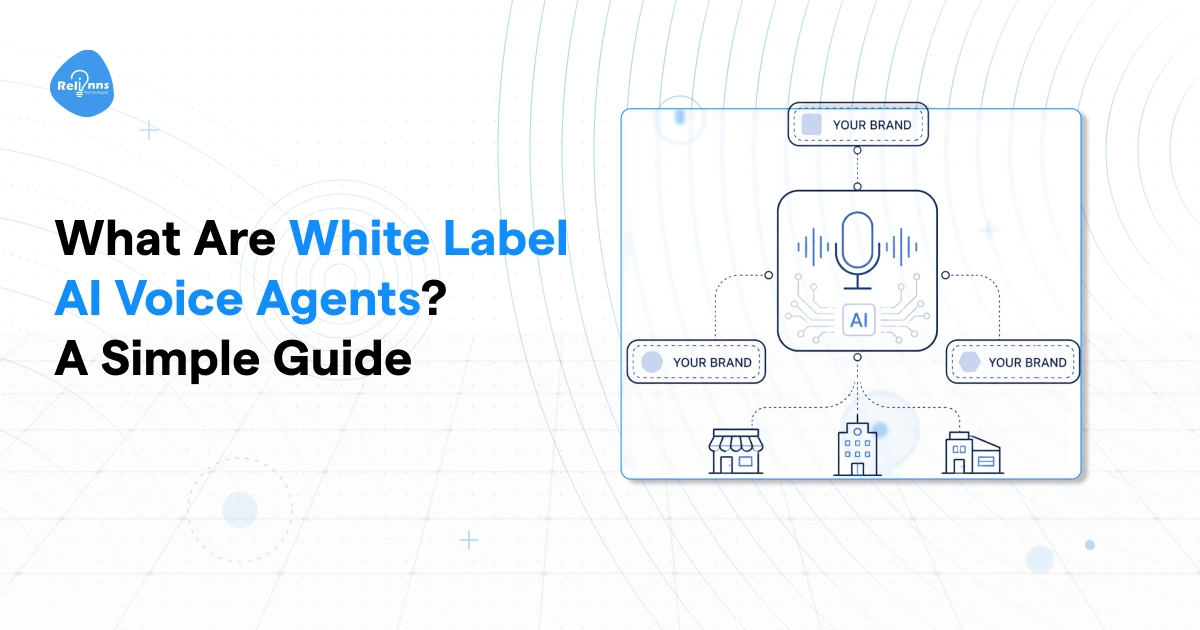
Three layers make up every white label AI voice agent, and only one of them is visible to the client actually using it.
Start with the brand layer, since it's the one everyone fixates on. Custom domain for the dashboard. Your name, your logo, a voice persona you picked instead of whatever shipped by default. Vendor attribution stripped out of the reports, the emails, the call summaries, anywhere a client might actually look. It feels like ownership. Mostly, it's paint.
The agent's voice has to sound convincing, not robotic, or none of that paint matters. A flawlessly rebranded dashboard wrapped around a voice that sounds like an old GPS unit isn't winning anyone over.
But the infrastructure layer is where the real engineering lives, and nobody outside your dev team asks about it until it breaks. The telephony backbone actually routing calls, usually something like Twilio underneath. The speech models converting audio into text and back. The LLM doing the work of figuring out what a caller actually wants. None of it carries your logo. It can't. The SIP trunking and telephony layer beneath the rebrand stays exactly the same, no matter whose name is on the dashboard above it.
Then comes the commercial layer, the one most people skip past while they're busy admiring the logo. Who actually sets the price the client sees. Whether the deal runs on a flat license or a usage-based voice AI cost model. Whether you can pull your client's call history and configurations out if you ever walk away. Whose name lands on the invoice every month.
Here's my honest take: most teams building a white label AI voice agent spend 80% of their evaluation time on the brand layer and maybe 10% on this one. That's backward.
Brand and infrastructure get demoed. Commercial terms get buried in a contract nobody rereads twice, and that's exactly where ownership of a white label voice agent actually gets decided.
Whoever controls the contract controls the client. Everything else is decoration.
You're Not as White Label as You Think
Reseller, referral partner, white label partner. People use these words for white label ai voice agents like they're interchangeable. They're not. The gap between them is about money, not vocabulary.
A referral partner sends the lead and earns a commission. The vendor keeps the client, the relationship, the invoice. A true white label partner is a different deal entirely. You own the relationship, set the price, bill directly, and the vendor disappears behind your brand.
Same software, sometimes. Completely different business.
I'd argue the word "reseller" should just retire. It gets used for both setups and is honest about neither.
But the gap compounds too. Every month a referral client stays active, you're collecting a sliver while someone else banks the rest. Run that for two years, and it's not a rounding error; it's the entire margin you assumed was yours.
Don't take a sales deck's word for which one you are. Read the contract. Ask three things before signing anything.
Does my brand replace the vendor's everywhere, including support emails, not just the dashboard?
Do I set the price the client sees, or does the vendor set it and hand me a cut?
Can I export my client's data and configurations the day I leave?
The contract decides which one you are. The sales deck never does.
Answer yes to all three, and you're running a real white label voice agent. Miss even one, and you're a referral partner with better branding.
Once that's settled, picking between building, licensing, or referring a white label ai voice agent gets a lot less confusing, especially once you start comparing platforms side by side before assuming any of them work the same way underneath.
Build, License, or Refer: Which Path Actually Fits
Three paths exist for white label AI voice agents: build one yourself, license a white label voice agent platform, or stay a referral partner taking whatever cut someone else allows. Three different businesses, dressed up to look the same.
This is the same build versus buy question that comes up everywhere in AI. Build in-house, and you own everything: the code, the timeline, the client relationship. For teams set on building one from scratch, that ownership comes with no vendor strings attached. It also comes in months, not weeks. I'd skip this path unless you've already got engineers sitting idle.
License a white label ai voice agent platform and the timeline drops to weeks. You still own the client relationship, assuming the contract says so in writing, not a sales call's promise. You're renting the engine, not building one. Most companies evaluating white label AI voice agents end up here, in the middle.
If licensing is the right path, compare the best white label voice agent platforms on branding completeness, client ownership, data portability, margins, and compliance before signing.
Stay a referral partner, and you skip both the build and the license fee. You also don't own anything that matters. The vendor keeps the client, keeps the invoice, and hands you whatever cut they decide.
Expert tip: Get "white label" defined in writing before comparing per-minute pricing across vendors. A sales call promising your branding everywhere means nothing once the contract shows up without it.
Look at that margin row again. That gap is a voice AI return-on-investment question hiding behind a branding decision. Building costs more upfront but pays more over the years. Referring costs nothing and pays the least, forever.
The margin row is the real decision here. Everything else is logistics.
Pick whichever path fits your team. But even the right pick leaves one thing open: what happens when a fully licensed white-label voice agent still has a seam that nobody mentioned during the demo?
Choosing a Partner Who Actually Disappears
Four things matter when you're vetting white label AI voice agents, and none of them are the dashboard color.
Brand completeness. Does your logo replace the vendor's everywhere, not only the parts you remember to check. Infrastructure reliability and compliance. Will the platform answer questions about uptime and data handling rather than dodge them? Data portability. Can you walk out with your client's history if the relationship ends? Margin structure. Do you set the price, or inherit whatever cut someone handed you?
Get all four right, and you've found a real white label voice agent. Miss even one and you're renting a logo, not a business. Rank them if you want. I'd put margin structure first. It's the one people skip.
This is the whole point we started with. Real white labeling means the vendor disappears everywhere: the dashboard, the contract, the invoice, the support thread your client might stumble into.
Some teams don't want white label AI voice agents at all, not even the good ones. They want zero vendor dependency, all the way down to the infrastructure. No platform underneath, no roadmap that isn't theirs.
That's a different conversation. A voice agent built with no vendor lock-in, from the ground up, on terms nobody else gets to change.