AI Patient Appointment Scheduling in Healthcare
Date
May 13, 26
Reading Time
10 Minutes
Category
Generative AI
Share


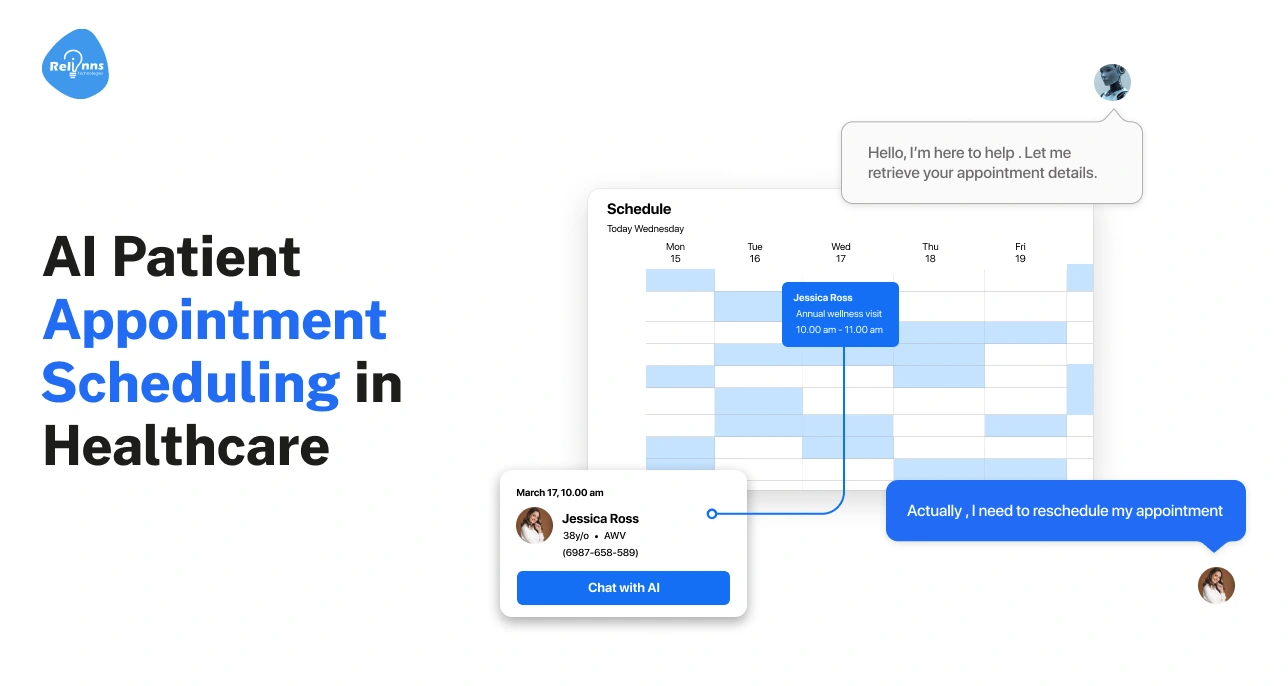
Missed appointments cost healthcare providers billions every year. The result? Wasted time, frustrated patients, and lost revenue.
Many clinics still rely on manual scheduling or basic reminder calls. These methods are slow, error-prone, and impersonal.
That’s where artificial intelligence steps in. AI patient appointment scheduling can streamline bookings, send smart reminders, and even adjust schedules automatically. It reduces no-shows, eases staff workload, and keeps patients engaged.
In this guide, we’ll explore how AI is transforming healthcare scheduling and why providers are adopting it fast.
TL;DR: AI-Driven Patient Appointment Scheduling
- What It Does: Automates booking, reminders, and follow-ups to simplify scheduling and reduce manual work
- Why It Matters: Cuts no-shows, fills empty slots faster, and improves patient communication without adding staff
- How It Works: Uses AI, chatbots, and predictive logic to manage intake, scheduling, rescheduling, and waitlists in real time
- Where It Helps Most: Primary care, diagnostics, specialty clinics, and high-volume practices with frequent cancellations
- What to Get Right: Integrate with EHRs, design smart scheduling rules, and keep a human fallback for complex cases.
- How to Measure Success: Track no-shows, fill rates, booking time, and staff workload to see real impact quickly.
What AI Patient Appointment Scheduling Means in Healthcare
AI patient appointment scheduling is when healthcare providers use artificial intelligence to automate, enhance, and manage patient bookings, reminders, and follow-ups.
It helps clinics reduce missed appointments, improve patient communication, and optimize provider schedules, all without adding more staff.
Let’s break down what makes AI different and where it fits in everyday healthcare workflows.
How AI Appointment Scheduling Differs from Traditional Systems
Beyond basic automation, AI scheduling delivers measurable improvements in patient experience and operational visibility.
| Feature | Traditional Scheduling | AI Scheduling |
| Appointment Booking | Manual entry by staff | Automated patient intake and smart slot allocation |
| Staff Workload | High; many calls and follow-ups | Reduced; AI handles reminders and reschedules |
| Error Rate | Human errors are common. | Minimizes double-booking and missed slots |
| Efficiency | Limited; dependent on office hours | Operates 24/7, adjusts in real-time |
| Patient Experience | Generic, impersonal interactions | Personalized reminders, confirmations, and follow-ups |
| Data & Reporting | Basic logs, limited insights | Analytics on no-shows, peak demand, and workflow efficiency |
The gap isn't just operational. It's the difference between a clinic patients trust and one they quietly stop visiting.
Basic Appointment Reminder Tools vs AI-Power Reminders
Another question arises with the need of adopting AI when reminder tools already exist. We've broken down the key differences below for you to see exactly where basic tools fall short.
| Feature | Basic Reminder Tools | AI-Powered Reminders |
| Personalization | Generic calls or texts | Tailored messages based on patient history and preferences |
| Follow-Up | Only initial reminders | Automated rescheduling, waitlist backfill, and follow-ups |
| Interaction | One-way communication | Two-way conversational AI for confirmations and questions |
| Adaptability | Static schedule | Learns patterns, optimizes over time |
Simply put, a reminder tool tells patients when to show up. AI scheduling makes sure they actually do.
Where AI Fits in the Patient Scheduling Workflow
AI doesn't sit on the sidelines. It runs through the entire scheduling process: intake, booking, confirmations, rescheduling, and follow-ups.
It handles the repetitive, time-consuming tasks that slow your staff down. Your team stays focused on patients who need real attention.
The result is a workflow that's faster, tighter, and a lot less dependent on who picked up the phone.
Many healthcare providers looking to implement this effectively work with AI solutions experts like Relinns Technologies to build AI-driven scheduling and patient engagement solutions tailored to real clinical workflows.
Why Healthcare Providers Are Using AI for Patient Scheduling and Appointment Reminders
Healthcare providers face constant pressure to keep schedules full and patients happy. AI makes this easier. Clinics are adopting it not just for convenience, but for real, measurable benefits.
Here’s why artificial intelligence has gained traction among healthcare providers for scheduling and reminding patients:
Reducing No-Shows and Missed Appointments
AI sends timely, personalized reminders and confirmations. It can follow up automatically and even reschedule when patients cancel. The result: fewer empty slots and more patients seen.
Example: A patient who books a follow-up three weeks out gets a reminder at seven days, three days, and the morning of the appointment, across their preferred channel, without a single staff member making a call.
Lowering Administrative Workload for Staff
Front desk teams spend hours on calls and follow-ups. AI handles routine scheduling tasks, freeing staff to focus on complex cases or patient care.
Consider: A busy primary care clinic fielding 80 calls a day. With AI handling confirmations and rescheduling, that number drops significantly, and staff actually have time to focus on the patients in front of them.
Improving Patient Access and Scheduling Speed
Patients can book anytime through apps, portals, or messaging. AI matches them with the right provider and available slot quickly, reducing wait times.
When a patient needs an appointment at midnight, it is available. No hold music. No waiting until Monday morning.
Optimizing Provider Utilization and Clinic Capacity
AI tracks schedules in real time, fills cancellations, and balances appointments across providers. Clinics get better use of rooms, equipment, and staff time.
For instance, if Dr. A has a cancellation at 2 PM, the system immediately contacts the next eligible patient on the waitlist and fills the slot before the gap becomes a loss.
Enhancing Patient Reminders and Communication Consistency
AI ensures reminders are consistent, clear, and personalized. Patients receive updates via multiple channels (text, email, or chat), without staff intervention.
As patients already expect instant, effortless communication from every service they use, a clinic that delivers that experience builds trust before the appointment even begins.
Taken together, these benefits don't just improve operations. They make the clinic a place patients actually want to return to.
How AI Patient Appointment Scheduling Works: A Step-by-Step Overview
AI doesn't just automate; it thinks and adapts. Here’s how a typical AI-driven scheduling workflow runs behind the scenes:
| Step | The AI Impact |
| Patient Intake & Booking Capture | Patients book via app, AI chatbot, or voice. NLP and conversational AI capture details accurately, skipping manual entry errors. |
| Intelligent Provider Matching & Slot Allocation | Matches patients to the right provider and slot. Machine learning predicts optimal times and balances workloads. |
| Automated Confirmations & Patient Reminders | Generative AI and chatbots send texts, emails, or calls. They answer questions, confirm appointments, and adjust reminders automatically. |
| Rescheduling & Cancellation Handling | AI spots cancellations instantly. Conversational AI suggests new slots so no time goes unused. |
| Waitlist Backfilling & Slot Optimization | AI fills gaps from waitlists automatically. Predictive analytics keeps providers busy without overbooking. |
| Follow-Up Scheduling & Repeat Visit Coordination | Automatically schedules chronic care or post-procedure visits. Generative AI ensures follow-ups happen on time. |
Quick Takeaways:
- Makes scheduling effortless for patients and staff
- Maximizes room and provider usage
- Uses NLP, conversational AI, generative AI, and predictive analytics to improve over time
- Supports multiple channels: chat, text, email, and voice
Want to understand the technology behind this? Our guide on AI chatbots in healthcare breaks down exactly how conversational AI handles patient interactions end to end.
How Automation Improves Patient Appointment Scheduling
AI-powered automation in scheduling isn’t just about saving time but transforming how clinics operate.
Artificial intelligence tools handle routine tasks, optimize workflows, and keep patients on track. Here’s how it makes a difference:
- Reduced Manual Inefficiencies: AI handles bookings, confirmations, and updates automatically. No more double entries, missed calls, or spreadsheet juggling.
- Faster and More Accurate Appointment Matching: Machine learning matches patients to the right provider and time, reducing errors and scheduling conflicts.
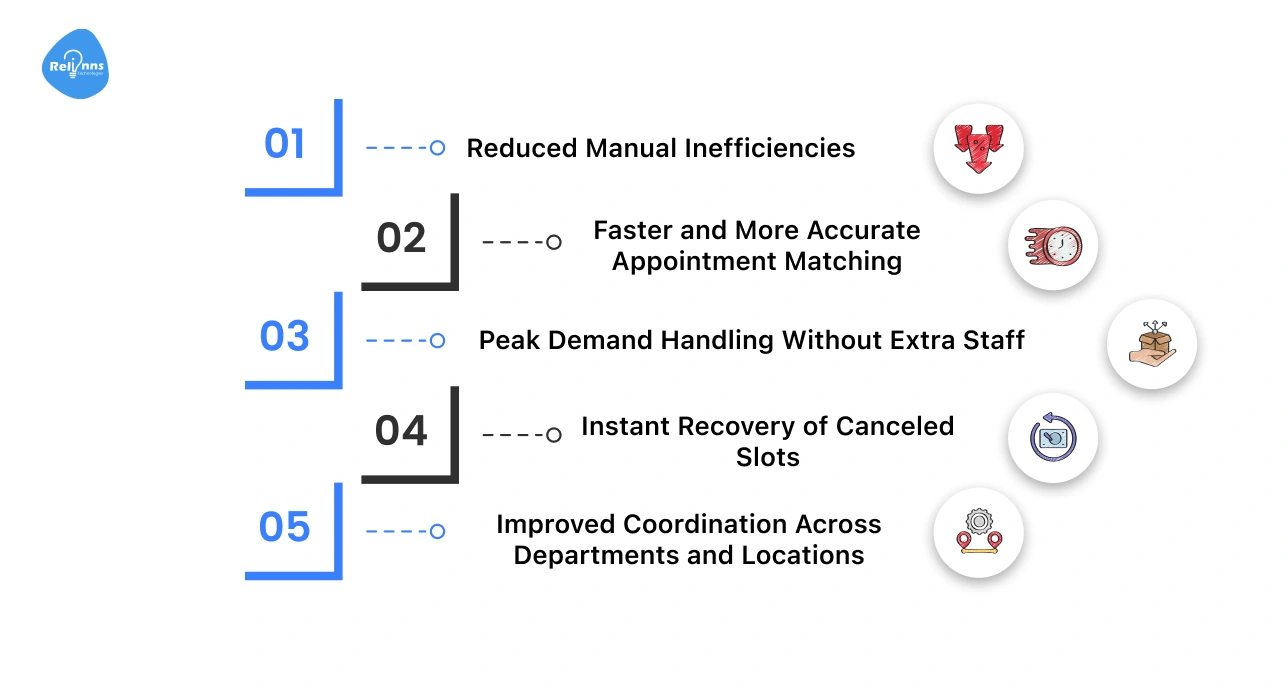
- Peak Demand Handling Without Extra Staff: During busy periods, predictive algorithms adjust schedules in real time, keeping appointments flowing smoothly.
- Instant Recovery of Canceled Slots: AI spots cancellations, offers new slots, and notifies patients automatically. Empty slots don’t stay empty.
- Improved Coordination Across Departments and Locations: Real-time schedules sync across teams, rooms, and clinics. NLP and conversational AI help streamline patient communication at every touchpoint.
Thus, AI automation improves patient experience and clinic efficiency.
By combining predictive analytics, conversational AI, and smart scheduling logic, healthcare providers can reduce no-shows, free up staff time, and ensure patients get care when they need it.
To see how this fits into the bigger picture, read our guide on how AI drives healthcare automation and improves workflows.
AI Scheduling in Action: Real Use Cases Across Healthcare Settings
Intelligent scheduling systems work differently depending on the care setting. Here's where it's already delivering results:
| Use Case | How AI Helps | Example |
| Primary Care | Automates routine visits and same-day bookings | A patient books a flu shot online and receives instant AI chatbot confirmation. |
| Specialty Care | Matches patients with the right specialist quickly | AI finds the earliest cardiology slot based on urgency and availability. |
| Diagnostics & Procedures | Manages lab tests, MRIs, and surgical slots efficiently | MRI cancellations are filled automatically from the waitlist. |
| Follow-Ups & Chronic Care | Schedules recurring visits automatically | AI reminds diabetic patients of quarterly check-ins and schedules them. |
| High-Volume Clinics | Balances appointments to prevent bottlenecks | AI redistributes appointments during peak demand. |
| Multilingual Communication | Sends reminders in patients’ preferred language | Spanish-speaking patients get automated reminders in Spanish. |
Across every care setting, the pattern is the same: less manual work, fewer missed appointments, and a smoother experience for both patients and staff.
HIPAA-Compliant Conversational AI for Healthcare Appointment Reminders
When it comes to US healthcare, HIPAA compliance is one of the most talked about requirements - and one of the most misunderstood.
Most clinics know they need it. Fewer know exactly where AI-powered patient communication fits in. Here's what you need to get right.
(If you want a deeper foundation first, our guide on HIPAA compliance for SaaS covers the core requirements every healthcare technology team should know.)
Why Compliance Is Critical in Patient Communication
A simple reminder can include a patient’s name, appointment details, or medical context. That’s protected health information.
One unsecured message is all it takes to create a liability. HIPAA exists to make sure every patient interaction, automated or not, is handled with the privacy it deserves.
How Conversational AI Secures Reminder Workflows
The old reminder model was one-way: send a text and hope the patient reads it.
Conversational AI turns this into a secure, two-way interaction. Patients can confirm, cancel, or reschedule through chat or voice, without calling the clinic. At the same time, HIPAA-compliant systems ensure that sensitive data is protected through encryption, controlled access, and minimal data exposure.
For instance, a patient scheduled for a follow-up receives a secure message: “Your appointment is on Thursday at 10 AM. Reply 1 to confirm or 2 to reschedule.” No sensitive medical details are exposed, and responses are handled within a HIPAA-compliant system with access controls. The patient reschedules with a single reply. The slot opens, the waitlist is notified, and the schedule updates automatically.
This way, clinics improve efficiency without compromising patient privacy or compliance.
Secure Communication Channels and Data Handling
Compliant AI systems use encrypted channels: secure SMS, dedicated apps, or patient portals. Data is protected in transit and at rest. Patient information doesn't pass through unsecured third-party systems at any point.
For instance, a reminder sent through a HIPAA-compliant portal displays only the appointment time and provider name. No diagnosis, no medical history, nothing that shouldn't be in a message.
Audit Trails, Authentication, and Access Control
Every interaction is logged. Clinics can see exactly who accessed what, and when. Role-based access controls mean only authorized staff can view or modify patient records, keeping exposure risk low.
Best Practices for Compliant AI-Powered Patient Reminders
Use encrypted platforms. Keep sensitive data out of reminder messages. Collect patient consent at intake. And always maintain a human fallback for situations the AI isn't equipped to handle.
When done right, conversational AI doesn't just automate reminders. It makes them more secure, more consistent, and far more patient-friendly than anything a manual process can deliver.
AI Appointment Scheduling Best Practices Every Healthcare Provider Should Follow
AI can improve scheduling quickly, but only if it is implemented the right way. The following best practices help you get results that are consistent, scalable, and easy to sustain.
Start with High-Impact Workflows
Reminders and confirmations are the fastest wins. Start here before automating anything else.
- Begin with reminders and confirmations.
- Reduce no-shows with minimal setup.
- Free up front desk time quickly.
Integrate with EHR and Practice Management Systems
Disconnected systems create gaps. Integration ensures your AI works with the data it needs, not around it.
- Sync schedules in real time to avoid conflicts.
- Access provider availability and patient data instantly.
- Ensure accurate bookings without manual checks.
Design Scheduling Logic for Urgency and Duration
Not every appointment is the same. Your scheduling logic needs to reflect that from day one.
- Differentiate between routine and urgent visits.
- Allocate time based on appointment type.
- Prevent overbooking and long wait times.
Maintain Human Fallback for Complex Cases
AI handles volume well. It doesn't handle nuance well. Know where to draw the line.
- Route edge cases to staff when needed.
- Allow patients to connect with a human easily.
- Handle sensitive or unclear situations better.
Monitor Performance and Optimize Workflows
Implementation isn't a one-time event. What works in month one may need adjusting by month three.
- Track no-show rates and booking speed.
- Measure slot utilization and staff workload.
- Continuously refine workflows based on data.
Design for Accessibility and Patient Preferences
Patients have different needs and different comfort levels with technology. Build for all of them.
- Support booking via chat, text, or voice.
- Offer multilingual communication options.
- Keep interfaces simple and easy to use.
Getting these fundamentals right from the start means fewer course corrections later, and a system your staff and patients will actually use.
What the Right AI Patient Appointment Scheduling Solution Should Actually Do
Choosing the right solution isn’t just about features; it’s about how well it fits your workflows and improves day-to-day operations.
Here’s what to evaluate:
- EHR and System Integration Capabilities: The solution should connect seamlessly with your EHR and practice management systems. Real-time data sync ensures accurate scheduling and avoids manual work.
- Real-time Availability and Calendar Synchronization: Look for systems that update schedules instantly. This prevents double bookings and ensures patients always see the latest availability.
- Multichannel Patient Reminders and Communication: Patients should receive reminders via text, email, chat, or voice. Consistent communication improves confirmations and reduces no-shows.
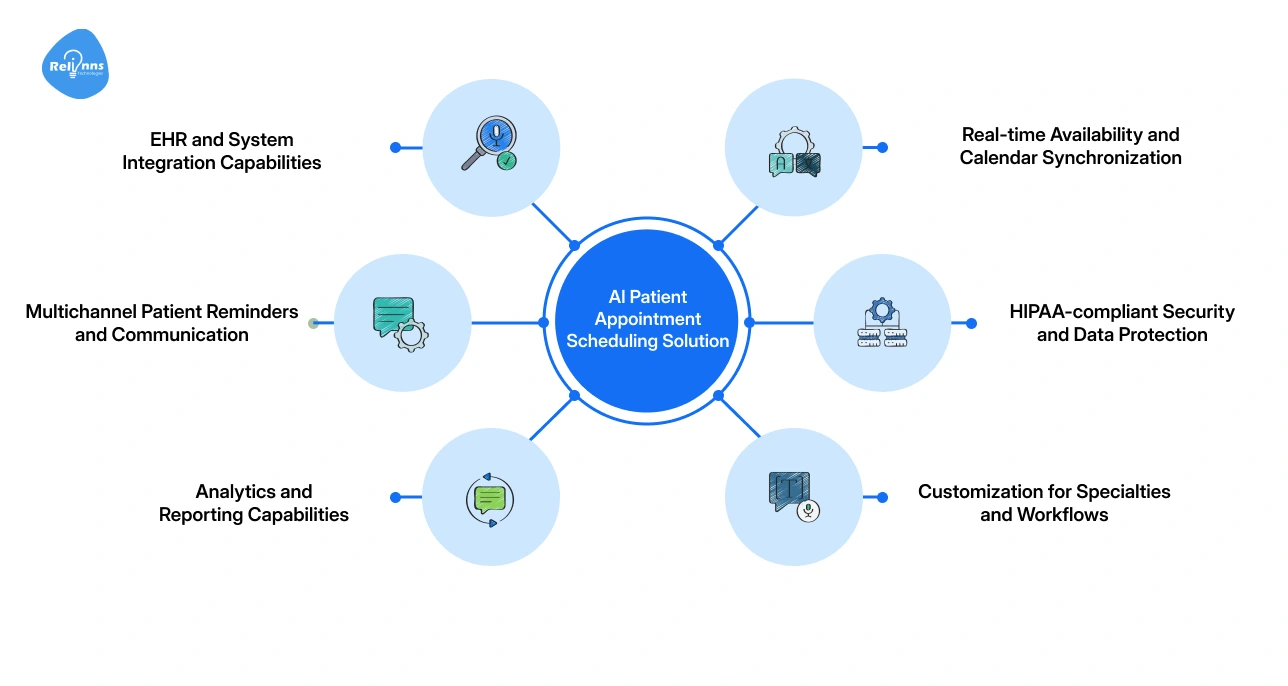
- HIPAA-compliant Security and Data Protection: Ensure the platform uses encryption, secure access controls, and compliant data handling to protect patient information.
- Analytics and Reporting Capabilities: Strong reporting helps track no-shows, booking trends, and performance. These insights help optimize scheduling over time.
- Customization for Specialties and Workflows: Every clinic is different. The system should adapt to appointment types, durations, and specialty-specific needs.
The right solution doesn't just check these boxes; it makes every one of them feel effortless in practice.
Working with a healthcare-focused AI partner like Relinns Technologies can help healthcare providers design and build custom AI scheduling solutions that integrate seamlessly with existing systems, align with clinical workflows, and meet strict compliance requirements, without adding complexity for your staff.
Key Metrics to Measure AI-Driven Patient Appointment Scheduling Success
Tracking the right metrics helps you understand if AI is actually improving scheduling performance. Here’s a quick overview of the core indicators to focus on:
| Metric | What It Is | Typical Improvement Range |
| No-Show Rate Reduction | Drop in missed appointments after AI reminders | 20-40% reduction (varies by specialty and reminder strategy) |
| Appointment Fill Rate (Post-Cancellation) | Percentage of canceled slots refilled automatically | Up to 70-90% with effective waitlist and automation systems |
| Average Time to Schedule | Time taken to book an appointment | Often reduced significantly, in some cases to under a few minutes |
| Administrative Workload Reduction | Decrease in manual scheduling tasks | 30-50% reduction depending on automation level |
| Patient Engagement with Reminders | Percentage of patients responding to reminders | 60-80% response rate for SMS and conversational channels |
| Wait Time to Next Available Appointment | Time until the next open slot | 15-30% reduction depending on capacity and demand patterns |
These benchmarks provide a directional view of performance improvements reported across AI scheduling implementations. Actual results may vary based on healthcare setting, system integration, and patient demographics.
Challenges and Risks of AI Patient Appointment Scheduling
AI patient appointment scheduling offers clear benefits, but it’s not without challenges.
From integration issues to patient trust, there are risks that healthcare providers need to plan for early. Understanding these helps you implement AI in a way that’s effective, safe, and scalable.
Integration and Data Silos
Challenge: Disconnected systems can lead to incomplete data and scheduling errors. For example, if your AI scheduling platform doesn't sync with your EHR, a provider's updated availability may not reflect in real time, leading to double bookings or missed appointments.
Solution: Integrate AI with EHRs and existing tools to ensure real-time data flow and accuracy.
Over-Automation Without Human Oversight
Challenge: Fully automated systems can struggle with complex or sensitive cases. Like, a patient calling to schedule after a difficult diagnosis who needs reassurance, not a chatbot running through available slots.
Solution: Maintain human fallback options for exceptions and edge cases.
Bias in Scheduling and Prioritization
Challenge: AI models may unintentionally favor certain patient groups or patterns. This happens when training data reflects historical inequities, such as longer wait times for certain demographics, and the model learns to replicate rather than correct them.
Solution: Regularly audit algorithms and use diverse data to reduce bias.
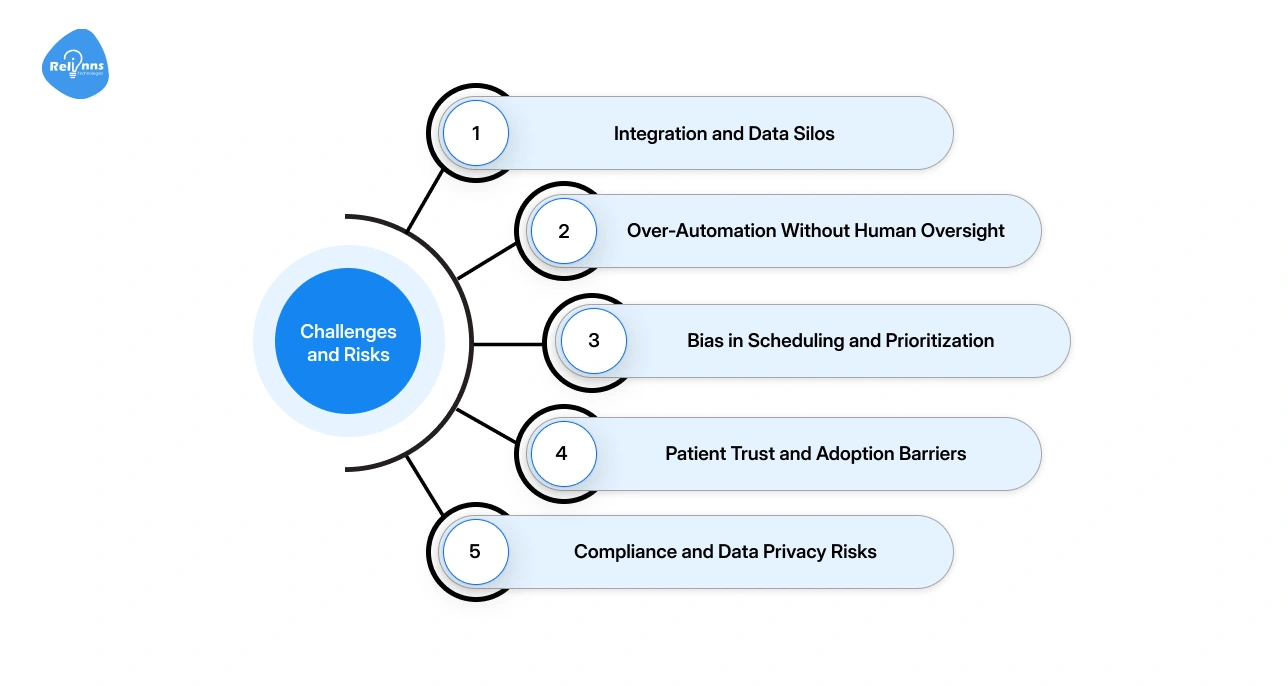
Patient Trust and Adoption Barriers
Challenge: Some patients may hesitate to interact with AI-driven systems. Such a barrier must be addressed early, because a patient who doesn't trust the booking process is a patient who picks up the phone or doesn't book at all.
Solution: Offer simple interfaces and clear communication, with easy access to human support.
Compliance and Data Privacy Risks
Challenge: Mishandling patient data can lead to serious legal and security issues. Sometimes, even a well-intentioned integration with a third-party tool that lacks a signed BAA is enough to create a compliance gap.
Solution: Use HIPAA-compliant systems with strong encryption and access controls.
These challenges are manageable. But they're far easier to handle before go-live than after. Plan for them early and your implementation will be on much stronger footing.
Closing Thoughts
AI patient appointment scheduling is no longer optional for growing healthcare providers. It solves real problems: missed appointments, staff overload, and poor patient communication.
With the right setup, AI handles bookings, reminders, and rescheduling with speed and accuracy. It keeps schedules full and patients informed. At the same time, it supports staff instead of replacing them.
Success depends on how well you implement it. Focus on integration, simple workflows, and patient trust.
When done right, AI scheduling creates a system that is efficient, reliable, and easy for both patients and providers to use.
Frequently Asked Questions (FAQs)
What is AI patient appointment scheduling?
AI patient appointment scheduling uses artificial intelligence to automate bookings, reminders, and rescheduling, helping healthcare providers reduce no-shows and manage schedules more efficiently.
How does AI reduce missed appointments in healthcare?
AI sends timely, personalized reminders across channels and allows easy confirmations or rescheduling, ensuring patients stay informed and less likely to miss appointments.
Is AI appointment scheduling HIPAA compliant?
Yes, AI scheduling can be HIPAA compliant if it uses encryption, secure access controls, audit logs, and avoids sharing sensitive patient data in unsecured communication channels.
Can AI scheduling integrate with EHR systems?
Most AI scheduling solutions integrate with EHR and practice management systems, enabling real-time data sync, accurate availability, and seamless appointment booking without manual intervention.
What are the benefits of AI in healthcare scheduling?
AI improves scheduling speed, reduces administrative workload, minimizes errors, increases appointment fill rates, and enhances patient communication through personalized, automated interactions.
Does AI replace front desk staff in clinics?
No, AI handles repetitive tasks like reminders and bookings, while staff focus on complex cases, patient interactions, and situations that require human judgment.
What features should an AI scheduling solution have?
Key features include EHR integration, real-time scheduling, multichannel reminders, HIPAA compliance, analytics, and customization based on specialty and appointment workflows.