Enhancing Healthcare Workflows with AI Automation
Date
Jun 16, 26
Reading Time
8 Minutes
Category
Generative AI
Share


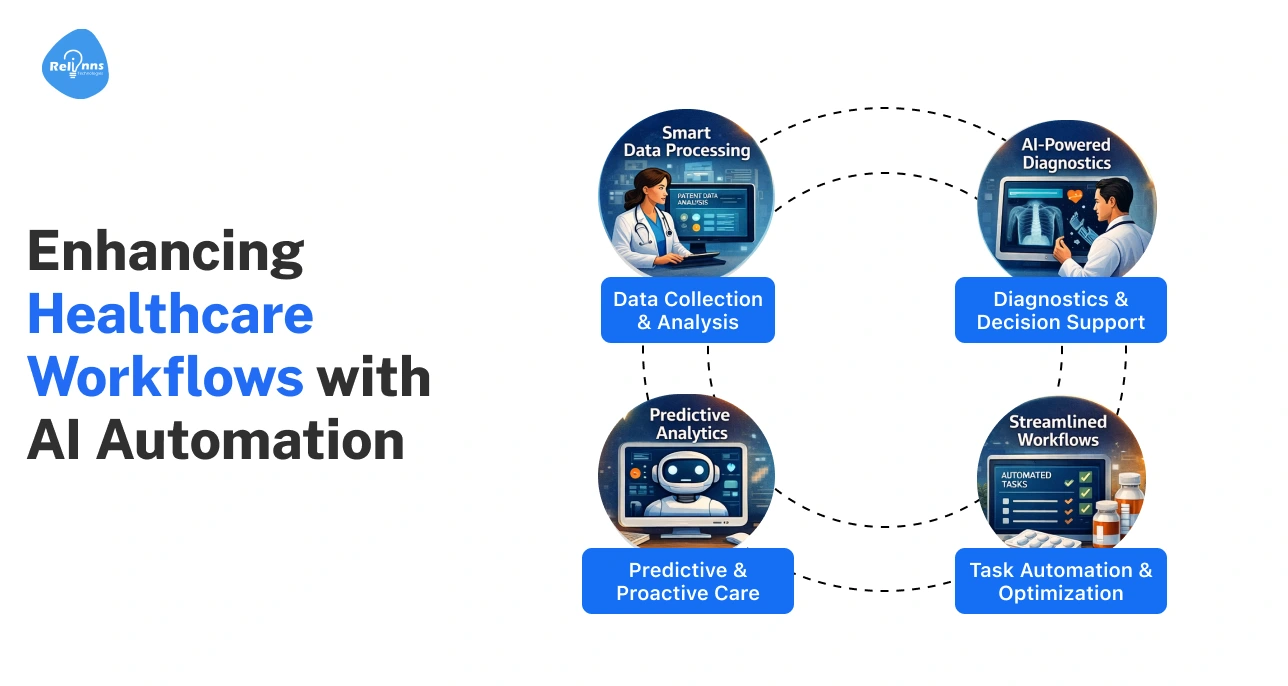
Most hospital delays don’t happen during treatment.
They happen in the workflow around it. Patient information must be entered, appointments scheduled, records updated, and approvals coordinated across departments. Many of these steps still rely on manual work or disconnected systems. As patient volumes grow, these inefficiencies can slow care delivery and increase the workload for clinicians and staff.
This is why healthcare workflow automation is gaining attention across the industry. By using AI to automate routine tasks and connect systems, hospitals can streamline operations and reduce delays.
In this guide, we explain how AI powers healthcare workflow automation, the key workflows it can automate, and how hospitals can implement AI to streamline operations and improve care delivery.
What is Healthcare Workflow Automation With AI?
Healthcare workflow automation with AI uses software and intelligent systems to handle routine tasks, coordinate processes, and move information across hospital systems.
Instead of relying on manual steps, AI can analyze data, trigger actions, and guide workflows so care teams can focus more on patients.
Before we dive into the specifics, we’ll look at how AI-driven automation differs from the traditional approach:
Traditional Automation vs AI-Driven Automation in Healthcare
The key difference between these approaches lies in how intelligently the system handles complex healthcare workflows.
Both automate tasks, but only one can learn, adapt, and improve workflows over time.
| Aspect | Traditional Automation | AI-Driven Automation |
| Logic | Follows fixed rules and predefined instructions | Learns from data patterns and continuously improves decisions |
| Flexibility | Works only in predefined scenarios | Adapts to changing inputs and situations |
| Decision support | Limited or none | Analyzes data and recommends actions or priorities |
| Data handling | Mostly structured data | Handles structured, unstructured, and multimodal data |
| Use cases | Simple task automation | End-to-end workflow coordination and optimization |
In short, traditional automation executes tasks, while AI for healthcare workflows understands processes and continuously improves how healthcare systems operate.
Key Technologies Powering AI Healthcare Workflows
Several technologies make AI workflow automation in hospitals possible. These include:
- Machine learning models to analyze clinical and operational data
- Natural language processing (NLP) to interpret clinical notes and patient communication
- Workflow orchestration platforms to automate and coordinate tasks across systems
- Integration APIs to connect EHRs, billing systems, and hospital software
- Predictive analytics to anticipate patient needs and workflow bottlenecks
Together, these technologies are powering AI healthcare solutions like healthcare chatbots and workflow assistants that help hospitals automate routine tasks, improve coordination, and support faster decision-making.
Many healthcare organizations looking to optimize their workflows gain from partnering with AI solutions providers like Relinns Technologies to reduce administrative burdens and enhance clinical decision-making.
Why Healthcare Organizations Need Workflow Automation
Healthcare organizations manage thousands of tasks every day.
For instance, a patient visiting the emergency department would need triage, diagnostic tests, specialist consultations, and documentation across multiple systems. These steps involve efficient and quick coordination between several departments and staff members.
This is why workflow automation for healthcare is becoming a priority for hospitals.
- Administrative Burden in Healthcare: Doctors and nurses spend significant time on documentation, scheduling, billing, and other administrative work. These tasks take time away from patient care and increase workload.
- Fragmented Healthcare Systems and Data Silos: Hospitals often use separate systems for EHRs, billing, labs, and imaging. When these systems do not communicate well, data must be transferred manually.
- Limitations of Traditional Automation Tools: Rule-based tools handle simple tasks but struggle with complex workflows. They cannot easily analyze clinical data or coordinate processes across departments.
Therefore, automating healthcare tasks with AI helps hospitals reduce manual effort and improve coordination across departments.
Key Healthcare Workflows That AI Can Automate
Hospitals, clinics, and other healthcare providers deal with a lot of operational tasks to ensure patients receive timely and coordinated care.
Introducing artificial intelligence in this domain means using intelligent systems to handle routine processes and support faster decision-making.
Here’s what AI solutions for healthcare workflow automation can do for you:
Patient Intake and Triage Automation
AI can collect patient information through digital forms or chat interfaces before a visit. It can review symptoms and flag urgent cases.
Example: An AI triage tool, such as Ada Health, can identify signs of severe chest pain and alert emergency staff immediately, reducing waiting time and speeding up triage.
Clinical Documentation and Medical Record Management
AI tools can convert doctor-patient conversations into structured notes. They also extract key details and update EHR records automatically.
For instance, after a consultation, the AI can summarize the visit and add it to the patient’s record.
Appointment Scheduling and Patient Communication
AI can manage appointment bookings, send reminders, and handle common patient requests automatically. Patients can confirm, cancel, or move their appointments through chat or messaging.
For example, if someone needs to shift a visit, the AI assistant can check available slots and update the schedule within seconds.
Diagnostic Workflows and Medical Imaging Analysis
AI can review medical images and highlight possible abnormalities.
Likewise, AI tools can flag suspected tumors in radiology scans so radiologists review urgent cases first.
Billing, Insurance, and Claims Processing
AI can verify insurance coverage, generate billing codes, and detect claim errors before submission. This helps hospitals process claims faster and lower rejections.
AI and automation in healthcare have become a key driver of operational efficiency for modern hospitals.
At this stage, it’s worthwhile to look at how AI workflow automation supports coordination across different healthcare departments, leading to faster decisions and more efficient patient care.
AI Workflow Automation Across Healthcare Departments
In a healthcare setting, a patient may move from screening to diagnostics, specialists, and follow-up care. When information moves slowly, delays happen.
AI workflow tools for multi-department healthcare cases help teams share data faster and keep processes moving.
| Healthcare Department | How AI Helps | Real-world Example |
| Emergency Department Triage and Case Prioritization | Reviews symptoms, vitals, and history to decide urgent cases | A patient reporting chest pain is marked “high priority” so staff can act immediately. |
| Radiology Workflow Automation | Interprets scans and highlights possible abnormalities for faster review | A system flags a “suspicious tumor” so the radiologist reviews that scan first. |
| Care Coordination Across Specialists | Shares patient data and updates across teams so everyone sees the same information | A cardiologist and radiologist review updated reports in the same patient record. |
| Hospital Discharge and Follow-Up Workflows | Prepares summaries, schedules follow-ups, and sends reminders | After surgery, the patient receives discharge instructions and the next appointment automatically. |
These workflows show how AI automation keeps departments connected and care moving smoothly.
The Architecture of AI-Powered Healthcare Workflow Automation Systems
Healthcare AI automation depends on a structured system that connects data, intelligence, and hospital operations. Each layer of the automation system plays a role in capturing information, processing it, and triggering the right action.
Together, these components allow hospitals to move information quickly and coordinate workflows across departments.
Layer 1: The Data Layer (EHRs and Healthcare Data Sources)
The foundation is healthcare data. AI systems pull information from EHRs, lab systems, imaging platforms, patient portals, and billing tools.
This layer gathers clinical notes, test results, patient history, and operational data so workflows have the right context.
For example, if a patient’s lab results and symptoms indicate a potential infection, the system can surface that information instantly for clinical review.
Layer 2: AI Models and Decision Engines
AI models like machine learning algorithms and clinical prediction models review patient information, detect patterns, and support decisions such as prioritizing urgent cases or identifying workflow delays.
These models help teams respond faster and make informed choices, resulting in quicker interventions and smoother clinical coordination.
Layer 3: Integration Layer Connecting Hospital Systems
Integration layers link EHRs, diagnostic systems, scheduling tools, and billing software so information flows smoothly between them.
For instance, when a diagnostic test is completed, the result can automatically update the patient record and notify the treating physician.
Layer 4: Workflow Automation and Orchestration Layer
This layer activates actions. It triggers alerts, assigns tasks, updates records, and moves information to the right team at the right time.
In a simple healthcare workflow, it can route lab results to a doctor, update the patient record, and trigger a follow-up appointment automatically.
Here’s a simple process flow to understand how AI workflow automation operates:
Healthcare Data → AI Analysis → System Integration → Automated Workflow Actions
The premise of AI workflows in healthcare is thus simple: capture the right data, analyze it intelligently, and trigger the right action at the right time.
How Healthcare Organizations Can Implement AI Workflow Automation
Adopting AI in hospital operations is rarely a one-step change. Most organizations start small, test what works, and expand gradually.
A structured approach helps teams introduce automation without disrupting daily clinical work.
Typical steps healthcare leaders follow include:
- Identify high-impact workflow bottlenecks.
- Prioritize processes suitable for intelligent automation.
- Select the right AI workflow tools.
- Ensure compliance with healthcare regulations and data privacy rules such as HIPAA, GDPR, and regional health data standards.
- Integrate AI with existing healthcare infrastructure.
- Run pilot deployments before full rollout.
- Train teams and adapt operational protocols.
- Track performance metrics and refine the system.
The table below shows how these steps often play out in real hospital environments.
| Implementation Step | What It Involves | Example in Practice |
| Identify bottlenecks | Review operational data and staff feedback to find where delays occur. | Long discharge approval times signal a need for faster coordination. |
| Prioritize processes | Choose tasks that are repetitive and time-consuming. | Automating intake forms or appointment management first |
| Select AI tools | Evaluate solutions designed for healthcare environments. | Choosing a clinical documentation assistant that integrates with hospital systems |
| Ensure compliance | Confirm that systems follow healthcare regulations and protect patient information. | Verifying secure handling of medical records and audit trails |
| Integrate systems | Connect AI tools with EHRs, lab systems, scheduling platforms, and billing software. | Radiology results automatically reaching the treating physician |
| Pilot deployment | Start with a controlled rollout in one unit or department. | Testing automated intake in the emergency department |
| Train teams | Help staff understand how to work alongside AI tools. | Teaching clinicians how to review AI-generated summaries |
| Monitor performance | Measure improvements in processing time, accuracy, and coordination. | Reduced delays in documentation or faster appointment confirmations |
When introduced thoughtfully, AI workflow automation becomes less about technology and more about helping healthcare teams move information faster, reduce operational friction, and focus more time on patient care.
Understanding the Barriers to AI-Driven Healthcare Workflows
Implementing AI in hospital workflows brings great potential but also real-world challenges. Correspondingly, addressing these obstacles helps organizations adopt AI smoothly and avoid costly mistakes.
Data Privacy, Compliance, and Security
Patient data is highly sensitive, and hospitals face strict regulations like HIPAA and GDPR. A single breach can harm patients and damage trust.
Solution: Use encrypted storage, maintain audit trails, and select AI platforms designed for regulatory compliance.
Looking to build HIPAA- and GDPR-compliant workflows? Partnering with experienced experts like Relinns Technologies can help you implement secure, trustworthy AI systems while maintaining full regulatory compliance.
Integration With Legacy Healthcare Systems
Many hospitals still use the older EHRs or disconnected software. AI may struggle to access or update these systems, causing delays.
Solution: Deploy middleware or APIs to bridge systems and ensure data flows seamlessly.
Model Reliability and Clinical Trust
AI outputs are only helpful if clinicians trust them. A false alert or missed diagnosis can create hesitation. Imagine a radiologist receiving a scan flagged incorrectly as normal while a tumor is present. This causes the trust to erode fast.
Solution: Validate AI models with real clinical data, involve staff in testing, and maintain human oversight.
Change Management and Staff Adoption
Staff may fear AI will replace them or disrupt routines. Nurses and doctors may resist new interfaces. It’s important to show how AI complements their work rather than replacing it.
Solution: Provide hands-on training, show how AI saves time, and position it as a support tool, not a replacement.
Budget and Resource Constraints
Implementing AI requires investment in software, integration, and staff training.
Solution: Begin with pilot programs in high-impact areas to show measurable ROI before scaling.
On the whole, dealing with these challenges requires careful planning, clear communication, and phased adoption to ensure AI becomes a trusted partner in care delivery.
Agentic AI and the Future of Healthcare Workflows
Healthcare is entering an era where AI does more than assist; it manages workflows autonomously, helping hospitals run efficiently and proactively.
Agentic AI for Autonomous Healthcare Workflows
A paradigm-shifting development in the artificial intelligence domain, agentic AI for healthcare can manage end-to-end workflows without constant human input.
These systems can assign patient intake tasks, route lab results to the correct specialist, and schedule follow-ups automatically, all without constant manual coordination by hospital staff. Purpose-built platforms like Keragon AI Healthcare Agents apply this approach to front-office operations such as intake, appointment reminders, and no-show recovery.
Prominent examples in this field are the intelligent hospital workflow orchestration systems used in radiology and emergency care.
AI-Powered Hospitals and Self-Managing Workflows
In AI-powered hospitals, routine processes such as appointment bookings, diagnostic imaging, and discharge planning operate seamlessly.
Platforms such as Aidoc and Google Cloud Healthcare AI can monitor workflows, flag delays or urgent cases, and integrate with hospital systems to streamline care coordination, allowing clinicians to focus on complex patient care.
Predictive and Proactive Healthcare Operations
By analyzing historical data and real-time metrics, AI predicts bottlenecks and patient surges.
For instance, predictive models can anticipate ICU bed shortages or identify patients at high risk of readmission, allowing hospitals to intervene proactively.
The future of AI healthcare thus promises hospitals that are more proactive, where clinicians focus on care while intelligent systems handle complex operational workflows.
Final Thoughts
AI is transforming how hospitals manage daily operations. By handling routine tasks, coordinating departments, and analyzing data, intelligent systems allow clinicians to focus on patient care.
They reduce delays, cut administrative work, and improve decision-making. Implementing these tools requires planning, the right technology, and staff engagement, but the benefits are measurable.
Hospitals that adopt smart workflows can streamline operations, enhance efficiency, and deliver better outcomes. From patient intake to discharge, these solutions make healthcare processes faster and more reliable.
Embracing intelligent systems is no longer optional; it’s essential for modern, high-performing hospitals.
Frequently Asked Questions
What is healthcare workflow automation with AI?
It uses AI systems to manage routine hospital tasks, coordinate departments, and streamline operations, improving efficiency and patient care while reducing administrative workload.
How does AI improve hospital workflow efficiency?
AI identifies bottlenecks, automates repetitive tasks, prioritizes urgent cases, and coordinates departments, enabling faster decisions and better patient outcomes.
Which hospital tasks can AI automate?
AI can automate patient intake, triage, appointment scheduling, medical record updates, diagnostics, imaging review, billing, and insurance claim processing.
What is agentic AI in healthcare?
Agentic AI autonomously manages workflows, assigns tasks, coordinates departments, predicts bottlenecks, and ensures smooth operations without constant human oversight.
What are the challenges of implementing AI in hospitals?
Key challenges include data privacy compliance, legacy system integration, clinician trust, staff adoption, and budget or resource constraints.
How can hospitals implement AI workflow solutions?
Identify high-impact workflows, select AI tools, integrate with existing systems, ensure compliance, run pilots, train staff, and monitor performance.
Is AI workflow automation HIPAA and GDPR compliant?
Yes, when hospitals use secure, regulated platforms with encryption, audit trails, and compliance protocols to protect patient data.