AI for Patient Engagement: Improving Care and Outcomes
Date
Mar 27, 26
Reading Time
12 Minutes
Category
Generative AI
Share


Most patients leave their doctor's office confused.
They nod along, go home, and forget half of what they were told. They miss follow-ups. They skip medications. Not because they don't care, but because the system wasn't built to keep them engaged.
Healthcare has a communication problem. And it might be costing more than we realize.
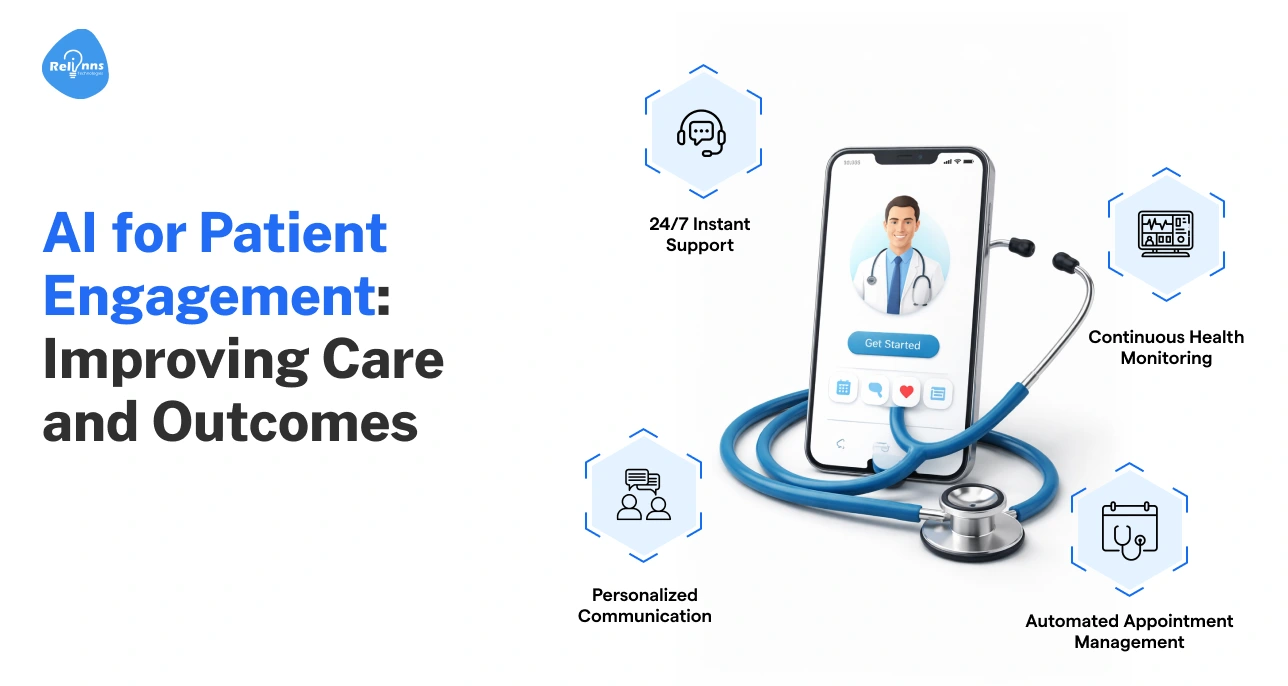
This is where AI for patient engagement steps in. From answering questions at 2 a.m. to personalized care reminders, AI is helping providers improve care and outcomes with conversational AI and generative AI, without burdening already stretched clinical teams.
In this guide, you'll learn how AI in patient engagement works, where it fits, and what real-world impact it’s delivering.
What AI-Driven Patient Engagement Means in Modern Healthcare
Patient engagement is all about keeping patients informed, supported, and active in their care. Traditional methods like phone calls and printed discharge summaries are helpful, but they often fall short.
AI-driven patient engagement adds a new layer of intelligence, making interactions smarter, faster, and more personal.
Think: A system that knows when a patient is likely to miss their appointment, sends a reminder in their preferred language, and answers their follow-up questions, all without much human intervention.
Traditional Patient Engagement Tools vs AI-Driven Engagement
Before we dive into what AI in patient care implies, it's crucial to understand the difference between how healthcare has traditionally engaged patients and what AI-driven engagement actually looks like in practice.
The table below breaks down the key contrasts:
| Feature | Traditional Patient Engagement Tools | AI-Driven Patient Engagement |
| Communication | Phone calls, emails, printed pamphlets | Chatbots, AI messaging, voice assistants |
| Personalization | Same information for everyone | Tailored advice based on patient history |
| Availability | Limited to office hours | 24/7 support |
| Response Time | Hours to days | Instant |
| Follow-ups | Manual reminders | Automated, timely follow-ups |
| Data Insights | Basic tracking | Predictive insights and trends |
| Patient Experience | Reactive | Proactive and interactive |
| Health Literacy | Generic materials | Adaptive content matched to patient understanding |
The shift isn't just technological; it's a fundamental change in how healthcare shows up for patients.
How AI Fits Into the Broader Patient Care Ecosystem
AI works alongside doctors, nurses, and hospital systems to create a more connected care experience, one that doesn't stop when the clinic closes.
It handles repetitive tasks like reminders, education, and follow-ups. This frees staff to focus on care that needs a human touch.
For example, when a patient is discharged after knee surgery, AI sends recovery instructions, tracks check-ins, and only escalates to a nurse when something looks off.
The Role of Generative AI in Modern Patient Communication
When we talk about artificial intelligence in healthcare, it's worth mentioning how generative AI, an emerging subset of AI, has become one of the most powerful tools for patient communication. It helps:
- Create personalized messages and reminders for each patient.
- Summarize complex medical information in simple language.
- Generate follow-up instructions after visits automatically.
- Help patients get answers anytime via chat or voice assistants.
- Support educational content tailored to a patient’s condition or treatment plan.
The result is communication that feels less like a system talking at you and more like a care team that actually knows you.
If your organization is looking to bring these capabilities to life, companies like Relinns Technologies provide AI development solutions specifically for healthcare. From building chatbots to patient engagement platforms, it helps providers implement intelligent systems that improve communication and overall patient experience.
Why Healthcare Still Struggles to Keep Patients Engaged
Keeping patients engaged is harder than it looks.
Even with the best intentions, healthcare systems face roadblocks that make communication, follow-up, and active participation difficult. Here are the main barriers:
- Fragmented Communication: Patients hear from multiple departments that rarely coordinate. Mixed or repeated messages make it easy to miss what actually matters.
- Limited Time for Personalized Care: Doctors and nurses tend to many patients. Personalized check-ins often get rushed or skipped, leaving patients feeling like just a number, not a person.
- Health Literacy and Information Overload: Medical jargon is intimidating. Too much information, delivered all at once, makes it hard for patients to understand (let alone act).
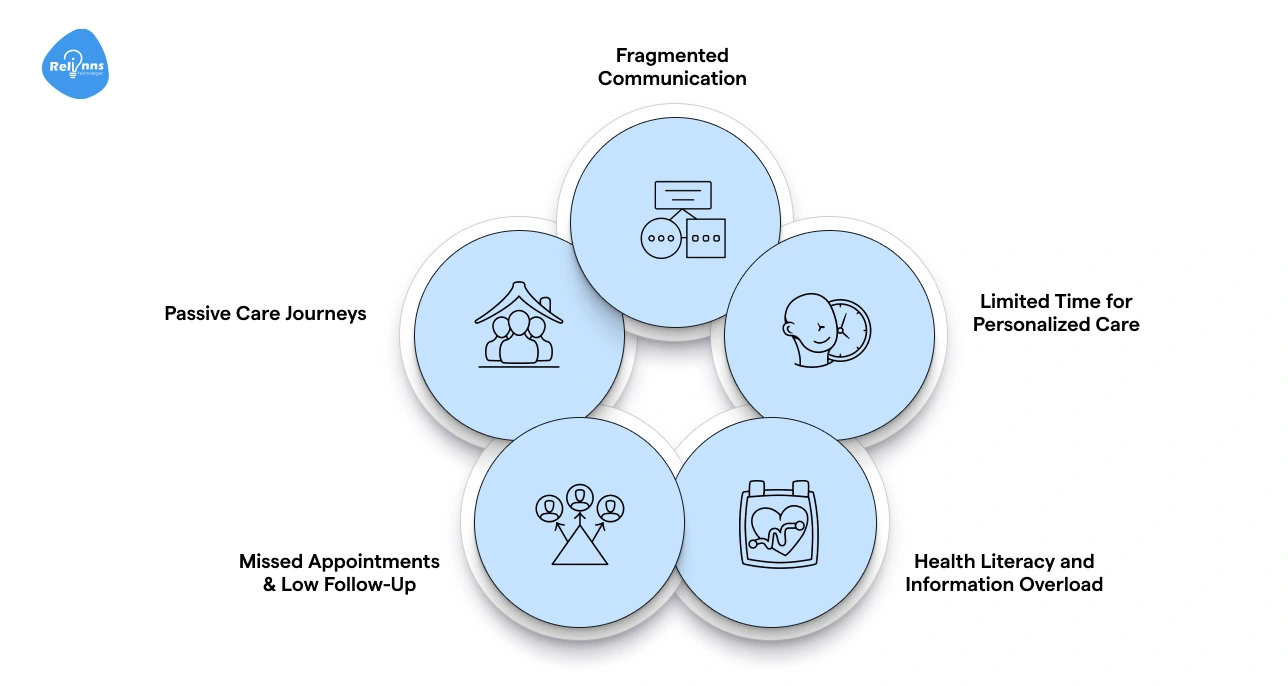
- Missed Appointments & Low Follow-Up: Inconsistent reminders and manual tracking cause patients to forget or postpone care, affecting outcomes.
- Passive Care Journeys: Most patients wait to be told what to do next. Without tools that prompt self-monitoring or proactive steps, participation quietly drops off.
Every one of these barriers is exactly where AI for patient engagement is making its mark and turning barriers into breakthroughs.
AI Technologies Reshaping How Patients Experience Care
AI makes patient care smarter, more responsive, and deeply personal. Different technologies handle different parts of engagement, helping patients get the right guidance and support at the right time, while freeing care teams to focus on hands-on care.
Here's a breakdown of the core technologies powering this shift and what each one brings to the patient experience.
| Technology | What It Does | Example |
| Generative AI & LLMs | Generates personalized messages, summaries, and follow-ups automatically | A clinical AI assistant sends a patient-friendly summary of lab results with tailored next-step instructions. |
| NLP & Conversational AI | Powers chatbots and voice assistants to understand and respond to patient questions naturally | A chatbot schedules appointments and answers medication questions 24/7. |
| Predictive Analytics & Remote Monitoring | Analyzes patient data to predict risks, prevent no-shows, and enable proactive interventions | A predictive analytics engine flags a patient likely to miss a follow-up and triggers automated reminders or nurse outreach. |
| AI-Driven Learning Automation | Adjusts educational content based on patient engagement and understanding | An adaptive learning platform sends personalized nutrition and exercise lessons to a diabetes patient, adapting to their responses. |
These technologies work together to make healthcare proactive and patient-centered. Patients get help when they need it, and care teams can focus on meaningful care.
AI for Patient Engagement in Action: Real-World Use Cases
AI is no longer a future promise in healthcare; it's already at work. From simple reminders to personalized education, these technologies are making care more proactive, personal, and accessible.
Here's how it plays out in the real world:
AI-Powered Chatbots and Virtual Assistants for Patient Support
AI-powered chatbots for patient engagement and virtual assistants provide instant answers and support. They can:
- Answer questions about symptoms, medications, or care plans.
- Guide patients through simple procedures or preparation steps.
- Reduce the workload of care teams by handling routine queries.
Learn more about how AI chatbots are transforming healthcare in our AI Chatbots for Healthcare Guide.
Conversational AI for Appointment Scheduling and Reminders
AI makes scheduling and reminders effortless. It can:
- Book appointments automatically based on patient preferences.
- Send timely reminders via chat, SMS, or voice.
- Reduce missed appointments and improve follow-up compliance.
Example: A patient receives an automated WhatsApp reminder 48 hours before their appointment, with a one-tap option to confirm, reschedule, or ask questions - no phone call needed.
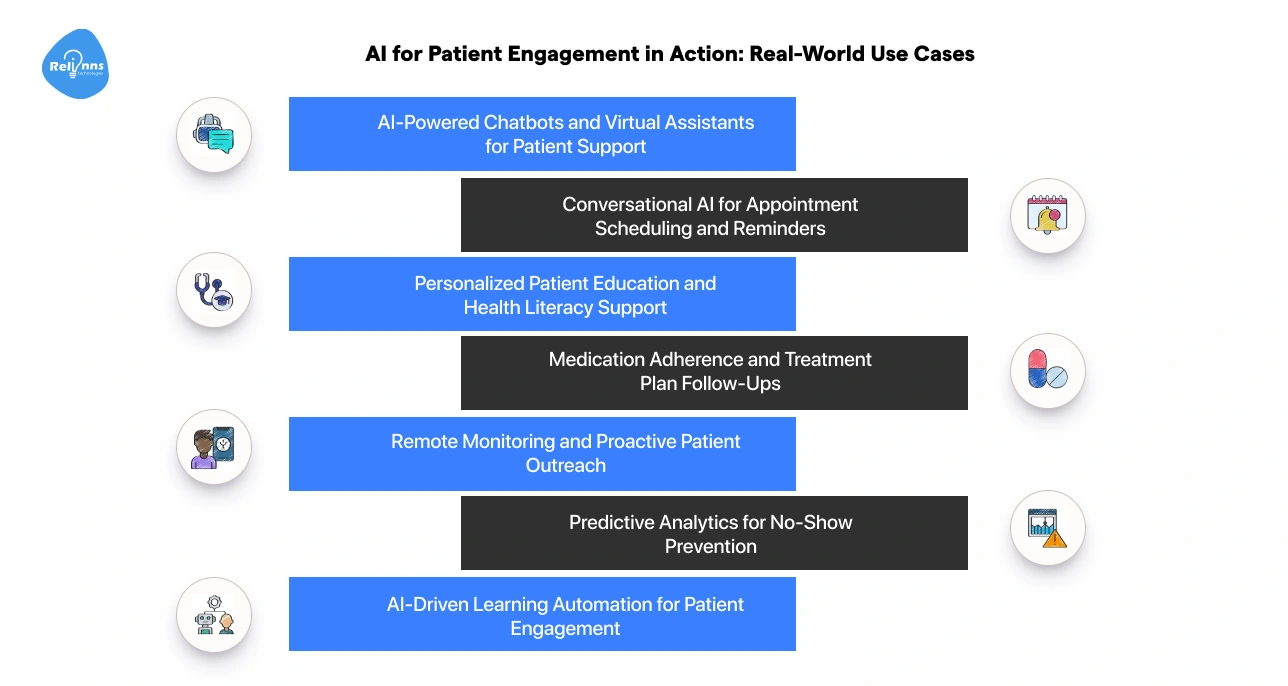
Personalized Patient Education and Health Literacy Support
Patients often struggle to understand complex medical information. AI can:
- Deliver explanations in simple, easy-to-read language.
- Provide tailored educational content based on a patient’s condition.
- Help patients stay informed and engaged in their care.
This capability makes health literacy a feature of the care experience, not an afterthought.
Medication Adherence and Treatment Plan Follow-Ups
AI helps patients stay on track with their treatments. It can:
- Send reminders for medications and exercises.
- Track adherence and alert care teams if a patient misses doses.
Consider: A post-surgery patient who receives daily check-in messages, medication reminders, and a flag to their care team the moment adherence drops, all without a single manual follow-up.
Remote Monitoring and Proactive Patient Outreach
AI analyzes real-time health data and can flag potential risks earlier for care teams. This allows:
- Continuous monitoring of vital signs or symptoms.
- Proactive check-ins before issues escalate.
It turns reactive care into a continuous safety net, catching problems before they become emergencies.
Predictive Analytics for No-Show Prevention
AI identifies patients likely to miss appointments and triggers interventions.
This becomes crucial especially where patient volumes are high, staff bandwidth is limited, and every missed appointment means delayed care and lost revenue.
AI-Driven Learning Automation for Patient Engagement
AI adapts educational content based on patient responses and engagement. Patients get personalized lessons, tips, and follow-ups tailored to their needs.
Real-world Impact: Relinns’ clients, like Cipla, automated over 10,000 drip campaigns, reducing missed doses by 40% using BotPenguin. Other partners like Interpath Labs use AI-powered chatbots that let patients book tests, access lab results, and get quick answers, making interactions faster and more convenient.
Together, these use cases show how AI enhances healthcare workflows, creating a care experience that is smarter, more connected, and built around the patient.
The Patient Journey Reimagined: How Generative AI Engages at Every Touchpoint
Patient engagement isn't a single moment; it's a continuous experience.
Generative AI supports patients at every stage of their care journey, ensuring no question goes unanswered, no follow-up gets missed, and no patient feels left behind.
The table below shows exactly where generative AI steps in and what it delivers at each stage:
| Patient Journey Stage | Generative AI Application | How It Helps |
| Before the Visit | LLM-powered symptom guidance, conversational AI appointment support, AI-generated pre-visit instructions | Patients arrive prepared, less anxious, better informed. |
| During the Care Experience | NLP-driven real-time information access, generative AI procedure explanations | Complex care steps are explained in plain language, instantly. |
| After the Visit | AI-generated discharge summaries, automated care plan reinforcement, LLM-powered follow-ups | Recovery stays on track without a single manual follow-up. |
| Between Visits | Predictive analytics monitoring, AI-driven learning automation, proactive generative AI outreach | Small issues are flagged early, before they become emergencies. |
What makes this powerful isn't any single touchpoint; it's the fact that care never truly stops. Generative AI turns the gaps in the patient journey into opportunities for connection, support, and better outcomes.
Real Benefits, Better Outcomes: What AI Delivers in Patient Care
AI doesn’t just automate tasks; it makes healthcare smarter, more personal, and easier to navigate. Patients get support when they need it, and care teams can focus on meaningful care.
Key benefits of AI-driven patient engagement include:
- 24/7 Access and Support: Patients can get answers anytime via chatbots, virtual assistants, or AI-driven portals.
- Personalized Communication and Education: Messages, reminders, and educational content are tailored to each patient’s needs and understanding.
- Faster Scheduling and Follow-Ups: Automated appointment bookings, reminders, and follow-ups reduce missed visits and delays.
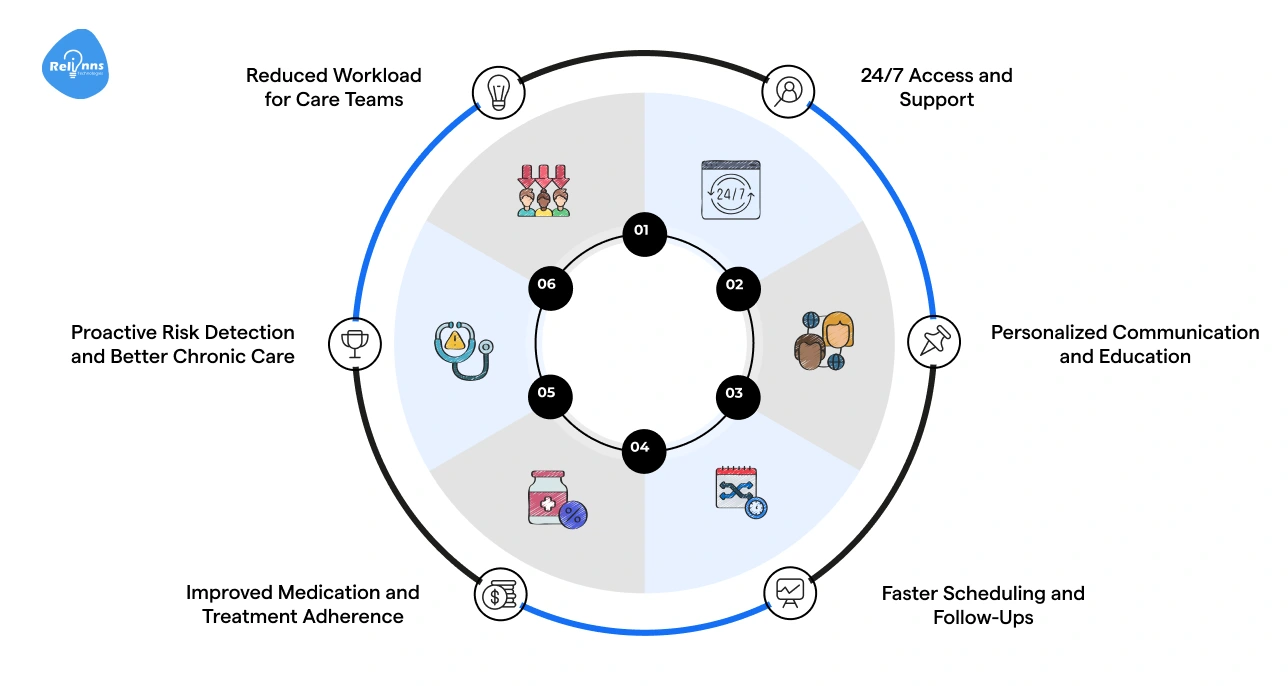
- Improved Medication and Treatment Adherence: AI tracks care plans, sends reminders, and nudges patients to stay on track.
- Proactive Risk Detection and Better Chronic Care: Predictive insights flag issues early, helping prevent complications and manage long-term conditions effectively.
- Reduced Workload for Care Teams: Routine queries, monitoring, and reminders are handled by AI, freeing staff for direct patient care.
The Bottom Line: When patients feel supported and informed at every step, they don't just experience better care, they achieve better outcomes.
The Challenges of AI in Patient Engagement (and How to Address Them)
AI brings real value to patient engagement, but it's not without complexity. Understanding these challenges upfront helps healthcare organizations implement AI responsibly and effectively.
Data Privacy and Healthcare Compliance Requirements
AI handles sensitive patient data, which raises privacy and regulatory concerns. Interestingly, a majority of violations don't come from external breaches; they stem from poor internal data governance, misconfigured systems, and insufficient access controls.
The Fix: Implement strong encryption, access controls, and follow HIPAA, GDPR, and local healthcare rules to protect patient information.
Curious about whether your AI solution is truly HIPAA-compliant? Read our HIPAA Compliance for SaaS article to get it right from day one.
Risk of Inaccurate AI Responses in Clinical Contexts
AI may give wrong or unclear guidance, confusing patients or delaying care. For instance, a chatbot misreading a patient’s symptom description could suggest the wrong next step, causing unnecessary alarm or, worse, a missed red flag.
The Fix: Use human oversight, validate AI outputs, and clearly mark when advice needs clinician review.
Bias and Fairness in AI Healthcare Systems
AI trained on limited or skewed data can favor some patient groups over others. This leads to unequal care experiences, where certain demographics receive less accurate guidance.
The Fix: Use diverse datasets, test algorithms for fairness, and continuously monitor for disparities.
Integration Challenges With EHR and Hospital Systems
AI tools may not easily connect with existing electronic health records or workflows. It creates data silos, duplicated efforts, and frustrated care teams who end up managing two systems instead of one.
The Fix: Choose interoperable solutions, follow standard APIs, and involve IT teams early in deployment.
Balancing AI Automation With Human Care
Too much automation can reduce human interaction, affecting trust and experience. After all, patients facing serious diagnoses or emotional distress don't need a chatbot; they need a human who listens.
The Fix: Keep humans in the loop for sensitive tasks, while letting AI handle routine reminders, education, and follow-ups.
On the whole, the risks of AI in patient engagement are real, but they're manageable. The organizations that get it right are the ones that treat AI as a tool to enhance human care, not replace it.
Best Practices for Getting AI in Patient Engagement Right
AI works best when it's implemented thoughtfully.
These best practices help healthcare organizations deploy AI in ways that genuinely support patients, protect data, and deliver measurable results, without overcomplicating the process.
| Best Practice | What It Includes |
| Design AI Tools for Patient Understanding and Accessibility | Use simple language, clear instructions, and accessible interfaces across devices. |
| Maintain Clear Human Escalation Paths | Provide an easy way to reach care staff when AI can’t answer or handle complex issues. |
| Ensure Compliance With Healthcare Data Regulations | Follow HIPAA, GDPR, and local rules; secure patient data with encryption and access control. |
| Continuously Monitor AI Performance and Patient Feedback | Track accuracy, engagement, and satisfaction; update AI models as needed. |
| Measure Engagement and Health Outcomes Together | Evaluate patient interactions and actual health results to improve tools and care. |
Key Takeaways
- AI is only as effective as the guardrails around it. Compliance, oversight, and human escalation aren't optional.
- Patient accessibility should drive every design decision, not technology capability.
- Measuring outcomes alongside engagement is what separates good implementation from great results.
- The best AI deployments are never set-and-forget. They evolve with patient needs and feedback.
Many providers leverage partnerships with AI development companies like Relinns Technologies that help healthcare providers put these best practices into action and build intelligent patient engagement platforms with GDPR, SOC-2, and HIPAA-compliant AI tools.
What’s Next: The Future of AI in Patient Engagement
We're only scratching the surface. As AI matures, patient engagement will shift from reactive support to fully personalized, continuous care.
Here’s a brief overview of what the future of AI looks like in patient engagement:
Multimodal AI for Voice, Chat, and Remote Care
AI will combine text, voice, and even video to support patients everywhere. From answering questions via chatbots to guiding care over video, interactions will feel natural and timely.
In fact, multimodal AI models are already transforming customer experience, education, and financial services - and healthcare is next.
Learn all about what multimodal AI is in our Multimodal AI Guide.
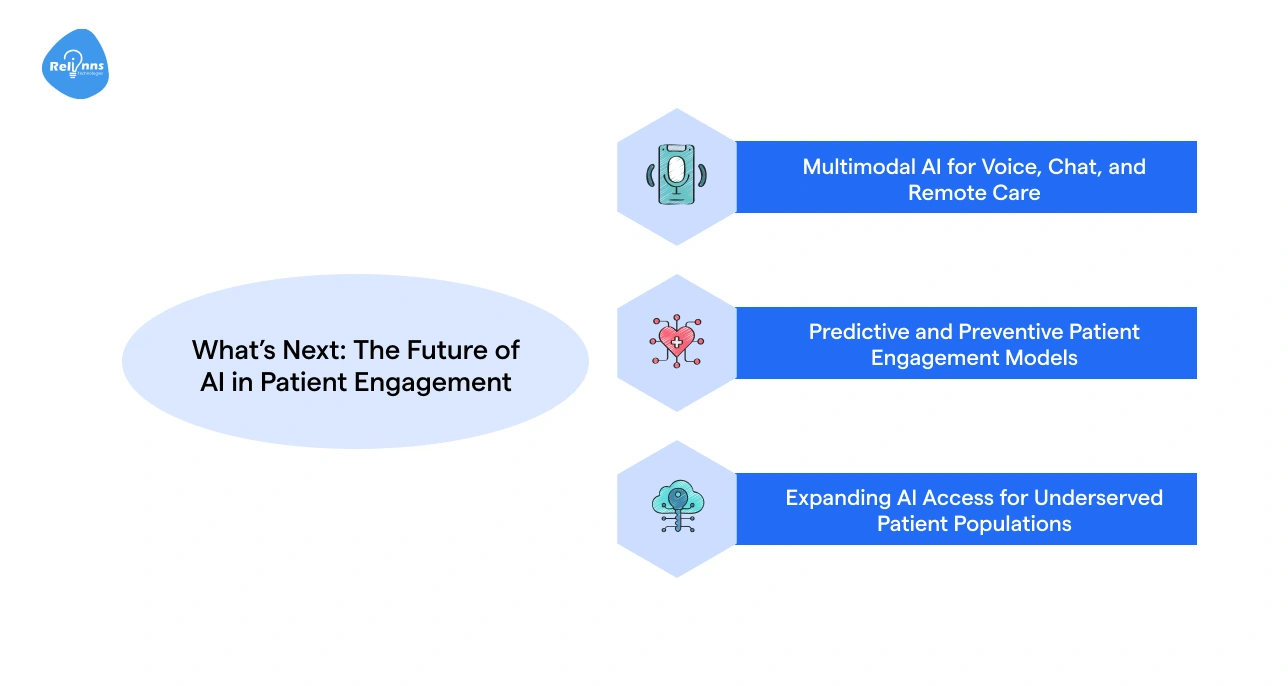
Predictive and Preventive Patient Engagement Models
AI will move from reactive support to proactive care. Predictive models will identify patients at risk, anticipate follow-up needs, and suggest preventive measures before issues escalate.
For example, a diabetic patient's wearable data could trigger an AI-generated nutrition adjustment and an automatic care team alert weeks before a complication would have shown up in a routine checkup.
This makes predictive AI a quiet frontline of preventive care.
Expanding AI Access for Underserved Patient Populations
AI can help reach patients with limited access to care. Remote monitoring, low-bandwidth chat tools, and multilingual support will make engagement more equitable and inclusive.
The future will be patient-centered, proactive, and connected, helping patients stay informed, supported, and in control of their health.
Wrapping Up
AI, especially generative AI, is helping patients feel seen, informed, and supported throughout their care.
It can answer questions, generate personalized guidance, and nudge patients when they need it most. At the same time, it frees clinicians to focus on hands-on care that only humans can provide.
By making communication smarter and follow-ups easier, AI turns everyday healthcare into a smoother, more reliable experience. The result is better adherence, fewer gaps, and stronger connections between patients and providers.
Thoughtfully applied, generative AI isn’t just technology; it’s a partner that keeps patients confident and engaged in their health.
Frequently Asked Questions (FAQs)
What is AI for patient engagement?
AI for patient engagement uses chatbots, generative AI, and predictive tools to keep patients informed, supported, and active throughout their healthcare journey.
How does AI improve patient engagement in healthcare?
AI personalizes communication, automates reminders, delivers education, and predicts risks, making patient interactions more timely, proactive, and effective.
What are examples of AI-powered chatbots in healthcare?
Chatbots answer questions, schedule appointments, provide medication reminders, and guide patients through procedures, reducing staff workload and improving follow-ups.
Can AI improve patient outcomes in hospitals?
Yes, AI enhances adherence, detects risks early, reduces readmissions, and helps patients stay informed, leading to better overall health outcomes.
What is generative AI in patient communication?
Generative AI creates personalized messages, educational content, and follow-up instructions, helping patients understand care instructions and engage more consistently.
How do predictive analytics support patient engagement?
Predictive analytics identifies patients at risk of missing appointments or treatment steps, triggering reminders or care team outreach before issues arise.
Is AI in patient care safe and compliant?
When implemented with HIPAA, GDPR, and local rules, AI can securely handle patient data while maintaining privacy and regulatory compliance. However, it's advisable to practice human discretion for sensitive cases.
How does AI help patients stay on track with medications?
AI sends reminders, tracks adherence, and alerts care teams when patients miss doses, improving treatment compliance and overall health outcomes.
What role does AI play in remote patient monitoring?
AI analyzes real-time health data, flags potential risks, and triggers proactive outreach, preventing complications before they escalate.
Can AI personalize patient education in hospitals?
Yes, AI adapts educational content to patient needs, literacy level, and engagement, helping patients understand their conditions and treatment plans better.