AI Agents in Supply Chain: Use Cases, Architecture, and ROI
Date
Oct 29, 26
Reading Time
12 Minutes
Category
AI Agents
Share


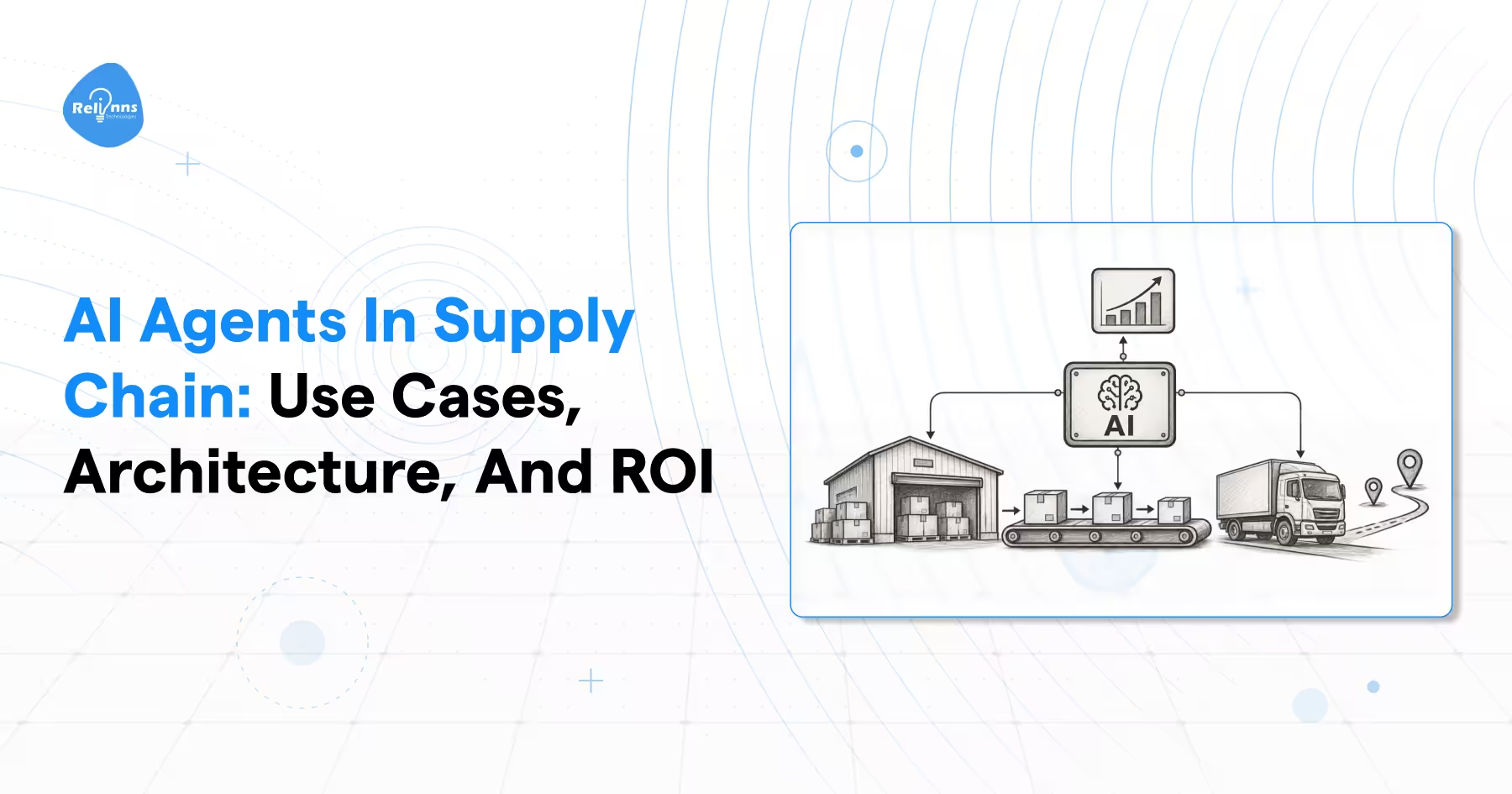
AI agents in supply chain are gaining attention because traditional planning systems cannot react fast enough to constant operational change.
A supplier delay, inventory shortage, carrier rejection, or production issue can affect several teams before anyone has the full picture. Most systems record these events, but people still interpret the impact, coordinate functions, and decide what happens next.
This article explains where supply chain AI agents create real value, why many pilots stall, what infrastructure they need, where human control still matters, and how to measure whether the operating model has actually improved before investing further.
What Is an AI Agent in Supply Chain?
An AI agent in supply chain is software that monitors operational data, understands what changed, selects an appropriate action, and acts within approved limits.
Gartner projects that by 2028, 33% of enterprise software applications will include agentic AI, up from less than 1% in 2024. (Source: Gartner)
The important distinction is not whether software uses AI. It is what the software can decide and do.
A traditional workflow follows fixed instructions. An agent can examine current conditions, compare available actions, use approved tools, and continue working toward a defined objective.
| Layer | What It Does | What It Owns |
|---|---|---|
| Workflow or RPA | Runs predefined steps | One fixed task path |
| Copilot | Reads context and suggests | An answer a person still acts on |
| AI agent | Reasons and acts inside limits | One bounded objective |
| Orchestration | Decides which agent acts next | Sequencing between agents |
| Execution layer | Carries shared state across the process | The transaction from start to finish |
Different agents can own different parts of supply chain execution:
- Sourcing agent: identifies suppliers, runs comparisons, and prepares sourcing decisions.
- Procurement agent: validates requests, creates approved purchase orders, and follows supplier responses.
- Logistics agent: monitors movement, evaluates disruptions, and selects approved routing actions.
- EXIM agent: checks import and export documents, shipment requirements, and customs exceptions.
- Finance agent: validates invoices against terms, amendments, and delivery evidence.
One agent can complete a bounded objective. That does not make the entire transaction autonomous.
The gap between the AI agent and the execution layer is where many supply chain AI programs stall.
Why Can't Your Existing Planning Stack Keep Up?
Traditional planning assumes conditions remain stable long enough to plan against them. They no longer do.
ERP, WMS, and TMS platforms record orders, inventory, shipments, and transactions. When conditions change, people still interpret the signal, compare alternatives, coordinate teams, and decide what happens next.
Three constraints make that model difficult to scale.
Aggregation Loss
Human planners cannot continuously evaluate every SKU variant, location, supplier, capacity constraint, and customer commitment.
Planning therefore gets grouped into broader categories. Important differences disappear, and decisions become less precise than the underlying operational data allows.
Cycle Lag
Many decisions still depend on scheduled reviews and analyst availability.
A disruption can affect production, inventory, logistics, and customer commitments immediately. Waiting for the next planning cycle can mean acting after the best response window has passed.
Negotiated Tradeoffs
Supply chain decisions affect several functions at once.
Lower inventory improves working capital but can hurt service. Faster freight protects delivery commitments but raises cost. Traditional processes often resolve these conflicts through repeated coordination rather than evaluating the enterprise impact together.
BCG describes three ways AI agents expand the available decision space:
- Always-on decisions: Responses are not limited by planning cycles or analyst availability.
- Granular decisions: Agents can evaluate individual products and variants instead of relying on broad categories.
- Cross-functional optimization: Revenue, service, cost, and risk can be evaluated within the same decision process.
Source: BCG, The AI First Supply Chain
Consider a supplier missing a Monday delivery.
The traditional response requires teams to find an alternative, revise capacity, update logistics, and later correct the forecast.
With agentic AI in supply chain, one agent can detect the miss while others evaluate partial shipments and production resequencing. Ranked scenarios can reach the manager within the same decision window.
That raises the next question. If the technology can work this way, why do so many deployments still underdeliver?
Why Do Most Supply Chain AI Pilots Stall at “Interesting”?
Adoption is not the main problem. Scope is.
BCG found that 44% of companies are deploying AI in supply chain management, more than in finance, HR, or procurement. Yet many remain focused on narrow use cases and copilot tools that produce limited productivity gains.
Source: BCG, The AI First Supply Chain
The pilot may work exactly as designed. Its value simply stops at the edge of one task or function.
1. The Copilot Ceiling
A copilot can analyze data, explain an exception, or recommend an action.
A person still decides, updates another system, contacts another team, and confirms the outcome.
The analysis became faster. The coordination work remained.
2. Scope Stops at the Function
A logistics agent can optimize freight decisions using logistics data.
It cannot determine whether higher freight cost protects enough revenue to justify the expense unless it also understands commercial priorities, customer commitments, inventory, and margin.
This is where agentic AI in supply chain needs broader context.
3. Nobody Owns the Full Tradeoff
Cross-functional decisions need authority across operations, finance, and commercial teams.
BCG argues that COOs and CTOs often cannot resolve these enterprise tradeoffs alone. Broader transformation requires CEO level sponsorship because the optimization crosses organizational boundaries.
4. Teams Wait for Perfect Data
Some pilots stop because teams assume every source system must be cleaned and integrated first.
That standard can delay useful deployment indefinitely.
A better approach is to connect the data needed for one bounded decision, validate the outcome, and expand from there.
Action Item
Build the audit trail before the autonomy. For every material action, record the signal, transaction state, decision, policy applied, approval, and evidence that verified the outcome.
The technology may be working. The operating model may not have changed.
There is a deeper reason for that.
Does Deploying More Agents Make Your Supply Chain More Autonomous?
No. Autonomy is a property of the transaction, not the number of agents deployed.
A supply chain becomes autonomous when a transaction can move from sourcing through commitment, freight, delivery, and settlement without a person carrying context between systems.
A company can deploy twenty agents and still have almost no transaction autonomy.
More Agents Do Not Automatically Mean More Automation
Teams may track:
- Agents deployed
- Tasks automated
- Tool calls completed
- Prompts processed
- Decisions recommended
These metrics show activity.
They do not show whether a complete transaction can move without manual coordination.
Consider three agents.
A supplier confirmation agent handles supplier responses. A logistics agent manages routine freight actions. An invoice agent automates invoice checks.
Each may perform its task well.
Yet a buyer may still transfer the supplier award into procurement. A planner may still coordinate the supplier, carrier, plant, and customer after a delay. Finance may still reconstruct an invoice discrepancy from contracts, delivery records, and email.
Task autonomy is high. Transaction autonomy remains low.
The Missing Layer Is Shared Transaction State
Agents need a persistent record of what has happened across the transaction.
That state can include:
- Supplier and carrier identities
- Commercial terms
- Purchase order amendments
- Delivery milestones
- Validated documents
- Approvals
- Exceptions
- Supporting evidence
- Settlement status
Settyl describes this architecture as a System of Execution. ERP remains the system of record while the execution layer carries context and work across supply chain functions.
Source: Settyl, AI Agents in Supply Chain Execution
One transaction can then move through several specialized agents without requiring a person to rebuild context at every handoff.
Measure Autonomy at the Transaction Level
Settyl uses Autonomy Rate to evaluate how much eligible transaction work reaches a verified outcome without human intervention.
For this article, the metric can be expressed as:
Count agents and a program can look advanced.
Measure autonomy at the transaction level and you learn whether the operating model actually changed.
ERP still owns master data, purchase orders, receipts, and financial postings.
The execution layer owns the journey between those states. Agents perform the work required to move that journey forward.
With that distinction clear, use cases stop looking like isolated AI features.
Where Are Supply Chain AI Agents Actually Delivering Results Today?
Supply chain AI agents are being applied across demand forecasting, inventory, procurement, logistics, predictive maintenance, warehouse coordination, and risk monitoring. These AI agent use cases show how agents can move beyond recommendations to execute approved actions across operational workflows.
IBM reports that 62% of supply chain leaders recognize that AI agents embedded into operational workflows accelerate speed to action, including decisions, recommendations, and communications. (Source: IBM)
| Function | What the Agent Does | Signal It Reads | Practical Autonomy Potential |
|---|---|---|---|
| Demand forecasting | Updates forecasts and adjusts replenishment | POS data, promotions, weather, market trends | High |
| Inventory | Triggers replenishment and rebalances stock | Stock levels, sales velocity, lead times | High |
| Procurement | Validates requisitions, creates POs, follows acknowledgements | Supplier performance, pricing, contract terms | Medium |
| Logistics | Selects carriers, books freight, responds to exceptions | ETAs, congestion, carrier rejections | Medium |
| Predictive maintenance | Detects wear and schedules downtime | IoT sensor data, equipment logs | High |
| Warehouse | Assigns picking tasks and adjusts labor | Order flow, robotic path data | High |
| Risk monitoring | Detects supplier, geopolitical, and weather risks | External feeds, supplier signals | Lower |
The autonomy levels above are practical design guidance, not industry benchmarks. Actual authority depends on data quality, risk, permissions, and governance.
Demand Forecasting
Agents can combine historical demand with current sales, promotions, weather, and market signals.
When demand changes, they can update forecasts and trigger approved inventory or replenishment actions instead of waiting for the next planning cycle.
Procurement
Procurement agents can validate requisitions, check commercial terms, create approved purchase orders, and follow supplier acknowledgements.
These capabilities also connect to agentic commerce, where AI agents can evaluate purchasing options and initiate transactions within predefined business rules.
Higher value awards, policy exceptions, and unusual commercial decisions should remain subject to defined approval rules.
Logistics Exception Handling
A logistics agent can monitor shipment progress and respond when the original plan fails.
It can compare eligible carriers, delivery commitments, available capacity, and approved cost thresholds before recommending or executing a revised transport plan.
Risk Monitoring
Risk agents monitor external and supplier signals for disruptions that may affect operations.
Their autonomy is usually lower because geopolitical events, supplier distress, and major sourcing changes often require commercial judgment.
What One Connected Transaction Looks Like
A sourcing agent runs the RFQ and records the approved supplier.
A procurement agent converts that decision into a purchase order.
The supplier requests a revised delivery date, which updates the shared transaction state.
A carrier later rejects the shipment, so the logistics agent evaluates alternatives and rebooks it.
Delivery evidence and purchase order amendments remain attached to the transaction.
The finance agent evaluates the invoice using that history rather than reconstructing events from separate systems.
Every use case above depends on infrastructure that must exist before the first agent reaches production.
What Do You Need in Place Before Agentic AI Works?
Agentic AI needs more than a capable model.
It needs connected operational data, reliable tools, shared transaction context, clear authority limits, and human review where commercial risk is high.
The goal is not perfect infrastructure. It is enough trusted infrastructure for one bounded decision to run safely.
Connected Data, Not Perfect Data
Agents need current information from ERP, WMS, TMS, IoT systems, supplier platforms, and other operational sources.
BCG recommends connecting high-value data incrementally rather than waiting for a perfect data foundation.
Source: BCG, The AI First Supply Chain
Deterministic Tools Beside the Model
A reasoning model is probabilistic. Mathematical optimization can produce deterministic calculations against defined objectives and constraints.
Databricks argues for combining reasoning models with optimization tools in supply chain applications.
The model interprets the business request, calls the optimization tool, and explains the result. Quantitative recommendations can then trace back to actual decision variables rather than model-generated estimates.
Source: Databricks, Transforming Supply Chain Management with AI Agents
Research by David Simchi Levi and his coauthors similarly explores using large language models as an interface to established supply chain optimization tools.
Shared Transaction State
Agents need the same transaction history.
Supplier commitments, purchase order changes, shipment events, approvals, exceptions, documents, and settlement status should remain attached to the transaction instead of being reconstructed at every handoff.
Open Protocols
MCP provides a standardized way for agents to access tools and resources.
A2A addresses communication and collaboration between independent agents.
Open protocols matter commercially because an architecture based only on proprietary integrations can make future models, systems, and agents harder to add.
Governed Authority
Every agent needs explicit operating limits.
Define:
- Monetary thresholds
- Approved suppliers and carriers
- Confidence thresholds
- Approval hierarchies
- Segregation of duties
- Permitted external actions
- Human review points
The objective is not maximum independence.
It is maximum eligible execution inside defined authority.
Get those foundations right, and the remaining failure modes become easier to predict.
What Goes Wrong With Agentic AI in Supply Chain?
Most failures with agentic AI in supply chain come from five design problems: ungrounded outputs, too much autonomy too early, weak change management, protocol lock-in, and poor security around operational systems.
None require exotic fixes. All become expensive after agents reach production.
1. Ungrounded Outputs in a Numbers Domain
Supply chain decisions depend on quantities, costs, lead times, capacity, inventory, and service commitments.
A model should not invent those values.
Fix: Ground every material number in an optimization tool, validated calculation, or trusted system record.
2. Too Much Automation Too Early
Giving an agent broad authority before its decisions are validated creates brittle workflows.
A bad replenishment or supplier decision can affect inventory, production, cash, and customer commitments.
Fix: Start with one high-impact decision where financial exposure is limited. Expand authority only after measured performance supports it.
3. Change Management Comes Too Late
A technically capable agent still fails if planners do not know when to trust it, challenge it, or escalate a case.
Roles also change when software begins completing work people previously owned.
Fix: Define operating roles, exception handling, and human review before production deployment.
4. Protocol Lock-In
A proprietary architecture can make future tools, models, and agents difficult to add.
Fix: Evaluate support for open protocols such as MCP and A2A during procurement.
5. Security Stops at the Model
Agents may access ERP, warehouse systems, supplier data, APIs, and operational technology.
Fix: Use encrypted connectivity, strict access controls, isolated execution, activity monitoring, and explicit permissions for external actions.
Build the audit trail before the autonomy. For every material action, record the signal, transaction state, decision, policy applied, approval, and evidence that verified the outcome.
That audit trail makes the next increase in autonomy defensible.
The next question is whether any of this produces measurable business value.
How Do You Measure Whether AI Agents Are Working?
Measure AI agents across financial, operational, speed, autonomy, and trust outcomes.
BCG projects that agentic AI can produce working capital reductions of up to 30% and EBITDA uplift of two to four percentage points for some organizations.
These are projected outcomes for some organizations, not observed industry averages.
Source: BCG, The AI First Supply Chain
| Tier | Metric | What It Tells You |
|---|---|---|
| Financial | Logistics cost, inventory carrying cost, working capital release | Whether the program pays |
| Operational | Forecast accuracy, order cycle time, equipment uptime, stockout rate | Whether decisions improved |
| Speed | Time from disruption signal to executed response | Whether the decision loop closed |
| Autonomy | Autonomy Rate, manual touches per transaction, straight through processing, ERP write back success | Whether the operating model changed |
| Trust | Agent recommendations approved without modification | Whether users trust the output |
Watch Manual Touches Early
Financial results can take time to become visible.
Manual touches per transaction can change much sooner.
Track how often a buyer, planner, logistics manager, or finance employee must carry information between systems or restart work an agent could not complete.
If task automation rises while manual touches remain flat, individual agents may be improving while the transaction remains fragmented.
Measure Autonomy, Not Activity
Agent count, prompts processed, and tool calls completed are implementation metrics.
They do not prove business value.
A stronger program should show:
- Fewer manual handoffs
- Faster disruption response
- More completed transactions inside governance limits
- Better operational outcomes
- Measurable financial improvement
The measurement picture changes when agents move from distribution networks into the plant.
How Do AI Agents for Manufacturing Differ From Logistics Agents?
AI agents for manufacturing operate against physical constraints that logistics agents do not face in the same way.
They must account for machine capacity, material availability, changeover time, production sequence, quality tolerance, and maintenance windows.
This can lower the safe autonomy ceiling because a poor production sequence may affect several downstream commitments.
Adaptive Production Scheduling
Manufacturing agents can monitor orders, material availability, machine capacity, and delivery commitments together.
When a supplier delay or machine issue changes the plan, an agent can evaluate alternative production sequences and send approved options into the scheduling process.
Quality Control and Defect Detection
Agents can combine inspection data, sensor readings, production records, and quality thresholds.
When a deviation appears, they can identify affected batches, collect supporting evidence, and determine whether production should continue, pause, or move to human review.
Maintenance Around Delivery Commitments
Traditional maintenance may follow fixed schedules or equipment thresholds.
An agent can also consider orders, production capacity, available technicians, and delivery commitments before proposing the safest maintenance window.
This is where deterministic optimization becomes especially important.
Production sequencing should remain grounded in real capacity and material constraints.
IBM also identifies direct communication between manufacturing agents and contractors' AI systems as an emerging future use case for maintaining service commitments. (Source: IBM)
Manufacturing changes the constraints. The deployment principle remains the same.
Start with one transaction where value and authority boundaries are clear.
Where to Start
Do not begin by trying to automate the entire supply chain.
Start with one transaction where manual coordination is visible, repeatable, and measurable. Expand only after the agent proves it can act safely inside defined limits.
| Step | What to Do | Why It Matters |
|---|---|---|
| 1. Pick One Transaction | Choose a process with clear inputs, decisions, and outcomes, such as supplier acknowledgement, freight exception, replenishment request, or PO change. | Keeps the first deployment bounded and measurable. |
| 2. Measure Manual Touches | Count how often people move information, request context, approve routine actions, rebuild history, or restart work after an exception. | Creates a baseline for measuring transaction autonomy. |
| 3. Give Controlled Write Access | Allow the agent to write to one approved system within monetary limits, approval rules, and complete audit logging. | Tests real execution rather than recommendation only. |
If task automation increases while manual touches remain flat, the agent is improving one task without improving the transaction.
An agent with read access only behaves more like a copilot. Controlled write access tests whether it can complete approved work inside real operational constraints.
The strongest starting point is not maximum autonomy.
It is one useful decision that can be executed safely, measured clearly, and expanded only after evidence supports it.
If you are designing that first workflow, explore Relinns' AI agent development services to build the agents, integrations, authority controls, and execution logic around your existing systems.
Frequently Asked Questions
What Is an AI Agent in Supply Chain Management?
An AI agent in supply chain management is software that monitors operational information, reasons about changing conditions, and performs approved actions toward a defined objective. It can work across planning, procurement, inventory, logistics, manufacturing, and risk processes while operating inside defined access and authority limits.
How Are AI Agents Different From Supply Chain Automation?
Traditional supply chain automation follows predefined rules and process paths. AI agents can evaluate changing context, choose between available actions, use approved tools, and adjust the next step based on new information. The difference is controlled decision-making rather than simply faster execution of a fixed workflow.
Do AI Agents Replace Supply Chain Planners?
No. AI agents can reduce repetitive analysis, coordination, monitoring, and routine execution. Planners remain responsible for complex tradeoffs, exceptions, policy decisions, and commercial judgment. The practical goal is to move eligible routine work to agents while keeping people responsible for decisions requiring broader business context.
Do AI Agents Replace ERP?
No. ERP remains the system of record for master data, purchase orders, receipts, financial postings, and other authoritative transactions. Agents work across those records by gathering context, completing approved tasks, managing exceptions, and moving transactions between states without replacing the underlying ERP.
How Long Does an AI Agent Deployment Take?
There is no reliable universal timeline. Deployment depends on integration complexity, data access, workflow scope, authority limits, and testing requirements. A narrow workflow with accessible APIs can progress faster than a cross-functional program. Measure readiness by validated capabilities instead of promising an arbitrary number of weeks.
What Data Do You Need Before Deploying Supply Chain AI Agents?
You need the data required for the specific decision the agent will own. That may include ERP records, inventory levels, supplier data, shipment events, contracts, machine signals, or customer commitments. The data should be accessible, current enough for the decision, and protected by clear governance and permissions.
I also rechecked the major factual anchors against the current primary or original sources: Gartner supports the 33% by 2028 projection, BCG supports the 44% adoption, decision space framing, and projected financial outcomes, IBM supports the 62% speed to action figure and manufacturing direction, and Settyl explicitly distinguishes ERP as the system of record from a System of Execution. (gartner.com)
For the two protocol references, the current official documentation describes MCP as the agent-to-tool integration layer and A2A as the agent-to-agent communication layer.