What Is Agentic Commerce? How AI Agents Are Changing Buying
Date
Sep 30, 26
Reading Time
8 Minutes
Category
AI Agents
Share


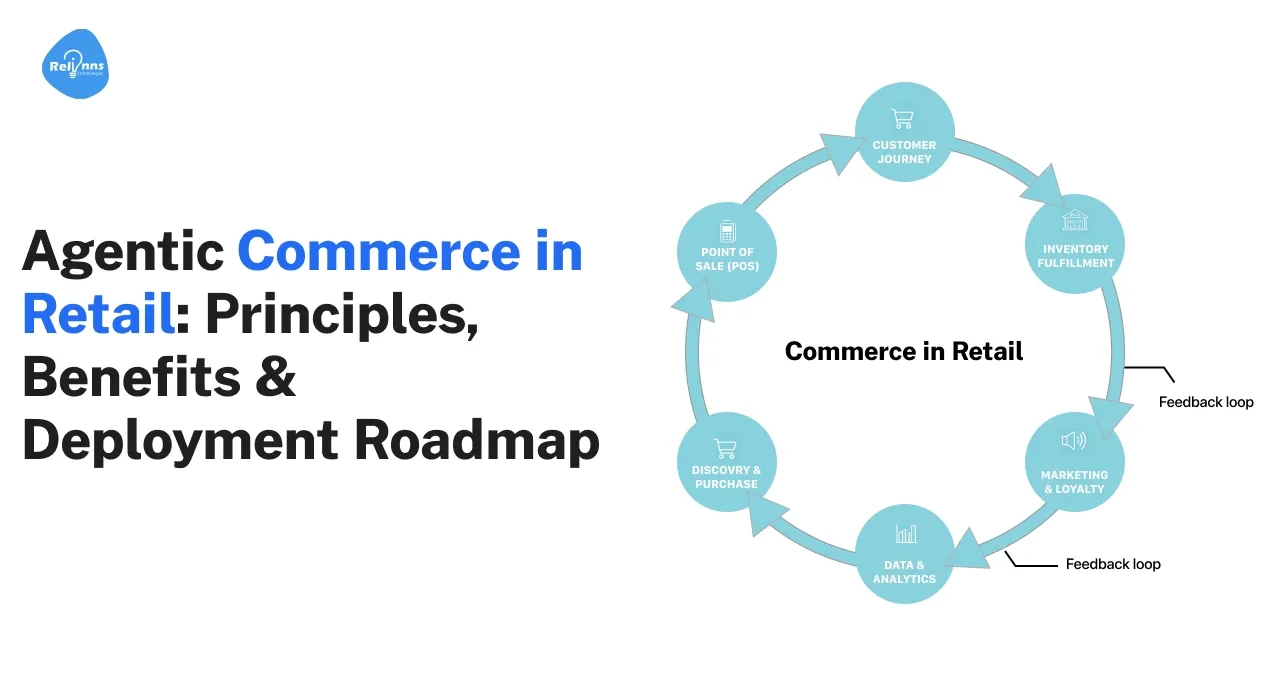
Retail is moving toward a new operational model shaped by automation, intelligence, and autonomous workflows.
This evolution reflects a broader transition toward systems capable of interpreting intent, managing decisions, and streamlining complex processes on behalf of customers.
As product catalogs expand and customer expectations grow more sophisticated, traditional ecommerce models struggle to deliver accuracy, speed, and consistency at scale.
The emergence of agentic commerce provides a strategic response by enabling AI systems to autonomously support shoppers throughout the discovery, evaluation, and transaction stages.
This guide explores the principles, applications, and benefits of agentic commerce and outlines the technical, operational, and strategic steps required for successful adoption across retail operations.
What Is Agentic Commerce?
Agentic commerce refers to a new era of online shopping where AI agents autonomously handle tasks like searching, comparing, and purchasing products for users based on their preferences and guidelines.
These agents do more than assist. They can act on behalf of the user, making the buying process faster and more personalized while reducing manual effort.
This shift means businesses increasingly need to prepare product information, integrations, and transaction systems for interactions initiated by agents rather than only human shoppers. For consumers, agentic commerce can reduce the work required to discover, compare, and purchase suitable products.
New to the concept? Read our guide to what AI agents are to understand how they reason, use tools, and complete tasks across connected systems.
Understanding Agentic Commerce in Modern AI in Ecommerce Ecosystems
Agentic commerce is a model in which AI systems interpret consumer objectives, analyze contextual variables, and autonomously perform multiple retail tasks.
Unlike traditional automation, these agents can reason across steps and adjust their next action based on available information, user instructions, and changing conditions.
The approach can support more efficient decision cycles and reduce the amount of manual work required from the shopper.
Adopting agentic commerce requires understanding how autonomous agents structure tasks, process constraints, and deliver recommendations. These systems rely on well-defined data pipelines, tool integrations, and decision governance to function effectively.
As AI capabilities advance, their ability to manage increasingly complex retail workflows continues to expand.
For retailers ready to move from exploration to implementation, an AI agent development company can help build workflows that require custom data access, integrations, permissions, transaction logic, or human approval.
Foundational Principles Behind Agentic Commerce and What Is Agentic Commerce
McKinsey & Company estimates that by 2030, the U.S. B2C retail market alone could see up to US$1 trillion in revenue from agentic commerce, with global projections between US$3 trillion and US$5 trillion.
Agentic commerce systems break down user goals into discrete actions supported by structured reasoning. They communicate across multiple channels, compare different data sources, and execute purchase-related tasks using secure integrations.
These agents can adjust decisions as additional information becomes available.
Their functionality depends on strong infrastructure, including product data, identity systems, price feeds, and fulfillment networks. With proper alignment, these systems can operate across the customer journey while maintaining defined controls.
Core Functional Principles
- Translating goals into structured sequences across retail workflows
- Analyzing product and merchant data using consistent evaluation logic
- Applying constraints such as budget, delivery preferences, and timing
- Interacting safely with payments and transactional endpoints
- Providing reasoning summaries to support final human decisions
How Agentic Commerce Influences Retail Performance Through AI in Ecommerce
Agentic commerce reshapes retail interactions by improving discovery, supporting structured evaluation, and reducing manual steps across purchasing workflows.
These automated systems can reduce the work customers perform when searching and comparing products. Retailers can also use agent-based workflows to connect product information, inventory, service, and transaction processes more closely.
1. Improving Product Discovery Using Agentic Commerce and AI in Ecommerce
Extensive catalogs and vague user intent often slow discovery. Agentic commerce systems can streamline this stage by understanding objectives and generating shortlists aligned with user preferences.
Such refinement can shorten the path between initial intent and relevant products.
Discovery Improvements
- Identifying relevant results from large catalog datasets
- Filtering products based on constraints and behavioral patterns
- Summarizing reviews to support customer decisions
- Tracking price information and purchase conditions
- Maintaining context across connected discovery interactions
2. Enhancing Evaluation and Decision Confidence With Agentic Commerce Models
Evaluating options requires balancing numerous variables. Agentic systems can support this process by producing structured comparisons, highlighting relevant features, and providing reasoning behind recommendations.
This gives customers more context before they make a purchase decision.
Evaluation Enhancements
- Presenting attribute-based comparisons using standardized frameworks
- Highlighting relevant product advantages based on user priorities
- Verifying stock levels and delivery estimates
- Providing reasoning that explains recommendations
- Clarifying policy differences for warranties and returns
3. Optimizing Checkout Processes Through Agentic Commerce and AI in Ecommerce
Checkout requires customers to move through payment, authentication, discounts, and final confirmation.
Agentic workflows can reduce some of these manual steps when the required integrations and permissions are available.
Checkout Optimizations
- Selecting permitted payment options based on user preferences
- Applying loyalty incentives and vouchers
- Supporting authentication steps
- Presenting installment options where available
- Synchronizing final confirmations across selected channels
Business Advantages Generated Through Agentic Commerce Frameworks
Agentic commerce can create opportunities across customer experience, purchasing efficiency, and retail operations.
Its business value depends on the quality of the underlying data, integrations, controls, and AI agent use cases rather than autonomy alone.
1. Revenue Opportunities Enabled by Agentic Commerce in AI in Ecommerce Systems
Revenue opportunities can emerge when product discovery becomes more relevant and unnecessary purchasing friction is reduced.
Agentic commerce systems can use customer requirements and available business data to generate more relevant product suggestions and guide users toward suitable options.
Revenue Drivers
- Delivering product suggestions aligned with user requirements
- Presenting bundles matched to relevant purchase contexts
- Reducing unnecessary steps across digital engagement flows
- Providing comparisons across suitable options
- Supporting post-purchase journeys that encourage future purchases
2. Operational Efficiency Through Agentic Commerce Ecosystems
Operational efficiency can improve when agents handle repetitive tasks and coordinate information across connected systems.
These systems can support areas such as customer service, catalog operations, inventory checks, and internal information retrieval.
Efficiency Outcomes
- Handling routine support requests
- Updating catalog and pricing information across connected systems
- Validating inventory and fulfillment details
- Supporting staff decisions with relevant business information
- Reducing manual intervention in repetitive administrative processes
3. Supporting Customer Loyalty Through Agentic Commerce Personalization
Personalized interactions can become more useful when agents retain relevant context and apply customer preferences to future recommendations.
Retailers can use these capabilities across product discovery, rewards, repeat purchasing, and post-purchase support.
Loyalty Improvements
- Providing replenishment prompts based on relevant purchase information
- Delivering promotions based on preferences and permitted customer data
- Maintaining context across connected commerce channels
- Supporting loyalty redemption
- Handling common post-purchase requests
Technical Foundations Required for Agentic Commerce Deployment
Adopting agentic commerce requires technical infrastructure that supports data access, integrations, governance, and controlled agent actions.
These foundations directly influence whether an agent can perform actions reliably across a retail workflow.
1. Building Multi-Agent Architectures for Agentic Commerce Systems
Agentic commerce may use multiple agents across different functions. Individual agents can specialize in areas such as discovery, evaluation, transactions, or customer support.
Deloitte notes that multi-agent environments require reusable architectural components as well as observability, context continuity, and modular design.
Such architecture requires clear task boundaries, shared context, and communication between components.
Architectural Requirements
- Tool execution frameworks with defined permissions
- Shared memory supporting context continuity
- Event driven orchestration coordinating multiple workflow steps
- Observability systems monitoring transactions and agent actions
- Modular infrastructure supporting capability expansion
2. Governance, Trust, and Safety in Agentic Commerce Frameworks
Governance establishes boundaries around what an autonomous system can access, decide, and change.
Controls become particularly important when agents interact with customer information, payments, inventory, or transactional systems.
In its research on agentic AI, McKinsey notes that roughly 8 in 10 companies have deployed generative AI in some form, while a similar share reports no material bottom-line impact.
That gap reinforces the need to connect AI initiatives to defined workflows and measurable business outcomes rather than deploying technology without operational goals.
Governance Practices
- Setting transaction boundaries based on category and value
- Requiring human approval for sensitive or complex decisions
- Providing accessible reasoning and action logs
- Enforcing privacy controls across data workflows
- Conducting periodic audits for safety and compliance
3. Data Quality, Integrity, and Readiness for Agentic Commerce Systems
Reliable data supports accurate agent decisions.
Agents may depend on current product information, pricing, inventory, identity, fulfillment, and customer context to produce useful outcomes. Retailers can also use AI agents in supply chain to coordinate inventory, fulfillment data, and operational workflows across connected systems.
Retailers therefore need consistent data formats and processes for detecting and correcting outdated or conflicting information.
Data Essentials
- Harmonizing schemas across pricing and product management systems
- Collecting current delivery and inventory information
- Maintaining metadata quality for product information
- Aligning customer identity where appropriate and permitted
- Implementing recovery processes for data inconsistencies
Case Study: Walmart AI Super Agents Initiative
Problem: Large-scale retail workflows across customers, store staff, suppliers, sellers, and developers involved many different tools and interfaces.
Solution: Walmart introduced four AI-powered super agents aimed at customers, associates, suppliers and sellers, and developers. These agents are intended to consolidate underlying AI capabilities into unified entry points supporting discovery, transactions, operations, and internal processes. Source: Yahoo Tech
Results and stated goals:
- The agents are intended to become primary AI entry points for their respective user groups
- Walmart has stated a goal of online sales reaching approximately 50 percent of total sales within five years
- The strategy connects AI more closely with discovery, transactions, and retail operations
Guidelines for Adopting Agentic Commerce Across Retail Operations
Adopting agentic commerce requires preparation before autonomous actions are expanded.
Retailers need reliable data, integration access, governance rules, and a clearly defined workflow before increasing agent responsibility.
A. Preparing Retail Data Ecosystems for Agentic Commerce Enablement
Retailers must establish data integrity and interoperability before deploying autonomous commerce workflows.
Strong data foundations help agents work with consistent information across products, pricing, inventory, and customer systems.
Preparation Steps
- Standardizing product data across digital commerce systems
- Providing API access for current pricing and inventory details
- Applying structured markup to improve machine readability
- Aligning customer identity across approved systems
- Implementing audit capabilities for transparency and compliance
B. Pilot Programs for Introducing Agentic Commerce Functions
Pilot programs help retailers test narrow use cases before increasing autonomy.
These early projects can reveal data gaps, integration problems, customer behavior, and situations requiring human oversight.
Pilot Program Opportunities
- Replenishment agents supporting repeat purchases
- Price alert systems monitoring defined thresholds
- Guided discovery for complex product categories
- Autonomous post-purchase support for common requests
- Loyalty tools assisting with reward selection and redemption
C. Scaling Agentic Commerce Through Controlled Expansion Frameworks
Scaling requires controls that preserve reliability while agent responsibilities expand.
Retailers should increase autonomy only after the workflow, integrations, safeguards, and exception handling have been validated.
Scaling Mechanisms
- Setting action limits based on transaction type or user permissions
- Escalating ambiguous scenarios for human review
- Applying rate controls to sensitive system interactions
- Conducting routine safety and performance assessments
- Monitoring production data to guide further improvements
Conclusion: Long-Term Retail Value Created by Agentic Commerce
Agentic commerce represents a shift from AI that primarily recommends toward AI that can take permitted actions across the purchasing journey.
As retail systems become more connected, the ability to combine product data, reasoning, integrations, governance, and transaction controls will determine where autonomous commerce can operate safely and usefully.
Retailers preparing their data, governance, and system integrations now will be better positioned to evaluate where agentic workflows genuinely fit their business.
Why Relinns for Agentic Commerce Development?
Agentic commerce becomes a custom engineering challenge when agents need to work across product data, inventory, customer systems, APIs, transaction logic, approval rules, and operational controls.
Relinns provides AI agent development services for retailers that need agents connected to product data, customer systems, APIs, inventory, transaction logic, and existing business workflows.
For agentic commerce, the first step is defining what the agent should accomplish, which systems it can access, which actions it may perform, and where human approval is required.
This helps keep the implementation tied to a clear commerce workflow, with the right controls around data, transactions, and business actions.
Frequently Asked Questions
How does agentic commerce personalize retail experiences without extensive customer profiling?
Agentic commerce can personalize experiences using contextual cues, consent based information, and behavioral signals available to the retailer. The amount and type of personalization depends on the data a business is permitted to use and the controls applied to the agent.
What operational challenges can agentic commerce help retailers address?
Agentic commerce can support repetitive tasks such as information retrieval, routine customer requests, catalog operations, inventory checks, and purchasing workflows.
The practical value depends on whether agents have reliable access to the systems and data required to complete those tasks.
How can agentic commerce support loyalty program engagement and customer retention?
Agentic commerce can use relevant customer preferences, purchase context, and loyalty information to support reward recommendations, replenishment, promotions, and post purchase interactions.
These workflows should operate within the retailer's consent, privacy, and customer data policies.
How does agentic commerce support retailers expanding into new international markets?
Agentic systems can support multilingual interactions, regional product information, pricing, and market specific workflows when connected to the required systems.
Businesses still need to configure regional rules, compliance requirements, product availability, and operational processes for each market.
What metrics help evaluate the long term performance of agentic commerce systems?
Relevant metrics depend on the workflow. Retailers can track conversion, task completion, transaction success, escalation rate, customer satisfaction, processing time, failure rate, and operational cost.
The strongest measurement framework connects agent activity directly to the business outcome the workflow was designed to improve.