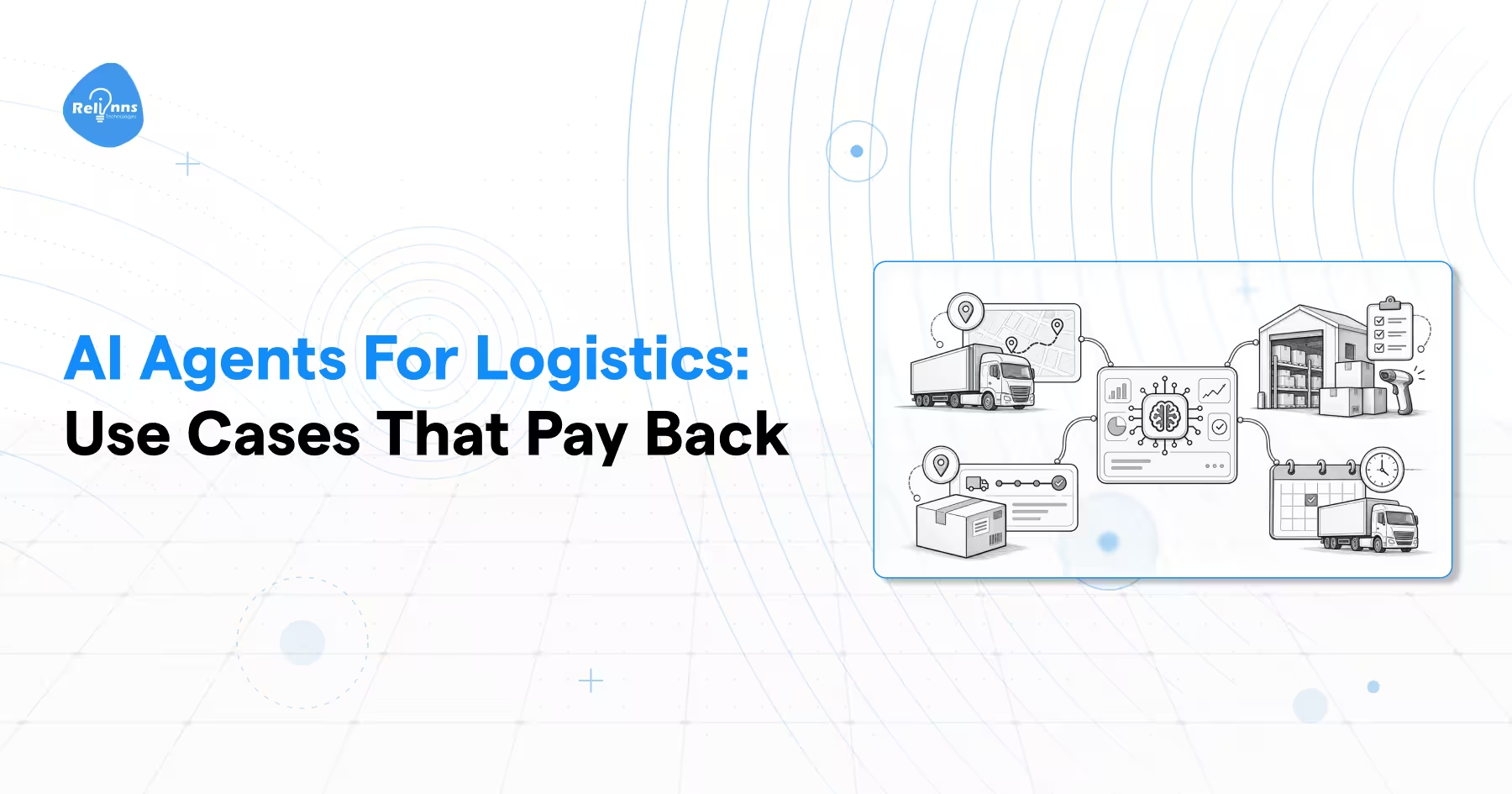
AI Agents for Logistics: 5 Use Cases That Pay Back in 2026
Date
Oct 29, 26
Reading Time
12 Minutes
Category
AI Agents
Share


TL;DR
- The agents reaching production are narrow and execution focused, not autonomous supply chain platforms.
- Freight invoice audit and document processing offer some of the clearest early value.
- Load matching depends heavily on clean carrier and shipment data.
- An agent that cannot update your TMS or ERP still leaves execution to a human.
- Forrester found only 15% of AI decision makers reported an EBITDA lift in the previous 12 months.
- Legacy integration, weak master data, and unclear process ownership kill otherwise workable pilots.
- Start with one agent, one workflow, one owner, and one measurable baseline.
You have been pitched AI agents at least a dozen times this year. Some of it is real. Most of it will not survive contact with your TMS.
That matters because AI agents for logistics are being aimed at work built around exceptions, handoffs, and semi-structured documents. Those are exactly the conditions where rigid automation often struggles.
Spending is still accelerating. Gartner projects SCM software with agentic AI will grow from less than $2 billion in 2025 to $53 billion by 2030, while enterprise adoption rises from 5% to 60%.
Start with what an agent actually is, because the word is doing too much work right now.
What Does an AI Agent Actually Do in a Logistics Operation?
An AI agent in logistics is software that reads what is happening, decides what action fits the situation, and then performs that action inside approved systems.
Unlike rule-based automation, it can work with changing inputs instead of relying only on a fixed sequence. Gartner predicts that 40% of enterprise applications will include task-specific AI agents by the end of 2026, up from less than 5% in 2025.
A TMS can tell an operator that a shipment is late.
An agent can read the delay, check carrier and shipment data, compare available options, prepare the next action, and record why it chose that response.
Traditional automation works well when every input follows an expected pattern. Logistics rarely does.
New document formats, changed delivery windows, carrier rejections, missing fields, and unexpected exceptions require context before the next step can happen.
That is where AI agent uses in logistics become relevant. They can interpret current conditions and decide what should happen next within defined rules and permissions.
The catch is execution.
An agent that identifies the right action but cannot update the TMS, ERP, or another system of record still leaves the final work to a person.
| Traditional Automation / RPA | BI Dashboard | AI Agent | |
|---|---|---|---|
| Handles a new invoice format | Usually fails outside predefined formats | Not applicable | Extracts data and flags confidence |
| Decides between two carriers | No | Shows supporting data | Yes, within approved rules |
| Acts without an operator present | Only through fixed rules | No | Yes, within granted authority |
| Explains a decision | Limited to predefined logic | Not applicable | Yes, if designed to log reasoning |
| Needs clean data | Yes | Yes | Yes, more than many teams expect |
That last row is where many logistics AI budgets quietly die.
Source: Gartner, 2025
Why Do Most Logistics AI Pilots Stall Before They Reach Production?
Most logistics AI pilots stall because they are scoped as transformation programs instead of one workflow with a clear owner, usable data, and a path to update the system of record.
The technology is rarely the only problem.
Forrester found that just 15% of AI decision makers reported an EBITDA lift during the previous 12 months. It also predicted that enterprises would defer 25% of planned AI spending into 2027 as pressure for measurable returns increased.
The market narrative often suggests multi-agent systems will soon coordinate supply chains with minimal human involvement.
Production reality is much narrower.
Maturity Is Still Limited
McKinsey surveyed roughly 500 organizations in late 2025 and early 2026.
Only about one third reported maturity level three or higher in strategy, governance, and agentic AI governance and controls.
That matters because an agent taking operational actions needs permissions, accountability, monitoring, and clear escalation rules before it can safely move beyond recommendations.
Logistics Has a Low Tolerance for Failed Process Change
Logistics businesses operate on tight margins.
Changing working processes carries operational risk when TMS, ERP, carrier systems, and customer commitments are connected.
That risk encourages teams to favor narrow workflows with measurable outcomes over broad transformation programs.
The Agents That Survive Are Usually Narrow
Late supplier follow-ups, invoice exception triage, document intake, and confirmation chasing are less ambitious than autonomous logistics platforms.
They also have clear inputs, outputs, owners, and system actions.
One logistics practitioner summarized the production reality clearly:
Source: Practitioner discussion, r/SupplyChainLogistics, 2026
The gap is not between using AI and avoiding AI.
It is between agents that recommend an action and agents that can execute it safely inside the system where work happens.
So which agents clear that bar today?
Which AI Agents for Logistics Actually Pay Back in 2026?
Five categories offer particularly practical production paths: freight invoice audit, exception management, document processing, RFQ to quote, and load matching.
They share the characteristics that make agent deployments easier to measure: high volume, bounded scope, clear escalation rules, and a defined system where the result belongs.
Broader autonomous planning has more dependencies and is harder to treat as a first deployment.
Freight Invoice Audit Agent
LTL billing generates large volumes of invoices, accessorial charges, rate calculations, and exceptions.
Transflo reports LTL invoice error rates between 30% and 40% in its Workflow AI product materials.
What it does: The agent breaks an invoice into components, compares charges with contracted rates and shipment records, and routes genuine mismatches to the right person.
Transflo launched Workflow AI for LTL in January 2026 specifically for invoice matching, validation, exception handling, and resolution.
Systems it touches: AP, TMS, contracted rate tables, shipment records, carrier portals.
Build it first if: Your contracted rates are structured and invoice exceptions consume significant finance or operations time.
Source: Transflo, 2026
Exception and Dispatch Management Agent
Operations teams spend significant time finding out what happened before they can decide what to do.
A shipment exception agent continuously monitors events, identifies deviations, checks alternatives, and prepares a structured response.
What it does: It monitors tracking data, identifies exceptions, retrieves carrier or sailing alternatives, and presents an action inside defined operational limits.
project44 reports that early deployments of its Ocean Exceptions Agent identify roll risk up to 35 hours earlier than standard carrier updates and reduce detection and rebooking readiness from hours to under five minutes.
Human operators still retain authority over the final rebooking decision.
Systems it touches: TMS, carrier APIs, visibility platforms, email, shipment records.
Build it first if: Your team spends a large share of its day investigating exceptions and chasing status updates.
Source: project44, 2026
Logistics Document Processing Agent
Logistics still depends on commercial invoices, bills of lading, delivery documents, customs records, rate confirmations, emails, and customer-supplied files.
The problem is not simply reading a PDF. The extracted information must reach the correct shipment or order record with enough confidence to use it.
What it does: The agent identifies document type, extracts required fields, validates them against business rules, matches the document to the correct transaction, and escalates low confidence results.
A useful production analogue comes from Vooma. Its Zengistics case study reports that automated inbound order processing now handles 98% of order entry, with load creation becoming ten times faster.
The important part is not the percentage alone. The extracted information flows into the operating workflow rather than ending in a separate output.
Systems it touches: TMS, ERP, customs software, email intake, document storage.
Build it first if: Teams spend hours reading documents and retyping the same fields into operational systems.
Source: Vooma, Zengistics case study
RFQ to Quote Agent
Freight quoting is sensitive to response time.
An RFQ that sits in an inbox for hours can become irrelevant before someone prices it.
What it does: The agent reads the request, extracts shipment details, retrieves lane and rate data, applies pricing rules, and prepares a quote. Within approved thresholds, it can send automatically or route the quote for review.
Vooma reports that WorldWide Logistics reduced individual quote response from roughly two to three hours to under nine minutes. Its case study describes this as a 95% reduction in individual quote response time.
The same case study reports a 25% improvement in median response time across quoting activity.
Systems it touches: Email, rate engine, TMS, pricing rules, customer data.
Build it first if: Slow quote response directly affects load conversion.
Source: Vooma, WorldWide Logistics case study
Load Matching Agent
Carrier sourcing still depends heavily on carrier history, capacity information, phone calls, load boards, and operator knowledge.
A load matching agent can rank suitable carriers using lane history, availability, equipment, pricing, and other operational signals.
What it does: It compares open loads with available carrier capacity and ranks suitable options before outreach or tendering.
Descartes reports that Bahr Transportation books loads up to 15 times faster using MacroPoint capacity matching than through traditional manual procurement.
That does not mean load matching should always be your first agent.
This workflow depends heavily on carrier records, lane history, capacity data, and shipment information being usable.
If those foundations are weak, document processing or invoice audit is usually a safer starting point.
Systems it touches: TMS, carrier database, telematics, load boards, capacity networks.
Build it first if: Your carrier master data and shipment data are already reliable.
Source: Descartes MacroPoint customer case study
| Agent | Relative Time to First Value | Data Prerequisite | Suggested Launch Authority | Primary Value Driver |
|---|---|---|---|---|
| Freight invoice audit | Fast | Contracted rates and invoice data | Flag automatically, review exceptions | Recovered spend and audit time |
| Exception management | Medium | Reliable tracking feeds | Recommend first | Operations time and disruption cost |
| Document processing | Fast | Document samples and field rules | Extract, validate, escalate | Manual entry time |
| RFQ to quote | Fast | Lane, rate, and pricing data | Draft or send within rules | Quote speed and conversion |
| Load matching | Medium | Clean carrier and shipment data | Recommend first | Coverage speed and sourcing effort |
The relative timing and launch authority above are implementation guidance, not industry benchmarks. Actual readiness depends on integration quality, workflow volume, risk, and available data.
One high-volume logistics workflow is missing from that list because it sits on the ecommerce side of the operation.
Can AI Agents Fix NDR and Failed Delivery Recovery?
Yes. NDR recovery is one of the clearest last-mile workflows for measuring whether an agent improves operations.
NDR recovery AI agents work the non-delivery report queue.
They identify why delivery failed, contact the customer, confirm the correct next action, and send the reattempt instruction back to the courier system before the shipment moves toward return.
The Problem Is Time
NDR queues are commonly handled by support or operations teams.
A failed delivery may require someone to check the reason code, contact the customer, confirm an address or delivery slot, and update the courier.
As the shipment remains unresolved, the business risks a return while also carrying forward shipping, reverse movement, handling, and inventory costs.
What the Agent Does
The agent reads the NDR reason and determines what information is missing.
It can contact the customer through WhatsApp, SMS, or a call workflow, confirm a corrected address or new delivery time, and record that response against the shipment.
If the courier exposes the required API action, the agent can then submit the reattempt instruction directly.
Why It Is a Strong First Build
The workflow has high volume and a clear outcome.
A shipment either receives a confirmed recovery action or it continues toward return.
That makes performance easy to compare with existing NDR and RTO baselines.
The important constraint is integration.
The difficult part is not the conversation. It is whether the courier lets another system submit the reattempt instruction.
If that write path does not exist, the agent can organize the queue and collect customer responses, but someone still enters the final instruction manually.
That brings up the next question. Which agent should you build first?
Which Logistics AI Agent Should You Build First?
Build the agent that sits on your highest volume, lowest judgement workflow where the required data is already usable.
For many operations, that means document processing or invoice audit.
The deciding factor is not which agent sounds most advanced. It is which workflow already has enough reliable data, system access, and ownership to support execution.
A common discovery mistake is trying to solve several operational problems in one pilot.
A strong first deployment should answer three questions clearly:
- What decision does the agent support?
- Which systems must it read or update?
- How will success be measured?
You do not need every company dataset to be AI-ready.
You need the data required for one workflow to be usable.
| You Are a | Build First | Build Second | Skip for Now | Why |
|---|---|---|---|---|
| Freight forwarder | Document processing | Exception management | Load matching | Document volume is often the larger bottleneck |
| Freight broker | RFQ to quote | Load matching | Demand forecasting | Quote speed connects directly to revenue |
| 3PL or warehousing company | Invoice audit | Exception management | Autonomous planning | Spend recovery gives the CFO a measurable case |
| Shipper with internal logistics | Invoice audit | Document processing | Load matching | Contracted rates are often already structured |
| D2C or ecommerce brand | NDR recovery | Customer support triage | Route optimisation | RTO provides a clear existing baseline |
For 3PL AI agents, invoice audit is often a practical first build because invoice data, contracted rates, exceptions, and financial outcomes can be clearly defined.
The same principle applies across every company type.
Start where the workflow already has structure.
Before You Scope Anything, Answer These Four Questions
1. Which workflow consumes the most hours each week?
2. Where does its data live, and can an API read it?
3. Can the agent update the result in the system, or does it only produce a recommendation?
4. Who owns the approval policy when the agent makes the wrong decision?
Question three determines whether the agent can remove execution work or only prepare another output for a person.
Why Does an AI Agent Need Write Access to Your TMS or ERP?
Because without write access, the agent recommends an action while a person still executes it.
An agent that reads your TMS, identifies a late shipment, and suggests the best carrier option has created useful analysis.
But if an operator must copy that result into the TMS manually, the workflow still contains the same execution step.
That limits how much operational work the agent removes.
The Read-Only Trap
Most AI pilots look strong during a demonstration because reading data is easier than changing production records.
The agent identifies the exception, checks available options, ranks them, and explains its recommendation.
Then production starts.
Someone still opens the TMS, updates the carrier, changes the shipment record, enters the ETA, and documents the decision.
The agent saved analysis time. It did not complete the workflow.
What Write Access Actually Requires
Safe execution needs more than an API connection.
The agent needs:
- A defined system of record
- An API or integration layer that accepts changes
- Role-based permissions
- Clear approval rules
- A log for every action
- A way to reverse an incorrect update
- Human escalation outside its authority
Write access should also be narrow.
A dispatch agent may be allowed to update shipment status while still requiring approval before confirming a booking above an agreed cost threshold.
The Audit Trail Is Part of the Product
Every action should record what the agent saw, what it decided, which rule allowed the action, what changed, and whether the result was confirmed.
Without that record, teams cannot investigate mistakes or increase autonomy safely.
This is why write access is more than an integration detail.
It determines whether AI agents for logistics actually execute work or simply produce another recommendation.
Write access is one of three conditions that decide whether a pilot reaches production.
The other two usually appear during scoping.
What Kills Most Logistics AI Pilots, and How Do You Avoid It?
Three issues stop many logistics AI pilots before they create operational value: fragmented integrations, unreliable master data, and unclear process ownership.
None are primarily model problems.
They are workflow design problems, which means they should be identified before development begins.
| Blocker | What It Looks Like | The Fix |
|---|---|---|
| Legacy systems and fragmented integrations | The agent cannot read reliable operational state or trigger actions safely | Identify the system of record and required integrations before orchestration begins |
| Poor master data and document quality | Matching and extraction become unreliable, so users stop trusting the output | Define mandatory fields, confidence thresholds, validation rules, and a fallback queue |
| No clear process owner | Nobody owns approvals, risk, exceptions, or KPIs after the demo | Assign one workflow owner, one technical owner, and one approval policy |
Legacy Integrations
A capable agent cannot compensate for missing system access.
If shipment status sits in one portal, rates in another, carrier data in spreadsheets, and write actions inside a closed TMS, integration becomes the real project.
Poor Master Data
Carrier names, lane data, equipment types, rates, addresses, and shipment identifiers must be consistent enough for the agent to match records confidently.
When confidence is low, the workflow needs a defined human review path instead of a guessed result.
No Named Process Owner
Someone must decide what the agent can do, which exceptions require review, and which metric defines success.
Without that owner, even a technically successful pilot has no route into daily operations.
The pattern is consistent.
The model may work while the workflow does not.
That makes scoping one of the most important parts of the project.
How Do You Scope Your First Logistics AI Agent?
Scope one agent, not five.
Define the decision it supports, the systems it needs, the escalation rule, and the baseline metric before development starts.
Then give the agent more authority only after it performs reliably on real logistics data.
A strong first deployment removes work from one measurable workflow rather than trying to redesign the entire operation.
1. Pick one high-volume workflow with an existing baseline for time, cost, errors, or recovery.
2. Audit data and integration readiness across the TMS, WMS, ERP, carrier APIs, email, and documents.
3. Build in one to two week sprints with regular operational reviews. Start with recommendations before allowing direct execution.
4. Validate against real shipments and edge cases with the people who own the workflow.
5. Review the original KPI and decide whether to expand authority, scale the workflow, or stop.
Relinns builds custom agents around the TMS, WMS, ERP, and other systems a business already uses rather than requiring those systems to be replaced.
The approach uses staged autonomy, explicit approval rules, and audit logging from the first production workflow. Relinns also works across agentic commerce, healthcare, insurance, and supply chain use cases where agents need to operate inside existing business systems.
Frequently Asked Questions
What Are AI Agents for Logistics?
AI agents for logistics are software systems that read operational data, make bounded decisions, and complete approved actions inside logistics systems. A shipment exception agent can detect a delay, evaluate available options, update the shipment record, and escalate when human approval is required.
How Long Does It Take to Deploy a Logistics AI Agent?
There is no universal deployment timeline. An 8- to 12-week target may be reasonable for a well-scoped single workflow when APIs, data, and approval rules are already available, but it should be treated as a planning range rather than an industry benchmark. Complex integrations can take longer.
Do AI Agents Replace Logistics Planners and Dispatchers?
No. AI agents are better suited to repetitive coordination, monitoring, information gathering, and routine execution. Planners and dispatchers still handle negotiation, unusual exceptions, commercial tradeoffs, and decisions where incomplete information or customer context requires human judgement.
Do I Need Clean Data Before Starting?
Not across the whole company. You need reliable data for the workflow the agent will own. That may include shipment IDs, carrier records, rates, lane data, delivery status, invoice fields, customer contact details, or exception codes. Missing information should have clear validation and fallback rules.
What Is the Difference Between AI Agents and My Existing TMS?
A TMS records and manages transportation activity. An AI agent acts on that information. The TMS may show that a shipment is delayed. The agent can evaluate the delay, check approved alternatives, prepare or execute the next action, and record the outcome in the TMS.