AI Agent Memory: How Agents Remember and Why It Matters
Date
Oct 27, 26
Reading Time
7 Minutes
Category
AI Agents
Share


Answer Box
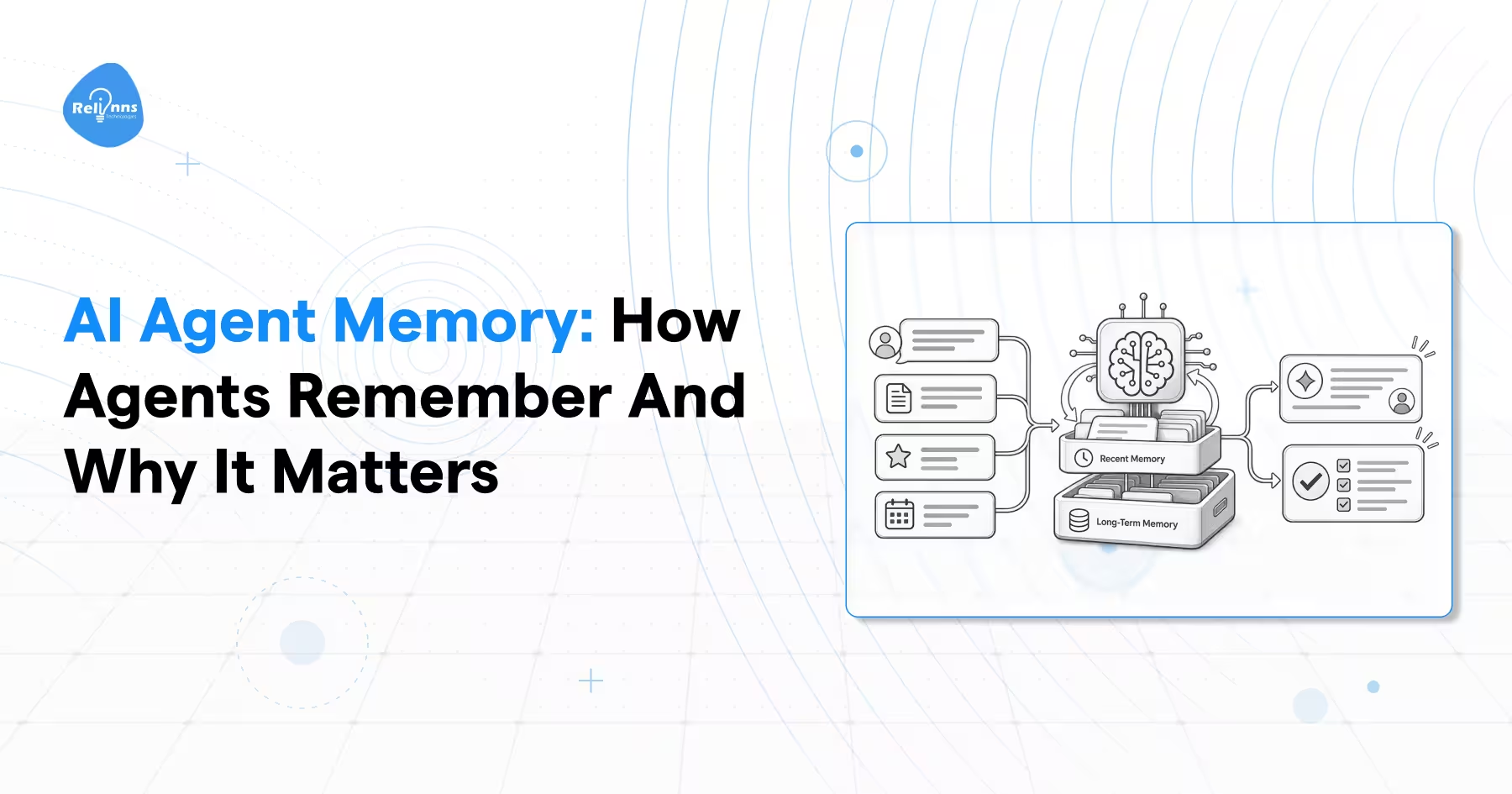
AI agent memory lets an agent retain useful information during a task and recall selected information across future sessions. It includes temporary working context, persistent semantic facts, and episodic memories of past interactions. Good memory prevents repeated work, preserves continuity, and retrieves only relevant information instead of carrying every previous interaction into each new task.
An AI agent may perform well once but lose continuity when the next task begins. Without reliable AI agent memory, it may repeat questions, forget preferences, lose task state, or redo completed work.
Passing more context into the model is not enough. Memory needs rules for what to retain, where to store it, when to retrieve it, and when to remove it.
Memory is one part of the broader AI agent architecture, but it needs its own design for storage, retrieval, updates, and deletion.
What Is AI Agent Memory?
AI agent memory allows an agent to preserve useful information beyond a single model response so earlier inputs, decisions, and outcomes can influence later actions. It gives the system continuity instead of treating every interaction as completely new.
Context, State, and Memory
These concepts are related, but each serves a different role in agent behavior.
| Concept | What It Means | Practical Role |
|---|---|---|
| Context | Information currently available to the model during a task | Helps the agent understand the immediate situation |
| State | The current condition of a task or workflow | Tracks completed steps, pending actions, and approval status |
| Memory | Information intentionally retained for later use | Lets previous facts, decisions, and interactions influence future actions |
Effective AI agent state management keeps these layers coordinated without treating every piece of available information as permanent memory.
What Memory Can Contain
- Current task status
- User preferences
- Previous decisions
- Known facts
- Completed actions
- Relevant past interactions
- Learned procedures
Important Principle
Memory should be selective. A reliable agent should not store every message forever.
The system should decide what deserves to be remembered, what should remain temporary, and what should be deleted when it is no longer useful, accurate, or appropriate.
Types of Agent Memory
Not every memory serves the same purpose. A reliable agent separates temporary task information from facts, experiences, and procedures that remain useful later. This distinction helps prevent irrelevant information from affecting future decisions.
| Memory Type | What It Retains | Practical Role |
|---|---|---|
| Session Memory | Information relevant to the current interaction | Keeps the current conversation or task coherent |
| Working Memory | Information actively required to complete the current goal | Holds intermediate results, decisions, and temporary task state |
| Semantic Memory | Facts and knowledge that remain useful over time | Recalls known information without repeating discovery |
| Episodic Memory | Previous interactions, events, and outcomes | Helps the agent recall what happened in similar past situations |
| Procedural Memory | Instructions or patterns for completing tasks | Preserves how specific actions or workflows should be performed |
Clarifying the Difference
Consider an agent managing customer onboarding.
Session memory retains what the customer says during the current interaction.
Working memory tracks which onboarding steps are complete and which still require action.
Semantic memory can preserve an approved preference or verified customer fact that may matter later.
Episodic memory can recall a previous onboarding issue and its outcome.
Procedural memory preserves the approved steps the agent should follow when that type of issue appears again.
These memory types should work together without storing everything permanently. Information should be preserved according to its purpose, expected lifetime, and relevance to future decisions.
Short-Term vs. Long-Term Agent Memory
The difference between short-term vs. long-term agent memory is not simply how long information is stored. The more useful distinction is whether the information supports only the current task or has enough future value to justify persistent retention.
| Area | Short-Term Memory | Long-Term Memory |
|---|---|---|
| Duration | Current task or session | Across sessions or future tasks |
| Purpose | Maintain immediate context and state | Preserve information that remains useful later |
| Typical Content | Current inputs, intermediate results, temporary decisions | Preferences, facts, events, historical outcomes |
| Storage | Context, runtime state, temporary stores | Persistent databases or retrieval systems |
| Main Risk | Losing required task context | Retrieving outdated or irrelevant information |
| Deletion | Often removed after task completion | Requires explicit retention and deletion rules |
Core Decision Rule
Do not ask:
Can this information be stored?
Ask:
Will this information improve a future decision enough to justify retaining it?
Information should remain short-term when it only supports the active task. This includes temporary calculations, intermediate outputs, current approvals, and active workflow state.
Move information into long-term memory only when there is a clear reason to retrieve it later. That may include verified preferences, stable facts, important prior outcomes, or reusable experience.
This keeps memory useful instead of allowing it to become an uncontrolled history of previous interactions.
Agent Memory Architecture: How Memory Is Stored and Retrieved
Different memory types need different storage and retrieval methods. A reliable agent memory architecture should match each type with the system best suited to store it, retrieve it, update it, and remove it when necessary.
Vector Memory for AI Agents
Vector memory for AI agents is useful when retrieval depends on semantic similarity rather than an exact field or identifier.
Vector storage can support:
- Similarity-based retrieval
- Past interaction discovery
- Unstructured memories
- Semantic facts
- Relevant experience retrieval
A vector store is not the complete memory system. Structured information may be better stored in:
- Relational databases
- Key-value stores
- Workflow state stores
- User profile records
- Event logs
The right architecture may combine several storage methods instead of forcing every type of memory into one system.
Retrieval Process
A practical retrieval flow looks like this:
Current task → retrieval query → candidate memories → ranking → relevance filtering → selected memory added to context
Ranking matters because finding a related memory is not enough. The system should retrieve information that is relevant, current, permitted, and useful for the present task.
Once relevant memories are retrieved, an agent needs a way to use that information to guide its next action. A ReAct agent follows a reasoning-and-action loop, using tool results as observations to determine whether another action is needed or it can return a final response.
Summarization and Compression
Older interactions do not always need to remain available word for word. Summarization can preserve important facts, decisions, and outcomes while reducing:
- Context size
- Storage volume
- Retrieval noise
This reduces the chance that older information overwhelms the current task.
Retrieval Boundary With RAG
When retrieval becomes part of a broader system that decides what knowledge to search and how retrieved evidence should guide actions, agentic RAG architecture becomes the relevant deeper topic.
Agent memory should remain focused on retaining and recalling useful state, facts, experiences, and procedures.
Memory Decay, Conflict Resolution, and Privacy
Stored information does not remain correct forever. As an agent accumulates memory, older facts may lose relevance, duplicate records may appear, and new information may contradict what was stored earlier. Reliable memory therefore needs rules for aging, correction, retrieval, and deletion.
| Memory Problem | What Can Go Wrong | Design Response |
|---|---|---|
| Decay | Old information remains influential after it loses value | Expiration rules and relevance weighting |
| Conflict | New information contradicts an older memory | Recency, source authority, or explicit resolution rules |
| Duplication | Several memories represent the same fact | Deduplication and consolidation |
| Retrieval Noise | Irrelevant memories enter the active context | Ranking and relevance thresholds |
| Privacy | Sensitive information persists longer than necessary | Access controls, retention rules, and deletion |
| Incorrect Memory | Wrong information becomes persistent | Verification and correction mechanisms |
Memory Decay
Some memories should become less influential as they age. They do not always need immediate deletion.
Relevance weighting and expiration rules can reduce the chance that outdated information affects future decisions while still preserving information that may retain limited value.
Conflict Resolution
When memories disagree, the system needs a defined resolution rule.
It may:
- Prefer verified information
- Prefer newer information where appropriate
- Preserve the source of each memory
- Request clarification when the conflict cannot be resolved safely
The correct choice depends on the information being stored. A recent value is not automatically more reliable than an older verified record.
Privacy
An agent should remember only what it is permitted and useful to remember.
Retention periods, access controls, correction mechanisms, and deletion rules should therefore be part of memory design from the start. Information that no longer has a justified purpose should stop influencing future agent behavior.
How Do You Design Memory for a Reliable Agent?
Reliable memory design requires clear decisions about what gets stored, how it is retrieved, when it changes, and when it should disappear. A consistent process prevents useful memory from turning into irrelevant, conflicting, or outdated context.
| Step | Memory Design Decision |
|---|---|
| 1. Define What Deserves Memory | Decide what information has future value |
| 2. Separate Working and Persistent State | Decide what survives beyond the current task |
| 3. Match Storage to the Information | Choose storage based on data structure and recall needs |
| 4. Define Retrieval Rules | Control when and what memory enters context |
| 5. Define Update and Conflict Rules | Decide how new information changes existing memory |
| 6. Define Retention and Deletion | Control how long information remains available |
| 7. Test Memory Behavior | Verify that memory improves agent decisions |
1. Define What Deserves Memory
Decision: Separate temporary task information from information that can improve future decisions.
Action: Preserve verified preferences, important facts, and reusable decisions. Keep temporary calculations and intermediate outputs transient.
2. Separate Working and Persistent State
Decision: Determine how long information should remain available.
Action: Remove working state after task completion. Persist information only when future sessions have a valid reason to retrieve it.
3. Match Storage to the Information
Decision: Choose storage according to the type of information.
Action: Use structured storage for defined records and workflow state. Use semantic retrieval when recall depends on meaning.
4. Define Retrieval Rules
Decision: Control what stored information reaches the model.
Action: Specify when memory is searched, which memory types qualify, how relevance is scored, and how much retrieved information enters context.
5. Define Update and Conflict Rules
Decision: Determine how new information affects existing memory.
Action: Decide whether it replaces existing information, adds to it, creates a separate event, or requires clarification.
6. Define Retention and Deletion
Decision: Establish when memory should stop influencing the agent.
Action: Set rules for expiration, sensitive information, obsolete records, and user deletion requests.
7. Test Memory Behavior
Decision: Confirm that memory improves decisions instead of introducing noise.
Action: Test retrieval accuracy, conflict handling, task state, irrelevant memory filtering, and confirmed deletion.
Memory design is one part of the broader process for how to build an AI agent, alongside tools, workflow logic, evaluation, and deployment.
Frequently Asked Questions
What Is AI Agent Memory?
AI agent memory is the information an agent intentionally retains so it can use earlier context, facts, decisions, or experiences later. Memory may exist only during the current task or persist across multiple sessions depending on its purpose.
What Are the Types of Agent Memory?
Common types include session memory, working memory, semantic memory, episodic memory, and procedural memory. Each serves a different purpose, ranging from maintaining current task context to preserving facts, previous experiences, and reusable procedures.
What Is the Difference Between Short-Term and Long-Term Agent Memory?
Short-term memory supports an active task or session. Long-term memory preserves information that has a clear reason to influence future sessions. The distinction should depend on future usefulness, not simply how long storage is technically available.
How Is Agent Memory Stored?
Agent memory can use several storage systems. Structured state may live in databases or workflow stores, while semantic memories may use vector retrieval. Production designs often combine storage methods because different information requires different retrieval behavior.
Why Do AI Agents Need Memory?
Memory allows an AI agent to maintain continuity, preserve useful state, recall relevant information, and avoid repeating completed work. Without appropriate memory, each new interaction may require the agent to rebuild information it previously discovered or received.
Final Verdict
Good agent memory is selective rather than unlimited. A reliable system preserves information that can improve future decisions, retrieves it when relevant, updates it when circumstances change, and stops using it when retention is no longer justified.
The architecture should distinguish temporary state from persistent memory while controlling storage, retrieval, conflicts, privacy, and deletion. Memory becomes useful when it improves the agent's next decision rather than simply increasing the amount of information available.