Agentic RAG Architecture: A Practical Blueprint for Production Systems
Date
Oct 29, 26
Reading Time
9 Minutes
Category
AI Agents
Share


Answer Box
Agentic RAG architecture places retrieval inside an agent-controlled reasoning loop. The agent decides whether retrieval is needed, what evidence to fetch, and whether the returned evidence is sufficient. It can repeat retrieval until it has enough evidence or reaches a stopping condition, unlike fixed retrieval systems that retrieve once before generation.
Fixed retrieval works when one search can answer the question. It becomes less reliable when the task needs multiple sources, repeated retrieval, or evidence gathered across several reasoning steps.
Agentic RAG architecture gives the agent control over retrieval during reasoning. It decides when to search, what to retrieve, and whether the evidence is sufficient.
This guide covers the retrieve-reason-act loop, architecture layers, retrieval responsibilities, orchestration patterns, traditional RAG comparison, and production design decisions.
What Is Agentic RAG Architecture?
Agentic RAG architecture is an architectural pattern where an AI agent controls retrieval during reasoning. Instead of receiving one fixed set of retrieved documents before generation, the agent can decide when retrieval is needed, reformulate a query, examine new evidence, and determine whether another retrieval step is necessary.
An agent RAG architecture therefore treats retrieval as part of the reasoning process rather than as a fixed stage before the model responds.
| Area | Fixed Retrieval Architecture | Agent Controlled Architecture |
|---|---|---|
| Retrieval Timing | Predetermined | Decided during reasoning |
| Number of Retrievals | Usually one retrieval stage | Can repeat when required |
| Query Formation | Original or predefined query | Agent can reformulate the query |
| Evidence Evaluation | Limited before generation | Evidence can be evaluated before continuing |
| Stopping | Pipeline completes automatically | Agent or system rules determine when retrieval ends |
The architectural focus is control. The system needs clear rules for retrieval, evidence evaluation, repeated searches, and stopping conditions.
How Does the Retrieve Reason Act Loop Actually Work?
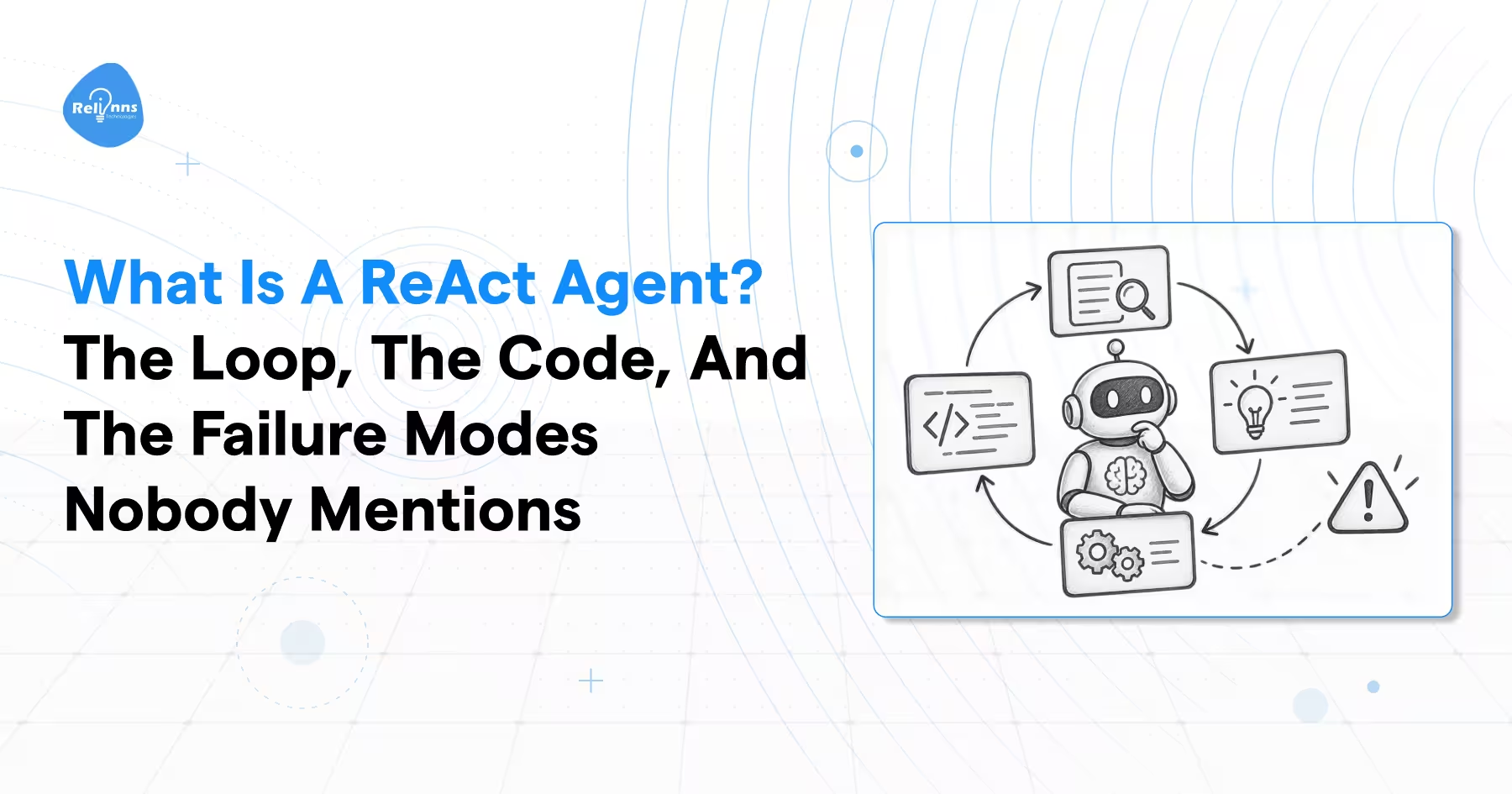
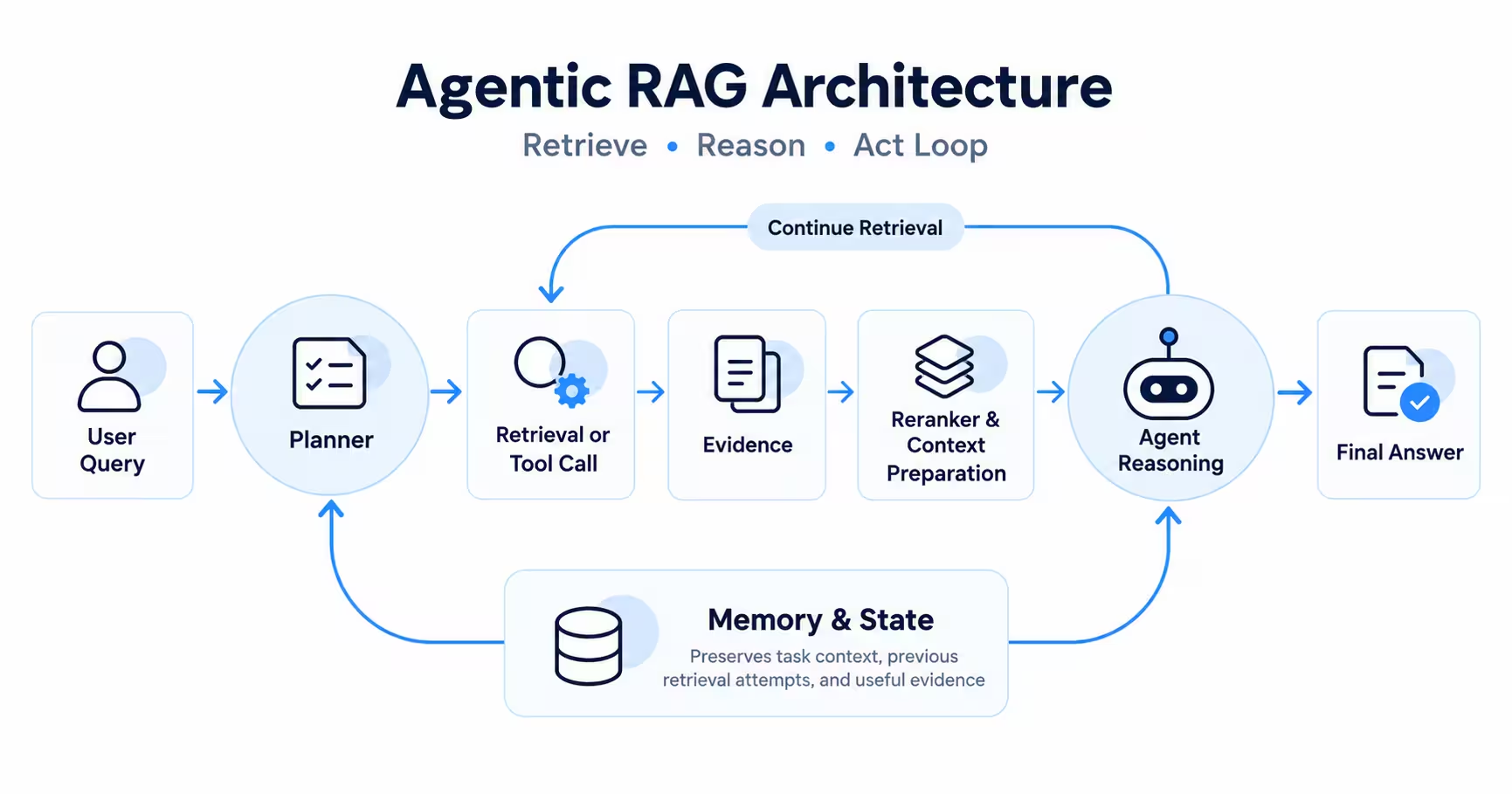
The retrieve reason act loop controls how an agent gathers evidence during a task. Instead of retrieving once and immediately generating an answer, the agent can inspect what it knows, search for missing information, evaluate the result, and decide whether another retrieval step is required.
1. Reason: The agent evaluates the current question, available context, and evidence already collected. It identifies what information is still missing.
2. Retrieve or Act: The agent searches an approved knowledge source or invokes an available tool that can provide the required information.
3. Observe: The returned documents, records, or tool results become available for the next reasoning step.
4. Evaluate: The agent checks whether the new evidence is relevant and sufficient to continue toward an answer.
5. Continue or Stop: If important evidence is still missing, another retrieval cycle begins. If the task requirements are satisfied, the agent proceeds to the final response.
This design is closely related to the interleaving of reasoning and actions introduced by ReAct. Self RAG later explored adaptive retrieval and reflection, while FLARE demonstrated active retrieval during generation rather than relying on a single initial retrieval. (arXiv)
Stopping Conditions
Production systems should not allow this loop to continue without limits.
| Control | What It Limits |
|---|---|
| Maximum Iterations | Number of reasoning and retrieval cycles |
| Token or Cost Budget | Resources consumed during the task |
| Evidence Sufficiency | Whether enough relevant evidence has been collected |
| Confidence Threshold | Whether the system can proceed with sufficient certainty |
| Tool Failure | Repeated unsuccessful retrieval or tool calls |
| Task Completion | Whether the required objective has been satisfied |
These controls make the loop bounded and observable rather than unrestricted.
The Core Layers of an Agentic RAG Architecture
A production agentic RAG system should separate planning, retrieval, evidence preparation, and memory rather than forcing every responsibility into one model call. This separation makes each stage easier to control, test, observe, and improve without changing the entire system.
Agentic RAG Components at a Glance
| Layer | Primary Responsibility |
|---|---|
| Orchestration and Planner | Decides what should happen next |
| Retrieval and Tool | Fetches evidence or executes actions |
| Context Fusion and Reranking | Selects and prepares useful evidence |
| Memory and State | Preserves relevant task and historical information |
Orchestration and Planner Layer
The orchestration layer controls the sequence of work. It interprets the request, breaks complex tasks into smaller steps, and decides which action should happen next.
It can select a retrieval source, invoke a tool, route work to another component, or continue reasoning without retrieval. It also tracks current task state so later decisions reflect what has already happened.
This layer determines when retrieval is necessary rather than treating retrieval as a mandatory first step.
Retrieval and Tool Layer
This layer obtains the evidence required by the planner. Retrieval may come from vector search, keyword search, SQL queries, APIs, enterprise search, internal knowledge stores, or approved external tools.
The retrieval method should match the information being requested. Semantic questions may benefit from vector retrieval, while exact records may require structured database queries.
Retrieval quality also depends on query formation. Even the correct source can return weak evidence when the request sent to it is poorly formed.
Context Fusion and Reranking Layer
Raw retrieval results should not automatically enter the model context. This layer prepares evidence before reasoning continues.
It removes duplicate information, ranks results by relevance, prioritizes stronger evidence, and selects what should enter the active context. Source information should remain attached so the system can trace where evidence came from.
The objective is not to provide more context. It is to provide the most useful evidence for the current reasoning step.
Memory and State Layer
The memory layer preserves information that should remain available across reasoning steps or future interactions.
It can track the current task state, previous retrieval attempts, useful evidence already found, session history, and persistent information where retention is justified. This helps prevent repeated searches and allows later steps to build on earlier work.
The deeper design of retention, retrieval, and persistent state belongs to AI agent memory, which covers that architecture separately.
Agentic RAG Architecture Diagram
The agentic RAG architecture diagram should show how a request moves through planning, retrieval, evidence preparation, and reasoning. Unlike a fixed pipeline, the process can return to retrieval when the available evidence is incomplete.
Agentic RAG vs Traditional RAG Architecture
The choice between traditional and agentic retrieval should depend on query complexity. Traditional RAG is efficient when one retrieval pass can provide enough evidence. Agentic RAG becomes useful when the system must gather information across several steps, reformulate searches, or evaluate evidence before continuing.
The original RAG formulation combines generation with access to retrieved external knowledge. Later active retrieval approaches expanded this model by allowing retrieval decisions to occur during generation or reasoning. (arXiv)
| Area | Traditional RAG | Agentic RAG Architecture |
|---|---|---|
| Retrieval Control | Fixed pipeline | Agent controlled |
| Retrieval Attempts | Usually one stage | Multiple when needed |
| Query Reformulation | Limited | Can change during reasoning |
| Evidence Evaluation | Minimal before generation | Can evaluate evidence and continue |
| Best Fit | Simple knowledge lookup | Complex or multi-source questions |
| Latency | Usually lower | Usually higher |
| System Complexity | Lower | Higher |
| Control Requirements | Simpler | Requires routing and stopping logic |
The important distinction in agentic RAG vs RAG is control over retrieval.
Traditional RAG follows a predetermined retrieval path. An agentic architecture can decide that the first result is insufficient, modify the query, search another source, and continue gathering evidence.
That flexibility also introduces more decisions. Teams must define routing rules, retrieval limits, stopping conditions, and acceptable latency before using the agentic path in production.
The practical rule is simple:
Use the simplest retrieval architecture that can answer the query reliably.
Straightforward questions may not justify an agent-controlled loop. Complex questions that depend on several sources or successive reasoning steps may benefit from it.
Common Orchestration Patterns
Once retrieval becomes agent-controlled, the next design question is how that control should be organized. Most systems use one of three orchestration patterns depending on query complexity, data distribution, and how much coordination the task requires.
| Pattern | How It Works | Best Fit |
|---|---|---|
| Router | Selects the appropriate retrieval path based on query difficulty or type | Mixed workloads |
| Iterative Agent Loop | One agent retrieves and reasons repeatedly | Complex questions over related knowledge |
| Multi-Agent Pattern | Specialist agents retrieve from different systems or domains | Distributed or highly specialized data |
Router Pattern
A router evaluates the incoming request before choosing a retrieval strategy. Simple questions may receive a direct response or use traditional RAG. Other requests can be sent to a specific retrieval tool or the full agentic retrieval loop.
This pattern helps avoid using a complex reasoning process when the task does not require one.
Iterative Agent Loop
The iterative pattern uses one agent throughout the task. It reasons about what information is missing, retrieves evidence, evaluates the result, and decides whether another search is necessary.
The loop continues until the agent reaches a defined stopping condition. This pattern fits questions where each retrieval step can reveal what needs to be searched next.
Multi-Agent Pattern
A multi-agent design separates retrieval responsibilities across specialist agents. A supervisor or coordinator determines which specialist should handle each part of the request and then combines the returned evidence.
This can be useful when information is spread across very different systems, including databases, document repositories, APIs, or specialized knowledge domains.
GraphRAG can become relevant where retrieval depends heavily on relationships between entities or broader patterns across a corpus. Microsoft Research describes GraphRAG as combining knowledge graphs with retrieval and generation to support questions that standard local retrieval can struggle with. (Microsoft)
When Is Agentic RAG the Wrong Choice?
Agentic retrieval adds control, but that control is not always necessary. A simpler architecture may be more appropriate when questions are straightforward, and one retrieval pass consistently provides enough evidence.
It may also be unnecessary when the knowledge source is narrow and structured, response latency is tightly constrained, or the workflow requires highly deterministic behavior.
The same applies when additional reasoning increases cost without materially improving task accuracy.
The architecture should therefore be chosen according to query complexity and retrieval needs. A production system should use agentic retrieval because repeated reasoning improves the result, not simply because the approach is newer or more flexible.
How Do You Design an Agentic RAG Architecture for Production?
A production design should begin with workload decisions, not model choice. The architecture needs clear rules for routing, retrieval, context, memory, stopping, and evaluation before it is exposed to real users.
To implement agentic RAG, the architecture needs clear rules for routing, retrieval, context management, memory, stopping conditions, and evaluation before it is exposed to real users.
| Step | Production Decision |
|---|---|
| 1. Define Query Classes | Identify what actually needs agentic retrieval |
| 2. Design the Routing Policy | Decide which path handles each query |
| 3. Select Retrieval Sources | Define what systems the agent may search |
| 4. Define the Loop | Set reasoning, retrieval, evaluation, and stopping behavior |
| 5. Control Context | Rank and limit evidence entering the model |
| 6. Add Memory and State | Preserve useful information across retrieval steps |
| 7. Instrument the System | Log retrievals, tool calls, failures, and outcomes |
| 8. Evaluate Against Real Queries | Test whether the architecture improves task success |
1. Define Query Classes
Separate simple lookups from tasks that require several evidence sources or sequential reasoning.
2. Design the Routing Policy
Define when the system should use conventional retrieval and when it should enter the agentic loop.
3. Select Retrieval Sources
Specify which vector stores, databases, APIs, document repositories, and approved tools the agent may access.
4. Define the Loop
Set retrieval limits, stopping rules, retry behavior, and what should happen when a tool or source fails.
5. Control Context
Define how evidence is ranked, filtered, preserved with its source, and limited before entering model context.
6. Add Memory and State
Preserve useful retrieval history and task state so the agent can continue from previous steps without repeating failed searches.
7. Instrument the System
Log retrievals, tool calls, errors, stopping decisions, evidence used, and final outcomes. This makes failures traceable rather than hidden inside the final response.
8. Evaluate Against Real Queries
Measure whether the system retrieves the right evidence and completes the task correctly. A fluent answer alone is not proof that the architecture works.
This production process sits within the broader work of how to build an AI agent, where retrieval is one part of the complete system.
Frequently Asked Questions
What Is Agentic RAG Architecture?
Agentic RAG architecture places retrieval inside an agent-controlled reasoning process. Instead of receiving one fixed set of retrieved documents before generation, the agent decides when retrieval is needed, what source to search, whether the evidence is sufficient, and whether another retrieval step should follow.
What Are the Layers of an Agentic RAG System?
A production system typically separates four responsibilities: orchestration and planning, retrieval and tools, context fusion and reranking, and memory and state. Together, these layers control what happens next, collect evidence, prepare useful context, and preserve information required across reasoning steps.
What Is the Retrieve Reason Act Loop?
The retrieve reason act loop begins when the agent identifies missing information. It retrieves evidence or invokes a tool, observes the result, and evaluates whether the task can continue. If evidence remains insufficient, the process repeats. Otherwise, the system stops retrieval and produces the response.
How Is Agentic RAG Different From Traditional RAG?
Traditional RAG usually retrieves evidence through a predefined stage before generation. Agentic RAG gives the agent control during reasoning. It can reformulate queries, retrieve from additional sources, evaluate returned evidence, and decide whether another retrieval cycle is required before producing an answer.
When Should You Not Use Agentic RAG?
Agentic RAG may be unnecessary when questions are simple, one retrieval pass consistently works, or the workload is predictable. It may also be unsuitable when response latency is tightly constrained or additional reasoning adds cost and complexity without meaningfully improving retrieval quality or task success.
Does Agentic RAG Need Agent Memory?
Memory is valuable when retrieval spans several reasoning steps. It can preserve task state, previous searches, useful evidence, and earlier decisions so the agent does not repeat work or lose context.
Final Verdict
Agentic RAG architecture is not simply a more complex version of standard retrieval. The fundamental change is control. Retrieval becomes something the agent can invoke, evaluate, and repeat during reasoning.
A production system therefore needs clear routing, defined retrieval tools, evidence ranking, memory and state, stopping rules, instrumentation, and evaluation against real queries.
The decision should remain practical. Use agentic retrieval when repeated evidence gathering and iterative reasoning materially improve task success. When a simpler retrieval path answers the question reliably, the additional architectural complexity is unnecessary.