7 Types of AI Agents in 2026: Which One Fits Your Business?
Date
Oct 27, 26
Reading Time
15 Minutes
Category
AI Agents
Share


TL;DR
- 7 types of AI agents, sorted by decision behavior: simple reflex, model-based reflex, goal-based, utility-based, learning, hierarchical, multi-agent
- Each adds capability but costs predictability and oversight
- Single-agent systems held 59.2% of market revenue in 2025 (Grand View Research)
- Over 40% of agentic AI projects get canceled by 2027 (Gartner)
- Pick the simplest type the problem needs; add complexity only when forced
You searched "types of AI agents" and got five different answers. IBM says 5. Red Hat says 8. One list on page one goes all the way to 22. Nobody agrees, and that's the first sign something's off with how this topic gets covered.
Here's what actually happens because of that confusion: teams skip the classification step. They don't figure out which type fits their problem. They just reach for the most autonomous option on the shelf, because "agent" sounds impressive and multi-agent sounds even more impressive.
That's the expensive mistake. Picking the wrong agent type is the costliest decision in the whole project, and it happens before a single line of code gets written. Not during testing. Not at deployment. At the whiteboard.
Gartner isn't subtle about where this leads. On June 25, 2025, they predicted over 40% of agentic AI projects will get canceled by the end of 2027, citing escalating costs, unclear business value, and inadequate risk controls. That's not a technology problem. That's a wrong-type problem.
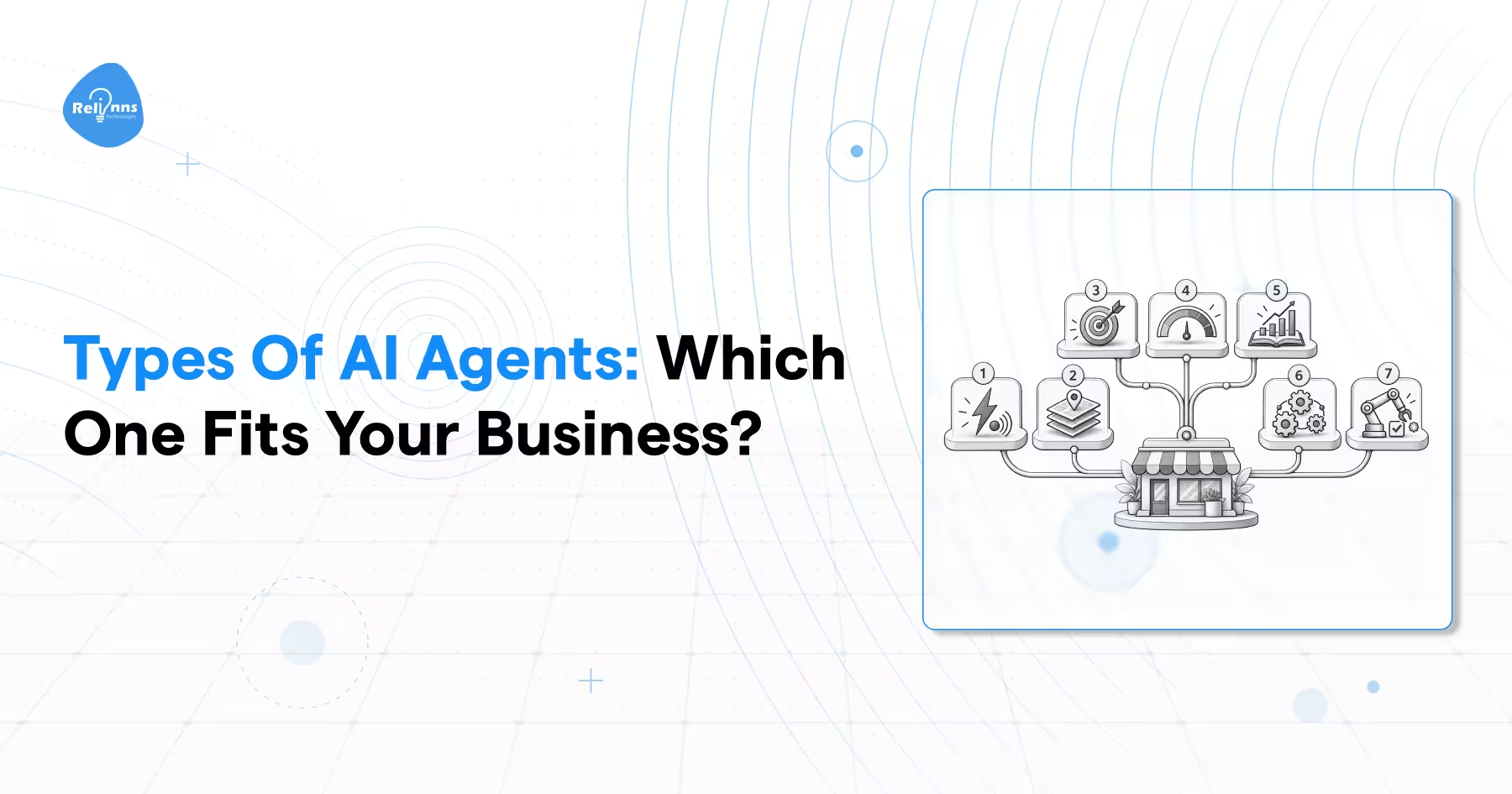
So here's what we're doing instead. Seven types of AI agents, sorted by how they actually make decisions, each with a real example and the specific way it breaks. Plus a table showing which one fits based on what you can actually oversee.
But first, you need to know the four things every agent shares, because most teams skip one. And it's not the one you'd guess.
What is an AI agent, and what are its four moving parts?
An AI agent is software that reads its environment, decides on an action, and then goes and does it, all pointed at a goal a human set. That's the whole definition. A script runs the same steps no matter what's happening around it. An agent actually looks at its situation first, then picks a move.
Gartner has a name for what happens when vendors skip that distinction. They call it agent washing, basically slapping the word "agent" on old chatbots and RPA tools that never earned it. In June 2025, Gartner estimated only about 130 of the thousands of agentic AI vendors out there are the real thing.
Every genuine agent runs on four parts:
| Part | What it does | Skipped when |
|---|---|---|
| Perception | Reads sensors, events, user input, query results | Rarely |
| State | Holds what the agent knows beyond the current input | Often, and this is where things break |
| Decision logic | Rules, plans, scores, or a learned policy | Never, this is what makes it a type |
| Action | Calls APIs, writes records, triggers processes | Rarely |
State is the one everyone skips, and that single gap is the whole difference between type one and type two on our list.
Quick gut check before we go further. A scheduled job that runs the same steps every night is automation, not an agent. ChatGPT answering your question is a chatbot. A tool that suggests text inside your app is a copilot. The only thing that earns the "agent" label is a system that decides, then acts, inside limits you set. You own the goal. It figures out the path.
Once you hold onto those four parts, the fight over whether there are 5 types or 22 stops being confusing. It's actually a mistake you can catch in about ten seconds.
Why does every article give a different number of AI agent types?
Because most writers are mixing up two totally separate ways of sorting agents, and nobody stops to say so.
The classic five, simple reflex, model-based reflex, goal-based, utility-based, and learning, sort agents by decision behavior. That's a fancy way of saying "how does this thing pick its next move." It comes straight out of Russell and Norvig's Artificial Intelligence: A Modern Approach, the textbook most of this field learned from.
Then there's job role. Labels like "coding agent" or "contract review agent" or "lead qualification agent" describe what the agent does for the business, not how it thinks. Both ways of sorting are fine on their own. Stack them together, though, and you get lists of 8, 12, 22 items that look thorough but don't actually help anyone choose.
Here's the cleaner way to see it:
| Axis | Question it answers | Example labels | Useful for |
|---|---|---|---|
| Decision behavior | How does it pick an action? | Simple reflex, goal-based, utility-based | Choosing the architecture |
| System architecture | How many agents, arranged how? | Single, hierarchical, multi-agent | Choosing the topology |
| Job role | What business task does it own? | Lead qualification agent, RAG agent | Naming the project |
Our seven types of AI agents come from five decision behaviors plus two architectures, hierarchical and multi-agent. Architecture earns its own slot because it changes how the whole thing fails and how much oversight it needs, not just how smart it looks.
One honest note. Some taxonomies add a "functional agent" tier below simple reflex, for plain API wrappers with zero decision logic. Fair framing. I won't pretend the field's settled on one answer, because it isn't.
And agentic RAG? That's a job role, not a type. Worth knowing, wrong bucket.
The 7 types of AI agents at a glance
Here's the whole list in one place, running from the simplest to the most tangled.
Simple reflex agents sit at the bottom, firing fixed rules with zero memory. Multi-agent systems sit at the top, where several agents divide the work and coordinate with one another. Every step up that ladder buys you more adaptability. And it costs you predictability, dollar for dollar.
Worth knowing before you scan the table: Grand View Research found that single-agent systems accounted for 59.2% of global AI agent market revenue in 2025. Most working deployments aren't stacking agents on agents. They're sitting quietly in the lower half of this list, doing one job well.
| # | Type | How it decides | Memory | Real example | Main limit | Oversight load |
|---|---|---|---|---|---|---|
| 1 | Simple reflex | Condition-action rules | None | Thermostat, disk-usage alert | Breaks on unseen conditions | Low |
| 2 | Model-based reflex | Rules over an inferred state | Internal world model | Google Maps routing through a tunnel | Wrong model, wrong decisions | Low-medium |
| 3 | Goal-based | Plans a sequence to a target | Model plus goal | Warehouse robot path planning | Needs a precise goal | Medium |
| 4 | Utility-based | Scores outcomes, picks the highest | Model plus utility function | Flight search balancing price and layovers | Bad weights, confident wrong answers | Medium-high |
| 5 | Learning | Updates itself from feedback | Model plus experience | Fraud detection reducing false positives | Behavior drifts over time | High |
| 6 | Hierarchical | Supervisor decomposes, sub-agents execute | Per layer | Amazon Robotics job manager and drive units | Supervisor failure is fatal | High |
| 7 | Multi-agent | Peers coordinate or compete | Distributed | Supply chain agents across suppliers | Coordination and cascading errors | Very high |
Scan that last column from top to bottom. That's the real story of this table, not the type names. Oversight starts out nearly free at the top and gets expensive fast by the bottom.
What is a Simple Reflex Agent?
A simple reflex agent runs on condition-action rules and nothing else. No memory, no forecast, no sense of what happened five minutes ago. Same input walks in, same output walks out, every single time.
How it decides is almost embarrassingly plain: if this, then that. It checks the current state, matches it against a rule, fires the action. No thinking involved, in the way we'd normally mean thinking.
Where it works: fully observable, stable environments where the rules don't need updating every week.
- Threshold alerts (CPU spikes past a set number, ping someone)
- Config drift enforcement (setting wanders off baseline, flag it)
- Service restarts (process dies, restart it)
Where it breaks is the flip side of that same simplicity. A holiday traffic dip and a real outage look exactly identical to a fixed threshold, because the agent has no idea what day it is or what normal even means. It just sees a number crossing a line.
Take a disk utilization alert set to fire at 90%. Clean, simple, works fine, until usage creeps to 89% five times in a row and nothing happens. The agent isn't wrong, technically. It's just blind to the pattern sitting right in front of it.
And that's the whole limitation in one sentence: a simple reflex agent can't tell the difference between a fluke and a trend, because it has nothing to compare today against yesterday.
The fix for that blind spot turns out to be one line of memory. Which is exactly what the next type on this list bolts on.
What is a model-based reflex agent?
Same rule-based logic as before, but now it's applied to something the agent had to figure out on its own, not just what's sitting right in front of it.
That "figure out on its own" part is the internal model. In 2026, for LLM-based agents, that model usually splits into four memory tiers. Working memory is just the context window, whatever's live right now. Episodic memory holds past trajectories, what happened last time. Semantic memory stores facts and schemas. Procedural memory keeps the tool patterns, how things get done.
Here's the detail most page-one articles skip entirely. Stanford's Generative Agents architecture doesn't just dump memories back in order. It scores every stored memory on recency, importance, and relevance before deciding what to surface. So the agent pulls up the one thing that actually mattered, not just the last thing that happened.
Where this shines: partially observable settings. Intermittent connectivity, patch tracking, an ETL run that's drifting from its usual range.
Where it falls apart: a flawed model produces wrong decisions with total confidence, and those decisions stack.
Memory tells the agent what's going on. It says nothing about what to do next.
What is a goal-based agent?
A goal-based agent holds two things at once: a description of what it's trying to reach, and a model of the world it's operating in. Then it plans a path forward, step by step, reasoning ahead instead of just reacting.
This is where things get useful for multi-step work, where each move depends on how the last one landed. Compliance remediation. Deployments that have to respect a chain of dependencies. A report that has to land by Monday, no matter what breaks along the way.
Where it breaks: vague goals wreck the whole plan before it even starts. And even with a sharp goal, the plan itself stays brittle, because planning only works if the environment behaves the way the model assumed it would.
Picture an analytics agent working backward from a Monday deadline. It checks how fresh each data dependency is, and if something's stale, it triggers the upstream job on its own, no human nudge required.
One thing worth flagging for anyone building these: two goal-based agents chasing the exact same goal can take completely different routes to get there. So you're not just constraining the outcome, you're constraining the path too.
Goals tell you whether you arrived. They say nothing about what the trip cost you.
What is a utility-based agent?
A utility-based agent puts a number on every possible outcome and goes with whichever one scores highest. Not the first workable option. The best one, by its own math.
The line that separates this from a goal-based agent is short. A goal-based agent asks, "Did I hit the target?" A utility-based agent asks, "How well did I hit it, and what did it cost me to get there?"
This is where competing priorities that can't collapse into a simple yes or no finally get handled properly. Alert triage. Vulnerability prioritization. Resource allocation. Storage tiering, where you're weighing cost against speed against how often something actually gets accessed.
Here's the part that should worry you a little. The utility function is the control point, full stop. Get the weights wrong, and the agent chases exactly the wrong thing, and it does it with total confidence, because as far as it's concerned, the math checked out.
Say you've got a critical vulnerability sitting on a test box, and a high-severity one on a production database. A well-tuned utility-based agent deprioritizes the test box and goes after production first. A badly-tuned one might do the opposite and never flag it as a problem.
Every type we've covered so far assumes you can actually write the rule, the goal, or the score yourself. What happens when you can't?
What is a learning agent?
A learning agent gets better at its job by watching what happens after it acts. Four parts make that possible: a performance element that actually does the thing, a learning element that updates based on results, a critic that judges how well it went, and a problem generator that pushes the agent to try new approaches instead of getting stuck.
Here's something most explanations of AI agent types get wrong. Learning isn't a fifth category sitting next to the other four. It's a modifier you bolt onto any of them. Pick your base behavior first, simple reflex, goal-based, whatever fits. Then decide if it needs to adapt on top of that.
Where this earns its keep: anything that shifts faster than you can rewrite the rules by hand. Personalization. Fraud detection. Triage that needs to adjust as patterns move.
Where it gets risky: behavior changes over time, which makes testing and audits genuinely harder. Before you switch it on, you need drift monitoring, limits on what it's allowed to learn, and a way to roll it back.
Say an anomaly detector gets told a seasonal spike was a false alarm. Next cycle, it quietly suppresses that whole class of alert on its own.
Those first five types cover how one agent thinks. Some problems are just too big for one agent to hold, period.
What is a hierarchical agent?
A hierarchical agent puts one supervisor at the top, breaking a big objective into smaller pieces and routing each one down to sub-agents. Every sub-agent gets its own prompt, its own memory, and a narrow set of tools, nothing more than it needs for its one job.
That narrowness is the whole point. Each sub-agent's working memory stays clean, free of noise that has nothing to do with what it's actually solving. It's not distracted by context that belongs to a different piece of the problem.
This setup works well for long, multi-step jobs that split cleanly into stages. Approval workflows. RPA-style processes. A coding team broken into a repo navigator, a code generator, and a test runner, each one doing its own piece.
Where it breaks is obvious once you say it out loud. The supervisor is a single point of failure. One bad decomposition at the top, one misread response, and every worker downstream inherits that mistake.
Amazon Robotics runs something close to this. A central job manager assigns tasks and routes to the floor robots doing the actual picking and moving.
Flatten that hierarchy so the agents are peers instead of workers, and you land on the type everyone's talking about right now. Also the one that fails in the most expensive way on this whole list.
What is a multi-agent system?
A multi-agent system splits work across several agents that coordinate with each other, sometimes cooperating, sometimes competing, each one running its own decision logic under the hood.
Where it actually earns its cost: genuinely parallel work. Say you're investigating a system failure. One agent queries metrics, another checks logs, a third looks at schema changes, all at the same time, and then something synthesizes what they found into one answer.
Now the part vendor decks tend to skip over. This is where things go wrong, and it's worth saying bluntly:
- Coordination overhead piles up, and agents start conflicting with each other
- Token costs climb well past what a single agent would run you
- Cascading hallucinations. Agent A invents a customer ID that doesn't exist. Agent B has no way to check it, so it just trusts it. Agent C builds its answer on top of B's. By the end, three agents agree on something nobody verified, and that agreement makes it feel true.
Here's a stat that should give you pause before adding more agents. The DyLAN paper (Liu et al., 2023) cut multi-agent API calls by up to 27% simply by scoring each agent on peer ratings and cutting the weak ones mid-run. Removing agents made the system better.
Which raises the question most pitch decks never ask. Did you need seven agents, or one good one?
Do you need a multi-agent system, or a hybrid?
Most agents running in production right now are hybrids, not pure types. The actual design job isn't picking the flashiest option off this list. It's picking the simplest decision behavior that fits the problem, then adding complexity only where the problem genuinely forces your hand. Reflex logic handles the fast, safe stuff. Planning handles what needs flexibility. Learning shows up only where adaptation actually matters. And you default to a single agent, moving to multi-agent orchestration only when the work is truly parallel, not just because it sounds more advanced.
The broader AI agent architecture determines how these decision patterns, memory, tools, orchestration, and agent roles fit together in the final system.
Here's the belief everyone seems to walk in with: more autonomy equals a better agent, so obviously you build multi-agent from day one.
Three separate sources say otherwise, and none of them are competing with each other for a headline.
Grand View Research found single-agent systems held 59.2% of global AI agents market revenue in 2025. Gartner predicted, back in June 2025, that over 40% of agentic AI projects will get canceled by 2027, and flagged that plenty of use cases marketed as agentic never needed agentic architecture in the first place. And the DyLAN research from 2023 found that pruning weak agents mid-run raised accuracy while cutting API calls.
Three unrelated sources, same direction. So the synthesis holds: stay hybrid, stay layered, and lean simple by default.
That bill shows up as failure modes. And every single type on this list fails in a way you can actually predict before you ever deploy it.
How does each type of AI agent fail in production?
Every type on this list fails in its own specific way, and it's usually predictable if you know what to watch for. Simple reflex agents choke on conditions their rules never saw coming. Goal-based and utility-based agents get stuck looping on the same failed tool call. Learning agents drift somewhere you didn't sign off on. Multi-agent systems amplify each other's mistakes until a guess sounds like a fact. Knowing which failure belongs to which type is what separates a project that actually ships from one of Gartner's canceled 40%.
| Failure mode | What you see | Which types | Fix |
|---|---|---|---|
| Oscillating tool loop | Agent apologizes, tweaks one irrelevant parameter, resends the identical failing call until it times out | Goal, utility, learning | Circuit breaker: fingerprint each tool call, block the third identical one, force a strategy change |
| Trajectory drift | Agent treats its own early mistake as fact and chases the wrong sub-goal | Goal, utility | Structured error messages instead of raw stack traces |
| Context rot | Instructions buried mid-context get ignored as the window fills up | All LLM-based | Pin instructions at the top, mask bulky tool output in place |
| Cascading hallucination | One agent's invention becomes three agents' consensus | Hierarchical, multi-agent | Validate at every handoff; never trust a peer's claim as fact |
| Prompt injection via ingested data | A support ticket or PDF carries instructions the agent just follows | Any agent with tools | Dual-LLM setup: an unprivileged reader summarizes untrusted content, the privileged planner never touches the raw text |
Quick one worth knowing because it's the cheapest fix here. Standard JSON validation crashes the second there's a trailing comma, triggering a costly retry loop. Grammar-constrained decoding blocks invalid tokens before the model can even pick them, so malformed output basically can't happen anymore.
Before you deploy anything: fingerprint your tool calls, structure your error messages, pin instructions at the top of the context, quarantine anything untrusted coming in, and require a human to approve anything irreversible.
How do you choose the right type of AI agent?
Start with the decision the agent actually has to make. Not the tools you've got access to, not what's trending on X this week. The decision.
A threshold check needs a simple reflex agent. A multi-step deadline needs something goal-based. Competing alerts need utility scoring. A pattern shifting faster than you can rewrite rules by hand needs learning layered in. Once you've matched the type to the decision, check the second thing that actually matters: can you govern this once it's live?
Here's a ladder I use to cut through the noise, four questions instead of seven options:
- If you can write the rule, don't add a goal.
- If you can write the goal, don't add a score.
- If you can write the score, don't add learning.
- Add learning only when the pattern moves faster than you can rewrite the rule, and only with drift monitoring already in place.
| Your situation | Type | What you need before shipping |
|---|---|---|
| Fixed threshold, stable environment | Simple reflex | Document and test the rules |
| Signal alone is misleading | Model-based reflex | Inspect what the agent actually remembers |
| Multi-step, deadline-bound | Goal-based | Constrain the paths, not just the outcome |
| Competing priorities | Utility-based | Review and defend the weights |
| Shifting patterns | Learning | Monitor drift, bound behavior, keep a rollback ready |
| Separable stages, one owner | Hierarchical | Plan for the supervisor to survive failure |
| Genuinely parallel work | Multi-agent | Validate every handoff |
Warning signs you picked wrong: outputs that keep shifting, retraining every single cycle, failures nobody can explain, cost climbing faster than the output's actually improving.
One filter beats all the others, honestly. METR's evaluations of autonomous agents keep finding reliability concentrated in short, localized tasks. Stretch the horizon across dozens of interdependent tool calls, and context rot plus compounding error start dragging performance down. So the real question was never which type is smartest. It's whether your task fits inside a horizon the agent can actually hold onto.
If you're still not sure which type your problem needs, or what guardrails it'll take to run safely, that's the exact conversation our AI agent development team has before any build starts, not after.
One last filter before you commit to anything, because that 95% benchmark score in the vendor deck is measuring something that isn't your workflow.
Can you trust vendor benchmark scores when picking an agent type?
Treat them as directional, not gospel. Independent audits of SWE-bench, the benchmark most autonomous coding agents get measured against, found something uncomfortable. 32.67% of resolved instances had the fix already spelled out in the issue comments before the agent ever touched it.
And over 94% of the problems were merged before frontier models finished training, meaning the model may have just seen the answer already. On the cleaned version, SWE-bench+, agent success rates dropped from 12.47% to 3.97%.
That gap matters if you're evaluating a vendor. A high score can mean the agent solved something new, or it can mean the solution leaked into training data and the agent just recognized it. Those aren't the same capability, and a benchmark chart won't tell you which one you're looking at.
So skip the score. Ask better questions instead. Which type of agent is this, really? Does it hold state between steps? Does it plan ahead, or just react? Does it learn, and if so, from what? And what happens the third time a tool call fails in a row: does it loop forever or does something catch it?
One honest caveat here. Benchmark auditing moves fast, and numbers shift depending on which subset got audited. That's exactly why I'm citing this specific study rather than throwing out a vague "research shows" line.
Which brings you right back to where you started. The decision you need to make, and whether you can actually staff the oversight it needs.
Wrapping up
Seven types of AI agents, sorted by how they actually decide things. Two axes that stop the "5 vs 22" debate from being confusing. One ladder to work through before you pick. One question about governance that decides whether the thing survives contact with production.
Here's the takeaway worth keeping. The right move is almost always one type simpler than the one you were about to reach for. Not the most impressive option. The one you can actually run and explain when something breaks.
If you're scoping a build and want a second opinion on which type actually fits, that's a conversation worth having before the architecture gets locked in.