Joget Use Cases: 24 Workflows Across Healthcare, Insurance, Logistics and Retail
Date
Aug 10, 26
Reading Time
7 Minutes
Category
Joget Development
Share


TL;DR
- Joget fits processes with three parts: a structured intake form, a multi-step approval or handoff, and a record of who decided what. All three, not one.
- Documented and pattern-level use cases span four industries. Prior authorization tracking in healthcare, first notice of loss intake in insurance, multi-tier purchase order approval in logistics, return and refund authorization in retail.
- Each of the 24 entries carries a label. Documented deployment means Joget or a partner has published a named customer running it. Standard pattern means the workflow fits the shape with no published Joget customer attached.
- Joget suits internal workflow tools. Customer-facing interfaces are a weaker fit, so the storefront or portal stays where it is and the approval chain behind it moves here.
- This article names the workflows and how to pick one. It doesn't cover how to build any of them, what a build costs, or how Joget compares to other platforms.
What kinds of processes does Joget actually run?
Joget suits processes where a form starts a case, the case passes through people or systems in a defined order, and someone later needs proof of the decisions. Joget's form builder handles intake, Process Builder handles routing and approval logic, and plugins handle document generation and integration with existing systems. Processes without an approval step or an audit need are usually a weak fit.
Three conditions decide the fit:
- Structured intake. The work starts with defined fields, not a phone call or a free-text email.
- Multi-step approval or handoff. The case moves through at least two people, roles, or systems in a set order.
- Audit obligation. Someone later has to show who decided what, and when.
All three together make a strong candidate. One or two on their own rarely justify the build.
Low-code platforms are often read as general-purpose app builders that can handle any internal process. Joget's published deployments say otherwise: they cluster around approval chains, case routing, and document sign-off. Single-step data entry, high-volume transaction processing, and unstructured judgment work sit outside that shape. Match the platform to the process shape rather than to the department that owns it.
One boundary worth setting early. Joget runs the process layer alongside a hospital information system, an ERP, a warehouse management system, or a core insurance platform. It doesn't replace them, which is why integration scope drives most of the real build effort. For the platform mechanics behind this, see what Joget is and how its workflows work.
Healthcare shows this shape most plainly, because every case carries a compliance record.
Which healthcare workflows run on Joget?
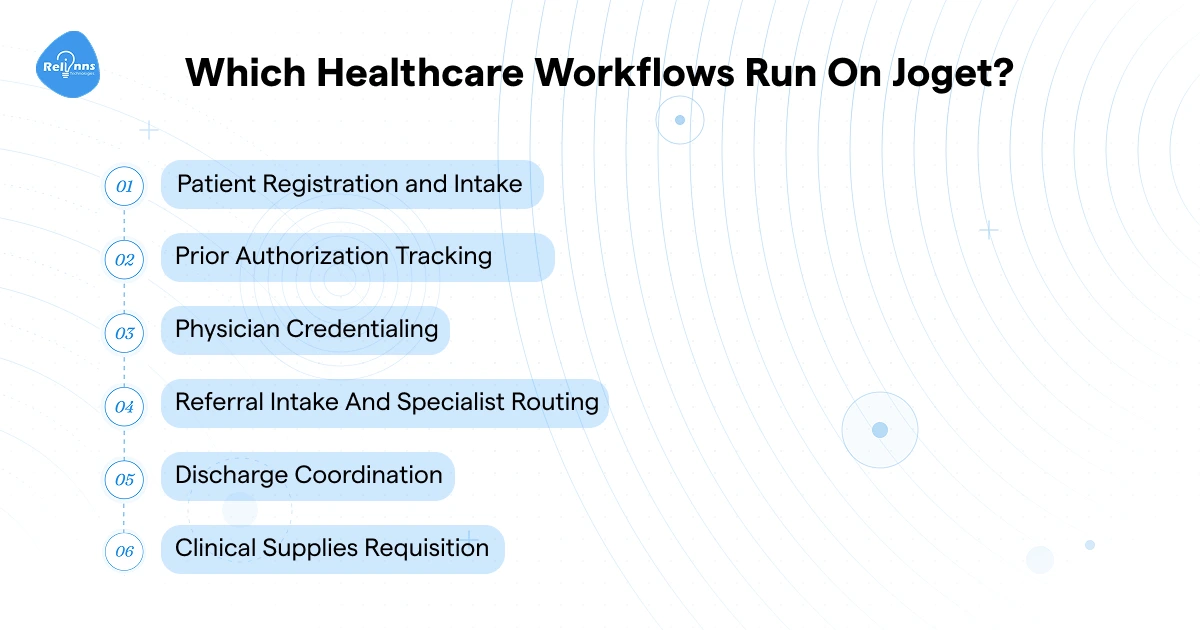
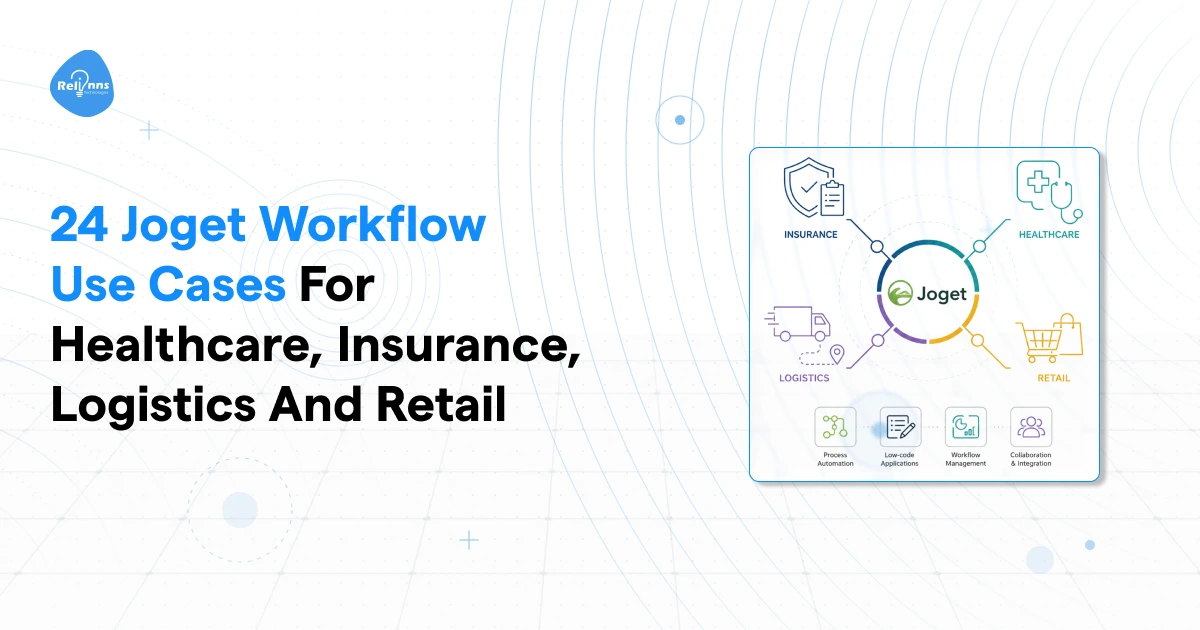
Joget runs healthcare processes that route a patient case or a staff request through clinical, administrative, and payer approval steps. A UAE healthcare authority that operates 27 hospitals and 115 clinics uses a Joget-built patient registration system to digitize registration processes and provide patients with access to lab records, according to Joget's published healthcare case studies. The six workflows below share one pattern: intake, ordered review, retained record.
Patient registration and intake. Digitizes registration and links patient records to lab results. Documented deployment: a UAE healthcare authority running 27 hospitals, 115 clinics, and 223 pharmacies. Joget forms carry intake, datalists expose records back to patients.
Prior authorization tracking. Tracks each request from submission to payer decision, with an expedited path for urgent cases and an appeals branch for denials. Standard pattern. The AMA's 2024 Prior Authorization Physician Survey of 1,000 physicians, fielded in December 2024, found that physicians received 39 requests per week, consuming 13 hours of physician and staff time, with 93% reporting care delays.
Physician credentialing. Collects credentials, triggers license and board verification, assembles the committee review package. Standard pattern. Approval-heavy and audit-bound, which is why the shape fits.
Referral intake and specialist routing. Captures an inbound referral, assigns it to the correct specialist queue, and confirms receipt back to the referring provider. Standard pattern.
Discharge coordination. Fires parallel tasks to pharmacy, case management, and patient education from a single discharge order. Standard pattern. Under the CMS Hospital Readmissions Reduction Program, 30-day readmission rates carry a Medicare payment penalty of up to 3%, so the coordination gap has a billing consequence.
Clinical supplies requisition. Routes department requisitions, dispatches in-stock items automatically, escalates above-threshold requests to department head approval. Standard pattern.
Insurance runs the same approval logic, with money attached to every decision.
Which insurance workflows run on Joget?
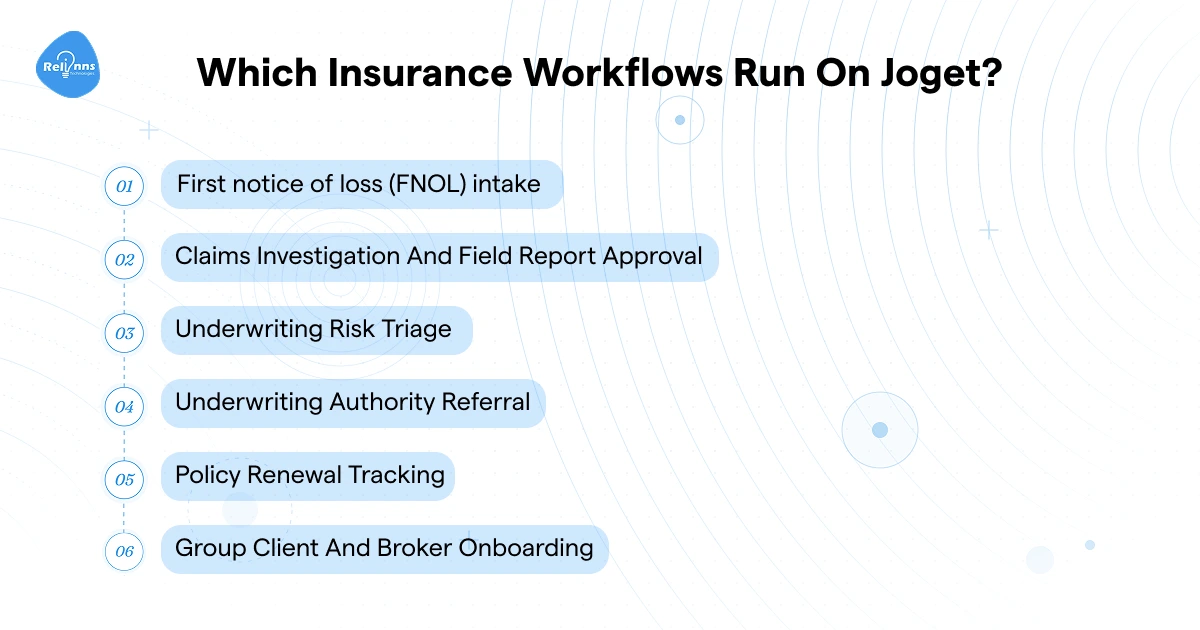
Joget runs insurance processes where a claim, policy, or client case moves through intake, assessment, and tiered approval. A Fortune 100 insurer built a Joget first notice of loss app integrated with its Guidewire core platform, and reports a 50% drop in call-center claim volume over six months, according to Joget's published insurance case studies. Claims and policy administration follow the same intake-to-approval shape.
First notice of loss (FNOL) intake. Captures a customer-submitted claim and issues a claim number on submission. Documented deployment: a Fortune 100 insurer, integrated with Guidewire, with the 50% call-volume reduction reported by Joget and its implementation partner rather than independently audited.
Claims investigation and field report approval. Assigns investigations to agencies, collects field forms from mobile investigators, routes reports through multi-level approval. Documented Joget deployment pattern with a general insurer, integrated alongside an existing legacy platform.
Underwriting risk triage. Applies rules to score incoming submissions and surfaces only exceptions for human review, keeping a record of each decision. Standard pattern.
Underwriting authority referral. Routes a risk above a junior underwriter's authority limit to a senior underwriter with the full case file attached, so the referral arrives with context rather than as a fresh request. Standard pattern, and one that low-code competitors sell as a productized feature while Joget content skips it.
Policy renewal tracking. Monitors expiry dates, triggers renewal outreach, recalculates premium by rule. Standard pattern.
Group client and broker onboarding. Onboards group health clients against a single system of record with SLA tracking. Documented deployment: Allied Benefit Systems, reported by Joget as more than 10 processes across 25 user screens.
One caveat that shapes scope. Joget suits internal workflow tools, and its published deployments are used by adjusters, underwriters, and operations staff. Customer-facing interfaces are a weaker fit, which is why the FNOL app above pairs Joget's process layer with the insurer's own core platform.
Warehouse and freight operations swap the claim for a shipment and keep the approval chain.
Which logistics and warehouse workflows run on Joget?
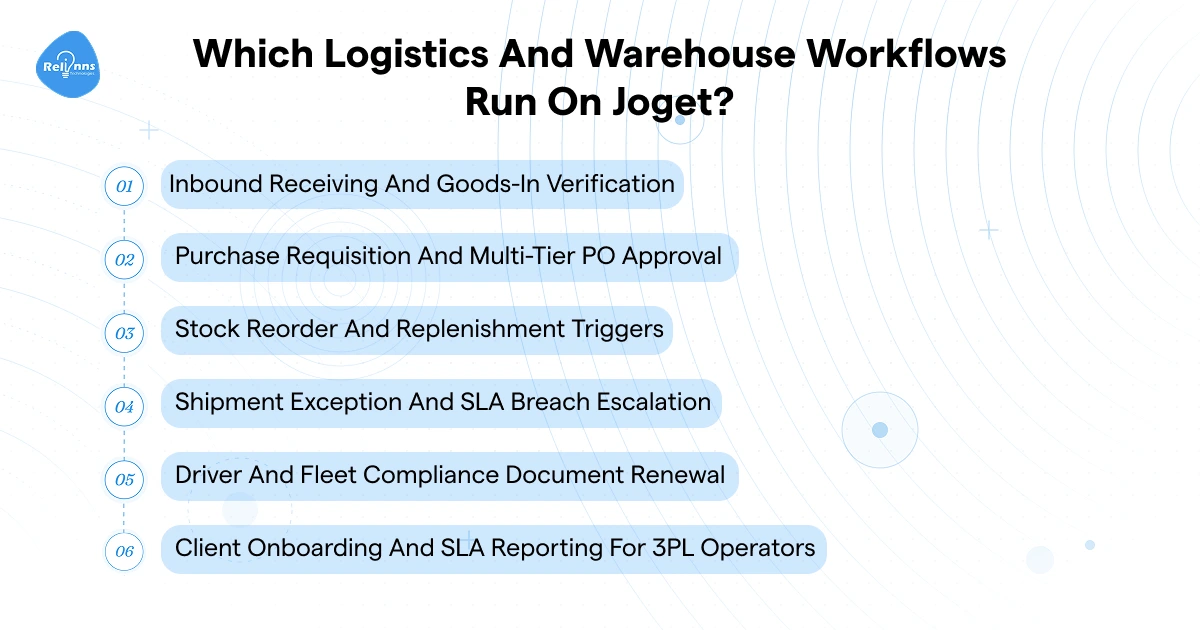
Joget runs logistics processes in which goods, documents, or client cases require ordered sign-off and an exception path. Joget's platform guide reports that one customer reduced the time for purchase requisition and purchase order approvals from 2 weeks to 3 days. Receiving, procurement approval, exception escalation, and compliance documentation all fit that shape.
Inbound receiving and goods-in verification. Records receipt against the purchase order, flags quantity and condition discrepancies, routes disputes to procurement with the receiving record attached. Standard pattern.
Purchase requisition and multi-tier PO approval. Routes requisitions through value-based approval tiers, so a low-value request skips the senior sign-off required for a capital purchase. Documented Joget deployment, with the two-weeks-to-three-days figure reported by Joget rather than independently audited.
Stock reorder and replenishment triggers. Watches stock levels and automatically raises a requisition when a threshold is crossed, then routes the request through the same approval chain. Documented Joget deployment pattern in inventory control.
Shipment exception and SLA breach escalation. Flags delays and missed scans, notifies the manager who owns the lane, records what resolved the SLA breach and when. Standard pattern.
Driver and fleet compliance document renewal. Tracks license, permit and insurance expiry dates, requests renewals ahead of lapse, blocks assignment on expired documents. Standard pattern.
Client onboarding and SLA reporting for 3PL operators. Structures a multi-week onboarding across commercial, IT and operations teams, then builds recurring SLA reports from the workflow data already captured.
Where Joget sits relative to an existing warehouse management system is a scoping decision, not a fixed answer. It can replace a system, extend one, or run alongside it. That choice drives most of the integration effort, and the mechanics are covered in setting up JSON API integration in Joget.
Retail adds a further complication, since approvals there gate revenue directly.
Which retail and ecommerce workflows run on Joget?
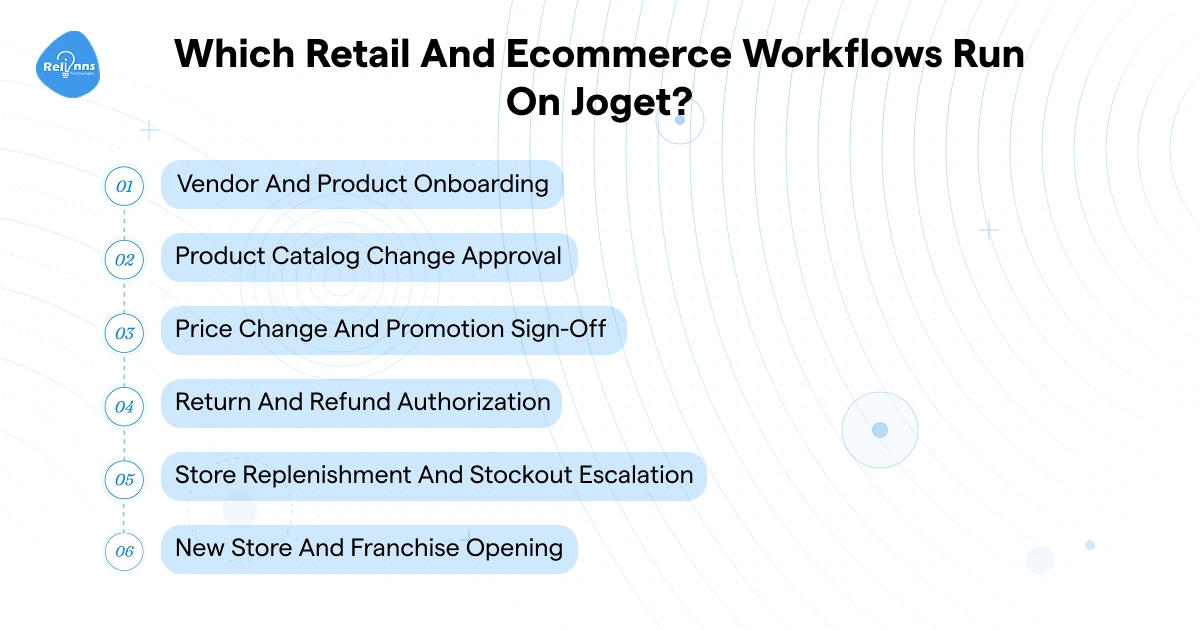
Joget runs retail processes in which a product, price, or return requires multi-party sign-off before it reaches a customer. Worth saying plainly: Joget's published retail-shaped work is adjacent rather than pure retail. A medical ecommerce marketplace, and a catalog management application built for a US vision insurance carrier with version control and staged product approval. The six workflows below follow that same approval shape.
Vendor and product onboarding. Coordinates category, finance, legal, logistics, and quality sign-off in one chain instead of five email threads, which is what shortens time-to-shelf. Standard pattern.
Product catalog change approval. Manages catalog additions and edits with version control, role-based permissions, and staged approval before changes go live. Documented deployment: a catalog application built for a US vision insurance carrier, as published by Joget and its implementation partner.
Price change and promotion sign-off. Routes price and promotion changes through commercial, finance, and regional approval, and records who released each change. Standard pattern.
Return and refund authorization. Authorizes the return, issues the label, releases the refund, and branches suspected fraud to manual review. NRF and Happy Returns, in their 2025 Retail Returns Landscape report published in October 2025, put the online return rate at 19.3% of sales and found 9% of all returns fraudulent, so the review branch carries real money.
Store replenishment and stockout escalation. Handles promotional stockouts and vendor lead-time failures through emergency procurement requests routed to a regional manager. Standard pattern.
New store and franchise opening. Tracks fit-out, licensing, staffing and stocking across teams that rarely share a system. Standard pattern.
One limit to weigh on the retail side. Joget suits the internal approval layer behind these workflows, so the shopper-facing storefront belongs in your ecommerce platform and the sign-off chain behind it belongs here.
Twenty-four options invite the wrong first choice, so sequencing matters more than breadth.
Which of these workflows should a team automate first?
Pick the workflow scoring highest on three factors together: the number of approval hops it passes through, the strength of the audit obligation attached to it, and its monthly case volume. An approval hop is a handoff in which work waits for a person or system to act. A four-hop, audit-bound, high-volume process returns more than a single-step process that runs at ten times the volume.
All three factors have to be present. Teams usually reach for the highest-volume process first, which sounds right but often disappoints, because volume without approval complexity leaves the build with nothing to remove. The manual cost in these workflows sits in the waiting, not the doing. Volume amplifies the return once hops and audit pressure are already there.
Two categories to leave alone for now:
- Single-approver requests with no compliance record behind them.
- Work already handled well inside an existing system of record, where a second tool adds a sync problem instead of removing a delay.
Three things to confirm before scoping. Which system holds the authoritative data. Who owns the audit requirement and what they need to produce. Whether anyone has documented the current process. An undocumented process should be mapped before it is built, since a workflow built on an unclear process keeps the confusion and adds software to it.
If the shortlist is clear and the mapping is the gap, that's the point to bring in Joget development services.
Conclusion
The 24 workflows above differ by industry name and share one shape: a form starts a case, people approve it in order, and the record survives the decision. That shape is the test. If a process in your operation matches it and carries several approval hops plus an audit obligation, Joget is worth scoping. One approver and no compliance record, and it isn't. Start with the process where the waiting costs you most, and map it before anyone builds it.