Why Your AI Outbound Calls Get Flagged as Spam & How to Fix it?
Date
Aug 25, 26
Reading Time
11 Minutes
Category
AI Voice Agents
Share


TL;DR
- "Spam Likely" is a carrier reputation label, not a legal ban, and it can hit fully compliant calls.
- STIR/SHAKEN only proves who you are. Most providers quietly sign you at Level B or C, which gets flagged anyway.
- Your AI agent triggers five behavioral signals: volume spikes, low answer rates, no inbound history, short calls, and a single repeated synthetic voice.
- You don't have one reputation. Hiya, First Orion, and TNS score the same number differently, so you can be clean on AT&T and buried on T-Mobile.
- Newer filters analyze the live audio, and a too-clean synthetic voice reads as automated.
- The fix is mechanical: Level A attestation, number warming, capped velocity, branded caller ID, tight latency, and fast remediation.
Your agent was humming along. Hundreds of dials an hour, booking meetings, qualifying leads. Then one morning the connect rate just craters. Same script, same list, same everything. But now the recipient's screen reads "Spam Likely," and people are letting it ring.
That's the moment most teams discover their AI outbound calls are flagged as spam. And by then the damage is already done.
The carrier decided about your call before your agent said a single word.
If you're running outbound AI agents at any real volume, this is the tax nobody warned you about.
To fix the label, you first have to see what the recipient's carrier sees. And it isn't your pitch.
What happens in the two seconds before the phone rings
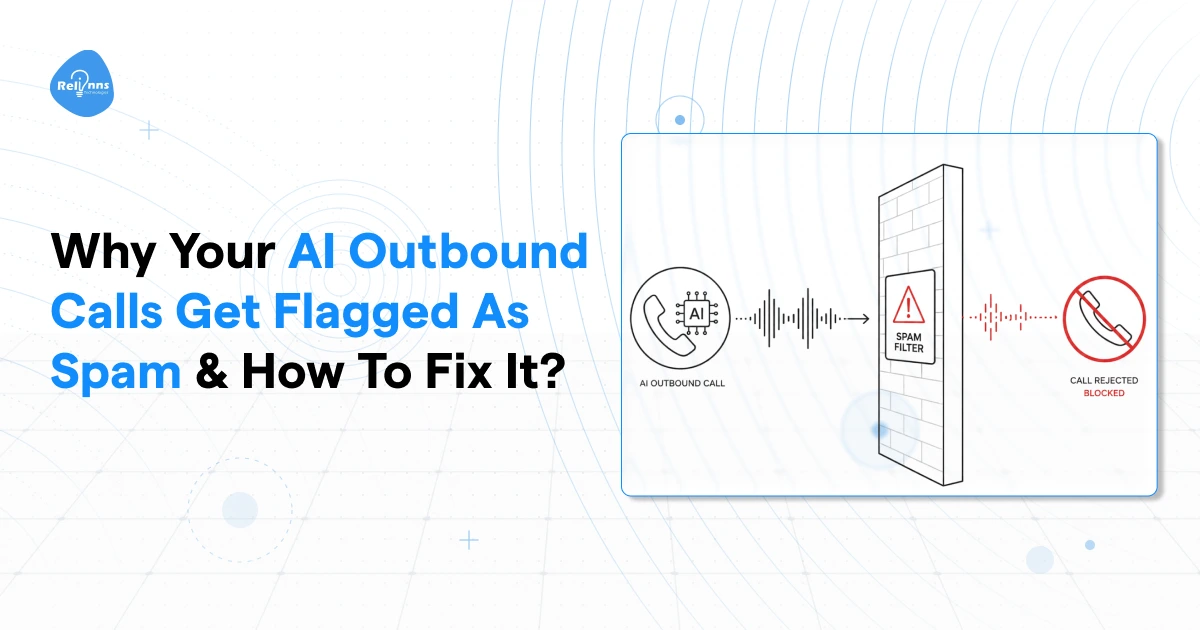
Let's clear up what that label actually is. "Spam Likely" or "Scam Likely" is not a legal ban. Nobody blacklisted you. It's a warning tag that gets slapped onto your caller ID by the phone network, and it can appear even if every call you make is fully legal.
Three parties decide it, and they work in sequence.
- First, the recipient's carrier.
- Second, the analytics engines that carriers plug into: Hiya, First Orion, and TNS Call Guardian. These companies keep a running reputation score on every number that places calls.
- Third, the phone itself. Apple's Silence Unknown Callers sends anything unrecognized straight to voicemail, iOS 26 added its own call screening, and Android does the same through Google.
Here's the part that trips people up. None of these systems hear your conversation. They can't. The decision happens before the connection completes. So they judge on metadata and patterns instead: how many calls the number places, how short they run, how often people reject them.
An AI voice agent isn't suspicious because it's AI. It's suspicious because its calling pattern looks like mass dialing. That's a distinction worth sitting with, because it changes the whole fix.
Around 86% of unknown calls now go unanswered. Once a number gets tagged, its answer rate can drop 60 to 80% inside 24 hours.
If you're new to how these systems work, start with what AI voice agents actually are and come back.
So you did STIR/SHAKEN. That should have solved it. Here's why it didn't.
STIR/SHAKEN was supposed to fix this. It didn't.
The logic sounds airtight. You implemented STIR/SHAKEN, your provider signs your calls, you're checking every box the carriers asked for. So your calls should sail through clean. A lot of teams stop worrying right here.
That confidence is misplaced.
STIR/SHAKEN only proves one thing: that you are who you say you are. It's a cryptographic signature confirming the caller ID isn't spoofed. That's it. It says nothing about whether the person on the other end wants your call. You can have perfect authentication and still get the "likely spam" label, because the two things measure completely different things.
And there's a quieter problem underneath. That signature comes with an attestation level, and most people never check which one they're getting. Plenty of VoIP providers sign traffic at B or C without ever mentioning it.
Here's where it bites AI outbound teams. You dial through Carrier X but present numbers assigned by Carrier Y. That mismatch drops you to Level B automatically. It's called the multi-homing deficit, and it's incredibly common with layered voice stacks.
So attestation is the floor, not the shield. The real trust decision happens one layer up, in the behavioral scoring engines. What you're aiming for is Level A, clean calling behavior, and a verified identity on the screen. All three.
Expert tip: The first question to ask any voice provider isn't "do you support STIR/SHAKEN." It's "what attestation level do my calls actually receive." That answer is set by their infrastructure, not anything you configure in your dialer.
Worth reading next: how caller authentication methods for voice agents actually work under the hood.
If authentication isn't the gatekeeper, what is? A scoring model that watches how your agent behaves.
5 Signals your agent trips without knowing it
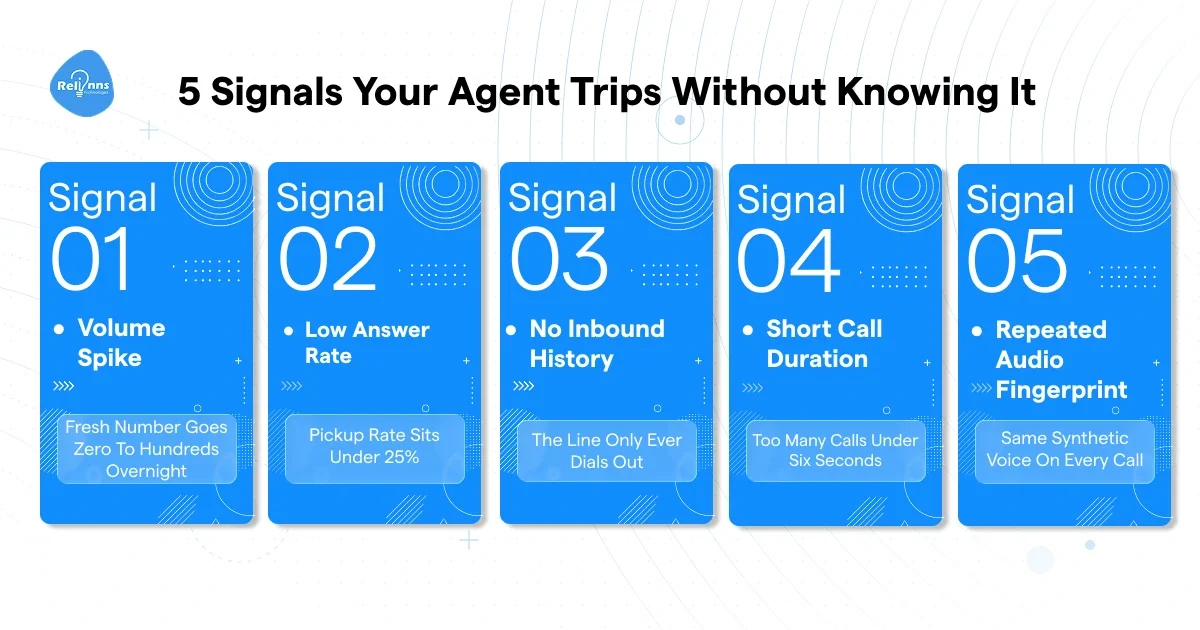
The scoring engines run behavioral profiles on every number. And an AI agent, running full tilt, sets off basically all of them. Here's what they watch and why your setup walks right into it.
A few of these have hard math behind them.
The call-to-answer ratio has a rolling threshold, and once you dip below it, the phone number reputation starts sliding.
The short-duration ratio flags any call under six seconds. And there's a sneaky one called unique-destination reach: if your number almost never dials the same person twice, that ratio creeps toward 1.0, which reads as pure automation. Scammers rarely call back. Neither does a cold-outreach bot.
That's the trap. Every efficiency you built into the agent looks like fraud from the carrier's side of the glass.
Strip away the intent, and an AI agent scores identically to a scam campaign on every axis. From the outside, the carrier genuinely can't tell you apart.
This is also why the no-inbound problem matters more than people think. If you want to understand the structural gap, inbound vs outbound voice AI lays it out, and what AI cold calling really involves covers why cold lists start you at a disadvantage.
Notice one signal on that list isn't about numbers at all. It's about the voice itself.
Your logs are lying to you, and you don't have one reputation
Open your call logs after a bad day. They'll say "No Answer" and "Voicemail" over and over. What they'll never say is "shown as Spam Likely on the recipient's screen." That data point doesn't exist in your dashboard.
So teams do the natural thing. They assume the script is off. They A/B test openers, shuffle call times, rewrite the first line. And nothing moves, because the problem sits a layer above the conversation. The call never got a fair shot at ringing.
The only honest test is dumb and manual. Grab a second phone on a consumer plan, call your own outbound number, and look at what shows up. If it reads "scam-likely" there, you've found your answer: rate collapse.
Now the part that surprises people. You don't have a caller ID reputation. You have three of them.
According to a study, Hiya catches roughly 87% of spam. First Orion lands around 55%. TNS Call Guardian sits near 34%.
Same number, three different verdicts.
Each engine powers different carriers and runs its own model. So your number can look perfectly clean on AT&T and get buried on T-Mobile the same afternoon. There's no single switch to check.
One practical move: the major players (First Orion, Hiya, Neustar, TNS) set up a joint enterprise vetting path back in 2022, so you can register your business identity across all of them at once instead of chasing each separately.
And stop blaming the list. When calls don't connect, the instinct is "these leads are junk." Usually they're fine. The number carrying the call is what's flagged. Fix the situation, not the prospect. A monitoring playbook for voice agents helps you catch which numbers are slipping before the whole pool goes.
Metadata is only half the exam. The newer half happens after the call connects, while your agent is talking.
The carriers are listening to your agent's voice now
This is the part almost nobody plans for. The scoring doesn't stop once the call connects. Some networks keep analyzing, in real time, using the audio itself.
Tools like Pindrop Pulse and Nuance Gatekeeper sit at the SIP trunk and profile the live stream. Models such as AASIST read more than 140 acoustic attributes on the fly, looking for the fingerprint of synthetic speech. Background texture, codec artifacts, the micro-patterns a neural voice leaves behind.
And here's the giveaway. A voice that's too clean gives you away. If a call claims to come from a mobile handset but the audio has zero room noise, zero breathing, that sterile studio quality, the system reads it as automated and the number's caller ID reputation takes a hit.
Timing matters just as much. Humans leave about a 200 millisecond gap between turns. Push past 500ms and it feels like dead air, so people say "Hello? Hello?" and hang up. Carrier analytics see that pattern and file it under predictive dialer.
Then there are decoy traps. Hiya and others route suspicious traffic to bots that chat with your bot, capture its signature, and update the block filters network-wide.
So your TTS choice and how human the voice sounds aren't cosmetic. They feed deliverability.
Every problem above is fixable. In priority order, here's the stack that actually restores answer rates.
How to Fix the AI Calling Spam Issue? 5 Easy Steps
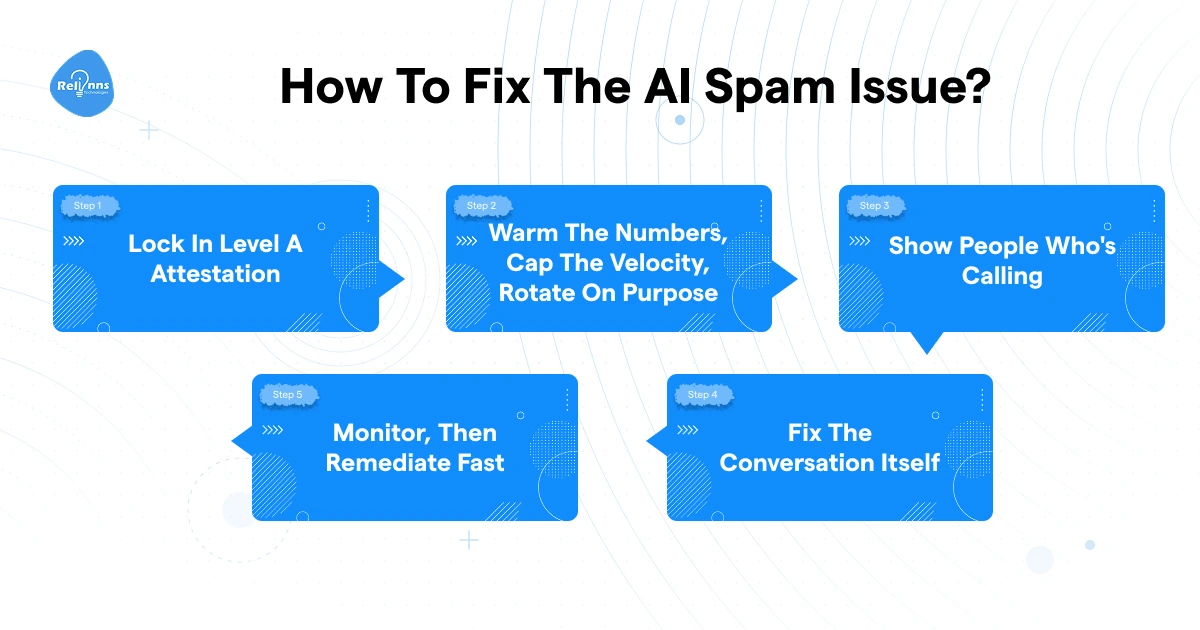
Work these top to bottom. I've sequenced them by leverage, not by how easy they are. Fixing your attestation before you touch anything else will do more than a month of script tweaks.
Lock in Level A attestation
Start here because nothing downstream works if the network already distrusts your signature. You want full attestation, and the only way to know is to ask your provider a blunt question and make them answer it.
If the answer is B or C, switch providers. It's that binary.
There's a fix for the multi-homing problem too. ATIS-1000092 Delegate Certificates let a carrier sign your traffic at Level A even on numbers you didn't get from them, because the certificate carries cryptographic proof that you own those numbers. Running toll-free outreach? Resp Org and SPC tokens do the same job, matching your toll-free numbers against verified records so they clear at full attestation.
Action: Email your carrier today with one line. "What STIR/SHAKEN attestation level do my outbound calls receive at the terminating network, and can you sign at A using delegate certificates for numbers I own?"
If you're still assembling your telephony layer, the guide to the AI voice stack covers where signing actually happens.
Warm the numbers, cap the velocity, rotate on purpose
Fresh numbers are fragile. Don't hammer a brand new line with 300 dials on day one, because that spike is the single loudest spam signal there is.
Ramp instead. Ten to fifteen calls a day the first week. Around 25 the second. Only push toward 50 once the number has two clean weeks behind it. That's number warming, and skipping it is why so many launches die in 48 hours.
Then cap it. Keep each number at 25 to 50 dials a day, 75 at the absolute ceiling. The math is unforgiving: one caller running 500 dials a day needs a pool of 10 to 20 numbers to stay under the line.
Two more things that matter. Keep your use cases on separate numbers, so appointment reminders never share a line with cold outreach. And vary your pattern, because exactly 200 dials every hour on the hour is itself a fingerprint. Human calling has noise in it. Yours should too.
Action: Pool size = (daily dials per caller ÷ 40) rounded up, then add local numbers for each region you dial into.
Getting this right at volume is its own discipline. Here's how to scale AI voice agents without torching your number pool.
Show people who's calling
CNAM is a dead end. Fifteen characters of plain text, slow to sync across databases, and modern handsets mostly ignore it. If you're relying on it to build trust, you're relying on nothing.
Rich Call Data is the upgrade. Under RFC 9795 and 9796, your business name, logo, and the reason for the call get signed right into the call and rendered on the screen. Nobody can spoof it, and the recipient sees a real identity instead of a bare number. Note the dependency: the standard only carries that branded caller ID when you're at Level A, which is exactly why 6a comes first.
And use local presence dialing. Matching your caller ID area code to the recipient's region lifts answer rates by 20 to 30%. Do it with numbers you actually own. Spoofing a local code is illegal and burns you faster than it helps.
Fix the conversation itself
The audio scoring from earlier means your agent's behavior on the line feeds its reputation. So tighten the latency. Keep turn-taking under the dead-air threshold with aggressive VAD endpointing and prefix caching, so the agent doesn't leave those long silences that make people hang up.
Open with a clear, friendly self-intro. "Hi, this is the scheduling line at Dr. Rivera's office." And if nobody picks up, leave a short voicemail. Silent hangups cluster with robocalls, so a dropped call with no message actively hurts you.
Latency is the lever most teams underuse. Tips to improve voice agent latency go deeper than I can here.
Monitor, then remediate fast
Watch answer rate per number like it's a vital sign. A line that ran 38% last month and sits at 14% today has almost certainly been flagged. Pull it, drop it into a 30-day cooldown, and rotate a clean one in.
Register your identity with Hiya, First Orion, TNS, and the Free Caller Registry so the engines know you're a real business.
And when a call gets blocked, read the rejection. SIP 603+ and SIP 608 responses now carry the reason for the block plus a redress URL, and the FCC requires this on IP networks by March 2026. That means you can dispute a bad flag programmatically instead of guessing.
Action: Every Monday, pull answer rate by number, retire anything that dropped more than 15 points week over week, and file redress on any number returning a 603 block.
A repeatable monitoring playbook turns this from firefighting into a routine.
Do all five and you stop losing numbers to guesswork. But there are a few moves that look smart and quietly make everything worse.
Three moves that quietly make it worse
Sometimes the tactic that feels clever is the one burning you. Avoid these.
1. Ringless voicemail.
Dropping a message straight into the mailbox without ringing feels like a clean workaround. It isn't. The FCC ruled in 2022 that these drops count as "calls" under the TCPA, so using them for cold outreach is unlawful, and carriers now detect the direct-to-mailbox routing and block it anyway.
2. Rotating random, unbranded numbers.
Cycling through a big pile of throwaway numbers to dodge the "likely spam" label is a pattern the engines already know. It's called snowshoeing, and it's a flag on its own. Rotate numbers you own, that are registered, and that carry a branded caller ID. Rotation only helps when the numbers have a clean identity behind them.
3. Dialing people who opted out.
If your opt-out list is per number rather than per lead, one caller can ring someone who has already said no on a different line. Those complaints stack straight onto your reputation. Sync suppressions across the whole pool the same day they come in.
Both TCPA compliance and call recording consent go deeper on the legal side.
Do the opposite of these three, and deliverability stops being luck.
Reputation is an asset you build, not a setting you flip
Pull it all together, and the through-line is simple. Getting your AI outbound calls flagged as spam comes down to three things the network watches at once: are you authenticated at Level A, does your calling behave like a real business, and can people see who's calling? Miss any one, and the label creeps back.
So treat every number like an asset. A line with weeks of clean, warmed, well-paced history is worth real money, and it compounds. Burn it, and you're starting from zero on a new one.
That's the whole game. Attestation, behavior, identity, watched continuously.
If you'd rather have this layer built and monitored for you, our AI voice agent development team can do that. And if you're pitching it internally, how to measure voice agent ROI helps make the case.