AI Agent vs Agentic AI: What's The Real Difference?
Date
Oct 27, 26
Reading Time
12 Minutes
Category
AI Agents
Share


TL;DR
- An AI agent is a bounded software entity. It perceives, reasons, and acts, and the model decides what happens next inside its own execution loop.
- Agentic AI is a design paradigm, not a product. Agency gets spread across an orchestrator, code, validation gates, and specific model calls, and code holds the wheel most of the time.
- The real split isn't capability; it's control. Who decides the next step: the model, or the code around it. That's the whole AI agent vs. agentic AI question in one line.
- More agents doesn't mean more agentic. Coordination is the ingredient. Ten uncoordinated agents are just ten separate automations.
- Autonomy breaks reliability by simple math. A 90% reliable step chained ten times gives you a 34.8% success rate. Nothing's broken; that's just what multiplication does.
- Demos measure whether something can work once. Production measures whether it works every time. GPT-4o hit ~61% on a single τ-bench attempt, but under 25% when it had to succeed across eight runs in a row.
- Match the architecture to path predictability, not to how impressive it sounds. Known sequence, use a deterministic workflow. Known macro steps, unknown substeps, go hybrid. Truly unmappable path, that's when full autonomy earns its cost.
- Most things sold to you as "agentic AI" are correctly built as simpler tiers. That's the design working, not a downgrade.
- Getting the tier wrong costs you in scoping, procurement, and risk, in that order, and none of it shows up on the model bill.
An AI agent is a thing. Agentic AI is a property of a system. You can build agents with zero agentic behavior, and you can get agentic behavior out of a single agent working alone. That's the whole confusion in one sentence, and almost nobody states it that plainly.
Here's what's odd, though. Search "ai agent vs agentic ai" and five different enterprise vendors will hand you five versions of the exact same definition. Meanwhile, ask working developers on r/LLMDevs and half of them will tell you the terms are basically interchangeable, just grammar cousins like "artist" and "artistic." Both groups can't be right. One of them is selling something.
So let's settle it properly. Not with another vendor's tidy diagram, but with a definition that actually holds up when you poke at it, plus a way to figure out which one your workflow needs.
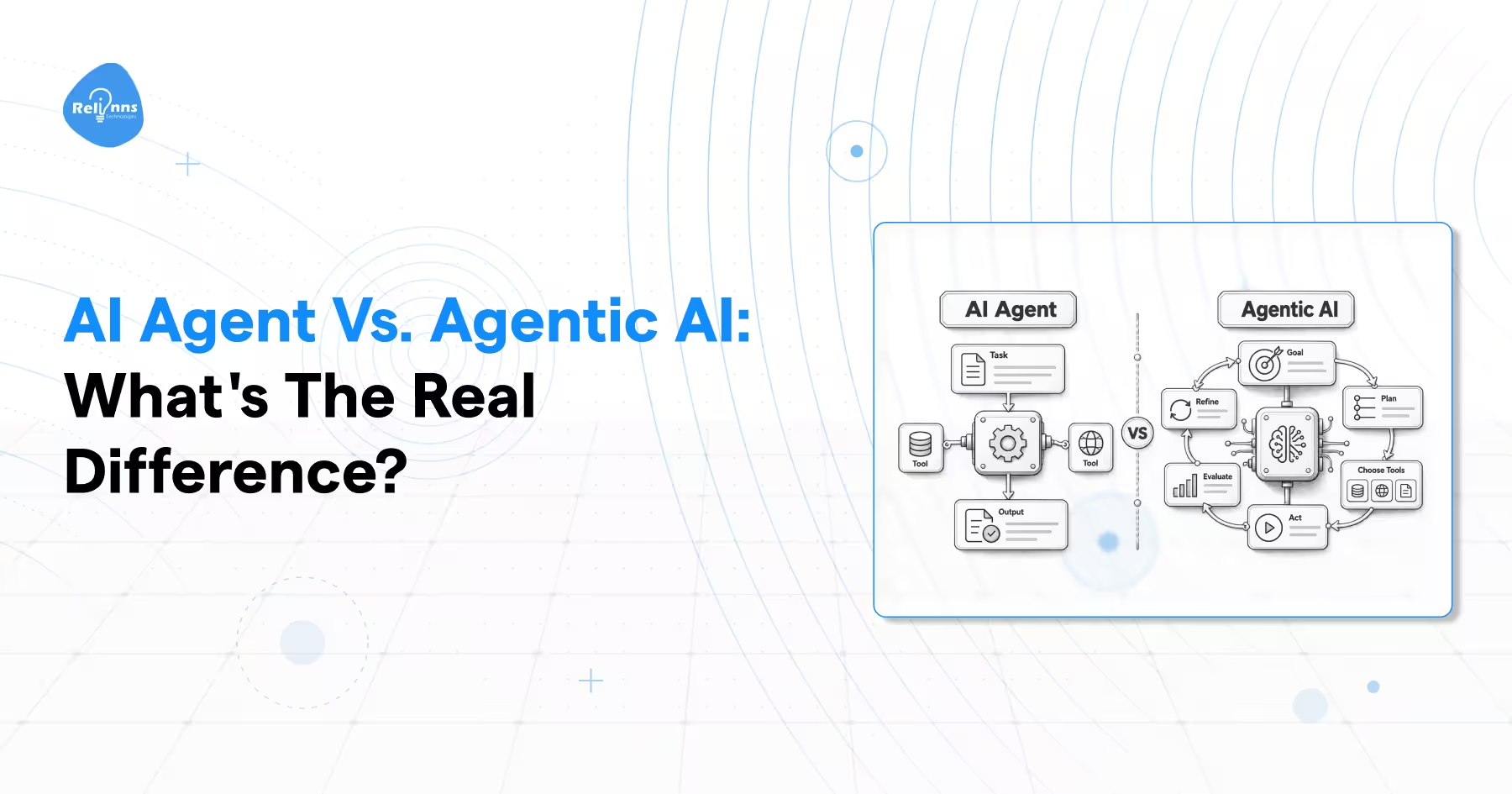
Agentic AI: a design paradigm where agency gets spread across code, validation gates, and specific model calls. Your code decides what happens next.
The real split: who's actually holding the wheel.
Start with the smaller of the two. Almost everyone gets this one wrong first.
What is an AI agent, in plain terms?
An AI agent is a bounded software entity that watches its environment, reasons over what it sees, and acts using tools. The model is the control unit here. It decides which tool to call, in what order, and when it's actually done. A 2025 taxonomy paper on arXiv (2505.10468) frames this the same way, and I'd trust that over most vendor blog definitions.
Here's the loop in three words: perceive, reason, act.
Ask an agent for the 345th Fibonacci number and watch what happens. It doesn't guess. It writes code, runs that code through an interpreter, and hands you back the actual computed answer. It checked its own work instead of pattern-matching to something plausible-sounding. That's the agent. And the tool is what made it one.
One agent, many tools. Not one tool, many agents. This distinction matters when evaluating the uses of AI agents in workflows that require multiple actions or tool calls.
And here's the part most pages skip entirely: reliability drops as you add tools. Give an agent thirty options to pick from, and it starts picking wrong more often. More surface area, more room to choose badly.
| Type | What it does | Enterprise example |
|---|---|---|
| Reactive | Responds to fixed triggers | IT bot answering a VPN failure |
| Model-based | Tracks internal state | Security agent adjusting access on context change |
| Utility-based | Weighs outcomes, picks the best one | Support agent ranking escalation priority |
| Learning | Improves from feedback over time | Search agent refining relevance from patterns |
Now add a second agent. Most people assume that's agentic AI. It isn't.
What is agentic AI, and why isn't it just "more agents"?
Agentic AI isn't a product you buy. It's a design paradigm, a way of structuring a system so that goal-directed behavior gets spread across an orchestrator, some deterministic control flow, validation gates, and specific model calls where they're actually needed. That's it. That's the whole idea.
So two agents sitting in the same codebase? Not agentic AI. Not even close.
Deploying more agents doesn't produce agentic AI. Coordination is the ingredient, not headcount. You can have ten agents running and still just have ten separate automations that happen to share a repo. Without something holding the actual goal, planning the sequence, and adjusting when a step breaks, what you've got is parallel, not orchestrated.
Four things have to show up together for a system to earn the label: goal-oriented reasoning, multi-step planning, dynamic adaptation, and cross-system orchestration. Miss one and you've basically built a workflow with an LLM bolted on. Which is fine, honestly, just don't call it agentic.
There's also a memory thing worth knowing. A task agent usually forgets the second the job's done. An agentic system remembers what worked last time, which is exactly why it can adapt, and exactly why it's a pain to audit six months later.
Put both definitions side by side, and one column starts doing something suspicious.
AI agent vs agentic AI: the difference, in one table
Strip away everything else, and it comes down to locus of control. Who's actually steering? In an AI agent, the model directs its own path; it picks tools from an open list, and it decides for itself when the job's done. In an agentic system, code steers the ship and the model gets called in for specific, bounded work. Classify this. Extract that. Draft this one section. Anthropic draws this exact line in their engineering write-up on building agents, and it's the clearest version of this split I've seen anywhere.
| Dimension | AI Agent | Agentic AI System |
|---|---|---|
| Who controls execution | Model decides the next step | Code decides, model fills in the gaps |
| Scope | One task, one domain | A workflow spanning systems and teams |
| Predictability | Non-deterministic. Step count and tool choice both vary | Deterministic. Fixed schemas, known routes |
| Cost and latency | High variance, step explosion is a real risk | Low variance, bounded and predictable |
| How it fails | Context saturation, repetition loops, tool hallucination | Rigid routing errors, schema violations, upstream API drift |
| Memory | Usually stateless per task | Persistent across the whole workflow |
| Best fit | Open-ended, ambiguous, exploratory work | High-volume, regulated, rigid business logic |
Anthropic's test for what actually counts as an autonomous agent comes down to three conditions, and you need all three. The model directs its own process. It picks tools from an open catalogue rather than a fixed menu. And it decides how far to go based on what it sees along the way. Miss even one and what you've built is an agentic workflow, not an agent.
Most things marketed as "agentic AI" are really just one of five patterns: prompt chaining, routing, parallelization, orchestrator-workers, evaluator-optimizer. That's most of it.
Which raises the question every vendor page conveniently skips. If agentic AI is meant to be the upgrade, why does giving it more autonomy make things worse?
Is agentic AI just a more advanced AI agent?
No. They sit on different axes, not different rungs on the same ladder. Agency is more like a dial you set per workflow than a level you graduate to. A well-built system turns that dial down for anything with a known path, and only turns it up where the path genuinely can't be known ahead of time.
Here's the belief everyone's currently running with: agents are step one, agentic AI is step two, and full autonomy is the destination you're building toward. Gartner's numbers feed that story hard. Their August 2025 release puts it plainly: 40% of enterprise applications will carry task-specific AI agents by the end of 2026, up from under 5% in 2025. That's a real curve. But a growth curve isn't proof of a hierarchy, and I think people are reading one into the other.
Three things push back on the ladder idea.
One, every page currently ranking for "ai agent vs agentic ai" is published by a company that sells an orchestration layer. Worth just saying that out loud. The definition that ranks is usually the definition with a product sitting behind it.
Two, the practitioners disagree with the vendors. Browse the actual r/LLMDevs thread on this exact question, and most top comments call the terms interchangeable; one guy compares it to "artist" versus "artistic." That's not noise. It tells you the split is real at the architecture layer and mostly cosmetic at the marketing layer.
Three, look at Devin versus Cursor. Devin runs the dial high: it plans, writes code, executes, tries to self-correct over long stretches, and it degrades hard on messy codebases, often chasing changes that don't hold up. Cursor runs the dial lower on purpose. Deterministic control over indexing, context pruning, patch application, a human still in the loop for the big calls. And Cursor's the more consistent one of the two.
There's a reason the lower-autonomy design keeps winning, and it's not opinion. It's arithmetic.
Why does adding autonomy break reliability?
Because errors multiply. They don't average out, and that one fact explains most of what goes wrong when people push autonomy too far. Every probabilistic step in a chain has its own success rate, and the end-to-end success rate is just the product of all of them multiplied together.
A system that nails 90% per step is only 34.8% reliable across ten steps. Nothing broke. That's just what multiplication does when you chain enough of it.
P(success) = the product of every step's success rate. That's the whole formula.
| Steps in the chain | Success rate at 90% per step |
|---|---|
| 3 | 72.9% |
| 5 | 59.0% |
| 10 | 34.8% |
| 20 | 12.1% |
A 90% model per step is genuinely good. The failure isn't the model. The failure is the step count. People blame the AI when they should be blaming the architecture that made it take twenty swings instead of four.
And "step" needs a real definition here, because vague words kill this argument fast. A step is a reasoning deduction, a tool selection, an argument generation, an output validation.
What looks like four business steps on a whiteboard is often twenty probabilistic ones once you count what the model's actually doing underneath.
Do this before you scope anything: count the probabilistic steps in your workflow. Then work out how many can get replaced with code that simply cannot be wrong. Every step you move from model to code is a step that stops multiplying against you.
One honest caveat. This math assumes each step is independent, and real steps aren't always. They correlate, sometimes in your favor, sometimes not. The curve's direction holds regardless. The exact numbers are illustrative, not measured off a real system.
That's the math. Here's what it actually looks like at 3 am when it's your system failing.
What actually breaks when agents run unsupervised?
Two things, mostly, and neither one shows up in a demo. Context fills up with its own exhaust until the model stops seeing the instructions you gave it at the start. And it gets stuck repeating something that's already failing, because a plausible next word isn't the same thing as a correct next move. That second part trips people up more than they expect.
Context saturation shows up in three ways:
- Attentional dilution. Long context lowers the signal-to-noise ratio. Instructions buried in the middle get skipped over, and whatever tool output came in most recently wins out over the original constraints.
- Context rot. Summarizing the history to save room drops state variables with every pass. Later turns end up acting on a copy that's already lost detail.
- The paradox in the middle of all this. Complex tasks need detailed instructions to run properly. But detailed instructions eat up the same capacity the model needs to actually reason through the task.
And then there's the loop problem, which nobody writing about AI agents vs. agentic AI seems to cover in any real depth:
| Loop | What it looks like | Why simple guards miss it |
|---|---|---|
| Hammer | Same tool, same arguments, same error, again and again | Caught easily by exact-match checks |
| Ping-Pong | Two tools undoing each other. Test fails, patch breaks the linter, linter reverts the patch, test fails again | Each individual call looks totally valid |
| Polling | Arguments shift slightly every turn; nothing actually progresses | Text differs each time, so string caches never catch it |
The model was trained to produce a believable next sentence, not to notice it's hit a dead end. Recognizing the dead end has to be somebody else's job entirely.
None of which explains the part that costs teams the most money. Why did the thing work perfectly in the demo?
Why do agents pass the demo and fail in production?
Because a demo measures whether something can work. Production measures whether it works every single time. Those are two different metrics wearing the same clothes. On τ-bench, the Berkeley and Sierra tool-agent benchmark, GPT-4o scored around 61% on a single retail-task attempt. Ask the same model to succeed across eight independent runs, and that number falls under 25%.
Here's the swap nobody explains clearly enough. pass@k means you try k times and it counts as a win if any single attempt lands. pass^k means it only counts if every single attempt lands. Same letters, completely different question.
As k goes up, pass@k climbs toward 100%. pass^k collapses toward zero. Same model, same task, opposite story depending on which question you asked.
And here's why that matters outside a research paper. Your customer support agent doesn't get eight parallel tries with one lucky winner counted as the result. It gets one shot, per customer, every time. That's pass^1 in the real world, not pass@8 in a lab.
There's a second version of this same problem in coding benchmarks. Models that clear 80 to 90% on SWE-bench Verified, the well-known 500-task subset, tend to fall to somewhere in the 60s, sometimes lower, once you run them on SWE-bench Pro, which uses 1,865 tasks across 41 private, modern repositories with held-out tests. That gap is basically the distance between a model recognizing an issue it's seen before and a model actually doing the engineering work fresh.
So the decision was never agent versus agentic. It's how far up the dial you actually need to go.
Which one does your workflow actually need?
Match the architecture to how predictable the path is. Not to how impressive the technology sounds in a pitch deck. If you can map the whole sequence in advance, build a deterministic workflow and drop model calls inside it where you need judgment. If the big steps are known but what happens inside each one isn't, go hybrid. Save full autonomy for problems where the path genuinely can't be mapped before you start, because that's the only place it earns its cost.
| Deterministic workflow | Hybrid agentic workflow | Autonomous agent | |
|---|---|---|---|
| Path predictability | High. Fixed sequence, known schemas | Moderate. Predictable macro steps, variable substeps | Low. Open-ended exploration |
| Who holds control | Code, entirely | Code backbone, model decides locally | Model, continuously |
| Error handling | Hardcoded fallbacks and retries | Validation gates plus bounded self-correction | Model replans on its own |
| Oversight needed | Standard monitoring | Step-level token and schema tracking | Full trajectory tracing, loop detection |
| Looks like | Contract parsing, onboarding pipelines | Code editors, research synthesis | Open-ended research, exploratory engineering |
There's one test that settles this fast. Can you draw the whole sequence on a whiteboard before the work even starts? Yes means deterministic. Mostly means hybrid. No means autonomous, and now you own the observability bill that comes with it too.
Most workflows sold to you as agentic AI are correctly built as tier one or tier two. That's not a downgrade, whatever the sales deck implies. That's the design actually working the way it should.
And there's a security cost that changes the math here too. Autonomy adds permissions; permissions add attack surface; that's just how it goes. Prompt injection is the sharpest version of this problem, since an agent following instructions buried in a document it was told to read crosses zero authentication boundaries doing it. Palo Alto's Unit 42, in its Global Incident Response Report 2026 published in February, found identity weaknesses played a role in nearly 90% of the incidents it investigated that year. Every agent you give more autonomy to is one more identity you now have to secure like you mean it.
Get the tier wrong, and the cost shows up in three places. None of them are your engineering budget.
What does getting this wrong actually cost?
Three places. And none of them are the model bill, which is what most teams brace for and worry about least in the end. Teams that think only in terms of agents buy point solutions, one after another, and end up with a pile of automations that don't talk to each other. Teams that think only in terms of the paradigm buy orchestration infrastructure before they even know what it's supposed to orchestrate.
Scoping. "We need an agent for X" is how most of these projects start, and it's also how most of them end up as a mess. You get disconnected automations, inconsistent logic between them, gaps where systems were supposed to connect and don't. The orchestration problem doesn't go away just because you skipped it. It just shows up later, more expensive, usually right when you're trying to scale.
Procurement. Agent platforms and orchestration infrastructure solve different problems, full stop. Buy the wrong one, and you're not tuning a setting later; you're doing a full replacement.
Risk. People treat this as one category when it's actually two. Agent-level risk looks like prompt injection, identity spoofing, privilege escalation. System-level risk is about who approves an autonomous decision and how you audit a chain of agent actions after something's gone wrong. Collapse them into one register, and you leave gaps in both, guaranteed
The bottom line
There's no ladder here. Never was. It's a dial, and most of the time the right move is turning it down, not up.
People are going to keep using "agent" and "agentic" like they mean the same thing, and honestly, in a meeting that's fine. Nobody's architecture breaks because someone used the wrong word in a Slack message. It gets expensive the moment that same looseness shows up in a design doc, because now code and model boundaries are getting decided based on a term nobody actually defined.
So define it before you build it. Draw the sequence out. Count the steps. Figure out which parts genuinely can't be known in advance, and only hand those over to the model.
If you're at the point of trying to work out which tier your own workflow actually belongs in, that's the exact conversation worth having first, before any of the build starts. That's usually where the real cost gets decided anyway.
FAQ
Is agentic AI the same as AI agents?
No. The difference is architectural, not a marketing spin. An AI agent is the thing doing a task, where the model decides its own next move. Agentic AI describes systems where control gets split between code and the model, and code holds the wheel most of the time. Different question, different answer, every time someone asks AI agent vs agentic AI.
Can you have agentic AI with only one agent?
Yes, and this trips people up constantly. Agency is a property of how the system's built, not a headcount. One agent wrapped in the right orchestration, validation, and planning layer counts. Ten agents with no coordination between them doesn't, no matter how it looks on a slide.
Is agentic AI the same as generative AI?
No, and they're not even solving the same problem. Generative AI produces output, text, code, images, whatever you asked for. Agentic AI decides what to do next and then goes and does it. One's a capability. The other's a control structure sitting on top of that capability.
Do I need agentic AI or just an AI agent?
Depends entirely on whether you can draw the sequence out before the work starts. If yes, you probably need an agent inside a deterministic workflow, not a full agentic system. If the path's genuinely unknown going in, that's when the higher tier earns its cost. Back to the whiteboard test from earlier, it holds up here too.