AI Agents for Sales: Use Cases, Qualification, and Setup
Date
Oct 29, 26
Reading Time
8 Minutes
Category
AI Agents
Share


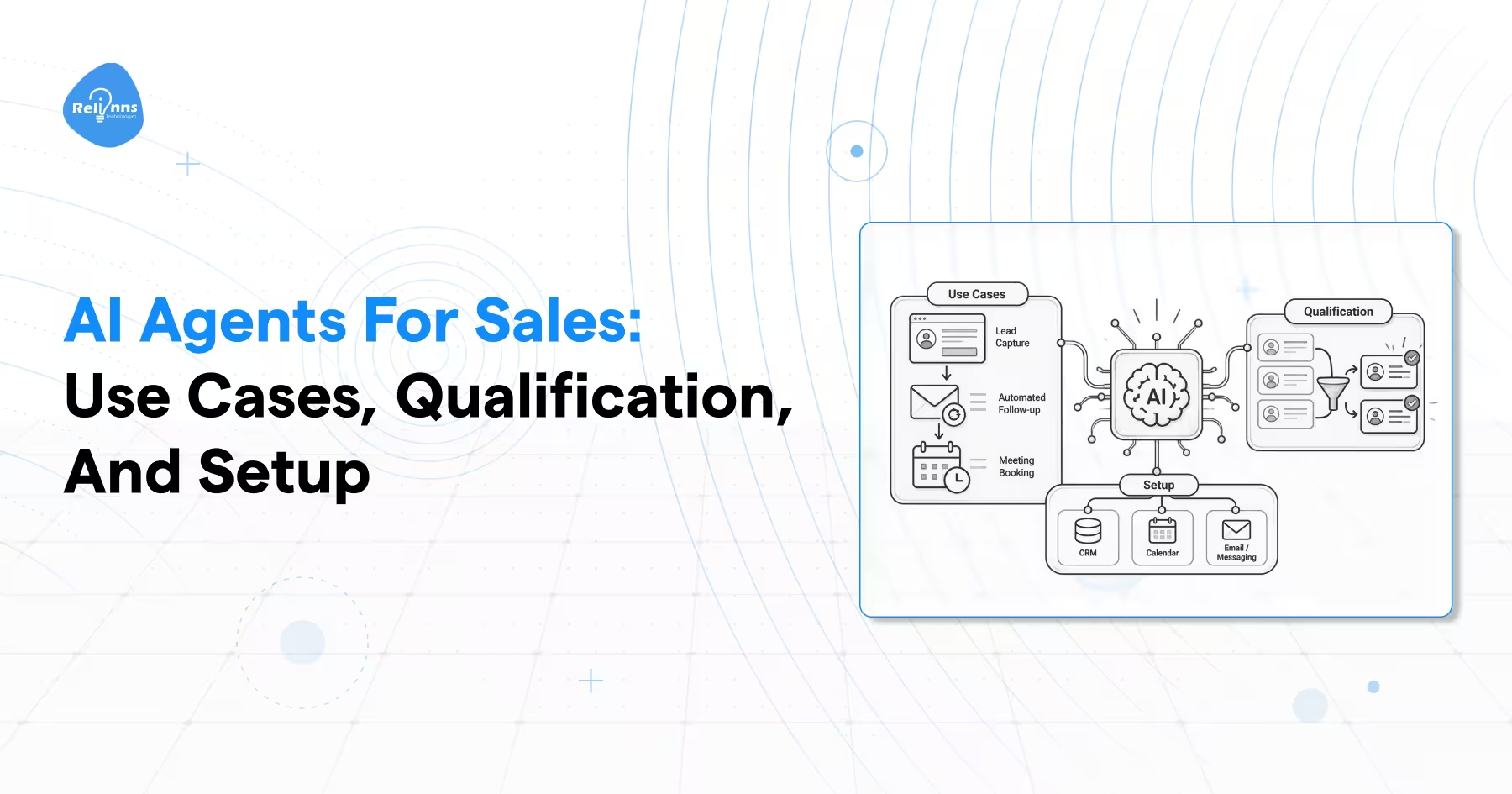
AI agents for sales are becoming more useful as reps spend more time on research, qualification, CRM updates, and follow-up than on actual selling.
Salesforce reports that sales representatives spend only 28% of their time actually selling. The rest goes toward administrative and other work outside direct selling.
But automating the wrong work creates another problem. More outreach does not automatically create a better pipeline. Poor qualification, weak context, and unnecessary automation can increase activity without improving opportunities.
The better approach is selective automation.
AI agents for sales work best when they own repetitive, data-heavy workflow steps while humans retain negotiation, relationship building, and high-value deal judgment.
That starts with understanding what makes an AI sales agent different from the sales automation teams already use.
What Are AI Agents for Sales?
AI agents for sales are software systems that understand sales context, decide what action should happen next, use connected tools, and complete approved workflow steps with limited human input.
Unlike fixed automation, they can change their next action as lead information, CRM activity, or conversation context changes.
A typical AI sales agent combines four capabilities:
- Reasoning to interpret prospect information and choose an appropriate next action
- CRM and tool access to retrieve or update customer and pipeline data
- Workflow execution to complete several connected sales tasks
- Context-based decisions to adapt when new information appears
A qualification agent might review form data, enrich the account, ask additional questions, update the CRM, and route a qualified prospect to the correct rep.
IBM similarly describes sales agents as systems that can analyze sales and customer data, plan actions, and execute parts of sales workflows with limited human input.
The main difference is how much independent action each system can take.
| Traditional Sales Automation | AI Sales Agent |
|---|---|
| Follows fixed rules | Chooses approved actions based on context |
| Runs predefined sequences | Coordinates several workflow steps |
| Uses preset triggers | Responds to changing lead signals |
| Usually performs isolated tasks | Works across connected sales systems |
| Human defines every next step | Agent can select the next permitted step |
A sales copilot mainly assists a representative. An agent can go further by taking permitted actions itself.
That distinction becomes important when deciding what sales work should actually become autonomous.
What Can AI Agents for Sales Actually Do Today?
The most useful AI agent use cases in sales focus on automating repetitive tasks rather than replacing the entire sales process.
They perform best when a task has accessible data, defined boundaries, and a clear outcome that teams can measure.
Their role can extend across the period before, during, and after a sales conversation.
| Stage | Task | How the AI Agent Helps |
|---|---|---|
| Before engagement | Prospect research | Collects relevant company, industry, role, and account information |
| Before engagement | Account enrichment | Adds missing contact and company data from approved sources |
| Before engagement | ICP scoring | Compares accounts with defined ideal customer criteria |
| Before engagement | Lead prioritization | Ranks prospects using fit, activity, and available intent signals |
| Before engagement | Intent identification | Identifies behaviors associated with possible buying interest |
| Before engagement | Meeting preparation | Summarizes account history, CRM notes, activity, and known needs |
| During engagement | Inbound qualification | Asks approved questions and captures fit, need, authority, and timing |
| During engagement | Product questions | Responds using approved product and pricing information |
| During engagement | Meeting scheduling | Books meetings using availability and routing rules |
| After engagement | Follow-up assistance | Prepares relevant next step communication from conversation context |
| After engagement | CRM updates | Logs notes, lead status, contact details, and activities |
| After engagement | Call summaries | Records requirements, objections, commitments, and risks |
| After engagement | Opportunity routing | Routes prospects by territory, account type, deal size, or ownership |
| After engagement | Next step recommendations | Suggests permitted actions based on pipeline stage and collected information |
Before a call, the agent can create an account brief containing recent activity, existing opportunities, relevant CRM history, and useful discussion points.
During the interaction, it can answer approved questions, gather qualification information, and schedule the appropriate meeting.
Similar capabilities can help AI agent for customer service handle routine inquiries and route requests to the right team.
Afterward, it can update records, summarize commitments, and prepare the next action.
IBM also identifies lead generation, qualification, customer engagement, lead nurturing, and CRM connected workflows among common sales agent applications. (IBM)
Agents are strongest when the task has clear inputs, accessible data, and a measurable next action.
These principles also apply to AI agents for business, where clearly defined workflows and measurable outcomes help determine which tasks to automate.
The closer a workflow moves toward pricing, negotiation, or commercial commitments, the more important human involvement becomes.
How Do AI Agents for Lead Qualification Work?
AI agents for lead qualification can evaluate inbound prospects before a salesperson spends significant time on them.
The useful part is not simply assigning a score. The agent should gather context, apply qualification criteria, update sales systems, and explain why a prospect should move forward.
A practical workflow looks like this:
1. Capture the inquiry
The agent receives information from a form, chatbot, demo request, or another approved inbound channel.
2. Enrich the lead
It adds available company and contact data such as industry, role, company size, location, or account history.
3. Check ICP fit
The agent compares the prospect against your ideal customer profile and defined exclusion criteria.
4. Ask qualifying questions
Missing information can be collected directly. Questions may cover business need, current process, team size, timeline, or decision authority.
5. Score intent and fit
The AI sales agent combines profile fit, stated requirements, and available buying signals.
6. Update the CRM
Qualification answers, lead source, score, and relevant context are added to the appropriate record.
7. Route the lead
Suitable prospects move to the correct representative based on territory, product interest, account type, ownership, or other rules.
A good qualification agent should explain why a lead received its score or routing decision. A simple label such as qualified or unqualified gives sales teams little information to review.
Mixed signals also require caution.
A strong ICP match may have no immediate buying need. A smaller company might show clear urgency and strong purchasing intent.
In these situations, the agent should surface the evidence and request human review instead of making an irreversible decision.
What Should AI Sales Agents Not Handle Alone?
Giving an agent access to sales systems does not mean every decision should become autonomous.
The right level of control depends on how much a mistake could affect revenue, customer trust, pricing, or contractual commitments.
Low Risk Work
Sales AI agents can usually handle routine work when the rules and expected outcomes are clear.
This includes:
- Prospect research
- CRM updates
- Meeting scheduling
- Call summaries
- Basic qualification
These actions are relatively easy to verify and correct.
Human Review Required
Some workflows benefit from AI assistance but still need a sales representative to approve the final action.
These include:
- Personalized outreach to strategic accounts
- Pricing exceptions
- Competitive positioning
- Complex objection handling
An agent can prepare the information or recommendation. The representative should decide what reaches the prospect.
Human Controlled
Contract negotiation, discount approval, legal commitments, major deal strategy, and final commercial terms should remain under human control.
An agent can retrieve information, summarize discussions, and present approved options. It should not independently commit the company to commercial terms outside its authority.
The closer a task gets to revenue commitment, negotiation, or reputation risk, the stronger human control should become.
Once those limits are defined, the next decision is whether an existing sales platform can support them.
Should You Buy an AI Sales Agent or Build One?
Buying works well when your CRM, prospecting, qualification, and sales engagement workflows follow standard patterns.
Building becomes more useful when the agent must follow company-specific logic, connect proprietary systems, or operate under custom permissions.
| Option | Best For |
|---|---|
| Sales platform AI | Standard CRM and sales engagement workflows |
| Prospecting platform | Research, enrichment, and outbound support |
| Custom AI agent | Proprietary systems and custom sales logic |
| Hybrid approach | Existing sales stack with custom orchestration |
When Buying Makes Sense
An existing product is usually sufficient for common tasks such as:
- Prospect research
- Basic qualification
- CRM updates
- Meeting scheduling
- Standard follow-up
- Pipeline summaries
The primary advantage is faster deployment.
The limitation is that workflows, integrations, permissions, and customization remain partly defined by the vendor.
When Building Makes More Sense
A custom agent becomes more relevant when sales actions depend on internal business rules.
This may involve:
- Proprietary CRM or data systems
- Custom qualification criteria
- Complex territory rules
- Several systems within one workflow
- Approval requirements for sensitive actions
- Strict access controls
When those requirements exceed a packaged tool, Relinns builds agents around the existing sales process through its AI agent development services.
Relinns can design the agent architecture, business logic, integrations, permissions, approval checkpoints, testing, and monitoring around the actual revenue workflow rather than forcing the process into a fixed product structure.
The decision is therefore not simply buy versus build. It is whether an existing product can support the workflow accurately and with enough control.
How Do You Implement and Measure AI Agents for Sales?
Implementation should begin with one well-defined workflow rather than a broad attempt to automate the entire sales process.
Identify where repetitive work slows representatives down. Then prepare the required data, permissions, integrations, and success criteria before increasing the agent's authority.
| Phase | What to Do |
|---|---|
| Audit | Identify repetitive sales workflows with clear inputs and outcomes |
| Prepare | Clean CRM data, define qualification rules, set permissions, and connect tools |
| Pilot | Start with a narrow workflow while human review remains available |
| Review | Measure accuracy, corrections, routing quality, and business outcomes |
| Expand | Increase responsibility after consistent performance |
Good starting workflows include:
- Lead research
- Inbound qualification
- CRM updates
- Meeting scheduling
- Follow-up summaries
These tasks are easier to evaluate because each has an expected result.
A qualification workflow should improve the quality of leads routed to sales. A CRM workflow should maintain accurate records. A scheduling workflow should reduce delays.
Measurement should then focus on business quality rather than raw automation volume.
Track:
- Qualified lead rate to determine whether stronger prospects reach sales
- Lead response time to measure how quickly inquiries receive action
- Meeting conversion rate to track how many qualified leads reach meetings
- Human correction rate to expose unreliable outputs
- CRM accuracy to verify that records remain correct
- Cost per qualified opportunity to compare operating cost with pipeline value
- Escalation rate to identify workflows requiring frequent human intervention
Human correction rate deserves particular attention.
If representatives repeatedly repair qualification scores, routing decisions, CRM fields, or summaries, the agent is shifting work rather than reducing it.
Do not judge the agent by activity volume. Judge whether it creates accurate CRM data, better qualified conversations, and more useful sales opportunities.
Frequently Asked Questions
What Are AI Agents for Sales?
AI agents for sales are systems that interpret sales context, use connected software, and complete approved workflow steps. They can research prospects, qualify leads, update CRM records, schedule meetings, and recommend next actions while operating within defined business rules and permissions.
How Do AI Agents Help Sales Teams?
They reduce manual work around prospect research, qualification, CRM administration, meeting coordination, and follow-up.
They can also gather information across connected systems and prepare useful context before a salesperson spends time on a prospect.
Can AI Agents Qualify Leads Automatically?
Yes. AI agents for lead qualification can collect prospect information, enrich records, compare leads with ICP criteria, ask qualifying questions, evaluate fit and intent, update the CRM, and route opportunities.
Ambiguous or strategically important prospects should still receive human review.
Will AI Sales Agents Replace Sales Reps?
AI sales agents are better suited to repetitive workflow execution than replacing sales representatives.
Human sellers remain important for negotiation, complex objections, relationships, strategic accounts, pricing decisions, and commercial commitments. The practical goal is to automate repeatable work while keeping consequential decisions under human control.
Can AI Sales Agents Update a CRM?
Yes, when they have appropriate permissions.
An agent can create or update contacts, add qualification information, record conversation summaries, change approved stages, log activity, and assign opportunities. Businesses should restrict which records and fields the agent can modify without human approval.
Conclusion
The strongest starting point for AI agents for sales is a workflow you can clearly measure, not the most complex part of selling.
Review your last 100 inbound leads. Identify which qualification questions, research steps, CRM updates, and routing decisions repeatedly followed the same pattern.
Those workflows are stronger candidates for automation than negotiation or closing.
When the workflow requires custom qualification logic, internal systems, approval rules, or controlled permissions, Relinns can turn it into a production agent through its AI agent development services.
The objective is not maximum automation. It is reliable automation that improves the work reaching your sales team.