AI Agents for HR and Recruiting: Use Cases, Risks, and Implementation
Date
Oct 29, 26
Reading Time
7 Minutes
Category
AI Agents
Share


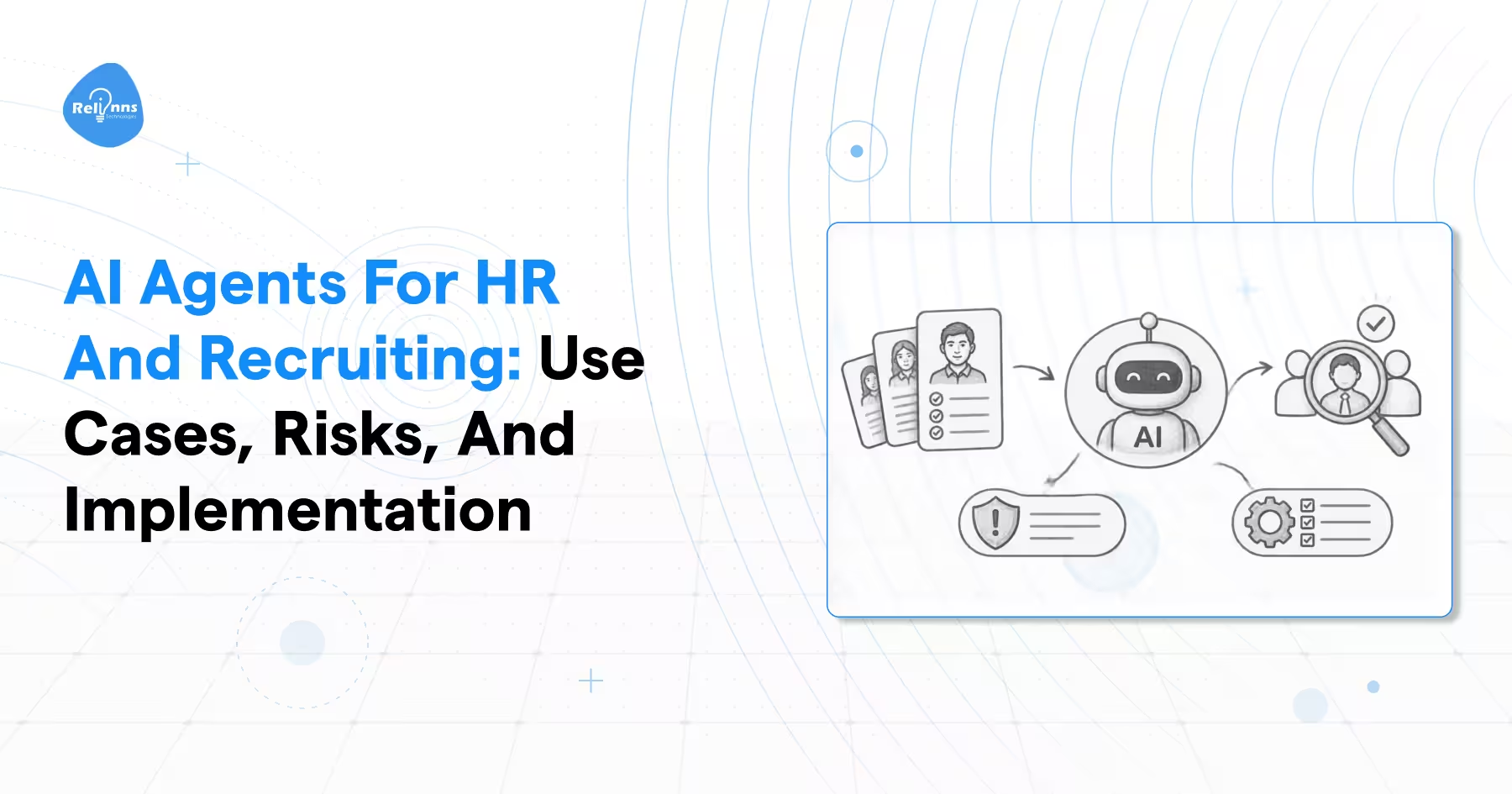
AI agents for HR are moving from experiments into recruiting and employee workflows. But adopting them is not simply a question of finding more HR tasks to automate.
The problem is that HR handles sensitive employee data, candidate evaluation, compensation, performance, and employment decisions. Giving an agent too much authority can create more review work and introduce risks that basic workflow automation never had.
The better approach is selective autonomy.
AI agents for HR should automate repeatable workflows and assist with decisions, not independently own every hiring or employee outcome.
That distinction matters whether you are automating candidate coordination or internal HR operations.
It starts with understanding what makes an HR AI agent different from the automation HR teams already use.
What Are AI Agents for HR?
AI agents for HR are software systems that understand HR requests, decide what action is needed, use connected tools, and complete approved workflow steps with limited human input.
Unlike fixed automation, they can adapt their next step based on employee, candidate, or system context.
HR is one of several practical AI agent use cases, alongside workflows in sales, customer service, and business operations.
A typical HR AI agent combines three core capabilities:
- Reasoning to interpret a request and determine the next action
- Tool use to access an HRIS, ATS, payroll platform, calendar, or knowledge base
- Workflow execution to complete several connected actions instead of one isolated task
A recruiting agent might review application data, check interviewer availability, schedule a meeting, update the ATS, and notify the candidate within one workflow.
The main difference from traditional HR automation is how each system responds to context.
| Traditional HR Automation | HR AI Agent |
|---|---|
| Follows fixed rules | Chooses steps based on context |
| Executes predefined workflows | Coordinates several workflow steps |
| Has limited adaptation | Responds to changing inputs |
| Often works within one system | Can work across connected HR systems |
This flexibility is useful, but it also makes boundaries essential.
What Can AI Agents for HR Actually Do Today?
The strongest agents do not attempt to run the entire HR function. They work best when the required information is available, the outcome is clear, and humans can review decisions that require judgment.
Two areas currently offer the clearest opportunities.
AI Agents for Recruiting and Talent Acquisition
AI agents for recruiting can reduce the administrative work surrounding hiring without taking ownership of the final employment decision.
Useful workflows include:
- Candidate sourcing: Search approved talent pools and surface candidates matching defined criteria.
- CV and profile screening: Extract skills, experience, qualifications, and other relevant information for recruiter review.
- Interview scheduling: Coordinate availability, send confirmations, and manage rescheduling.
- Candidate FAQs: Answer questions about roles, interviews, benefits, locations, and application requirements.
- Application updates: Give candidates timely status information without manual recruiter checks.
- Interview preparation: Summarize candidate information before interviews.
- Recruiter summaries: Convert application data and notes into concise briefs.
- Candidate follow-up: Send approved reminders and next-step communications.
A recruiter AI agent can therefore handle much of the coordination around hiring.
But screening assistance and hiring authority are different.
Screening assistance is suitable for AI. Final hiring decisions should remain appropriately human-controlled.
That distinction matters when using AI agents in recruitment for candidate ranking or recommendations. Recruiters should be able to review the information behind an output, identify errors, and override recommendations.
AI Agents for HR Operations
The opportunity extends well beyond recruiting.
HR teams also handle high volumes of repetitive employee requests that follow established policies.
HR AI agents can assist with:
- Employee policy questions
- Onboarding coordination
- Document collection
- Leave and benefits queries
- HR ticket routing
- Approved employee record updates
- Internal knowledge retrieval
- Offboarding coordination
Consider onboarding. One employee may need policy documents, payroll instructions, equipment requests, system access, training tasks, and manager notifications.
An agent can coordinate those steps across connected systems while sending exceptions to HR.
IBM provides a useful production reference. Its AskHR platform automates more than 80 common HR processes. IBM reports that AskHR resolves 10.1 million interactions annually, saving around 50,000 hours and USD 5 million per year. (IBM)
That shows the value of targeting repeatable operational work rather than treating every HR decision as an automation opportunity.
Which HR Tasks Should AI Agents Not Handle Alone?
As agents gain more workflow authority, HR teams need to decide where autonomy should stop.
The deciding factor should be the consequence of an incorrect action.
| Workflow | Recommended AI Role |
|---|---|
| Interview scheduling | Autonomous |
| Employee FAQs | Autonomous within approved knowledge |
| Candidate summaries | Assist recruiter |
| Resume screening | Human reviewed |
| Compensation decisions | Human controlled |
| Promotion decisions | Human controlled |
| Disciplinary action | Human controlled |
| Termination decisions | Human controlled |
The higher the legal, financial, or employment consequence, the less autonomy the agent should have.
Scheduling an interview carries limited risk and can usually be corrected.
Rejecting a candidate, changing compensation, or recommending termination can directly affect someone's employment.
The U.S. Equal Employment Opportunity Commission has specifically addressed automated systems used for recruiting, hiring, monitoring, pay, promotion, and termination. It also warns that AI and algorithmic systems used in employment decisions can create discrimination risks. (EEOC)
HR teams should therefore establish:
- Bias controls for candidate and employee outputs
- Data access limits for sensitive employee information
- Explainability for recommendations used by HR
- Audit trails for agent actions
- Human approval for consequential employment decisions
The goal is controlled autonomy, not maximum automation.
Should You Buy an HR AI Agent or Build One?
Buy when standard ATS, HRIS, and HR service integrations cover most of your workflow.
Build or use a hybrid approach when the agent must work across proprietary systems, custom policies, unusual approval logic, or strict data controls.
Understanding AI agent vs. off-the-shelf solutions can help HR teams evaluate customization, integration requirements, and long-term flexibility.
| Option | Best For |
|---|---|
| HR platform AI | Standard HR workflows inside existing systems |
| Recruiting AI platform | High-volume recruiting and candidate coordination |
| Custom AI agent | Proprietary systems and custom workflow logic |
| Hybrid | Existing HR stack with custom orchestration |
When Buying Makes Sense
A packaged product is usually enough for:
- Employee FAQs
- Interview scheduling
- Candidate communication
- Standard onboarding tasks
- HR ticket routing
- Knowledge retrieval
The advantage is faster deployment.
The limitation is that integrations, permissions, workflows, and customization remain partly defined by the vendor.
When Building or Going Hybrid Makes Sense
Custom development becomes more relevant when the workflow involves:
- Proprietary ATS or HR systems
- Custom approval chains
- Region-specific policies
- Strict employee data permissions
- Several systems in one workflow
- Human approval before sensitive actions
This is where the difference between adding an AI feature and building an operational agent becomes important.
Relinns builds agents around the systems and controls the workflow actually requires. Its AI agent development services cover use case mapping, architecture, tool and API integrations, guardrails, testing, deployment, logging, and post-launch monitoring.
That approach is more relevant when HR teams cannot force a complex internal process into a generic product.
How Do You Implement AI Agents in HR?
Implementation should start with workflow selection, not model selection.
Identify repetitive work, prepare reliable data, test low-risk tasks, and expand autonomy only when results remain consistent.
| Phase | What to Do |
|---|---|
| Audit | Identify repetitive HR and recruiting workflows |
| Prepare | Clean policies, job data, employee knowledge, and permissions |
| Pilot | Start with low-risk workflows |
| Review | Test accuracy, bias, escalation, and access controls |
| Expand | Increase autonomy after repeated correct performance |
Start with workflows such as:
- Employee FAQs
- Interview scheduling
- Candidate status updates
- Onboarding reminders
These tasks usually have defined inputs and limited consequences.
Preparation matters just as much as the model.
Before launch, define:
- Which systems the agent can access
- Which records it can change
- When human approval is required
- What triggers escalation
- How actions are logged
- Who reviews failures
Avoid beginning with final candidate rejection, compensation changes, promotion decisions, termination, or disciplinary action.
During the pilot, record recurring errors and meaningful human corrections.
A workflow should receive greater autonomy only when reviewers consistently approve the agent's output and actions.
Relinns follows the same production principle in its broader AI agent development process, which includes architecture design, integrations, edge-case testing, deployment, and monitoring.
If corrections continue, fix the data, instructions, permissions, or workflow before expanding autonomy.
How Do You Measure Whether HR AI Agents Are Working?
Do not judge an agent by the number of automated tasks.
Measure whether workflows are completed correctly and whether automation actually reduces work for HR, recruiters, employees, and candidates.
Track:
- Time saved per workflow to quantify reduced manual work
- Resolution rate to measure successful completion
- Recruiter handling time to assess hiring workflow efficiency
- Candidate response time to track communication speed
- Employee query resolution to measure successful self-service
- Escalation rate to identify workflows requiring frequent intervention
- Error rate to expose incorrect answers or actions
- Human correction rate to measure how often staff repair outputs
Human correction rate deserves particular attention.
An agent that saves five minutes initially but requires ten minutes of correction has not improved the process.
Do not measure success only by the number of automated tasks. Measure whether the workflow was completed correctly without creating extra work for HR.
Frequently Asked Questions
What Are AI Agents for HR?
AI agents for HR are systems that interpret HR requests, use connected tools, and complete approved workflow steps. They can support recruiting, onboarding, employee service, and HR operations. Their autonomy should match the risk of each task, especially when actions can affect employment outcomes.
How Are AI Agents Used in Recruiting?
AI agents for recruiting can support candidate sourcing, screening assistance, interview scheduling, FAQs, application updates, recruiter summaries, and follow-up. They are strongest at repeatable coordination work. Final hiring decisions and other consequential employment judgments should remain under appropriate human control.
Can AI Agents Screen Job Candidates?
Yes, with appropriate oversight. AI agents in recruitment can extract qualifications, compare profiles against defined job criteria, and prepare recruiter summaries. Human reviewers should remain involved in consequential screening decisions and should be able to inspect, correct, and override AI recommendations.
Will AI Agents Replace HR Teams?
AI agents are more suited to shifting repetitive work than replacing the entire HR function. Employee relations, performance decisions, compensation, difficult candidate decisions, workplace disputes, and sensitive conversations still require judgment, accountability, and human involvement.
Are AI Agents Safe for Employee Data?
They can be deployed with appropriate safeguards. HR teams should limit permissions, protect sensitive employee information, log actions, control access by role, and require human approval for high-risk changes. Security depends on the complete agent architecture and deployment, not simply the underlying model.
Conclusion
Start with a simple exercise.
List your 10 highest-volume HR and recruiting workflows. Separate tasks that follow clear rules from those requiring employment judgment.
Automate the first group gradually. Keep the second under appropriate human control.
Once a suitable workflow is identified, the harder work is connecting systems, defining permissions, testing edge cases, and establishing approval boundaries.
Relinns helps companies build production AI agents around those real operational requirements. Its approach covers architecture, integrations, guardrails, testing, deployment, and monitoring rather than stopping at a standalone AI prototype.