AI Agent vs Voice Agent: What's the Difference?
Date
Sep 22, 26
Reading Time
6 Minutes
Category
AI Agents
Share


Answer Box
An AI agent plans tasks, uses tools, and works across applications, APIs, data, and business systems. An AI voice agent is designed for live spoken conversations and adds speech and telephony capabilities. Choose voice when the workflow happens through calls. Choose a general AI agent for digital workflows. They can also work together when voice needs business system actions.
The terms AI agents and AI voice agents are often used as if they mean the same thing. They do not. The difference affects the user interface, response speed, technical architecture, integrations, workflow design, cost drivers, and the situations each system handles best.
The key question is simple: Does the workflow need to happen through a live conversation, or does the agent mainly need to reason and act across systems?
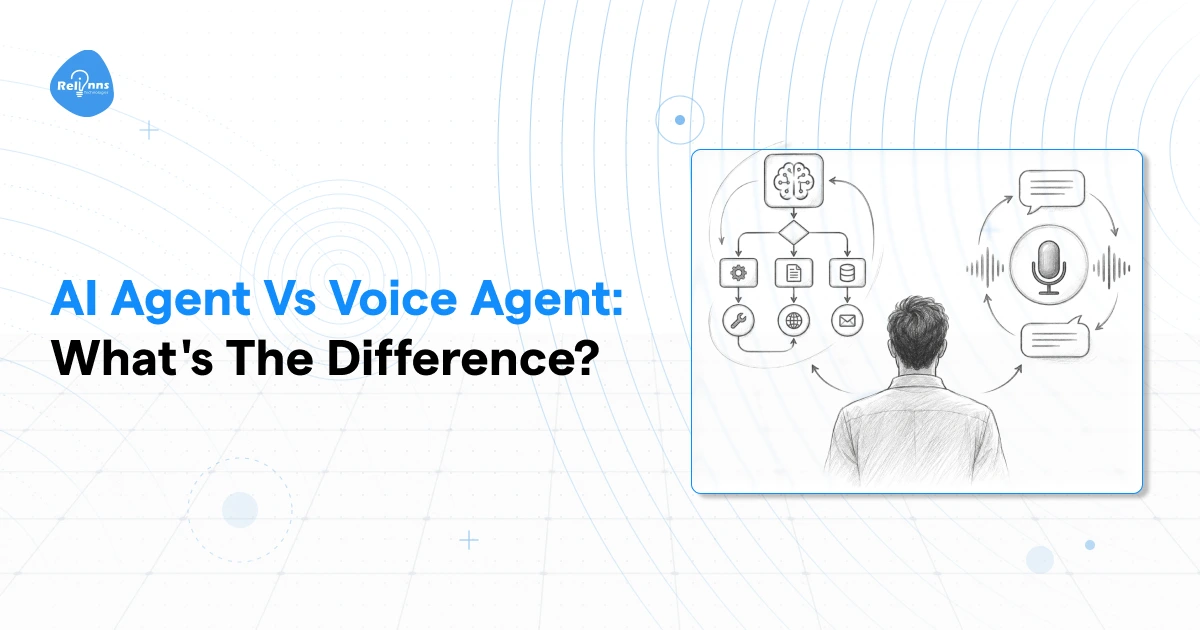
An AI agent is usually built around digital tasks, tools, data, and business systems. An AI voice agent adds real time spoken interaction and telephony requirements.
This comparison explains the difference so you can choose the right approach for your workflow.
What Is an AI Agent?
An AI agent is a system designed to understand a goal, decide what needs to happen next, and take actions across connected tools and business systems. Unlike a basic chatbot, it can move beyond answering questions and complete defined parts of a workflow.
An AI agent can:
- Understand a goal and required outcome
- Reason about the next action
- Retrieve information from approved sources
- Use connected tools and APIs
- Read or update business systems
- Complete several steps toward an outcome
- Request human approval when required
Consider a sales operations workflow. The agent could review an incoming lead, retrieve relevant CRM context, qualify the opportunity using defined criteria, update the record, and route it to the appropriate sales representative.
Human approval can remain part of the process where decisions require oversight.
For a deeper explanation, read the complete guide to what an AI agent is.
What Is an AI Voice Agent?
An AI voice agent is designed for spoken interactions, usually over phone calls. It combines AI reasoning with speech and telephony capabilities so the system can understand callers, respond in real time, and complete actions during the conversation.
Its voice layer typically handles:
- Speech recognition
- Language understanding and reasoning
- Real-time response generation
- Speech generation
- Interruptions and turn-taking
- Telephony
- Business system actions
Common workflows include:
- Appointment scheduling
- Lead qualification calls
- Customer support
- Order or delivery calls
- Reminder calls
- Call routing and escalation
The voice interface is the main difference. Behind the conversation, the agent can still retrieve customer data, use connected tools, update business systems, and trigger workflow actions.
This makes voice agents most useful when spoken interaction is part of how the business process gets completed.
AI Agent vs Voice Agent: What Is the Difference?
The main difference between an AI agent and a voice agent is the interaction layer. An AI agent primarily works across digital systems, tools, and data. An AI voice agent adds spoken conversation, telephony, and real-time response requirements while retaining reasoning and business system capabilities.
| Criteria | AI Agent | AI Voice Agent |
|---|---|---|
| Primary interface | Text, applications, APIs, systems | Spoken conversation |
| Main interaction | Digital workflow | Live voice conversation |
| Response requirement | Depends on workflow | Real time |
| Core capabilities | Reasoning, tools, data, actions | Reasoning plus speech and telephony |
| Typical systems | CRM, ERP, databases, APIs, internal tools | Telephony plus business systems |
| Common use cases | Research, operations, workflow automation, internal agents | Support calls, qualification, scheduling, reminders |
| Human involvement | Approval or escalation when required | Call transfer or escalation |
| Key technical concern | Integration and workflow reliability | Latency, speech quality, interruptions, integration |
| Best choice when | Work happens mainly across digital systems | Users need to speak with the agent |
How to Decide Between Them
Choose based on interface first, then workflow complexity.
If the customer needs to speak with the system during a live call, a voice agent is usually the better fit. It must understand speech, respond quickly, manage interruptions, and maintain conversation context while accessing relevant business data.
A general AI agent is usually enough when the main requirement is to reason, retrieve information, update records, coordinate tools, call APIs, or automate digital workflows.
The choice is not always exclusive. A voice agent can use broader AI agent capabilities behind the conversation to retrieve data, perform actions, and complete workflows across connected systems.
When Do You Need a Voice Agent vs a General AI Agent?
The right choice depends on where the interaction happens and what the system must accomplish.
If most work happens across digital systems, a general AI agent usually fits better. If spoken conversations are central to the process, an AI voice agent becomes more relevant.
Choose an AI Agent When
- A general AI agent is a better fit when:
- Work happens mainly inside digital systems
- The agent retrieves or analyzes information
- Several tools or applications must work together
- Users interact through chat, software, or internal interfaces
- Spoken conversation adds little value to the workflow
These agents are useful for research, internal operations, CRM processes, data handling, and workflow automation.
Choose an AI Voice Agent When
Consider a voice agent when:
- Phone calls are part of the workflow
- Customers expect immediate spoken responses
- The process includes appointment calls or lead qualification
- High call volume creates operational pressure
- Callers may need transfer to a person
- Conversation quality and response latency affect the experience
This is the clearest answer to when to use a voice agent. Voice becomes valuable when speaking is part of how the task gets completed.
Use the Workflow to Decide
| Scenario | Better Fit |
|---|---|
| Internal research assistant | AI Agent |
| CRM workflow automation | AI Agent |
| Incoming support calls | AI Voice Agent |
| Appointment scheduling by phone | AI Voice Agent |
| Multi system back office process | AI Agent |
| Lead qualification over calls | AI Voice Agent |
Some businesses need both when spoken interactions must trigger actions across connected systems.
Can AI Agents and Voice Agents Work Together?
Yes. In many business workflows, the right answer is not choosing one over the other.
A voice agent can manage the live conversation while broader AI agent capabilities handle reasoning, data access, connected tools, and workflow execution behind it.
Consider a customer calling to reschedule an appointment.
The Voice Layer Handles
Understanding what the caller says
Maintaining conversation context
Responding in real time
Managing interruptions and turn-taking
Asking for missing information
The Agent Layer Handles
Identifying the customer
Retrieving the existing appointment
Checking available time slots
Applying scheduling rules
Updating the booking system
Confirming the completed action
Requesting human approval when required
The voice interface handles how the customer communicates. The broader agent handles what needs to happen across business systems.
This is why AI voice agent vs AI agent is not always a strict choice. A business may need both when conversations must trigger actions across CRM, scheduling, support, payment, or other systems.
Relinns supports both AI agent development services and AI voice agent development, allowing the implementation to follow the workflow rather than forcing it into one category.
Which One Should You Choose?
The right choice comes down to how people interact with the system and what the workflow must complete. Start with the interface, then consider integrations, response requirements, and required actions.
Choose an AI Agent If
Choose an AI agent when the workflow mainly happens through data, software, APIs, internal tools, or digital interfaces.
It is better suited to research, automation, system updates, data retrieval, and coordinated business tasks.
Choose an AI Voice Agent If
Choose an AI voice agent when live spoken conversation is essential.
This includes customer calls, appointment scheduling, qualification, support, reminders, and call routing.
Consider Both If
Use both when customers need to speak naturally while the system also retrieves data, updates records, calls tools, or completes actions across connected business systems.
Frequently Asked Questions
What is the difference between an AI agent and a voice agent?
An AI agent primarily reasons, retrieves information, uses tools, and completes tasks across digital systems. A voice agent adds spoken interaction, speech processing, telephony, and real-time conversation. The central difference is the interaction interface and the response requirements around it.
Is a voice agent a type of AI agent?
Yes. An AI voice agent can be considered a specialized type of AI agent designed for spoken interactions. It can still reason, access data, use tools, and complete actions, but it also requires speech recognition, speech generation, and telephony capabilities.
When should I use a voice agent?
Use a voice agent when spoken conversation is part of how the task gets completed. It fits workflows such as incoming support calls, appointment booking, lead qualification, reminders, call routing, and situations where customers expect immediate verbal responses.
Can an AI agent and a voice agent work together?
Yes. A voice agent can handle the live conversation while broader AI agent capabilities manage reasoning, data retrieval, tool use, and workflow execution. This works well when spoken requests need to trigger actions across connected business systems.
Which costs more to build?
Neither is automatically more expensive. Cost depends on workflow complexity, integrations, model usage, telephony, speech services, monitoring, customization, and production requirements. Voice systems introduce additional speech and call infrastructure needs, while complex AI agents can require substantial workflow and integration engineering.
Final Verdict
The right choice depends on how the workflow operates.
An AI agent is better suited to broader digital reasoning, data access, tool use, and business actions. An AI voice agent adds spoken interaction, telephony, and real time conversation to those capabilities.
Some workflows need both, with voice handling the conversation while broader agent capabilities manage data, tools, and business actions.
For system and workflow automation, Relinns offers AI agent development services. For phone based workflows, Relinns offers AI voice agent development.