AI Agents vs Chatbots: Who Talks, Who Acts, and Why It Matters
Date
Oct 27, 26
Reading Time
11 Minutes
Category
AI Agents
Share


TL;DR
- Chatbot = answers. AI agent = acts.
- Chatbots: scripted, no system write access, resets each session, cheap per chat, expensive per new use case
- Agents: reasoning loop, read/write access, remembers customers, costlier per chat, cheap to add new use cases
- Most "AI agents" are rebranded chatbots ("agent washing"). Only ~130 of thousands of vendors are real
- Real difference: who controls the next step, your code or the model at runtime
- Buying rule: least autonomous system that reliably works. Fixed steps = workflow, not agent. Cross-system writes = agent
- Disclose AI use. Scope write permissions tightly
You bought AI for customer support. Deflection went up. Resolution barely moved.
Sound familiar? Here's the mismatch nobody flags before you sign the contract: you were sold a system that answers questions. What you actually needed was a system that finishes them.
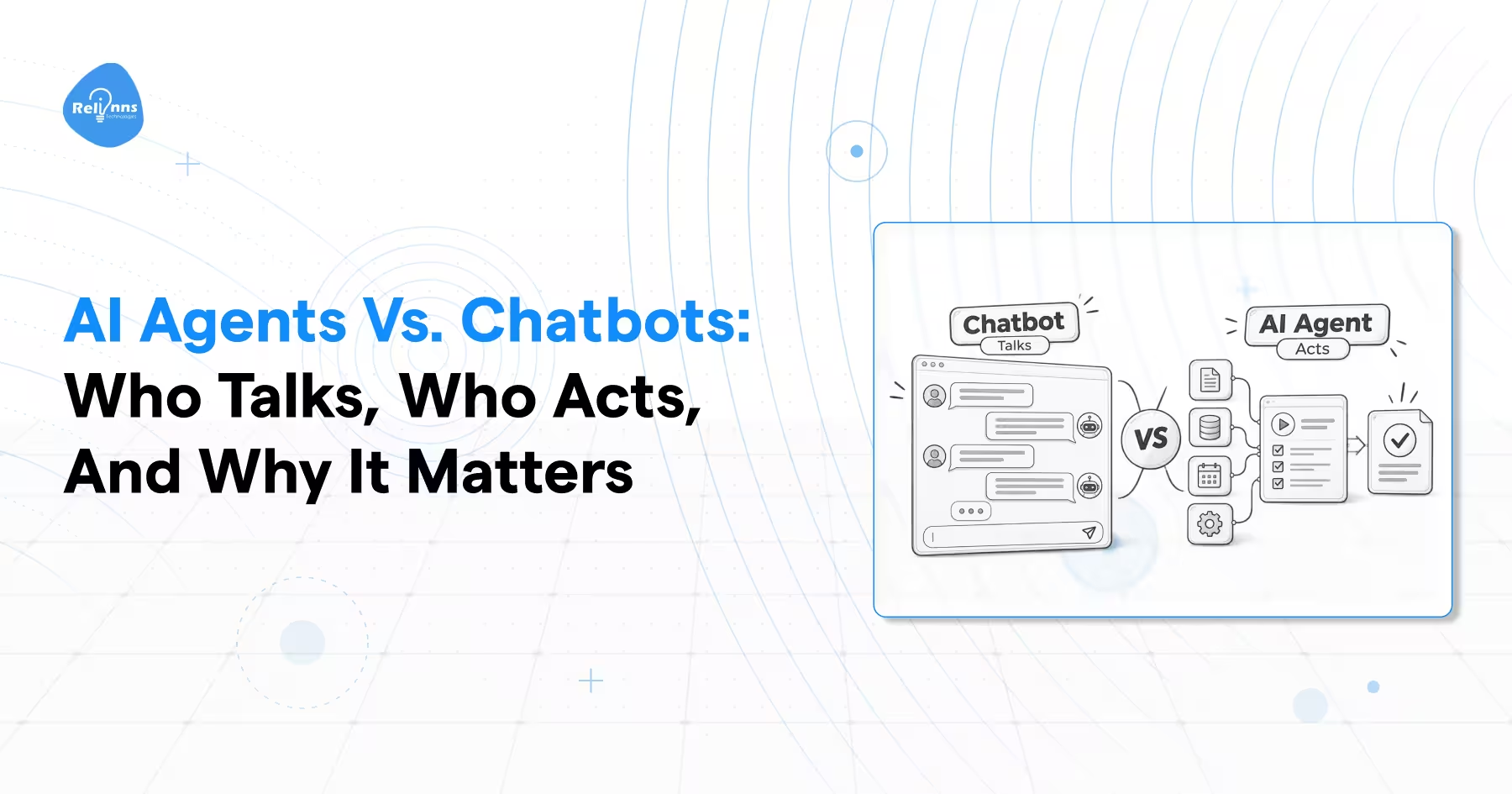
That gap has a name now, and it's simpler than the marketing makes it sound. A chatbot handles the conversation. An AI agent handles the work. A chatbot will tell you the refund policy word for word. An agent just issues the refund.
A chatbot resolves the conversation. An agent resolves the problem.
This post gives you the mental model, a table you can actually bring into a vendor call, and five questions that separate a real agent from a chatbot wearing a nicer name tag.
The confusion isn't on you, by the way. It got so bad that analysts had to invent a term just to describe how thoroughly this market blurred the line.
What is the difference between an AI agent and a chatbot?
A chatbot responds to what you ask. An AI agent decides what to do about it.
The chatbot matches your question to an answer it already has sitting in a database somewhere. The agent actually reasons across your systems, picks the right tool for the job, takes the action, and checks whether it actually worked.
McKinsey puts it plainly: agents are systems built on foundation models that plan and execute multi-step workflows in the real world, not just answer questions.
Think of it like this. A chatbot is a vending machine. You press a button, you get the snack that was already sitting inside. An agent is a person you send to the shop. One gives you what's already there. The other goes and gets what you actually need.
Here's the comparison that matters:
| Dimension | Chatbot | AI agent |
|---|---|---|
| What it does with a request | Answers it | Acts on it |
| Who decides the next step | Your script decides | The system decides in real time |
| System access | Read-only, or none | Read and write |
| Memory | Resets every session | Carries context across sessions |
| Handling something new | Falls back to "I don't understand" | Reasons from what's available |
| Cost shape | Near zero per chat, expensive per new use case | Per-conversation inference plus tool calls |
| What breaks | Misrouting and dead ends | Wrong action taken with full confidence |
Look at the system access row again. Every other row on that table is really a spectrum; some chatbots remember a little, some agents are slower than others. But read and write access isn't a spectrum. It's a yes or a no.
And that single row is where most vendor claims quietly fall apart.
Why do AI agent vs chatbot comparisons keep getting this wrong?
Here's the thing almost nobody says out loud. The real dividing line between an agent and a chatbot isn't intelligence. It's who owns control flow.
In a chatbot, your code decides every step in the sequence. In an agent, the model decides part of that sequence while it's actually running. Everything else people point to, better language, longer memory, more integrations- is just a downstream effect of that one architectural choice.
Most comparisons get this backwards. The common belief is that an agent is just a smarter chatbot, some kind of upgrade along a single line from dumb to smart. It's not. You can bolt the sharpest language model available onto a chatbot, and it's still a chatbot, because your script still decides what happens next no matter how good the responses sound.
Flip it around, and you can build an agent on a weaker model that still wins, because it can retry a failed step, go look something up, and change its approach mid-task. Intelligence isn't the variable. Control is.
So the difference between an ai agent and a chatbot really comes down to three categories, not two:
| Rule-based chatbot | LLM chatbot or copilot | AI agent | |
|---|---|---|---|
| Core engine | Scripted decision tree | Language model, single pass | Language model in a loop |
| Who picks the next step | Pre-written rules | Still your app logic | The model, at runtime |
| Can it take action | No | Rarely, and narrowly | Yes, across systems |
| Typical failure | Rigid, breaks on anything unscripted | Sounds smart, still can't do the task | Confidently does the wrong thing |
That middle column is where most products sold as "AI agents" actually live. And it's the quiet cause behind almost every stalled pilot I've seen.
An agentic chatbot adds another layer to this distinction, combining conversational interactions with greater autonomy in deciding what happens next.
So the honest question was never which one is better. It's which category you actually need. And chatbots win that argument more often than agent vendors want to admit.
What is a chatbot still genuinely good at?
Let's give credit where it's due, because most pages comparing AI agents vs. chatbots treat the chatbot like an embarrassing older sibling nobody wants to invite to dinner. That's not fair, and readers can tell when a page is quietly sneering at half its own comparison.
Chatbots win when the question is simple, the volume is huge, and nothing on the backend needs to be touched. Store hours. Order tracking. Password reset steps. Routing someone to the right queue. This category goes back to 1966, when Joseph Weizenbaum's ELIZA produced convincing replies just by picking out keywords and reshuffling them into a response. Sixty years later, that narrow case is about as solved as software gets.
Three spots where a chatbot is genuinely the right call:
- Regulated responses that need to be pre-approved word for word, no room for the model to improvise
- Trivial questions arriving at massive volume
- Legacy systems with no budget or path to replace them anytime soon
Here's where it gets expensive though. The real cost of a chatbot isn't per conversation. It's per new question you want it to handle. Every new request type means a new intent, a new flow, a new template someone has to write and maintain by hand. I've seen teams with hundreds of these intents spending more on upkeep than an actual agent platform would've cost them in the first place.
So the problem was never that chatbots are bad at their job. It's that most teams point them at problems they were never built to solve.
What does an AI agent actually do that a chatbot cannot?
An agent runs a loop instead of a lookup. It observes what came in, reasons about what's actually needed, calls a tool, reads what came back, and decides if the job's done or if it needs another pass. That loop is the entire trick. It's what lets an agent chain together steps nobody sat down and scripted in advance. PwC surveyed 300 senior executives in May 2025 and found 66% of agent adopters saw measurable productivity gains, with 57% reporting real cost savings.
Here's the loop, four words: observe, reason, act, evaluate. Say a customer got sent the wrong item. Watch what happens:
1. Looks up the order
2. Confirms it's actually the wrong item
3. Starts the exchange
4. Generates a return label
5. Replies with next steps
Nobody wrote a "customer got the wrong item, fix it" flow. The agent worked that sequence out on its own, in real time.
Tool use is really the whole game here. The agent gets handed a menu of tools it's allowed to use, and it picks. Read tools are safe; you can hand out a lot of them. Write tools are the ones that actually touch your business, and that's where things get serious.
| Category | Examples | Read or write | Needs approval |
|---|---|---|---|
| Knowledge retrieval | FAQ lookup, docs search | Read | No |
| Data lookup | Order status, account info | Read | No |
| Write operations | Refunds, exchanges, cancellations | Write | Usually |
| Communication | Sending emails, texts | Write | Sometimes |
| Escalation | Handoff to a human | Write | No |
Memory works in two layers too, not one. Short-term is just this conversation. Long-term is everything your systems already know about this specific customer, including that they've filed three unresolved tickets this month. In customer support, an AI agent for customer service can go beyond answering FAQs by retrieving order details, initiating authorized refunds, and coordinating multi-step resolution workflows through connected systems. A chatbot can't do that. It starts from zero every single time.
All of that sounds decisive on a demo screen. Problem is, the demo screen is exactly where this market learned to fake it.
Why do so many "AI agents" turn out to be chatbots?
Because vendors rebrand. That's really it. Gartner coined the term "agent washing" back in June 2025 to describe exactly this: companies taking existing chatbots, RPA tools, and basic assistants, slapping "agentic" on the label, and shipping them unchanged.
Gartner estimated that of the thousands of vendors claiming agentic capability, only about 130 were building anything real. The same report predicted over 40% of agentic AI projects will get canceled by the end of 2027, mostly from ballooning costs, fuzzy business value, or risk controls nobody thought through.
If you've already sunk budget into one of these and it stalled out, you're not the exception. You're the norm. A stalled agent pilot is probably the single most common outcome in this market right now, not a mark against your judgment.
The scaling numbers back this up too. McKinsey found that as of November 2025, only 23% of organizations were actually scaling an agentic system in even one business function, with another 39% still stuck experimenting. No function anywhere crossed roughly 10% fully scaled. Worth flagging honestly: that 40% cancellation figure from Gartner is a prediction from June 2025, not a fresh finding, and a lot of the coverage repeating it in 2026 conveniently drops that date.
So here's a five-question test you can run in any vendor demo, no partial credit:
| Question | Pass looks like | Fail looks like |
|---|---|---|
| Process a refund end to end | Done with zero human steps | Drafts an email for a human to send |
| What powers retrieval | Connected, structured records | Flat documents and keyword search |
| What does it remember after six months | Specific account history | Generic, session only |
| Can it show its reasoning | Traces the actual steps taken | Vague summary, no trail |
| Block a junior user from restricted data | Blocked at the data layer | Blocked only by a prompt instruction |
That last one matters most. A prompt filter can be talked around. A permission can't.
Passing all five still doesn't mean you should buy the thing, because the real bill shows up in a shape most buyers never bother to model.
What does each one actually cost to run?
A chatbot costs almost nothing per conversation and a lot per new use case. An agent flips that completely. You pay per conversation, inference plus whatever tools it calls, but adding the next use case costs you almost nothing extra. So the number you should actually be watching isn't cost per conversation. It's cost per resolved issue.
Here's some math nobody selling you an agent wants to walk through. Say each step in a task succeeds 95% of the time, which is a genuinely good number. Chain fifteen of those steps together and the whole task only completes successfully about 46% of the time. That's just 0.95 raised to the 15th power. Errors compound. One shaky step early on drags the whole chain down with it.
Practically, this means short agent tasks hold up fine. Long chains running unsupervised don't, not reliably. It's exactly why the deployments that actually work cap how many steps an agent can take before checking in, and put an actual human checkpoint in front of anything that writes to a real system.
And watch out for the benchmark trap. A lot of vendor numbers quietly report best-of-several-attempts success, where the agent got to try five times, and one worked. Your customer gets one shot. Ask what happens across repeated runs, not just the headline number on the slide.
| Chatbot | AI agent | |
|---|---|---|
| Cost per conversation | Near zero | Inference plus tool calls |
| Cost per new use case | High, new flow each time | Low once built |
| Latency | Fast, single lookup | Slower, multiple steps |
| What breaks at scale | Maintenance backlog | Compounding step failures |
| Resolution rate | Vendor reported, directional | Vendor reported, directional |
Still, the upside is real, even if it's a projection and not a result yet. Gartner expects agentic AI to autonomously resolve 80% of common customer service issues by 2029, cutting operational costs by 30% along the way.
Which finally makes this whole decision manageable. You're not picking the better technology anymore. You're matching a system to the job in front of you.
Which one should you actually buy?
Simple rule. Deploy the least autonomous system that reliably solves the problem in front of you. Not the most impressive one. The least autonomous one that actually works.
To figure out which that is, look at three things together: how complex the question actually is, whether solving it requires taking an action, and how many systems that action has to touch. Low on all three and a chatbot is the right call, full stop. High on even one of them, you need an agent.
| Your situation | What to deploy | Why |
|---|---|---|
| Simple, high volume, nothing to touch on the backend | Chatbot | No action needed; the script handles it fine |
| Multi-step, but the sequence never changes | Deterministic workflow, not an agent | Hardcode it. You don't need runtime reasoning for a fixed path |
| Resolution needs a write across two or more systems | AI agent | Nothing scripted can chain that reliably |
| Revenue critical: renewals, refunds, escalations, onboarding | Agent, human in the loop on the write | Autonomy where it helps, a person on anything expensive |
| Answers must be pre-approved word for word | Chatbot | An agent will paraphrase, and compliance won't love that |
That third row gets skipped constantly. Most comparisons act like it's a chatbot or an agent, nothing in between. But a lot of "we need an agent" situations are actually a fixed, multi-step workflow wearing a fancy name. If the sequence never changes, you don't need a model reasoning at runtime. You need code that just runs the steps.
Worth a separate word on sales and lead qualification, since that's often what brings people to this comparison in the first place. Qualification is naturally unscripted; every prospect answers differently, so agents fit better here than chatbots do. But the part that actually matters isn't how smooth the conversation sounds. It's whether the thing can write the qualified lead straight into your CRM.
One more thing, quickly: everything above is about text and messaging. Voice brings in latency and interruption handling that change this math, so treat that as its own decision entirely.
Before you commit budget: name the one workflow you're automating. Name every system it needs to write to. Name who signs off before a high-impact action fires. Name the number that'll prove it actually worked.
If you're scoping your first agent, resist the urge to boil the ocean. Pick one measurable write operation and prove it works before you expand.
One thing's still missing though, and skipping it is exactly what turns a working pilot into a liability six months in.
What has to be in place before either one goes live?
Two things: disclosure and permissions. Since August 2nd, 2026, the EU AI Act requires that any system talking directly to people, chatbot or agent, be built so those people know they're dealing with AI. That's per the European Commission's Article 50 guidelines, and it's not a suggestion. Breaches can run up to €15 million or 3% of worldwide turnover.
Two things worth actually doing something about:
- Disclosure. Doesn't matter if it's a scripted bot or a fully autonomous agent, the rule doesn't care. Tell people at the first interaction, clearly, not buried three clicks deep in your terms page.
- Least privilege. OWASP's 2025 LLM Top 10 flags Excessive Agency and Prompt Injection as risks that get worse specifically once a system can call tools. Here's the difference that actually matters: a chatbot that gets manipulated says something dumb. An agent that gets manipulated does something dumb, and that something might touch a real customer record.
So scope the write tools tight, and put a real approval step in front of anything irreversible. That's not extra caution for the sake of it. That's just the cost of giving a system enough freedom to actually be useful.
Get those two right, and the rest of this decision gets a lot less scary.
Wrapping up
So there it is. A chatbot answers. An agent acts. One hands you the policy, the other hands you the resolution. Once you see the difference between an AI agent and a chatbot that way, every buying decision after this gets a lot easier to make.
FAQ
Is an AI agent just an advanced chatbot?
No. It's not a smarter version of the same thing; it's a different architecture entirely. A chatbot follows a script your code wrote. An agent decides its own next step while it's running, and can actually act on your systems instead of just talking about them.
Can I upgrade my existing chatbot into an AI agent?
Not by flipping a setting. Your knowledge base and integrations carry over fine, but you're rebuilding the decision layer from scratch. Think new foundation, reused furniture.
Are AI agents more expensive than chatbots?
Per conversation, yes. Per new use case, often the opposite. Chatbots get expensive as you add more scripted flows. Agents get expensive per interaction but barely cost more to handle something new.
Do AI agents hallucinate?
Yes, they can. Grounding them in real, connected data and putting approval steps in front of anything that writes to your systems is what keeps a confident wrong answer from becoming a confident wrong action.