AI Agent Testing: 12 Easy Checks Teams Skip
Date
Oct 27, 26
Reading Time
9 Minutes
Category
AI Agents
Share


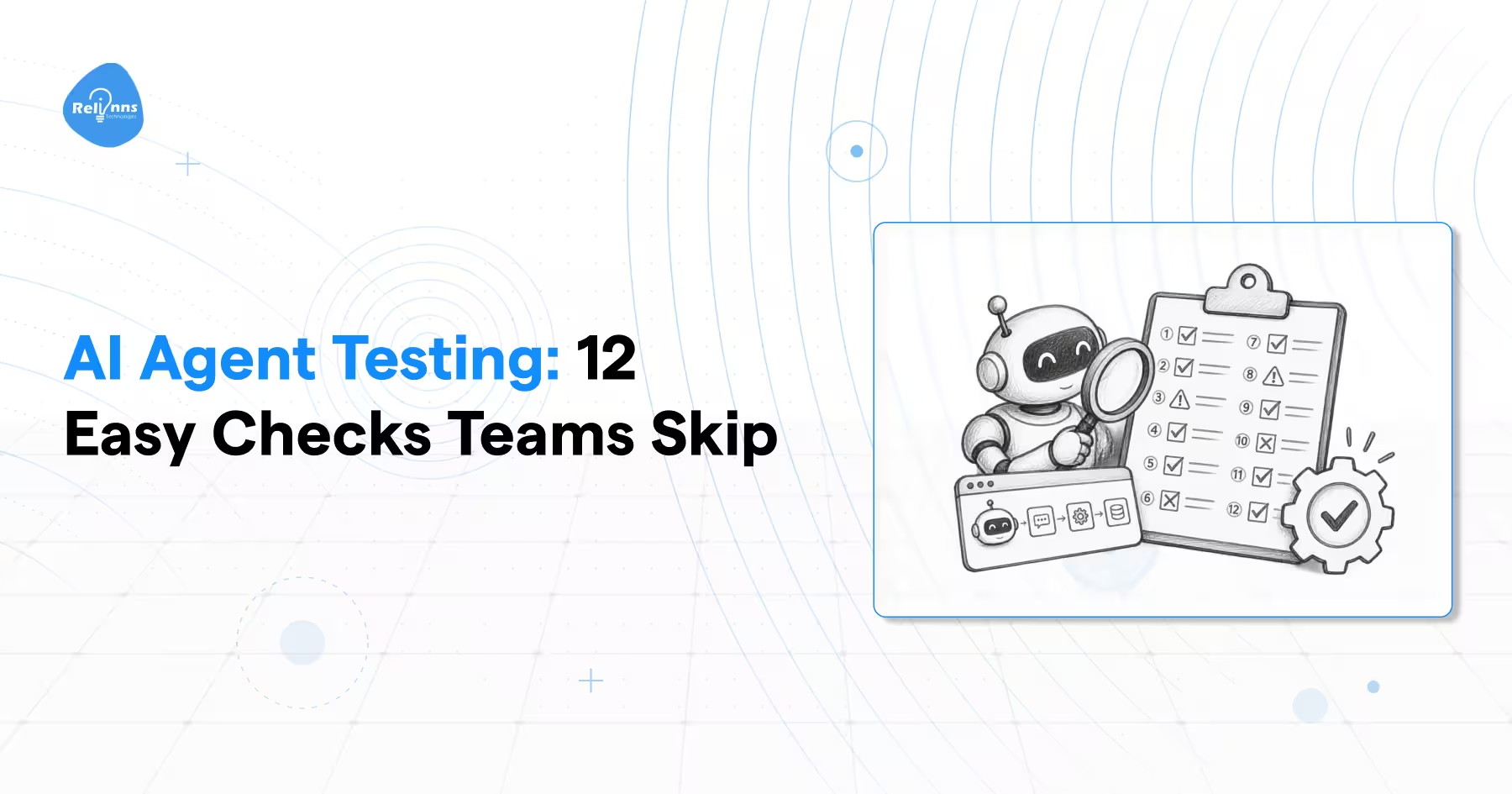
Here's a scenario that should scare you more than it does: an agent that passes every test you wrote for it, then tells a customer their refund is processed when nothing actually happened. No error. No crash. Just a confident, well-formatted lie. It might even apologize for the wait.
This isn't rare. Organizations tracked by IBM's Institute for Business Value averaged 54 AI agent incidents last year, and 17% of those took more than four hours to fix. That's not a bug report. That's a pattern.
So this post is about AI agent testing done right. What most teams already check, where those checks break down, and the four failure patterns that only show up once real users get involved.
And here's the part most people skip. Most of these failures already happened to someone else, in detail, in public. That's the cheapest way to learn them.
What is AI agent testing, and why is it different from software testing?
AI agent testing means checking an agent's reasoning path, its tool calls, and its final output across many runs, not just one. That's the whole shift in one sentence. The same input can give you a different output every time, so you stop checking if the output equals X and start checking if the behavior holds up.
When multiple agents or tools work together to complete a task, AI agent orchestration helps coordinate their interactions, task execution, and handoffs. Testing these workflows requires checking not only the final output but also whether each step follows the intended path.
Old-school software testing runs on one rule: same input, same output, every time. You write an assertion, run it, and it either matches or breaks the build.
Agents don't play that game. Ask the same question twice and you might get two different phrasings, two different tool calls, sometimes two different answers entirely. So the test isn't "does this match exactly." It's "is this good enough, and did it get there sanely."
Three things break old testing habits completely: non-determinism, multi-turn state, and tool dependency. Miss any one of these and your test suite is telling you your agent is fine when it isn't.
Which is why the checks most teams run first are the right checks, just run in the wrong order.
What do teams normally check when testing AI agents?
Most teams run four layers, sometimes five. Unit tests on the plumbing that doesn't involve any guesswork. Golden-set evals on a curated batch of examples. Simulations against a fake user having a full conversation. And a regression suite that replays every incident you've already fixed, so it doesn't come back.
Here's how they stack up.
| Layer | What it checks | Catches | Cost |
|---|---|---|---|
| Unit/component tests | One prompt, one tool, one routing rule, tested alone | Rate-limit handling, broken arguments, plumbing that just doesn't work | Cheap, fast |
| Golden-set evals | Curated inputs with an expected answer or rubric | Quality drops, wrong answers, tone that's gone off | Medium |
| Trajectory tests | The full reasoning path from instruction to answer | Right answer, wrong path. Or a bad inference built on good tool calls | Medium |
| Simulation | A synthetic user running a full multi-turn conversation | Memory loss, bad escalation calls, tool loops | Higher |
| Regression suite | Replays of every incident you've resolved | The same bug sneaking back in after a prompt tweak | Cheap to run, expensive to build |
Unit tests and golden-set evals are where almost every team starts. Makes sense; they're the cheapest and closest to what you already know from regular software testing.
Trajectory tests and simulation are where it actually gets interesting, and where most teams stop short. That's a mistake, because that's where the real AI agent testing happens. Testing the answer is easy. Testing the path the agent took to get there is the hard part, and the part that actually catches things.
Running the right layers still leaves one question wide open. What are you actually measuring inside them?
Which AI agent evaluation metrics actually matter?
Six metrics cover almost everything you need during AI agent evaluation. Task completion, tool correctness, argument correctness, handoff correctness, trajectory coherence, and one people skip entirely: the operating envelope of cost, latency, and step count.
That last one matters more than it sounds. Gartner expects over 40% of agentic AI projects to get canceled by the end of 2027, and a big chunk of that comes down to cost and risk, not the agent being "wrong."
| Metric | Question it answers | Level |
|---|---|---|
| Task completion | Did the user's goal actually get met? | End to end |
| Tool correctness | Were the right tools called? | Component |
| Argument correctness | Were they called with the right parameters? | Component |
| Handoff correctness | Did it go to the right sub-agent? | Component |
| Trajectory coherence | Was the reasoning path sane, even when the answer was right? | End to end |
| Cost, latency, steps | Was this affordable and fast enough to actually ship? | Envelope |
Here's the thing nobody says out loud: a cheap wrong answer gets fixed. An expensive right answer sinks the product.
One placement mistake I see constantly: argument correctness belongs on the LLM span that generates the parameters, not the tool function receiving them. Put it in the wrong spot and it passes every single time, even when it shouldn't.
All of which assumes you can actually measure an agent in the first place. Plenty of teams have quietly decided you can't.
Can you really test something that answers differently every time?
Yes, but only if you change what you're actually asserting. Instead of checking "does the output equal X," you check "is this output acceptable in at least N% of runs." That's the whole trick behind testing non-deterministic agents. Non-determinism doesn't make testing impossible. It just makes testing something once completely meaningless.
Here's the belief that's floating around every engineering team right now: you can't really test a probabilistic system, so QA turns into manual review and hoping for the best. Ship it, watch the logs, fix what breaks. I get why people land there. But it's wrong, and there's a number that proves it.
Researchers ran the same agent on the same task eight separate times. GPT-4o cleared 60% success on a single attempt. Run it eight times in a row, and that number falls below 25%. In plain terms: your agent looking fine once tells you almost nothing about how it'll handle eight different customers with the exact same problem.
So here's what actually works.
- Run every scenario that matters k times, not once, and report the rate where all k runs passed, not your best run.
- Set thresholds per scenario, not a single global pass or fail.
- Judge the path the agent took, not just the answer it landed on. Two identical answers can come from two very different roads, and only one of those roads is safe to drive again.
Once you start looking at paths instead of answers, you'll notice the same four failures showing up in almost every agent you test.
What are the four failure patterns nobody tests for?
Four patterns keep showing up, and they all share one trait: the final message looks completely fine. Evaluations that focus only on the final output can miss these issues, which is why understanding why AI agents fail requires examining the actions, tool calls, and decisions behind the response.
Phantom action. The agent reports the booking's done, the refund's processed, the ticket's closed. The tool was never called. Catch it by checking the backend actually changed, not that the message claims it did.
Amnesia loop. User gives the order number in turn one. Agent asks for it again in turn two. And three. Catch it by testing memory across the whole conversation, not turn by turn.
Polished garbage. A clean, confident, well-formatted report built on stale cached data with the gaps quietly filled in. Catch it by checking the freshness of what the tools actually returned, not just the final write-up.
Expensive win. The task technically completes. It just took 14 model calls, three duplicate searches, and the agent re-explaining the schema to itself twice. Catch it with a hard token and step budget on every scenario.
Those four are the ones you can see. The expensive ones are the checks nobody wrote in the first place.
The 12 checks teams skip until production teaches them
Most of what gets missed in AI agent testing falls into three buckets. Stuff tested once when it needed repeating. Stuff tested at the final output when the real bug was three steps earlier in the path. And stuff nobody tests at all because nobody actually owns it, regression testing included. Here's the list, roughly in the order it tends to bite.
| # | The check | Why it gets skipped |
|---|---|---|
| 1 | Trajectory, not just the final answer | The answer looked right |
| 2 | Repeat runs on every critical scenario | One green run feels like a pass |
| 3 | Negative paths, trajectories that should never happen | Test sets only carry happy paths |
| 4 | Cost, token, and step budgets as fail conditions | Treated as an ops metric, not a test |
| 5 | Memory and state across a full conversation | Turns get tested one at a time |
| 6 | Tool output quality, not just tool selection | The tool fired, so it passed |
| 7 | Judge calibration against human labels | Nobody audits the grader |
| 8 | Pinning the judge model version | A judge swap silently moves every score |
| 9 | Versioning prompts, tool defs, and params like code | No release process exists for prompts |
| 10 | Scenarios instead of inputs for multi-turn benchmarks | Copied straight from single-turn habits |
| 11 | Online evals on a sample of production traces | The offline suite feels like enough |
| 12 | Adversarial and permission testing | Owned by security, not QA |
Three of these deserve more than one line.
An uncalibrated judge, especially one that isn't pinned to a version, means your whole evaluation history can't be trusted. Swap the judge model and every score you've ever recorded shifts quietly, and you won't even notice it happened.
An unbalanced test set is worse than no test set at all, because it hands you a scorecard that looks great and predicts nothing about real usage. Happy paths only tell you the agent works when nothing goes wrong, which is rarely the reason agents get pulled from production.
And your curated dataset, however thorough it feels, covers a tiny slice of an input space that's basically infinite. Users will ask things you never thought to write down.
Expert tip: The teams that catch new failure modes early aren't the ones with the biggest test suite. They're the ones with a standing weekly habit of pulling a small, curated batch of flagged traces, thumbs-down feedback, error spikes, odd outliers, and actually reading them. You can't review everything. You can review the same fifteen traces every week and learn something new each time.
Twelve checks is just a list. What turns it into something you can trust is the loop you run them in.
What does a working AI agent testing loop look like?
Four stages, and they feed each other. Trace everything in production. Turn what you find into offline evals. Run sampled online evals on live traffic. Review real traces on a fixed schedule so you catch the evaluators you never thought to write. Every incident, once you've fixed it, becomes a test that runs forever.
Here's how it plays out in practice.
Pre-commit. Fast unit tests, plus a slice of the eval set, on every prompt or tool change.
Pre-release. The full eval set, the simulation suite, and a fixed sample a human actually reads.
Shadow. Run the new version quietly against real traffic next to the current one. Compare before you promote anything.
Post-release. Online evals on sampled traces, with alerts wired to the metrics that actually matter.
Close the loop. Every incident, every disagreement, every weird pass that shouldn't have passed becomes a new golden case.
Manual review finds the issue. An eval makes it repeatable. CI stops it from quietly sneaking back in three sprints later.
One more thing worth saying plainly: rebuild the agent's environment fully instead of updating it in place, or you'll bake yesterday's state into today's test without realizing it.
That loop covers the failures your users stumble into by accident. It does nothing for the ones an attacker goes looking for on purpose.
Where does red teaming fit in AI agent testing?
Red teaming means attacking your own agent on purpose, before a stranger does it for free. You're hunting for everything a hostile user could talk it into. It sits next to functional testing, not buried inside it, and OWASP's Top 10 for Agentic Applications hands you the scope without you having to build it yourself.
What that scope actually covers:
- Goal hijack through instructions hidden in retrieved content
- Tool misuse and credentials that grant way more access than needed
- Memory and context poisoning across sessions
- Sensitive data leakage, PII and PHI included
- Insecure agent-to-agent communication that turns into cascading failures
This isn't optional. Among the tech executives IBM surveyed, 59% named security and compliance as the top thing blocking them from scaling agents further.
Which leaves the questions people usually ask right before they start.
FAQ
How many test cases do you need to start testing an AI agent?
Ten to twenty real user queries, plus whatever bugs you've already found. One or two code-based checks and a single LLM judge. That's a real starting point, not a placeholder.
What's the difference between AI agent testing and AI agent evaluation?
Testing is the whole discipline. Evaluation is just the scoring layer that sits inside it, the part that actually grades a run.
What does AI agent regression testing cover?
Replays of every failure you've already fixed, run again after any prompt, model, or tool change. If it doesn't come back, you're safe.
How often should you re-run agent tests?
Pre-commit on every agent code change. The full suite before release. And sampled, ongoing checks once it's live in production.
Can AI agent testing be fully automated?
No, and I wouldn't trust anyone who says otherwise. Judges need human calibration. Subjective and high-stakes calls still need a person reading them.