AI Agent Evaluation: Metrics, Testing & Reliability
Date
Sep 30, 26
Reading Time
8 Minutes
Category
AI Agents
Share


Answer Box
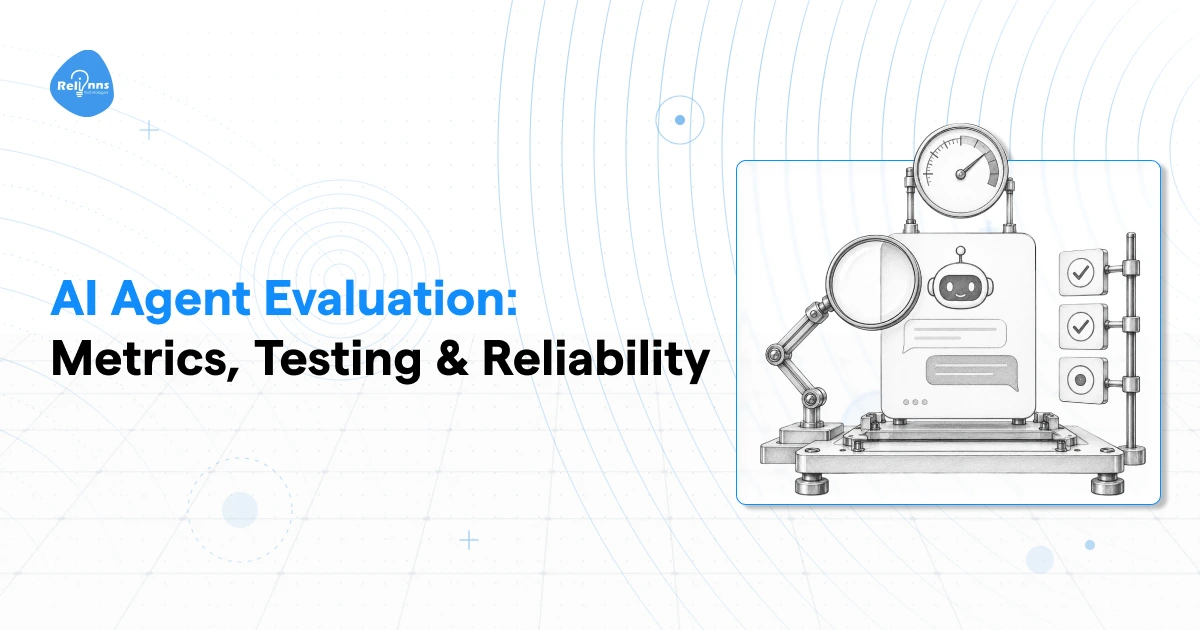
AI agent evaluation measures whether an agent actually works by scoring task success, output quality, and the steps it takes to reach a result. Because agent behavior can vary across runs, teams use realistic test cases, evaluation datasets, and regression suites to measure reliability before release and between versions. It helps separate a convincing demo from an agent that is ready for production.
An AI agent can look reliable after a few successful demonstrations. That is not enough to show how it will behave across different inputs, missing information, retrieval errors, tool failures, permission limits, or repeated runs of the same task.
This is why AI agent evaluation matters. It measures whether an agent performs reliably before release and between versions, using defined test cases, scoring criteria, failure checks, and regression testing.
A system that works once may still fail often enough to create production risk. Evaluation helps teams detect those weaknesses before deployment.
The boundary is important. Evaluation asks whether the agent works and how well it works. AI agent monitoring tracks how a deployed agent behaves after release.
What Is AI Agent Evaluation?
AI agent evaluation measures whether an agent completes its intended task correctly and whether the process used to reach that result is reliable. It looks beyond a single successful output and examines the decisions, tools, data, and actions involved.
Define the Evaluation Unit
Evaluation can measure several layers of agent behavior:
- Final task outcome
- Output quality
- Decision quality
- Tool selection
- Tool execution
- Retrieval quality
- Agent trajectory
- Escalation behavior
Judging only the final answer can hide important problems. An agent may reach the correct result after using the wrong data source, making unnecessary tool calls, attempting an unauthorized action, following poor intermediate reasoning, or creating excessive execution cost.
The goal is to determine whether success is repeatable and whether the path taken is acceptable.
Evaluation vs Monitoring
| Area | AI Agent Evaluation | AI Agent Monitoring |
|---|---|---|
| When | Before release and between releases | After deployment |
| Data | Test cases and evaluation datasets | Live production activity |
| Purpose | Measure quality and reliability | Detect live behavior and failures |
| Typical Output | Scores, pass rates, regression results | Alerts, traces, runtime metrics |
| Primary Question | Did the agent work correctly? | Is the deployed agent behaving correctly now? |
Evaluation supports release decisions. AI agent monitoring covers the separate production side of reliability.
AI Agent Evaluation Metrics That Matter
No single score can tell you whether an agent is reliable. Strong AI agent evaluation metrics measure the outcome, the path taken, the quality of decisions, and the operational cost required to complete the task.
Core Evaluation Metrics
The right metric depends on what the agent is expected to accomplish and what kind of failure would create the most risk.
| Metric | What It Measures | Useful When |
|---|---|---|
| Task Success Rate | Whether the agent completed the intended task | Almost every agent workflow |
| Output Quality | Accuracy, completeness, relevance, and format | Research, support, and document tasks |
| Tool Success Rate | Whether required tools were selected and used correctly | Tool-based agents |
| Escalation Accuracy | Whether the agent escalated when required | Human approval workflows |
| Failure Rate | Percentage of tasks ending incorrectly or incompletely | Reliability testing |
| Human Correction Rate | How often a reviewer must correct agent outputs or actions | Assisted workflows |
| Latency | Time required to complete the task | Time-sensitive workflows |
| Cost per Successful Task | Total execution cost divided by successful outcomes | Commercial evaluation |
A useful evaluation should combine several metrics rather than optimize one in isolation. High task success means less if the agent regularly uses the wrong tools, requires frequent human correction, or consumes excessive resources.
Business Metrics
Technical performance should eventually connect to the outcome the workflow was designed to improve.
Relevant business measures may include:
- Case completion
- Resolution quality
- Processing time
- Human review effort
- Conversion where relevant
- Error reduction
These measures should not replace technical evaluation. A workflow can produce acceptable aggregate business results while individual agent decisions remain inconsistent or unsafe.
The stronger approach is to evaluate both layers together. Technical metrics show whether the agent behaves correctly. Business metrics show whether that behavior creates useful results.
Teams planning a custom implementation can also review Relinns AI agent development services.
How to Evaluate Agent Trajectories, Decisions, and Tool Calls
The final answer tells you what happened. The trajectory tells you how it happened. This matters because an agent can reach the correct result while making poor decisions, using the wrong tools, or taking actions that create unnecessary risk and cost.
What Is an Agent Trajectory?
An agent trajectory is the sequence of steps the system takes from receiving a task to completing, stopping, or escalating it.
A trajectory can include:
- Observations
- Decisions
- Retrieval steps
- Tool calls
- Actions
- Intermediate outputs
- Escalations
Evaluating this sequence reveals problems that final output scoring can miss. An agent might call the wrong tool first, retrieve irrelevant information, take unnecessary steps, ignore required approval, access restricted data, or increase latency and execution cost.
These checks are also important for AI agent security, particularly when agents can access sensitive data or perform actions on behalf of users.
What to Score
Trajectory evaluation should check whether each important action was appropriate for the task.
- Was the correct tool selected?
- Were the tool arguments correct?
- Was the right data retrieved?
- Did the agent follow the intended order of operations?
- Did it respect permissions?
- Did it stop when required?
- Did it escalate correctly?
- Did it avoid unnecessary actions?
Decision Evaluation
Individual decisions can be scored against ground truth, approved policy, an expected action, human reviewer judgment, or a reference trajectory.
The evaluation method should match the decision being tested. A permission decision may require an approved policy, while a retrieval decision can be checked against known relevant sources.
Trajectory quality also depends on how tools, memory, permissions, and orchestration are structured within the AI agent architecture.
A useful evaluation process should show not only whether the agent succeeded, but whether it succeeded through an acceptable path.
How to Test Non-Deterministic AI Agent Behavior
The same agent may produce different paths or outputs from the same input. That means one successful test is not enough. Effective AI agent testing checks whether acceptable behavior holds across repeated runs, varied inputs, and known failure conditions.
Build an Evaluation Dataset
A useful evaluation dataset should reflect the situations the agent may actually encounter.
Include:
- Normal cases
- Edge cases
- Missing data
- Conflicting information
- Ambiguous requests
- Unsupported requests
- Tool failures
- Permission-restricted actions
- Escalation scenarios
The goal is to test both expected behavior and conditions where the agent should stop, refuse an action, or involve a human.
Use Realistic Cases
Representative workflow cases are more useful than isolated artificial prompts.
Each case should define:
- Input
- Available context
- Expected outcome
- Allowed actions
- Restricted actions
- Expected escalation behavior
- Scoring criteria
This gives reviewers a consistent basis for deciding whether the agent behaved correctly.
Run Repeated Tests
Run important cases multiple times.
Repeated testing can reveal:
- Output variability
- Unstable decisions
- Different tool selections
- Inconsistent escalation
- Cost variation
A case that passes once but fails regularly should not be treated as reliable.
Build Regression Suites
Every meaningful failure should become a future regression test.
When prompts, models, tools, retrieval systems, or workflow logic change, rerun the suite to check whether previously solved problems have returned.
Compare Results Against Ground Truth
Where an objective answer exists, compare the result directly against ground truth.
Where judgment is required, use defined rubrics, human reviewers, pairwise comparisons, or approved reference outputs.
The purpose of an agent eval framework is not to eliminate variation. It is to determine whether that variation stays within acceptable limits before the agent is released.
Why AI Agents Fail: Failure Modes to Catch
Understanding why AI agents fail requires more than reviewing incorrect final answers. Failures can occur during planning, retrieval, tool use, memory, permissions, or escalation. A useful evaluation process identifies where the breakdown happened and whether the agent responded safely.
| Failure Type | What Goes Wrong | What to Test |
|---|---|---|
| Planning Failure | Agent chooses the wrong sequence of actions | Expected task path and decision order |
| Retrieval Failure | Agent retrieves missing, irrelevant, or incorrect information | Source selection and grounding |
| Tool Failure | Agent selects the wrong tool, passes incorrect arguments, or cannot complete execution | Tool choice and error handling |
| Memory Failure | Agent forgets or incorrectly carries prior context | State consistency |
| Permission Failure | Agent attempts an unauthorized action | Access boundaries and stop behavior |
| Escalation Failure | Agent continues when human review is required | Escalation criteria |
| Output Failure | Final response is inaccurate, incomplete, or incorrectly formatted | Output scoring criteria |
| Integration Failure | Connected systems return errors or inconsistent data | Retry and fallback behavior |
Important Principle
The goal of evaluation is not to prove that an agent will never fail. Teams should determine:
- How the agent fails
- How often each failure occurs
- Which failures create the greatest business or operational risk
- Whether the failure can be detected during testing
- Whether the agent stops or escalates safely
Failure severity matters as much as frequency. A rare unauthorized action may require more attention than a frequent formatting error.
These results should feed directly into future test cases and regression suites.
How Do You Build an Agent Evaluation Process?
A reliable evaluation process should follow the same logic across every release. Evaluation should also form part of the broader process for how to build an AI agent, rather than being added only after development is complete.
1. Define the Agent Task
Start by documenting exactly what the agent is expected to do within the workflow.
- Trigger
- Inputs
- Expected outcome
- Allowed actions
- Restricted actions
- Escalation rules
This becomes the reference point for every evaluation that follows.
2. Define Success Before Testing
Set clear outcome categories before reviewing any results.
- Pass
- Partial pass
- Fail
- Unsafe fail
Keep these definitions fixed so performance can be compared consistently across runs and versions.
3. Build Representative Test Cases
Create cases that reflect both expected use and difficult conditions.
Include common workflows, incomplete inputs, permission limits, tool failures, and situations that require escalation.
Prioritize scenarios where failure creates the greatest operational risk.
4. Define the Metrics
Choose measures that reflect the task and its risks.
- Task success
- Accuracy
- Tool success
- Escalation accuracy
- Human correction
- Latency
- Cost per successful task
Each metric should help answer whether the agent performed acceptably.
5. Evaluate the Trajectory
Review how the agent reached its result.
Check its decisions, retrieval steps, tool choices, permissions, actions, and escalation behavior. This reveals problems that final output scoring may miss.
6. Record Failure Modes
Classify every meaningful failure using the same categories across tests.
This makes recurring planning, retrieval, tool, permission, or escalation problems easier to identify across versions.
7. Build Regression Tests
Turn important failures into permanent tests.
Rerun them whenever prompts, models, tools, retrieval systems, or workflow logic change. This checks whether previously resolved problems have returned.
8. Set a Release Gate
Define the minimum conditions the agent must meet before deployment.
The release gate can combine task success, failure severity, permission compliance, escalation accuracy, and regression results.
A strong agent eval framework turns release decisions into measurable evidence rather than subjective judgment.
Frequently Asked Questions
What is AI agent evaluation?
AI agent evaluation measures whether an agent completes tasks correctly before release. It reviews task success, output quality, trajectory, tool use, decisions, escalation behavior, and failures to determine whether performance is reliable enough for deployment.
What metrics matter for AI agents?
Useful metrics include task success, output quality, tool success, escalation accuracy, failure rate, human correction rate, latency, and cost per successful task. The right mix depends on the workflow, risk level, and expected business outcome.
How do you test a non deterministic agent?
Use representative evaluation datasets and run important cases repeatedly. Compare results with ground truth where available. When judgment is required, use defined rubrics, human reviewers, reference outputs, and regression suites to measure consistency across versions.
Why do AI agents fail?
AI agents can fail during planning, retrieval, tool use, memory handling, permission checks, integrations, escalation, or final output generation. Evaluation should identify where the failure occurred, how serious it was, and whether the agent stopped safely.
What is the difference between evaluation and monitoring?
Evaluation measures quality and reliability before release and between versions. Monitoring observes how a deployed agent behaves in production, including live failures, runtime activity, and performance changes after the system is already operating.
Final Verdict
An AI agent should not be judged by whether it succeeds once. It should be judged by whether that success can be measured and reproduced across representative conditions.
Reliable evaluation should verify outcome quality, trajectory quality, tool correctness, failure behavior, regression results, and release criteria. These checks show whether the agent is ready for broader use rather than simply capable of passing selected tests.
Relinns focuses on building AI agents with evaluation included throughout the development lifecycle. A production-ready agent should have defined test cases, measurable success criteria, known failure modes, regression coverage, and clear release gates before deployment.